


11 Aug UN’s Emergency Response to Colombia’s Deadly 7.4 Earthquake: UPSC & PCS Insights
✎ The Sendai Framework (2015–2030) and the UN’s humanitarian agencies (WFP, PAHO) play a pivotal role in coordinating international disaster response, emphasising sovereignty, coordination, and resilience-building.
Subject Relevance — Where This Topic Fits
- GS Paper II — International Relations: Role of international organisations in disaster response and humanitarian aid | GS Paper III — Disaster Management: Institutional mechanisms for disaster response and coordination
- Prelims: Disaster Management Act, 2005, Sendai Framework for Disaster Risk Reduction, United Nations Office for the Coordination of Humanitarian Affairs (OCHA), Pan American Health Organization (PAHO), World Food Programme (WFP), National Disaster Response Force (NDRF)
- Essay: The efficacy of international cooperation in mitigating humanitarian crises, Role of technology and institutional frameworks in disaster management
Quick Revision: The Sendai Framework (2015–2030) and the UN’s humanitarian agencies (WFP, PAHO) play a pivotal role in coordinating international disaster response, emphasising sovereignty, coordination, and resilience-building.
Why is this in the news?
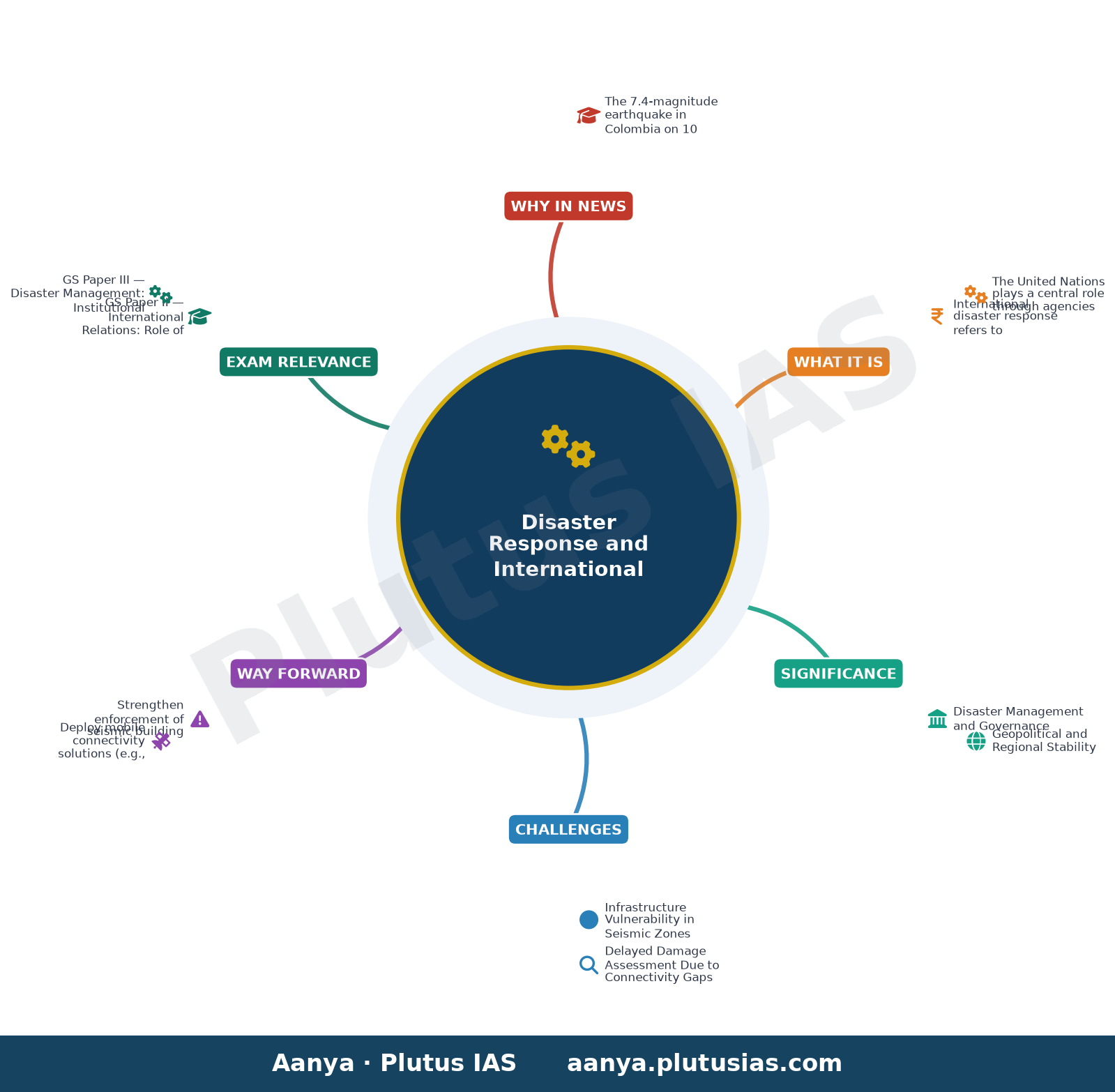
The 7.4-magnitude earthquake in Colombia on 10 August 2026, which resulted in significant loss of life, infrastructure damage, and displacement, has highlighted the critical role of international organisations such as the United Nations (UN) in providing timely humanitarian assistance and coordinating disaster response efforts. The UN’s immediate offer of support underscores the importance of global solidarity and institutional preparedness in addressing natural disasters, a topic of relevance for UPSC aspirants studying disaster management and international relations.
Background
- The Sendai Framework for Disaster Risk Reduction (2015–2030), adopted by the UN, emphasises the need for international cooperation to reduce disaster risks and enhance resilience, particularly in vulnerable regions.
- Colombia is located in a seismically active zone due to its proximity to the Pacific Ring of Fire, making it prone to earthquakes and volcanic activity.
- The National Disaster Risk Management System (SNGRD) in Colombia is the primary institutional mechanism for coordinating disaster response, aligning with the Sendai Framework’s priorities.
- The UN’s humanitarian agencies, including the World Food Programme (WFP) and the Pan American Health Organization (PAHO), are mandated to provide immediate relief, health support, and logistical assistance during disasters.
- International humanitarian law and the UN Charter encourage member states to offer assistance to countries affected by natural disasters, subject to the consent of the affected state.
- The recent inauguration of Colombia’s President Abelardo de la Espriella underscores the political will to prioritise disaster response as a national priority.
What is International Disaster Response and Humanitarian Assistance?
- International disaster response refers to coordinated efforts by states, international organisations, and non-governmental entities to provide relief, rehabilitation, and reconstruction assistance to countries affected by natural or man-made disasters.
- The United Nations plays a central role through agencies such as the United Nations Office for the Coordination of Humanitarian Affairs (OCHA), which mobilises resources and coordinates global humanitarian responses.
- The World Food Programme (WFP) specialises in delivering food assistance and nutrition support to disaster-affected populations, ensuring food security during crises.
- The Pan American Health Organization (PAHO), a regional office of the World Health Organization (WHO), provides health-related humanitarian assistance, including medical supplies, emergency healthcare, and disease control in disaster zones.
- The Sendai Framework for Disaster Risk Reduction (2015–2030) is a global blueprint adopted by the UN to guide member states in reducing disaster risks and enhancing resilience through international cooperation.
- Disaster response mechanisms are governed by principles of humanity, neutrality, impartiality, and operational independence, as outlined in the UN’s Humanitarian Principles.
- The National Disaster Response Force (NDRF) in India, while a domestic entity, exemplifies how disaster response agencies operate under structured frameworks to ensure rapid and effective relief during emergencies.
- International humanitarian assistance is typically provided upon the request of the affected country, ensuring sovereignty and alignment with national priorities.
Key Features
| Feature | Significance |
|---|---|
| Magnitude 7.4 Earthquake | A high-intensity seismic event causing widespread structural damage, landslides, and casualties across western Colombia and neighbouring countries. |
| Epicentre near San José del Palmar (Chocó) | Located in a seismically active zone, this proximity exacerbated damage in densely populated regions like Pereira and Cali. |
| Collapsed Infrastructure | Destruction of homes (1,575 damaged, 37 destroyed), health centres (18), and educational facilities (52), disrupting essential services. |
| Landslides and Connectivity Issues | Rural terrain and landslides impeded rescue operations, while limited connectivity hindered damage assessment. |
| International Response Coordination | UN agencies (WFP, PAHO) and neighbouring countries (Panama, Ecuador, Venezuela) mobilised support alongside Colombia’s disaster management mechanisms. |
Why it Matters
Disaster Management and Governance
- Demonstrates the critical role of national disaster response frameworks (e.g., Colombia’s emergency activation) in mitigating humanitarian crises.
- Highlights the necessity of inter-agency coordination (UN, WFP, PAHO) for rapid assessment and resource deployment in large-scale disasters.
- Exposes vulnerabilities in infrastructure resilience, particularly in seismic zones, necessitating urban planning and retrofitting policies.
Geopolitical and Regional Stability
- Underscores the transboundary impact of natural disasters, requiring regional cooperation (e.g., shared early-warning systems with Ecuador, Panama).
- Reinforces the importance of international solidarity mechanisms (e.g., UN’s Standby Arrangement System) for cross-border support.
Humanitarian and Socioeconomic Impact
- Long-term rehabilitation needs for displaced populations, including housing reconstruction and psychological support for survivors.
- Economic disruptions in trade and transport (e.g., airport closures) affecting local and regional economies.
Challenges
1. Infrastructure Vulnerability in Seismic Zones
- Inadequate adherence to seismic building codes in vulnerable regions, leading to disproportionate structural collapse.
- Limited retrofitting of critical infrastructure (hospitals, schools) despite known seismic risks in western Colombia.
UPSC Link: GS-III: Disaster Management
2. Delayed Damage Assessment Due to Connectivity Gaps
- Rural and mountainous terrain complicates access for rescue teams and hampers real-time data collection.
- Dependence on satellite imagery and drones for assessment, which may not capture ground-level needs accurately.
UPSC Link: GS-III: Science and Technology
3. Coordination Gaps in Multi-Agency Response
- Potential duplication or overlap in aid delivery if national and international agencies lack a unified command structure.
- Language barriers and logistical delays in deploying foreign rescue teams to remote areas.
UPSC Link: GS-II: International Organisations
4. Psychosocial and Long-Term Rehabilitation Needs
- Trauma among affected communities, particularly children, requiring mental health interventions.
- Sustainable resettlement policies for populations displaced by landslides or structural instability.
UPSC Link: GS-II: Social Sector
5. Economic Strain on Local Governance
- Strained municipal budgets for reconstruction, necessitating fiscal support from national and international donors.
- Disruption to livelihoods (e.g., agriculture, trade) in affected regions, exacerbating poverty.
UPSC Link: GS-III: Economic Development
Challenges — UPSC Perspective
| Issue | Concern |
|---|---|
| Seismic Building Codes | Lack of enforcement leading to preventable structural failures. |
| Rural Connectivity | Geographical barriers hindering rescue and assessment operations. |
| Aid Coordination | Risk of inefficiencies in multi-agency disaster response. |
| Mental Health Support | Inadequate preparedness for psychosocial trauma in disaster scenarios. |
| Fiscal Sustainability | Overburdened local governments unable to fund long-term recovery. |
Way Forward
- Strengthen enforcement of seismic building codes in high-risk regions through periodic audits and incentives for retrofitting.
- Deploy mobile connectivity solutions (e.g., satellite phones, mesh networks) to improve real-time damage assessment in remote areas.
- Establish a unified command structure for disaster response, integrating national agencies with UN and regional partners.
- Prioritise mental health interventions in relief packages, including training for local healthcare workers.
- Leverage international aid mechanisms (e.g., UN OCHA’s Flash Appeal) to mobilise targeted financial and technical support.
- Conduct post-disaster vulnerability mapping to identify high-risk zones for future infrastructure planning.
- Enhance regional cooperation on early-warning systems and cross-border search-and-rescue protocols.
UPSC Value Addition
Keywords for Mains Answer-Writing
Disaster Management · National Disaster Response Framework (NDRF) · Sendai Framework for Disaster Risk Reduction · United Nations Office for Disaster Risk Reduction (UNDRR) · Multi-hazard Early Warning Systems · National Disaster Management Authority (NDMA) · International Disaster Response Law · Humanitarian Assistance and Disaster Relief (HADR) · Earthquake Preparedness · Cross-border Disaster Cooperation · Sustainable Development Goal 13 (SDG 13) · Vulnerability Assessment and Risk Reduction
Concept Flow
Seismic activity in western Colombia → Structural collapse and landslides → Immediate humanitarian crisis (casualties, displaced populations) → Activation of national disaster response mechanisms → International aid coordination (UN, WFP, PAHO) → Long-term rehabilitation and resilience planning.
Prelims Practice Questions
Q1. Consider the following statements regarding the Sendai Framework for Disaster Risk Reduction (2015-2030):
1. It is a voluntary, non-binding agreement adopted by the United Nations General Assembly.
2. It aims to substantially reduce global disaster mortality by 2030.
3. The framework prioritizes the reduction of economic losses from disasters over human casualties.
4. It includes a target to increase the number of countries with national and local disaster risk reduction strategies.
How many of the above statements are correct?
- Only one
- Only two
- Only three
- All four
Answer: Only three — Statements 1, 2, and 4 are correct as per the Sendai Framework. Statement 3 is incorrect because the framework prioritizes reducing both human casualties and economic losses, not one over the other.
Q2. Assertion (A): The National Disaster Management Authority (NDMA) in India is headed by the Prime Minister.
Reason (R): The NDMA is established under the Disaster Management Act, 2005, and operates as the apex body for disaster management in the country.
Options:
A. Both A and R are true, and R is the correct explanation of A.
B. Both A and R are true, but R is not the correct explanation of A.
C. A is true, but R is false.
D. A is false, but R is true.
Answer: ? — Both Assertion (A) and Reason (R) are true. The NDMA is indeed headed by the Prime Minister, and it operates under the Disaster Management Act, 2005, making R the correct explanation of A.
Q3. Match the following international organizations with their primary roles in disaster management:
Column I (Organization) | Column II (Role)
1. UNDRR | A. Coordinates humanitarian assistance and disaster relief globally
2. UNOCHA | B. Provides financial and technical support for disaster risk reduction
3. World Bank | C. Leads international efforts to reduce disaster risk and build resilience
4. IFRC | D. Supports national disaster response through coordination and funding
Options:
1-A, 2-B, 3-C, 4-D
1-C, 2-A, 3-D, 4-B
1-B, 2-D, 3-A, 4-C
1-D, 2-C, 3-B, 4-A
Answer: ? — 1-C (UNDRR leads international efforts to reduce disaster risk), 2-A (UNOCHA coordinates humanitarian assistance), 3-D (World Bank provides financial and technical support), 4-B (IFRC supports national disaster response).
Mains Practice Question
✍ Critically examine the role of international cooperation in mitigating the impact of natural disasters such as earthquakes, with particular reference to the Sendai Framework for Disaster Risk Reduction (2015-2030). Also, discuss the challenges in implementing such cooperation in the context of developing countries like Colombia. (15 Marks)
Approach: MODEL-ANSWER SKELETON:
1. **Introduction (2 marks)**: Define natural disasters and their global impact, citing the Sendai Framework’s objective to reduce disaster risk and losses.
2. **International Cooperation Mechanisms (4 marks)**:
– Role of UNDRR, UNOCHA, and other UN agencies in coordinating disaster response and risk reduction.
– Highlight the Sendai Framework’s targets (e.g., reducing mortality, economic losses, and increasing early warning systems).
– Mention the International Disaster Response Law (IDRL) and its relevance in cross-border disaster cooperation.
3. **Challenges in Developing Countries (5 marks)**:
– Limited resources and infrastructure for disaster preparedness and response.
– Weak institutional frameworks and governance issues in implementing risk reduction strategies.
– Socio-economic vulnerabilities (e.g., poverty, urbanization) exacerbating disaster impacts.
– Cross-border complexities in disaster management (e.g., shared river basins, migration flows).
4. **Case Study: Colombia (3 marks)**:
– Analyze the recent earthquake in Colombia and the UN’s role in supporting the national response.
– Discuss the challenges faced by Colombia in disaster management, including connectivity issues and infrastructure damage.
5. **Conclusion (1 mark)**: Summarize the importance of international cooperation and the need for tailored strategies for developing countries.
Source: news.un.org
Generated by AanyaAi for educational purpose.

- आईआईटी रुड़की में रुटैग 2.0 की तीसरी वार्षिक समीक्षा बैठक: ग्रामीण विकास में तकनीकी बदलाव - September 26, 2026
- UPSC Exam: PM’s Scientific Advisor Reviews RUTAG 2.0 Projects at IIT Roorkee - September 26, 2026
- यूपीएससी के लिए: ‘मेरा स्वास्थ्य, मेरा गौरव’ अभियान से जानें युवाओं में नशामुक्ति का महत्व - September 26, 2026

No Comments