


09 Sep UP Environment Minister on Ganga’s Purity: Faith, Participation & UPSC Relevance
✎ The Ganga rejuvenation framework is a constitutional and statutory obligation under Article 48-A (Directive Principles of State Policy) and Article 51-A(g) (Fundamental Duties), mandating state action for environmental protection…
Subject Relevance — Where This Topic Fits
- GS Paper II — Governance, Constitution, Polity, Social Justice and International Relations (Environmental Governance) | GS Paper III — Environment and Ecology
- Prelims: Ganga Action Plan (GAP), Namami Gange Programme, National Mission for Clean Ganga (NMCG), Clean Ganga Fund, River Ganga (Rejuvenation, Protection and Management) Authorities Act, 2019, Water (Prevention and Control of Pollution) Act, 1974, Environmental Impact Assessment (EIA) 2006, National Green Tribunal (NGT), Wetland (Conservation and Management) Rules, 2017, National Water Policy 2012, Jal Jeevan Mission, Atal Mission for Rejuvenation and Urban Transformation (AMRUT)
- Essay: Sacred Rivers and Sustainable Development: Balancing Faith, Ecology, and Governance, Water Security in India: Challenges and Pathways for Integrated River Basin Management
Quick Revision: The Ganga rejuvenation framework is a constitutional and statutory obligation under Article 48-A (Directive Principles of State Policy) and Article 51-A(g) (Fundamental Duties), mandating state action for environmental protection and public participation in conservation.
Why is this in the news?
The statement by the Uttar Pradesh Minister of Forest, Environment and Climate Change, Arun Saxena, at the ‘Nirmal Ganga-Pollution Free Uttar Pradesh’ programme underscores the convergence of cultural reverence for the Ganga, the ecological necessity of its rejuvenation, and the imperative of multi-stakeholder participation in pollution abatement. This discourse aligns with ongoing national initiatives such as the Namami Gange Programme and highlights the need for integrated governance frameworks to address riverine pollution through lifestyle changes, technological interventions, and institutional coordination.
Background
- The Ganga, originating in the Himalayas and flowing through five states, is the lifeline of over 40% of India’s population, supporting agriculture, industry, and cultural practices.
- Religious and cultural significance of the Ganga is deeply embedded in Hindu traditions, including rituals like daily worship, immersion of ashes, and the use of Ganga water in life-cycle ceremonies.
- The Ganga Action Plan (GAP-I and GAP-II), launched in 1985 and 1993 respectively, marked early attempts to control pollution through sewage treatment and industrial regulation.
- The Namami Gange Programme (2014) is a flagship initiative by the Government of India, integrating river conservation with economic and social development, with a budgetary outlay of ₹20,000 crore (2014-2021) and ₹4,000 crore allocated for 2021-2026.
- The National Mission for Clean Ganga (NMCG) serves as the implementing arm, focusing on sewage infrastructure, riverfront development, afforestation, and public awareness.
- The River Ganga (Rejuvenation, Protection and Management) Authorities Act, 2019, establishes a statutory framework for coordinated action among central, state, and local authorities.
What is the Ganga Rejuvenation Framework?
- The Ganga rejuvenation framework is a multi-dimensional governance model that integrates ecological restoration, cultural preservation, and socio-economic development, recognising the river as both a natural resource and a cultural heritage.
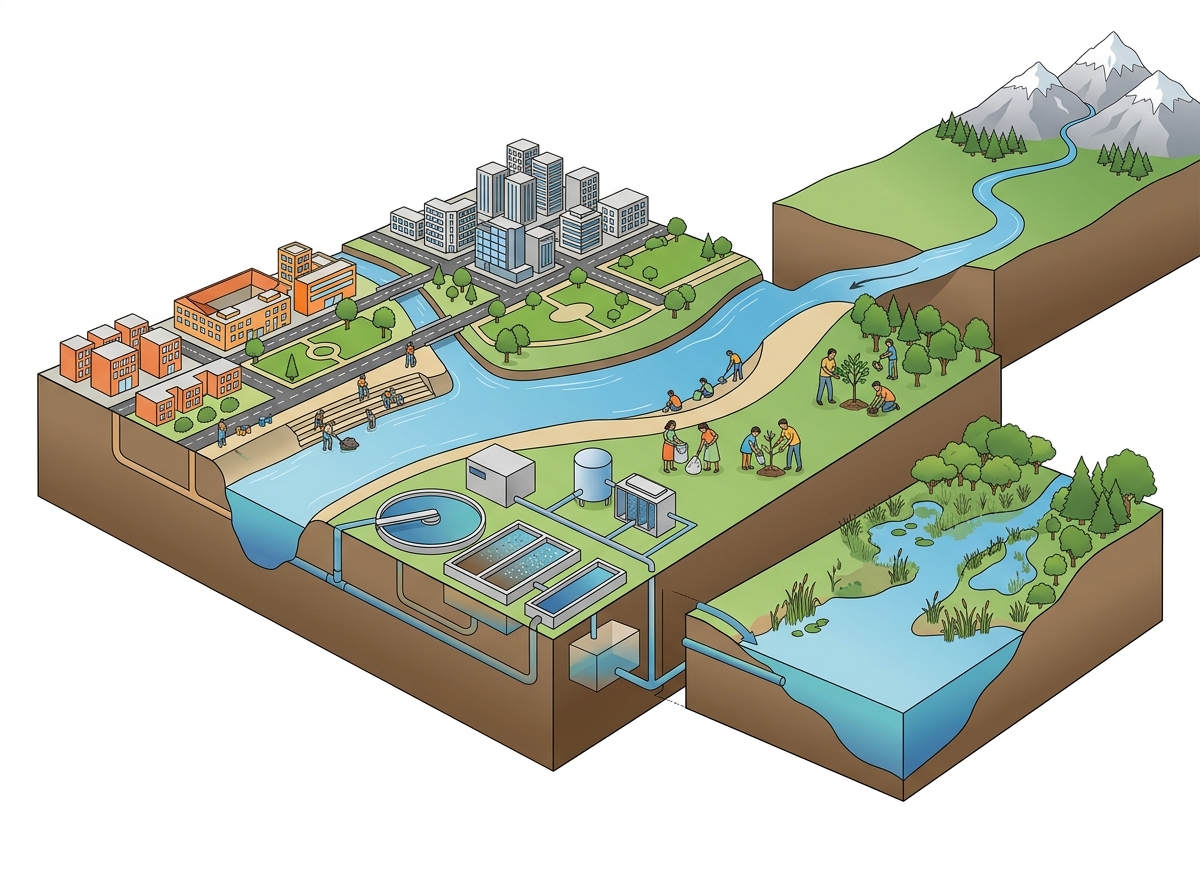
- Core pillars include pollution abatement (sewage treatment, industrial discharge control), conservation of biodiversity (wetlands, floodplains), and restoration of ecological flows through dam management and afforestation.
- Institutional mechanisms such as the NMCG, State Ganga Committees, and District Ganga Committees facilitate inter-state coordination, with the National Ganga Council chaired by the Prime Minister providing high-level oversight.
- Technological interventions encompass sewage treatment plants (STPs), effluent treatment plants (ETPs), real-time water quality monitoring, and the use of remote sensing and GIS for river basin management.
- Public participation is institutionalised through campaigns like ‘Namami Gange’, ‘Ganga Praharis’ (local volunteers), and community-led initiatives such as ‘Jal Saheli’ for water conservation and waste management.
- Legal and policy instruments include the Water (Prevention and Control of Pollution) Act, 1974, Environmental Impact Assessment (EIA) Notification 2006, and the Wetland (Conservation and Management) Rules, 2017, which regulate activities affecting riverine ecosystems.
- Financial mechanisms include the Clean Ganga Fund, corporate social responsibility (CSR) contributions, and convergence with schemes like the Jal Jeevan Mission and AMRUT for urban and rural water supply infrastructure.
- Monitoring and evaluation are conducted through the Comprehensive Ganga River Basin Management Plan (2015), which assesses ecological health, pollution levels, and socio-economic impacts.
Key Features
| Feature | Significance |
|---|---|
| Religious and cultural significance of the Ganga | The Ganga is not merely a river but a sacred entity in Indian civilization, deeply embedded in rituals, mythology, and socio-cultural practices, which amplifies the urgency of its conservation. |
| Intergenerational responsibility for river purity | The statement underscores that the preservation of the Ganga transcends individual or institutional boundaries, framing it as a collective duty for present and future generations. |
| Multi-stakeholder engagement model | The event demonstrates the integration of government agencies (e.g., UPPCB, Jal Nigam), private sector (e.g., HDFC Bank, SBI), civil society, and scientific experts in addressing river pollution. |
| Lifestyle for Environment (LiFE) initiative linkage | The emphasis on adopting sustainable lifestyles aligns with the national LiFE mission, promoting individual behavioural changes to reduce pollution and resource depletion. |
| Scientific and medical perspective on pollution impacts | The inclusion of medical experts highlights the direct health consequences of river pollution, particularly for vulnerable populations such as children and pregnant women. |
Why it Matters
Environmental Conservation
- The Ganga’s ecological health is critical for biodiversity, as it supports over 140 species of fish, 90 species of amphibians, and numerous migratory birds, making its pollution a biodiversity crisis.
- Riverine ecosystems act as carbon sinks; their degradation exacerbates climate change by reducing carbon sequestration capacity.
- The Ganga Basin, covering 11 states, sustains the livelihoods of approximately 40% of India’s population, making its pollution a socio-economic issue.
Public Health
- Polluted river water is a vector for waterborne diseases such as cholera, dysentery, and hepatitis, contributing to high infant mortality and morbidity rates in riparian communities.
- Heavy metal contamination (e.g., arsenic, lead) in the Ganga has been linked to chronic health conditions, including neurological disorders and cancer.
- The statement’s reference to reduced gastro-related issues post-Kumbh underscores the tangible health benefits of improved river water quality.
Cultural and Social Cohesion
- The Ganga’s sanctity fosters social cohesion, with rituals like *Ganga Dussehra* and *Chhath Puja* uniting communities across regions and religions.
- Riverine festivals and pilgrimages (e.g., Kumbh Mela) drive economic activities worth billions, making their sustainability a matter of cultural preservation.
- The framing of river purity as a shared heritage strengthens civic responsibility and national identity.
Policy and Governance
- The event reflects the implementation of the *National Mission for Clean Ganga (NMCG)*, which adopts a basin-wide approach to pollution control and river rejuvenation.
- The integration of scientific research (e.g., IITs, NIH) in policy-making ensures evidence-based interventions for river restoration.
- The emphasis on inter-departmental coordination (e.g., UPPCB, Jal Nigam) highlights the necessity of integrated governance for addressing pollution sources.
Challenges
1. Industrial and Agricultural Pollution
- Industries along the Ganga, particularly tanneries and textile units in Uttar Pradesh and West Bengal, discharge untreated effluents containing chromium, cadmium, and other toxic chemicals.
- Agricultural runoff from the Indo-Gangetic Plain introduces high levels of nitrogen, phosphorus, and pesticides, leading to eutrophication and algal blooms.
- The lack of stringent enforcement of the *Water (Prevention and Control of Pollution) Act, 1974* exacerbates industrial pollution due to weak monitoring and penalties.
UPSC Link: GS Paper 3: Environment & Pollution Control
2. Municipal Waste and Sewage Management
- Over 80% of the sewage generated in Ganga basin towns remains untreated due to inadequate infrastructure, with only 39% of the 3,000 MLD sewage generated in Uttar Pradesh being treated.
- Rapid urbanization and unplanned development have overwhelmed existing sewage treatment plants (STPs), leading to direct discharge of untreated waste into the river.
- The *Namami Gange Programme* faces challenges in scaling up STP capacity, particularly in tier-2 and tier-3 cities.
UPSC Link: GS Paper 2: Governance & Urban Development
3. Plastic and E-waste Pollution
- The Ganga is one of the top 20 rivers contributing to plastic pollution globally, with microplastics and single-use plastics accumulating in its sediment and biota.
- Informal e-waste recycling units along the riverbank, particularly in Kanpur and Varanasi, release toxic substances like lead and mercury into the water.
- The absence of a robust *Extended Producer Responsibility (EPR)* framework for plastic and e-waste management hampers effective waste segregation and recycling.
UPSC Link: GS Paper 3: Waste Management & Circular Economy
4. Climate Change and Hydrological Alterations
- Glacial retreat in the Himalayas, a key source of the Ganga, reduces river discharge, altering sediment flow and increasing the risk of flash floods and droughts.
- Extreme weather events, such as the 2013 Uttarakhand floods, have disrupted river ecosystems and exacerbated pollution by mobilizing contaminants from riverbeds.
- The construction of dams and barrages (e.g., Tehri Dam) has fragmented the river’s flow, disrupting aquatic biodiversity and sediment transport.
UPSC Link: GS Paper 1: Geography & Climate Change
5. Public Awareness and Behavioral Resistance
- Despite awareness campaigns, traditional practices such as immersion of idols, cremation ashes, and open defecation persist due to cultural inertia and lack of alternative infrastructure.
- Low public participation in waste segregation and riverfront cleanliness drives stems from a lack of incentives and enforcement mechanisms.
- The event’s emphasis on *LiFE* underscores the need for behavioural change, which requires sustained education and community engagement.
UPSC Link: GS Paper 4: Ethics & Public Participation
Challenges — UPSC Perspective
| Issue | Concern |
|---|---|
| Untreated industrial effluents | Toxic chemical discharge from tanneries and chemical industries in Kanpur and Unnao causes severe water quality degradation. |
| Inadequate sewage treatment | Only 39% of sewage in Uttar Pradesh is treated, leading to direct discharge into the Ganga. |
| Plastic pollution | The Ganga is a major contributor to global plastic waste, with microplastics affecting aquatic life and human health. |
| Agricultural runoff | Excessive use of fertilizers and pesticides in the Indo-Gangetic Plain leads to eutrophication and oxygen depletion. |
| Climate-induced hydrological changes | Glacial retreat and extreme weather events disrupt river flow and sediment dynamics. |
| Cultural and religious practices | Traditional rituals such as idol immersion and open defecation contribute to pollution despite awareness campaigns. |
Government Initiatives — Must-Memorise for Prelims
- National Mission for Clean Ganga (NMCG)
- Namami Gange Programme
- Atal Mission for Rejuvenation and Urban Transformation (AMRUT)
- Swachh Bharat Mission (Urban & Rural)
- Jal Jeevan Mission (JJM)
Way Forward
- Strengthen enforcement of the *Water (Prevention and Control of Pollution) Act, 1974* with stricter penalties for industrial polluters and mandatory installation of effluent treatment plants (ETPs).
- Scale up sewage treatment infrastructure in tier-2 and tier-3 cities through public-private partnerships (PPPs) and innovative financing models like viability gap funding.
- Implement a basin-wide *Extended Producer Responsibility (EPR)* framework for plastic and e-waste, mandating producer responsibility for collection and recycling.
- Promote nature-based solutions such as constructed wetlands, afforestation along riverbanks, and community-led riverfront cleanliness drives to enhance ecological resilience.
- Integrate climate adaptation strategies into river management plans, including glacial monitoring, floodplain zoning, and sustainable dam operations.
- Launch a mass awareness campaign under the *LiFE* initiative, focusing on behavioural change through school education, religious institutions, and local governance bodies.
- Enhance inter-departmental coordination between UPPCB, Jal Nigam, and municipal bodies to ensure seamless implementation of pollution control measures.
- Invest in research and development for low-cost, decentralized water treatment technologies tailored to rural and peri-urban areas.
UPSC Value Addition
Keywords for Mains Answer-Writing
Ganga Action Plan · National Mission for Clean Ganga (NMCG) · Namami Gange Programme · River pollution in India · Participatory governance in environmental conservation · Environmental ethics and cultural heritage · Inter-state river basin management · Waste management and circular economy · Climate change and water security · Public-Private Partnership (PPP) in environmental governance · Sustainable Development Goals (SDGs) 6 and 14 · Environmental jurisprudence and judicial activism
Constitutional & Policy Linkages
- Article 48A: Directive Principle of State Policy (DPSP) – Protection and improvement of environment and safeguarding of forests and wildlife.
- Article 51A(g): Fundamental Duty – To protect and improve the natural environment including forests, lakes, rivers, and wildlife.
Concept Flow
Religious and cultural reverence for the Ganga → Recognition of its ecological and socio-economic importance → Identification of pollution sources (industrial, agricultural, municipal) → Implementation of conservation policies (NMCG, Namami Gange) → Public participation and behavioural change (LiFE) → Monitoring and enforcement of environmental laws → Sustainable river basin management.
Prelims Practice Questions
Q1. Consider the following statements regarding the Namami Gange Programme:
1. It is a centrally sponsored scheme launched in 2014.
2. The programme aims to achieve the twin objectives of effective abatement of pollution and conservation and rejuvenation of the river Ganga.
3. The National Mission for Clean Ganga (NMCG) is the implementing authority for the programme.
4. The programme includes the establishment of Sewage Treatment Plants (STPs) and river-front development.
How many of the above statements are correct?
- Only one
- Only two
- Only three
- All
Answer: All — Statements 1, 2, 3, and 4 are all correct. The Namami Gange Programme was launched in 2014 under the National Mission for Clean Ganga (NMCG), which operates under the Ministry of Jal Shakti. The programme’s objectives include pollution abatement and rejuvenation of the Ganga, alongside infrastructure development such as STPs and river-front development.
Q2. Assertion (A): The Ganga Action Plan (GAP) Phase-I, launched in 1985, was primarily focused on the abatement of pollution in the Ganga river.
Reason (R): The GAP Phase-I was implemented by the National River Conservation Directorate (NRCD) under the Ministry of Environment, Forest and Climate Change.
In the context of the above two statements, which one of the following is correct?
- Both A and R are true, and R is the correct explanation of A
- Both A and R are true, but R is not the correct explanation of A
- A is true but R is false
- A is false but R is true
Answer: Both A and R are true, but R is not the correct explanation of A — Both the Assertion (A) and Reason (R) are true. The Ganga Action Plan Phase-I was indeed launched in 1985 to abate pollution in the Ganga river, and it was implemented by the National River Conservation Directorate (NRCD) under the Ministry of Environment, Forest and Climate Change.
Q3. Match the following initiatives with their respective objectives:
Column I (Initiative) | Column II (Objective)
———————————————–|———————————————–
A. National Mission for Clean Ganga (NMCG) | 1. Development of riverfronts and ghats
B. Namami Gange Programme | 2. Comprehensive pollution abatement
C. Ganga Gram Yojana | 3. Holistic conservation of the Ganga basin
D. Clean Ganga Fund | 4. Mobilisation of resources for Ganga rejuvenation
Select the correct match:
- A-3, B-2, C-1, D-4
- A-2, B-3, C-1, D-4
- A-1, B-3, C-2, D-4
- A-4, B-2, C-1, D-3
Answer: A-3, B-2, C-1, D-4 — The correct matches are: A (NMCG) – 3 (Holistic conservation of the Ganga basin), B (Namami Gange Programme) – 2 (Comprehensive pollution abatement), C (Ganga Gram Yojana) – 1 (Development of riverfronts and ghats), D (Clean Ganga Fund) – 4 (Mobilisation of resources for Ganga rejuvenation).
Mains Practice Question
✍ The conservation of the Ganga river transcends its ecological significance and is deeply intertwined with cultural, religious, and socio-economic dimensions. Critically examine the institutional and governance frameworks that have been established to ensure the rejuvenation of the Ganga, with particular reference to the Namami Gange Programme and the National Mission for Clean Ganga (NMCG). Also, analyse the role of public participation in achieving the objectives of these initiatives. (15 Marks)
Approach: 1. **Introduction**: Briefly define the cultural and ecological significance of the Ganga river, highlighting its status as a ‘living entity’ in Indian ethos and its critical role in water security.
2. **Institutional Framework**:
– **National Mission for Clean Ganga (NMCG)**: Its establishment under the National Ganga Council (NGC), composition, and mandate.
– **Namami Gange Programme**: Objectives, key components (e.g., sewage treatment, riverfront development, afforestation, and public awareness), and funding mechanisms.
– **Ganga Gram Yojana**: Focus on rural sanitation and riverfront development in Ganga basin villages.
– **Legal Framework**: Relevant provisions under the Environment (Protection) Act, 1986, and the Water (Prevention and Control of Pollution) Act, 1974.
3. **Governance Challenges**:
– Inter-state coordination issues (e.g., Uttar Pradesh, Bihar, West Bengal).
– Implementation gaps in sewage treatment infrastructure.
– Monitoring and evaluation mechanisms (e.g., real-time water quality monitoring systems).
– Role of the National Green Tribunal (NGT) in addressing violations.
4. **Public Participation**:
– Mechanisms for citizen engagement (e.g., ‘Ganga Prahari’ volunteers, ‘MyGanga’ app, and community-led initiatives).
– Success stories (e.g., reduced instances of gastro-related issues post-Kumbh Mela 2025, as cited in the news article).
– Barriers to effective participation (e.g., lack of awareness, socio-economic disparities, and enforcement issues).
5. **Critical Analysis**:
– Evaluate the effectiveness of the Namami Gange Programme in achieving its twin objectives of pollution abatement and rejuvenation.
– Assess the role of the Clean Ganga Fund in mobilising resources and its utilisation.
– Discuss the need for integrating traditional knowledge systems (e.g., ghats, rituals) with modern conservation practices.
6. **Conclusion**:
– Summarise the key challenges and propose actionable recommendations (e.g., strengthening inter-state cooperation, enhancing public-private partnerships, and leveraging technology for real-time monitoring).
– Emphasise the importance of a multi-stakeholder approach in ensuring the long-term sustainability of the Ganga river.
Source: amarujala.com
Uttar Pradesh PCS (UPPSC) — State PCS Practice
Prelims: Which of the following initiatives has been emphasized by Uttar Pradesh’s Environment Minister Arvind Kumar Saxena to ensure the cleanliness and purity of the Ganga river in the state?
- A. Mandatory participation of all religious institutions along the Ganga basin in cleanliness drives
- B. Introduction of a state-wide ‘Ganga Swachhta Abhiyan’ with community involvement and awareness programs
- C. Imposition of heavy penalties on industries polluting the Ganga without prior consent
- D. Establishment of a dedicated ‘Ganga Cleanliness Fund’ solely funded by the state government
Answer: B. Introduction of a state-wide ‘Ganga Swachhta Abhiyan’ with community involvement and awareness programs — The Environment Minister highlighted the need for collective participation, including community involvement and awareness programs, to ensure the Ganga’s cleanliness.
Mains: Discuss the role of community participation and administrative initiatives in preserving the cultural and environmental significance of the Ganga river in Uttar Pradesh. Suggest measures to enhance public engagement for its long-term sustainability.
Generated by AanyaAi for educational purpose.
Related guides on our sites
- Current affairs for upsc 2026
- How to prepare for GS paper 1 for UPSC CSE mains exam
- Best UPSC coaching for IFOS exam
- Best geography optional coaching

- Madras HC Rules: Life Convicts Can Avail 40 Days Leave in Two Instalments - October 25, 2026
- तेलंगाना का नया एयरोस्पेस और रक्षा नीति 2.0: UPSC के लिए महत्वपूर्ण जानकारी - October 24, 2026
- Agricultural Biological Resources ABS Benefits ₹1.04 Crore for Biodiversity - October 24, 2026

No Comments