


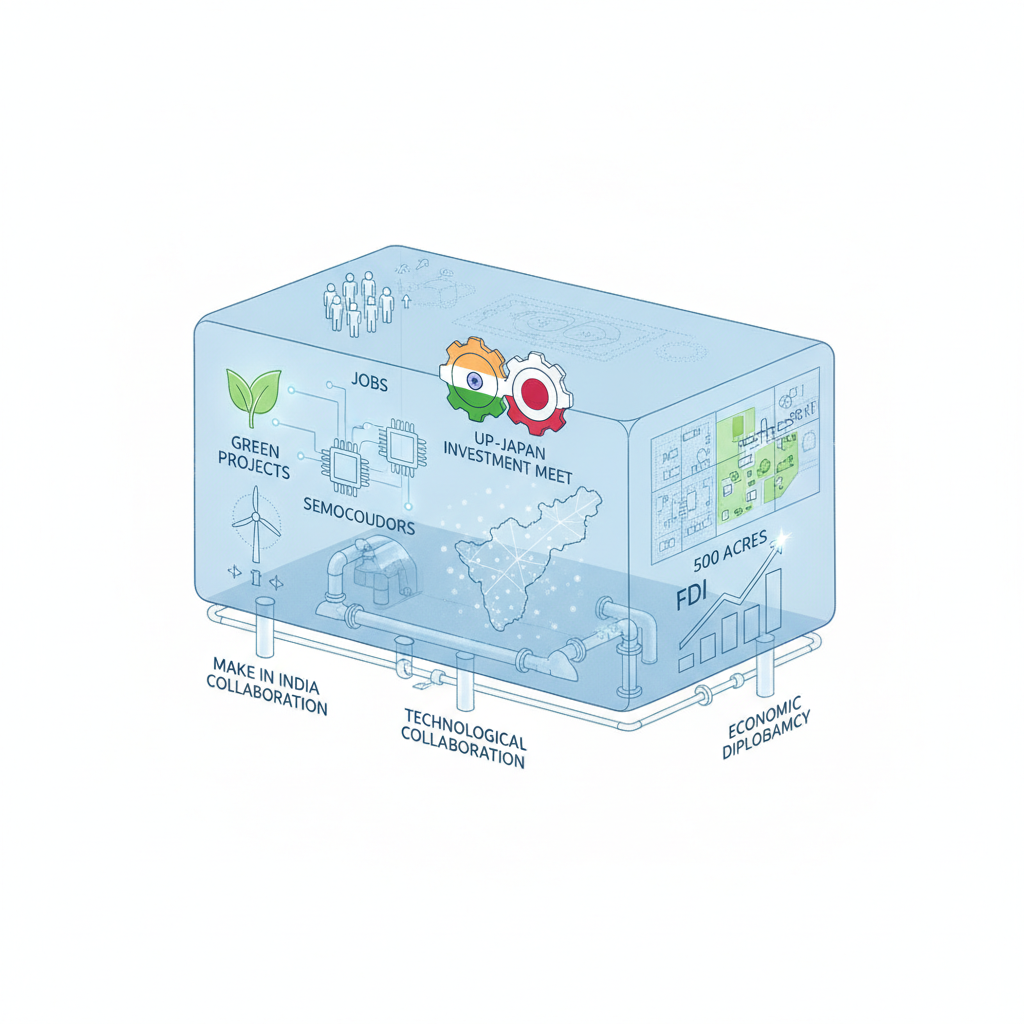
20 Aug UP-Japan Investment Meet 2026: Green Tech & Semiconductor FDI Boost for UP
Japanese investorsGreen projectsSemiconductor plantsIndustrial projects✎ The UP–Japan Investment Meet 2026 exemplifies India’s strategy to leverage FDI for industrialisation, green transition, and employment generation, with Uttar Pradesh positioning itself as a key manufacturing hub through state-led…
Subject Relevance — Where This Topic Fits
- GS Paper II — International Relations (Bilateral Investment Treaties, Economic Diplomacy) | GS Paper III — Economy (Foreign Direct Investment, Industrial Policy, Employment Generation, Manufacturing Sector) | GS Paper III — Environment (Green Energy Transition, Clean Technology) | GS Paper III — Science and Technology (Semiconductor Manufacturing, Digital Infrastructure)
- Prelims: Foreign Direct Investment (FDI), Uttar Pradesh Industrial Development Authority (UPIDA), Yamuna Expressway Industrial Development Authority (YEIDA), Japan External Trade Organization (JETRO), Semiconductor Mission India, Green Hydrogen Mission, Production-Linked Incentive (PLI) Scheme, Make in India 2.0
- Essay: India’s Strategic Partnerships in the Indo-Pacific: Leveraging FDI for Sustainable Development, The Role of State Governments in India’s Economic Diplomacy: A Case Study of Uttar Pradesh
Quick Revision: The UP–Japan Investment Meet 2026 exemplifies India’s strategy to leverage FDI for industrialisation, green transition, and employment generation, with Uttar Pradesh positioning itself as a key manufacturing hub through state-led initiatives like the ‘Japanese City’ in YEIDA.
Why is this in the news?
The ‘UP–Japan Investment Meet 2026’, commencing on 18 August 2026, marks a significant milestone in India’s economic diplomacy, particularly in Uttar Pradesh, where the state government is positioning itself as a hub for Japanese manufacturing, clean energy, and semiconductor industries. The five-day event, involving over 200 Japanese industrialists and policymakers, underscores the strategic alignment between India’s ‘Make in India’ initiative and Japan’s outward investment strategies, with a focus on job creation and technological collaboration. The event also highlights the role of state-level agencies like YEIDA and UPIDA in facilitating large-scale industrial projects, including a proposed ‘Japanese City’ on 500 acres of land.
Background
- Japan ranks among India’s top five foreign investors, with cumulative FDI inflows exceeding USD 35 billion as of 2025, driven by sectors such as automobiles, electronics, and infrastructure.
- Uttar Pradesh, India’s most populous state, contributes approximately 8% to the national GDP and is a key focus of the Centre’s ‘Make in India 2.0’ strategy, particularly in labour-intensive and high-tech manufacturing.
- The YEIDA region, spanning over 500 acres along the Yamuna Expressway, has been earmarked for integrated industrial townships under the ‘Japanese City’ initiative, aiming to replicate Japan’s industrial clusters in India.
- India’s Semiconductor Mission seeks to reduce import dependence and position India as a global semiconductor hub, aligning with Japan’s expertise in precision engineering and electronics.
- Japan’s decarbonisation commitments under the ‘Green Growth Strategy’ and India’s ‘Panchamrit’ targets at COP26 necessitate cross-border collaboration in renewable energy, hydrogen, and energy-efficient technologies.
- The PLI Scheme for Automobiles and Auto Components and the Production-Linked Incentive Scheme for Semiconductors and Display Manufacturing provide fiscal incentives for Japanese firms to establish manufacturing bases in India.
Uttar Pradesh–Japan Investment Partnership: Key Objectives and Modalities
- The UP–Japan Investment Meet 2026 is a state-led initiative aimed at attracting Japanese FDI into Uttar Pradesh, with a thematic focus on green projects, semiconductors, digital infrastructure, skill development, and tourism, to foster industrialisation and employment generation.
- The event is structured around a five-day programme, including CEO roundtables, B2B and G2B matchmaking sessions, and sector-specific workshops in Delhi, Lucknow, Agra, Greater Noida, and Varanasi, to facilitate direct interactions between Japanese investors and Indian stakeholders.
- A proposed ‘Japanese City’ on 500 acres of land in YEIDA is envisaged as a self-sustaining industrial township, integrating manufacturing units, R&D centres, skill development institutions, and residential facilities to replicate Japan’s industrial ecosystem in India.
- Major Japanese firms participating include JETRO, Escorts Kubota, Kubota Corporation, Toshiba India, Motherson Group, Daikin Airconditioning India, Sumitomo Corporation India, and Panasonic, with an investment worth over Rs 3,191 crore for projects by Escorts Kubota and Minda Corporation in the YEIDA region.
- The partnership aligns with India’s broader economic diplomacy, including the India–Japan Comprehensive Economic Partnership Agreement (CEPA) and the India–Japan Digital Partnership, to enhance trade and technological cooperation.
- The event also underscores the role of state-level agencies like YEIDA and Invest UP in streamlining regulatory approvals, land acquisition, and infrastructure development to expedite project implementation.
- Skill development initiatives, such as the Japan-India Institute for Manufacturing (JIM) and the Japan-India Institute for Skills (JIIS), are expected to be highlighted to address the demand for a skilled workforce in advanced manufacturing sectors.
- The partnership is expected to generate direct and indirect employment opportunities in Uttar Pradesh, particularly in the manufacturing, green energy, and digital infrastructure sectors, aligning with the state’s ‘One District, One Product’ (ODOP) initiative.
Key Features
| Feature | Significance |
|---|---|
| Multi-state event (Delhi, Lucknow, Agra, Greater Noida, Varanasi) | Facilitates sector-specific discussions across diverse industrial and cultural hubs, maximizing outreach and stakeholder engagement. |
| CEO Roundtable and B2B/G2B matchmaking sessions | Enables direct negotiations between Japanese investors and Indian businesses/government, accelerating deal finalization and reducing transaction costs. |
| Dedicated ‘Japanese City’ in YEIDA (500 acres) | Creates a specialized industrial ecosystem with infrastructure tailored to Japanese manufacturing standards, fostering long-term FDI retention and skill transfer. |
| Focus on green projects and semiconductors | Aligns with India’s decarbonization goals and semiconductor mission, positioning UP as a critical node in global supply chains for clean energy and electronics. |
| Skill development and tourism promotion | Addresses human capital gaps while leveraging UP’s cultural heritage to attract ancillary investments in hospitality and services. |
Why it Matters
Economic Growth and Industrialization
- Direct infusion of FDI exceeding ₹3,191 crore through Escorts Kubota and Minda Corporation projects, enhancing UP’s manufacturing GDP.
- Creation of high-skilled employment in sectors like semiconductors, green energy, and digital infrastructure, aligning with the ‘Make in India’ thrust.
- Development of a specialized industrial corridor (YEIDA) to attract ancillary industries, creating a multiplier effect on local economies.
- Strengthening India’s position in global supply chains for critical technologies (semiconductors) and clean energy, reducing import dependence.
Strategic Partnerships and Foreign Policy
- Deepening India-Japan economic ties under the ‘Special Strategic and Global Partnership,’ complementing initiatives like the India-Japan Act East Forum.
- Leveraging Japan’s expertise in precision manufacturing, green hydrogen, and semiconductor fabrication to bridge India’s technological gaps.
- Demonstrating India’s commitment to diversifying trade partnerships beyond traditional partners, enhancing geopolitical resilience.
- Showcasing UP as a model state for sub-national diplomacy, fostering decentralized economic cooperation under the ‘Act East’ policy.
Employment and Skill Development
- Generation of 10,000+ direct and indirect jobs in high-value sectors, addressing UP’s demographic dividend through formal employment.
- Collaboration with educational institutions for skill upgradation in semiconductor fabrication, green energy, and digital infrastructure, aligning with the National Skill Development Mission.
- Promotion of vocational training programs tailored to Japanese manufacturing standards, enhancing employability in global supply chains.
Infrastructure and Urban Development
- Development of a ‘Japanese City’ with plug-and-play infrastructure (power, logistics, residential zones) to reduce entry barriers for investors.
- Integration of greenfield industrial parks with existing transport networks (Yamuna Expressway, Delhi-Mumbai Industrial Corridor), improving connectivity.
- Leveraging Agra, Varanasi, and Lucknow as cultural and economic hubs to diversify investment beyond traditional industrial belts.
Challenges
1. Land Acquisition and Regulatory Hurdles
- Lengthy approval processes for land use conversion and environmental clearances in YEIDA, delaying project timelines.
- Potential resistance from local communities due to displacement concerns or inadequate compensation under the Right to Fair Compensation and Transparency in Land Acquisition Act, 2013.
UPSC Link: Land Acquisition Act, 2013
2. Skill Mismatch and Labor Productivity
- Shortage of skilled labor in niche sectors like semiconductor fabrication and green hydrogen, necessitating upskilling programs.
- Low productivity in traditional manufacturing sectors (e.g., textiles) due to outdated machinery, requiring technology transfer and automation.
UPSC Link: National Skill Development Mission
3. Infrastructure Bottlenecks
- Inadequate power supply and logistics infrastructure in tier-2 cities (Agra, Varanasi) to support high-tech manufacturing.
- Limited last-mile connectivity in industrial corridors, increasing operational costs for investors.
UPSC Link: Logistics Efficiency Enhancement Program
4. Policy Consistency and Ease of Doing Business
- Frequent changes in state-level policies (e.g., tax incentives, labor laws) creating uncertainty for investors.
- Complexity in compliance with multiple regulatory frameworks (central, state, municipal) deterring FDI.
UPSC Link: Ease of Doing Business (State Rankings)
5. Geopolitical and Economic Risks
- Japan’s economic slowdown or policy shifts (e.g., subsidies for domestic manufacturing) reducing outbound FDI.
- Global supply chain disruptions (e.g., semiconductor shortages) impacting project timelines and profitability.
UPSC Link: Global Value Chains
Challenges — UPSC Perspective
| Issue | Concern |
|---|---|
| Land acquisition delays | Legal disputes and community resistance may stall project execution. |
| Skill gaps in high-tech sectors | Insufficient vocational training programs hinder workforce readiness. |
| Infrastructure deficits in tier-2 cities | Poor connectivity and power supply increase operational costs. |
| Policy volatility at state level | Frequent changes in incentives create uncertainty for investors. |
| Global supply chain disruptions | Semiconductor shortages or trade restrictions may delay projects. |
Government Initiatives — Must-Memorise for Prelims
- Uttar Pradesh Industrial Investment and Employment Promotion Policy, 2022
- National Semiconductor Mission (NSM)
- Production Linked Incentive (PLI) Scheme for Electronics and IT Hardware
- National Green Hydrogen Mission
Way Forward
- Accelerate land acquisition and environmental clearances for the ‘Japanese City’ in YEIDA through single-window clearance mechanisms.
- Collaborate with Japanese agencies (JETRO, METI) to establish skill development centers in UP, focusing on semiconductor fabrication and green energy.
- Upgrade power and logistics infrastructure in Agra, Varanasi, and Greater Noida via public-private partnerships (PPPs).
- Streamline state-level approvals by adopting digital platforms (e.g., UP Investor Facilitation Portal) for real-time tracking of applications.
- Leverage the PLI Scheme for Electronics to subsidize semiconductor manufacturing units in UP, attracting anchor investors.
- Establish a dedicated ‘UP-Japan Skill Development Fund’ to finance vocational training programs in collaboration with Japanese technical institutions.
- Promote Agra and Varanasi as ‘heritage industrial hubs’ to attract tourism-linked investments in hospitality and ancillary services.
UPSC Value Addition
Keywords for Mains Answer-Writing
Foreign Direct Investment (FDI) · Uttar Pradesh-Japan Investment Meet 2026 · Green energy and semiconductors · Invest UP · Yamuna Expressway Industrial Development Authority (YEIDA) · Foreign Trade Policy 2023 · Make in India · Industrial corridors · Skill development and employment generation · Public-Private Partnership (PPP) · Special Economic Zones (SEZs) · Ease of Doing Business (EoDB) · Digital infrastructure and Industry 4.0 · Manufacturing and export promotion
Constitutional & Policy Linkages
- Article 246 (Distribution of Legislative Powers) – State vs. Concurrent List (Industry, Labour, Land).
- Article 297 (Property vested in the Union) – Land acquisition for industrial purposes.
- Seventh Schedule (State List: Industries; Concurrent List: Economic and Social Planning).
Concept Flow
India-Japan ‘Special Strategic and Global Partnership’ → UP-JICA/JETRO collaboration → Focus on green projects, semiconductors, and jobs → FDI infusion in YEIDA → Employment generation and skill development → Industrial corridor expansion → Supply chain integration with global markets.
Prelims Practice Questions
Q1. Consider the following statements regarding the UP–Japan Investment Meet 2026:
1. The meet is being organised to promote Foreign Direct Investment (FDI) in Uttar Pradesh.
2. The event includes virtual ground-breaking ceremonies for projects by Escorts Kubota and Minda Corporation.
3. The meet focuses exclusively on the manufacturing sector and excludes green energy and semiconductors.
How many of the above statements are correct?
- Only one
- Only two
- All three
- None
Answer: Only two — Statements 1 and 2 are correct as the meet aims to advance FDI and includes virtual ground-breaking ceremonies. Statement 3 is incorrect because the meet covers green energy, semiconductors, and other sectors.
Q2. Assertion (A): The Yamuna Expressway Industrial Development Authority (YEIDA) is being developed as a dedicated ‘Japanese City’ to attract investment.
Reason (R): YEIDA offers land parcels of 500 acres exclusively for Japanese industrialists, ensuring a conducive environment for manufacturing.
In the context of the above statements, which of the following is correct?
- Both A and R are true, and R is the correct explanation of A.
- Both A and R are true, but R is not the correct explanation of A.
- A is true, but R is false.
- A is false, but R is true.
Answer: Both A and R are true, and R is the correct explanation of A. — Both A and R are true. The YEIDA region is being developed as a ‘Japanese City’ on 500 acres, and the availability of land parcels is a key attraction for Japanese investors.
Mains Practice Question
✍ Evaluate the significance of state-led investment promotion initiatives such as the UP–Japan Investment Meet 2026 in the context of India’s industrial policy framework. (15 Marks)
Approach: MODEL-ANSWER SKELETON:
1. **Introduction**: Define state-led investment promotion initiatives and their role in India’s industrial policy framework, citing the Foreign Trade Policy 2023 and Make in India.
2. **Objectives of UP–Japan Investment Meet 2026**: Highlight FDI attraction, sectoral focus (green energy, semiconductors, manufacturing), and employment generation.
3. **Institutional Mechanisms**: Discuss the role of Invest UP, YEIDA, and state-government facilitation in improving the Ease of Doing Business (EoDB).
4. **Comparative Advantage**: Analyse how such initiatives leverage India’s demographic dividend, industrial corridors, and PPP models.
5. **Challenges**: Address concerns like bureaucratic hurdles, land acquisition, and regulatory compliance.
6. **Conclusion**: Assess the long-term impact on industrialisation, export promotion, and technological upgradation, with a balanced view.
Source: The Indian Express
Generated by AanyaAi for educational purpose.

- Vettri Payanam Scheme: Free Bus Travel for Women in Tamil Nadu - October 4, 2026
- पेंशन अदालत: 17वीं बैठक की अध्यक्षता करेंगे डॉ. जितेंद्र सिंह, जानिए मुख्य बातें - October 4, 2026
- CBN Rajasthan celebrates National Anti-Drug Day with Gandhi Jayanti events - October 4, 2026

No Comments