


11 Aug UP TTZ Survey: 10 Key Parameters for New Industries in Taj Trapezium Zone
✎ The Taj Trapezium Zone (TTZ) is an eco-sensitive zone around the Taj Mahal where industrial activity is regulated by the Supreme Court’s directives under the Environment (Protection) Act, 1986, requiring strict environmental…
Subject Relevance — Where This Topic Fits
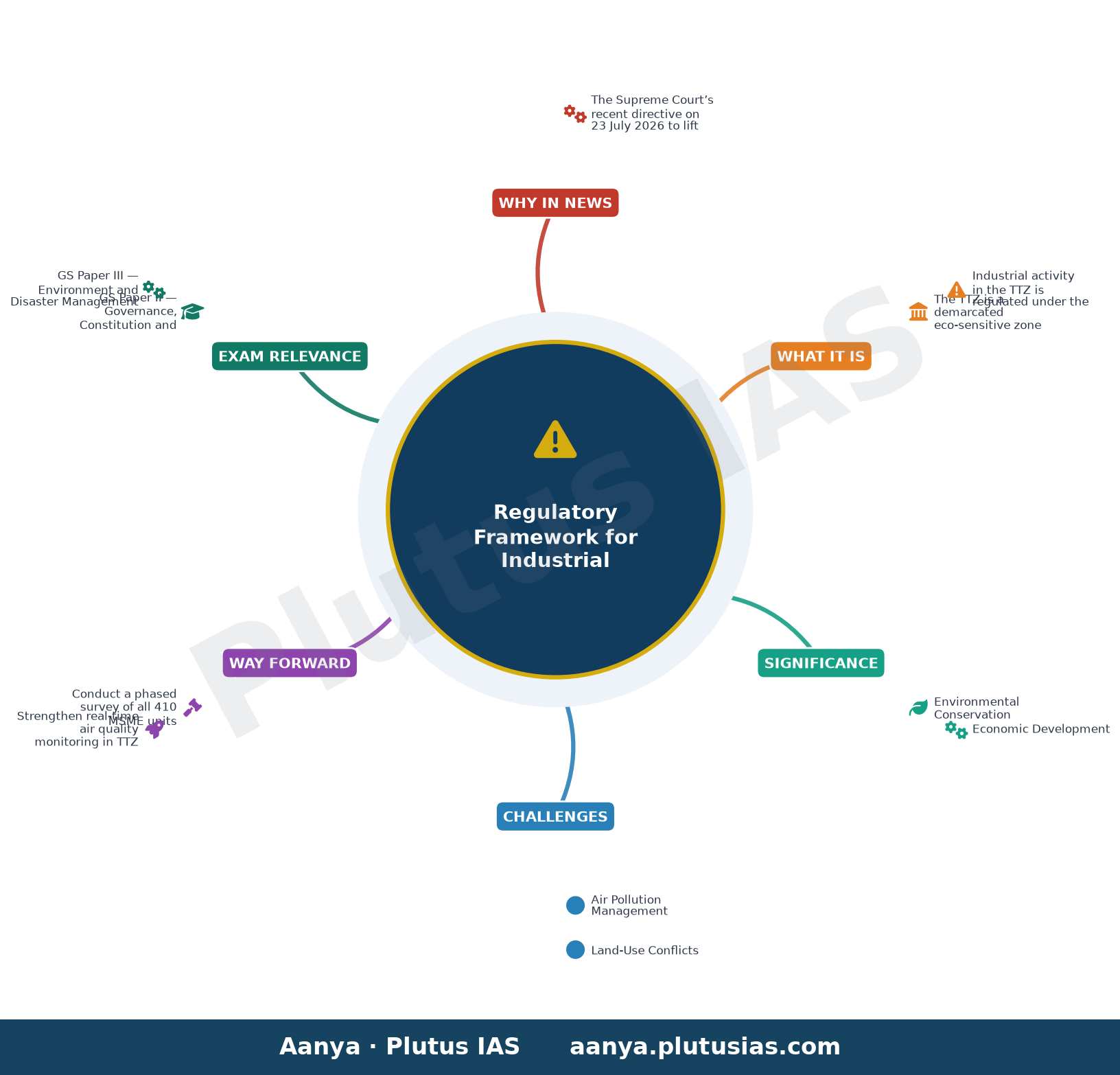
- GS Paper II — Governance, Constitution and Polity (Environmental Governance and Regulatory Authorities) | GS Paper III — Environment and Disaster Management (Industrial Pollution Control and Sustainable Development)
- Prelims: Taj Trapezium Zone (TTZ), Supreme Court directives on industrial activity, Environmental Impact Assessment (EIA), Pollution Control Board, National Environmental Engineering Research Institute (NEERI), Central Empowered Committee (CEC), MSMEs, Industrial Expansion Regulations
- Essay: Balancing industrial development with environmental conservation: The case of the Taj Trapezium Zone, Judicial activism in environmental governance: Implications for sustainable development
Quick Revision: The Taj Trapezium Zone (TTZ) is an eco-sensitive zone around the Taj Mahal where industrial activity is regulated by the Supreme Court’s directives under the Environment (Protection) Act, 1986, requiring strict environmental compliance for any new or expanded industrial units.
Why is this in the news?
The Supreme Court’s recent directive on 23 July 2026 to lift a two-year moratorium on new industrial establishments and expansions within the Taj Trapezium Zone (TTZ) has necessitated a structured verification process. A joint survey by the Uttar Pradesh Pollution Control Board, District Industries Centre, and district administration has commenced to assess 208 MSME units across 10 key parameters, including land-use compliance, project feasibility, and air pollution mitigation, to ensure adherence to environmental safeguards while facilitating industrial growth.
Background
- The Supreme Court, in 1996 (M.C. Mehta vs. Union of India), imposed a blanket ban on new industrial units and expansions in the TTZ to curb pollution, particularly from industries like foundries, chemical units, and brick kilns.
- The Central Empowered Committee (CEC) and the National Environmental Engineering Research Institute (NEERI) were designated as technical bodies to oversee environmental compliance in the TTZ.
What is the Taj Trapezium Zone (TTZ) and its Regulatory Framework?
- The TTZ is a demarcated eco-sensitive zone around the Taj Mahal, notified to preserve its architectural and cultural heritage from environmental degradation.
- Industrial activity in the TTZ is regulated under the Environment (Protection) Act, 1986, and the Supreme Court’s directives in the M.C. Mehta case (1996), which established a moratorium on new industrial units and expansions.
- The TTZ Authority, headed by the Divisional Commissioner of Agra, acts as the nodal body for granting permissions for industrial activities, subject to environmental clearances.
- The regulatory framework mandates compliance with 10 key parameters during the survey of industrial units, including land-use verification, project feasibility reports, air pollution control measures, and effluent treatment plant (ETP) installations.
- The Central Empowered Committee (CEC) and NEERI provide technical assessments to the TTZ Authority to ensure environmental safeguards are met before granting permissions.
- The current survey focuses on 208 MSME units, including 54 existing units seeking expansion, which require enhanced electricity load and compliance with pollution control norms.
- The Supreme Court’s 23 July 2026 directive marked a shift from a blanket ban to a conditional relaxation, allowing industrial activity if stringent environmental and procedural norms are satisfied.
- The process underscores the balance between economic development and environmental conservation, a critical theme in India’s sustainable development discourse.
Key Features
| Feature | Significance |
|---|---|
| Survey of MSME units in TTZ | Identifies eligible industrial units for expansion or new establishment within the Taj Trapezium Zone, ensuring compliance with environmental and land-use norms. |
| 10-parameter verification | Evaluates units on parameters such as land-use compliance, project feasibility, air pollution control, and effluent treatment infrastructure. |
| Supreme Court directives | Lifts the two-year moratorium on industrial expansion in TTZ, enabling resumption of approval processes as per judicial orders. |
| Multi-stakeholder verification | Involves Pollution Control Board, District Industries Centre, and administrative authorities for collective assessment of industrial units. |
| TTZ Authority approval | Mandatory clearance from the TTZ Authority Chairperson and Divisional Commissioner for industrial activities in the zone. |
Why it Matters
Environmental Conservation
- Ensures industrial activities in TTZ adhere to the Supreme Court-mandated environmental safeguards to protect the Taj Mahal and its surrounding ecosystem.
- Balances industrial growth with the preservation of cultural heritage sites under the Archaeological Survey of India’s jurisdiction.
Economic Development
- Facilitates the expansion of 54 existing MSME units, potentially increasing local employment and industrial output.
- Revives stalled industrial projects, contributing to regional economic revival and investment attraction in Agra.
Regulatory Governance
- Demonstrates the role of judicial oversight in environmental governance, ensuring policy implementation aligns with judicial directives.
- Highlights the inter-departmental coordination required for environmental compliance and industrial approvals.
Challenges
1. Air Pollution Management
- TTZ faces persistent air pollution challenges due to industrial emissions, vehicular traffic, and construction activities.
- Verification of air pollution control measures in industrial units remains critical to mitigate adverse impacts on the Taj Mahal.
UPSC Link: GS3: Environmental Pollution
2. Land-Use Conflicts
- Balancing industrial land allocation with conservation priorities in a densely populated and heritage-sensitive zone.
- Ensuring compliance with the Master Plan for Agra, which restricts certain industrial activities in TTZ.
UPSC Link: GS2: Urban Planning
3. Regulatory Delays
- Historical delays in approvals and clearances have hindered industrial growth in TTZ, necessitating streamlined processes.
- Multi-layered verification (TTZ Authority, CEC, NEERI) may introduce procedural bottlenecks despite judicial directives.
UPSC Link: GS2: Governance
4. Heritage Conservation vs. Industrial Growth
- The dual mandate of preserving the Taj Mahal while promoting economic activities creates inherent tensions in policy execution.
- Requires adaptive management strategies to reconcile conservation goals with developmental needs.
UPSC Link: GS1: Indian Culture
Challenges — UPSC Perspective
| Issue | Concern |
|---|---|
| Air quality degradation | Risk of irreversible damage to the Taj Mahal due to particulate matter and gaseous emissions. |
| Industrial encroachment | Potential violation of land-use norms in a heritage conservation zone. |
| Compliance verification | Ensuring all industrial units meet the 10-parameter criteria post-approval. |
| Stakeholder coordination | Aligning priorities among judicial bodies, environmental agencies, and industrial promoters. |
| Resource allocation | Adequate funding for monitoring and enforcement of environmental standards in TTZ. |
Way Forward
- Conduct a phased survey of all 410 MSME units identified by the Supreme Court to ensure comprehensive compliance assessment.
- Strengthen real-time air quality monitoring in TTZ with IoT-based sensors to track industrial emissions.
- Develop a dynamic database of industrial units in TTZ to streamline approvals and compliance tracking.
- Organize capacity-building workshops for MSMEs on environmental best practices and pollution control technologies.
- Establish a grievance redressal mechanism for heritage conservation groups to report violations promptly.
- Collaborate with NEERI for periodic environmental impact assessments of industrial activities in TTZ.
- Integrate TTZ compliance data with the National Clean Air Programme (NCAP) for broader air quality management.
UPSC Value Addition
Keywords for Mains Answer-Writing
Taj Trapezium Zone (TTZ) · industrial regulation in ecologically sensitive zones · Supreme Court directives on environmental governance · Taj Mahal conservation · environmental impact assessment (EIA) · National Environmental Engineering Research Institute (NEERI) · Central Empowered Committee (CEC) · MSME industrial expansion · pollution control in heritage zones · environmental governance and judicial intervention
Constitutional & Policy Linkages
- Article 48A: Directive Principles of State Policy on environmental protection and improvement of environment.
- Seventh Schedule: Concurrent List (Entry 17A: Forests and Entry 17B: Protection of Wild Animals and Birds) and State List (Entry 14: Industries).
Concept Flow
Supreme Court imposes moratorium on industrial expansion in TTZ (2024) → Industrial units face operational constraints → Judicial directive to resume approvals (2026) → Multi-stakeholder survey initiated → Verification of 10 parameters for compliance → TTZ Authority grants conditional approvals → Industrial units expand operations → Environmental monitoring and enforcement.
Prelims Practice Questions
Q1. Consider the following statements regarding the Taj Trapezium Zone (TTZ):
1. The TTZ is a defined area around the Taj Mahal designated for environmental protection.
2. The Supreme Court of India has imposed a blanket ban on all industrial activities within the TTZ.
3. The Central Empowered Committee (CEC) is one of the authorities required to grant consent for industrial units in the TTZ.
4. The National Environmental Engineering Research Institute (NEERI) is mandated to conduct environmental impact assessments in the TTZ.
How many of the above statements are correct?
- Only one
- Only two
- Only three
- All four
Answer: All four — Statements 1, 3, and 4 are correct. Statement 2 is incorrect as the Supreme Court has not imposed a blanket ban but has imposed restrictions subject to compliance with environmental norms and judicial oversight.
Q2. Assertion (A): The Taj Trapezium Zone (TTZ) is governed by a multi-stakeholder regulatory framework involving the Supreme Court, Central Empowered Committee (CEC), and the National Environmental Engineering Research Institute (NEERI).
Reason (R): The TTZ was declared to protect the Taj Mahal from air pollution caused by industrial activities, and its governance is guided by judicial directives and environmental safeguards.
Options:
A. Both A and R are true, and R is the correct explanation of A.
B. Both A and R are true, but R is not the correct explanation of A.
C. A is true, but R is false.
D. A is false, but R is true.
Answer: ? — Both Assertion (A) and Reason (R) are true, and R correctly explains A. The regulatory framework for the TTZ involves multiple institutions to ensure environmental protection and compliance with judicial directives.
Q3. Match the following regulatory authorities with their respective roles in the Taj Trapezium Zone (TTZ):
Column I (Authority) | Column II (Role)
————————————-|————————————-
A. Supreme Court of India | 1. Conducts environmental impact assessments
B. Central Empowered Committee (CEC)| 2. Grants consent for industrial units
C. National Environmental Engineering| 3. Imposes restrictions and monitors compliance
Research Institute (NEERI) |
D. Taj Trapezium Zone Authority | 4. Provides technical expertise and recommendations
Options:
1. A-3, B-2, C-1, D-4
2. A-2, B-3, C-1, D-4
3. A-3, B-1, C-2, D-4
4. A-4, B-2, C-1, D-3
Answer: ? — The correct match is: A-3 (Supreme Court imposes restrictions and monitors compliance), B-2 (CEC grants consent for industrial units), C-1 (NEERI conducts environmental impact assessments), and D-4 (TTZ Authority provides technical expertise and recommendations).
Mains Practice Question
✍ The Supreme Court’s directive to resume industrial activities in the Taj Trapezium Zone (TTZ) is premised on a delicate balance between environmental conservation and economic development. Critically examine the legal and institutional framework governing the TTZ, with particular reference to the role of the judiciary, statutory bodies, and environmental safeguards. Also, assess the implications of such judicial interventions for environmental governance in India. (15 Marks)
Approach: MODEL-ANSWER SKELETON:
1. Introduction: Define the TTZ, its ecological significance, and the Supreme Court’s role in its governance.
2. Legal and Institutional Framework:
– Supreme Court’s directives and the doctrine of judicial activism in environmental matters.
– Role of the Central Empowered Committee (CEC) as a statutory body under the Supreme Court.
– Functions of the National Environmental Engineering Research Institute (NEERI) in conducting environmental impact assessments.
– Mandate of the Taj Trapezium Zone Authority and its coordination with state agencies.
3. Environmental Safeguards:
– Compliance with the Environment (Protection) Act, 1986, and the Air (Prevention and Control of Pollution) Act, 1981.
– Implementation of the ‘polluter pays’ principle and the precautionary principle.
– Monitoring mechanisms such as real-time air quality data and periodic compliance reports.
4. Implications of Judicial Interventions:
– Strengthening of environmental governance through judicial oversight.
– Challenges in balancing economic development with conservation, including the role of MSMEs.
– Critique of judicial activism: potential overreach vs. necessary intervention in public interest.
5. Conclusion: Summarize the framework’s effectiveness and suggest measures for sustainable industrial development in ecologically sensitive zones.
Source: amarujala.com
Generated by AanyaAi for educational purpose.

- यूएस-चीन एआई हॉटलाइन: क्यों शी जिनपिंग-ट्रम्प शिखर वार्ता में टैरिफ से आगे बढ़ा ‘सुपर इंटेलिजेंस’ का मुद्दा - September 26, 2026
- US-China AI Hotline: Xi-Trump Summit’s Game-Changing AI Dialogue Explained - September 26, 2026
- आईसीएआर द्वारा स्वच्छता अभियान: गणेश विसर्जन से पर्यावरण संरक्षण तक - September 26, 2026

No Comments