


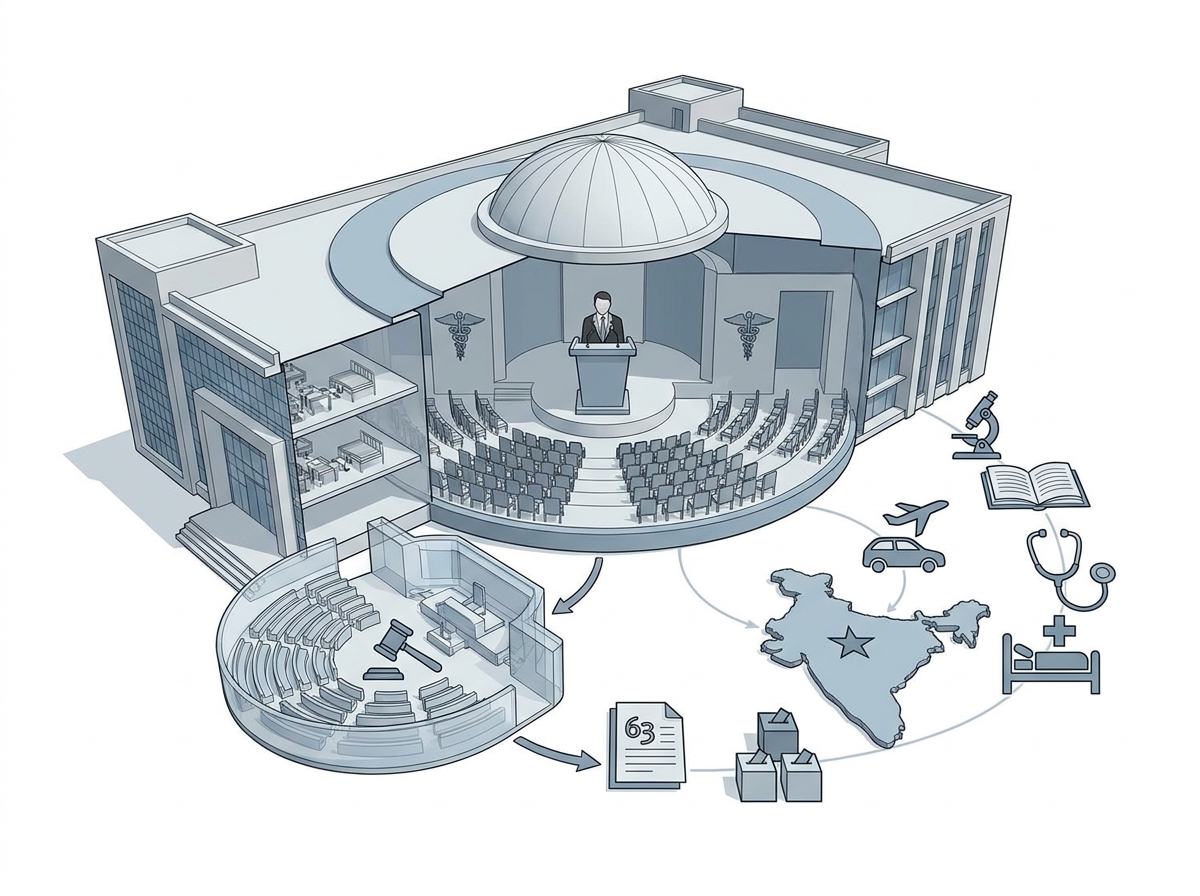
01 Sep UP Vice President to attend AIIMS Raipur convocation on Sept 2
✎ The Vice-President of India is the ex-officio Chairman of the Rajya Sabha and acts as the President in case of vacancy, as per Articles 63, 64, and 65 of the Constitution.
Subject Relevance — Where This Topic Fits
- GS Paper II — Constitutional Framework and Constitutional Bodies
- Prelims: Vice-President of India, AIIMS Raipur, convocation ceremony, constitutional provisions, Union Executive
- Essay: Constitutional Morality and Democratic Governance
Quick Revision: The Vice-President of India is the ex-officio Chairman of the Rajya Sabha and acts as the President in case of vacancy, as per Articles 63, 64, and 65 of the Constitution.
Why is this in the news?
The upcoming visit of the Vice-President of India, Shri C.P. Radhakrishnan, to Raipur, Chhattisgarh, on 2 September 2026, to attend the third convocation ceremony of AIIMS Raipur, underscores the constitutional role of the Vice-President as the ex-officio Chairman of the Rajya Sabha and a key institutional figure in India’s parliamentary democracy. This engagement highlights the intersection of constitutional governance with public health infrastructure, particularly in the context of medical education and healthcare delivery in a state-representative model.
Background
- The Vice-President of India is the second-highest constitutional office, elected by an electoral college comprising members of both Houses of Parliament.
- Article 63 of the Constitution of India provides for the office of the Vice-President, who acts as the ex-officio Chairman of the Rajya Sabha.
- AIIMS Raipur, established under the Pradhan Mantri Swasthya Suraksha Yojana (PMSSY), is one of the apex healthcare institutions in central India, aimed at correcting regional imbalances in tertiary healthcare.
- The convocation ceremony of AIIMS Raipur represents the academic and institutional milestone in the development of medical education and research in the region.
- The visit aligns with the constitutional duty of the Vice-President to engage with institutions of national importance and promote governance through symbolic and substantive participation.
- PMSSY, launched in 2006, seeks to address the shortfall of healthcare professionals and infrastructure by setting up AIIMS-like institutions in underserved states.
What is the constitutional role of the Vice-President of India?
- The Vice-President is elected for a five-year term by an electoral college consisting of members of both Houses of Parliament, under Article 66 of the Constitution.
- The primary constitutional function of the Vice-President is to serve as the ex-officio Chairman of the Rajya Sabha, presiding over its sessions, maintaining decorum, and ensuring the orderly conduct of parliamentary proceedings.
- In the event of the President’s absence, resignation, or inability to discharge duties, the Vice-President assumes the office of the President under Article 65, serving as the acting President.
- The Vice-President is not a member of the Rajya Sabha by virtue of holding office but is entitled to vote only in case of a tie.
- The office embodies the principle of continuity in governance, as the Vice-President is not directly elected by the people but through an indirect electoral process reflecting federal representation.
- The Vice-President’s role is distinct from that of the President, with a focus on parliamentary functions rather than executive or ceremonial duties.
- The Vice-President may be removed from office by a resolution of the Rajya Sabha passed by a majority of its total membership and agreed to by the Lok Sabha.
- The office serves as a bridge between the executive and legislative branches, reinforcing the checks-and-balances mechanism in India’s parliamentary system.
Key Features
| Feature | Significance |
|---|---|
| Visit of the Vice-President of India to Chhattisgarh | Demonstrates constitutional role of the Vice-President as ex-officio Chairman of the Rajya Sabha and ceremonial head of state in the absence of the President. |
| Inauguration/Participation in AIIMS Raipur’s 3rd Convocation | Highlights the expansion of tertiary healthcare infrastructure under the Pradhan Mantri Swasthya Suraksha Yojana (PMSSY) and the role of AIIMS in addressing regional healthcare disparities. |
| Convocation Ceremony as a Public Event | Serves as a platform for recognition of academic excellence, institutional accountability, and community engagement in higher education. |
| Vice-President’s Role in Academic Diplomacy | Reinforces the constitutional mandate of the Vice-President to promote national integration and educational advancement through symbolic participation in academic events. |
| Media Coverage and Public Outreach | Enhances visibility of constitutional institutions and public health initiatives, fostering trust in governance and institutional transparency. |
Why it Matters
Constitutional and Institutional Significance
- The Vice-President’s participation in the convocation underscores the constitutional linkage between the office and the promotion of educational institutions as instruments of national development.
- The event aligns with the Vice-President’s role in fostering inter-state cooperation and regional balance in healthcare and education, as envisaged under Articles 38 and 41 of the Directive Principles of State Policy.
- The visit exemplifies the ceremonial and symbolic functions of the Vice-President, distinct from the executive powers vested in the President under Article 53.
Healthcare Infrastructure Development
- AIIMS Raipur, established under the PMSSY, represents a critical intervention in addressing the deficit of tertiary healthcare facilities in central India.
- The convocation marks a milestone in the operationalisation of AIIMS Raipur, contributing to the reduction of medical tourism and enhancing local healthcare capacity.
- The event highlights the role of centrally sponsored schemes in bridging regional disparities in healthcare access and quality.
Educational and Human Resource Development
- The convocation serves as a platform for recognizing academic achievement, thereby incentivizing excellence in medical education and research.
- Institutional events like convocation ceremonies reinforce the social contract between higher education institutions and society, emphasizing accountability and performance.
- The participation of the Vice-President in such events underscores the importance of constitutional offices in promoting educational values and national integration.
Challenges
1. Regional Disparities in Healthcare Access
- Chhattisgarh, despite being a large state, faces significant challenges in healthcare infrastructure, particularly in tertiary care facilities.
- The concentration of AIIMS institutions in select states (e.g., Delhi, Bhopal, Raipur) raises questions about equitable distribution of healthcare resources.
- Limited availability of specialized medical professionals in rural and tribal regions of Chhattisgarh exacerbates healthcare inequities.
UPSC Link: GS2: Health, Education, Human Resources
2. Operational and Logistical Challenges in AIIMS Institutions
- Delays in the establishment and full operationalisation of AIIMS institutions due to land acquisition, funding, and administrative hurdles.
- Ensuring quality medical education and research output in newly established AIIMS institutions remains a persistent challenge.
- Balancing the dual mandate of healthcare service delivery and academic excellence in AIIMS institutions requires sustained institutional capacity.
UPSC Link: GS2: Governance, Health Infrastructure
3. Public Perception and Trust in Constitutional Institutions
- Maintaining public trust in institutions like AIIMS, particularly in regions with historical underinvestment in healthcare, requires transparent governance and measurable outcomes.
- Ensuring that convocation events translate into tangible benefits for local communities is essential to sustain public engagement and support.
UPSC Link: GS4: Ethics, Integrity in Governance
Challenges — UPSC Perspective
| Issue | Concern |
|---|---|
| Equitable Distribution of AIIMS Institutions | Concentration of AIIMS in select states versus the need for regional balance. |
| Healthcare Workforce Shortages | Insufficient availability of specialists and allied healthcare professionals in rural and tribal areas. |
| Funding and Operational Delays | Challenges in timely completion and full operationalisation of AIIMS institutions. |
| Quality Assurance in Medical Education | Ensuring adherence to national standards in newly established medical institutions. |
| Community Engagement and Trust | Bridging the gap between institutional achievements and local public expectations. |
| Administrative and Logistical Bottlenecks | Land acquisition, procurement, and inter-departmental coordination issues. |
Government Initiatives — Must-Memorise for Prelims
- Pradhan Mantri Swasthya Suraksha Yojana (PMSSY)
Way Forward
- Strengthen inter-state coordination to ensure equitable distribution of AIIMS institutions across regions.
- Accelerate the recruitment and deployment of medical professionals to underserved areas in Chhattisgarh.
- Enhance transparency in the operationalisation of AIIMS Raipur to build public trust and accountability.
- Invest in telemedicine and digital health infrastructure to extend tertiary care to remote regions.
- Promote research collaborations between AIIMS Raipur and state health departments to address local health priorities.
- Establish a monitoring mechanism to track the performance and impact of AIIMS institutions on regional healthcare outcomes.
- Encourage community participation in healthcare planning to align institutional goals with local needs.
UPSC Value Addition
Keywords for Mains Answer-Writing
Vice-President of India · Constitutional position and functions · Institutional visits and public functions · All India Institute of Medical Sciences (AIIMS) Rourkela · Medical education and healthcare infrastructure · Constitutional bodies and their roles · Public functions and constitutional duties · Institutional outreach and governance · Third convocation ceremony · Rajya Sabha and its functions
Concept Flow
Vice-President’s constitutional role in promoting national integration and educational advancement → Participation in AIIMS Raipur convocation → Symbolic reinforcement of healthcare and education as public goods → Highlighting PMSSY as a governance intervention → Addressing regional disparities in healthcare access → Long-term impact on human resource development and public health outcomes.
Prelims Practice Questions
Q1. Consider the following statements about the Vice-President of India:
1. The Vice-President is elected by a system of proportional representation by means of the single transferable vote.
2. The Vice-President holds office for a term of five years from the date on which he enters upon his office.
3. The Vice-President can be removed from office by a resolution of the Lok Sabha only.
How many of the above statements are correct?
- Only one
- Only two
- All three
- None
Answer: Only two — Statement 1 is correct as the Vice-President is elected by the system of proportional representation by means of the single transferable vote. Statement 2 is incorrect; the term is five years from the date of assuming office, but the office may terminate earlier by resignation or removal. Statement 3 is incorrect; the Vice-President can be removed by a resolution of the Rajya Sabha, not the Lok Sabha.
Q2. Assertion (A): The Vice-President of India is the ex-officio Chairman of the Rajya Sabha.
Reason (R): The Constitution of India explicitly vests the office of the Chairman of the Rajya Sabha in the Vice-President.
Options:
A. Both A and R are true, and R is the correct explanation of A.
B. Both A and R are true, but R is not the correct explanation of A.
C. A is true, but R is false.
D. A is false, but R is true.
Answer: ? — The Vice-President of India is indeed the ex-officio Chairman of the Rajya Sabha, as per Article 89(1) of the Constitution. The Reason (R) correctly explains this constitutional provision.
Q3. Match the following constitutional offices with their respective ex-officio roles:
Column I (Office) — Column II (Ex-officio Role)
1. Vice-President of India — A. Chairman of the Rajya Sabha
2. President of India — B. Supreme Commander of the Armed Forces
3. Chief Justice of India — C. Head of the Union Executive
4. Prime Minister of India — D. Leader of the Council of Ministers
Options:
A. 1-A, 2-B, 3-C, 4-D
B. 1-B, 2-A, 3-D, 4-C
C. 1-A, 2-B, 3-D, 4-C
D. 1-D, 2-C, 3-B, 4-A
- A
- B
- C
- D
Answer: A — The correct matches are: 1-A (Vice-President is ex-officio Chairman of the Rajya Sabha), 2-B (President is Supreme Commander of the Armed Forces), 3-C (Chief Justice is not directly an ex-officio role of any listed office; however, the President is the head of the Union Executive), 4-D (Prime Minister is the Leader of the Council of Ministers). The closest correct match is option A.
Mains Practice Question
✍ The Vice-President of India, as the ex-officio Chairman of the Rajya Sabha, plays a pivotal role in the functioning of Parliament. Critically examine the constitutional position and functions of the Vice-President, with particular reference to their role in parliamentary proceedings and institutional outreach. (15 Marks)
Approach: MODEL-ANSWER SKELETON:
1. Constitutional Provisions:
– Article 63: The Vice-President shall be ex-officio Chairman of the Council of States (Rajya Sabha).
– Article 64: The Vice-President shall be, ex officio, a member of the Council of States and shall not hold any other office of profit.
– Article 89: Details the role of the Chairman of the Rajya Sabha.
2. Functions and Powers:
– Presiding over the Rajya Sabha: Ensuring orderly conduct, maintaining decorum, and deciding on points of order.
– Casting Vote: The Chairman has a casting vote in case of a tie.
– Membership in Committees: Ex-officio member of key parliamentary committees.
– Institutional Outreach: Representing the Rajya Sabha in inter-parliamentary forums and public functions.
3. Constitutional Position vis-à-vis the President:
– Article 53(1): The executive power of the Union is vested in the President.
– Article 74: The President acts on the aid and advice of the Council of Ministers.
– The Vice-President’s role is distinct and complementary, focusing on parliamentary functions rather than executive duties.
4. Contemporary Relevance:
– The Vice-President’s role in parliamentary diplomacy, including international visits and engagements.
– The significance of institutional outreach in enhancing the Rajya Sabha’s visibility and role in governance.
5. Challenges and Criticisms:
– Balancing impartiality with political affiliations.
– Ensuring effective functioning amid political polarization.
– Addressing the need for institutional reforms to strengthen the Rajya Sabha’s role.
6. Recent Developments:
– Reference to the Vice-President’s participation in public functions, such as convocation ceremonies at institutions like AIIMS Rourkela, to highlight the evolving nature of the role.
Source: PIB (Press Information Bureau)
Chhattisgarh PCS (CGPSC) — State PCS Practice
Prelims: Who is the current Vice President of India who is scheduled to visit Chhattisgarh on 2nd September?
- Jagdeep Dhankhar
- Venkaiah Naidu
- M. Venkaiah Naidu
- Droupadi Murmu
Answer: Jagdeep Dhankhar — The current Vice President of India is Jagdeep Dhankhar, who will visit Chhattisgarh on 2nd September.
Mains: Discuss the significance of the Vice President’s visit to Chhattisgarh on 2nd September in the context of the state’s socio-economic and political landscape.
Generated by AanyaAi for educational purpose.
Related guides on our sites
- Current affairs for upsc 2026
- How to prepare for GS paper 1 for UPSC CSE mains exam
- Best UPSC coaching for IFOS exam
- Best mentorship programme for upsc

- UPSC Alert: 40-Day ‘Khet Bachao Abhiyan’ Launch by Union Minister - October 22, 2026
- भारत ने बताया UN रिपोर्ट में दाऊद इब्राहिम को ‘भारत-आधारित’ बताना ‘गलत’ - October 22, 2026
- GRAP Stage I activated in Delhi-NCR amid rising AQI: Key actions for aspirants - October 22, 2026

No Comments