


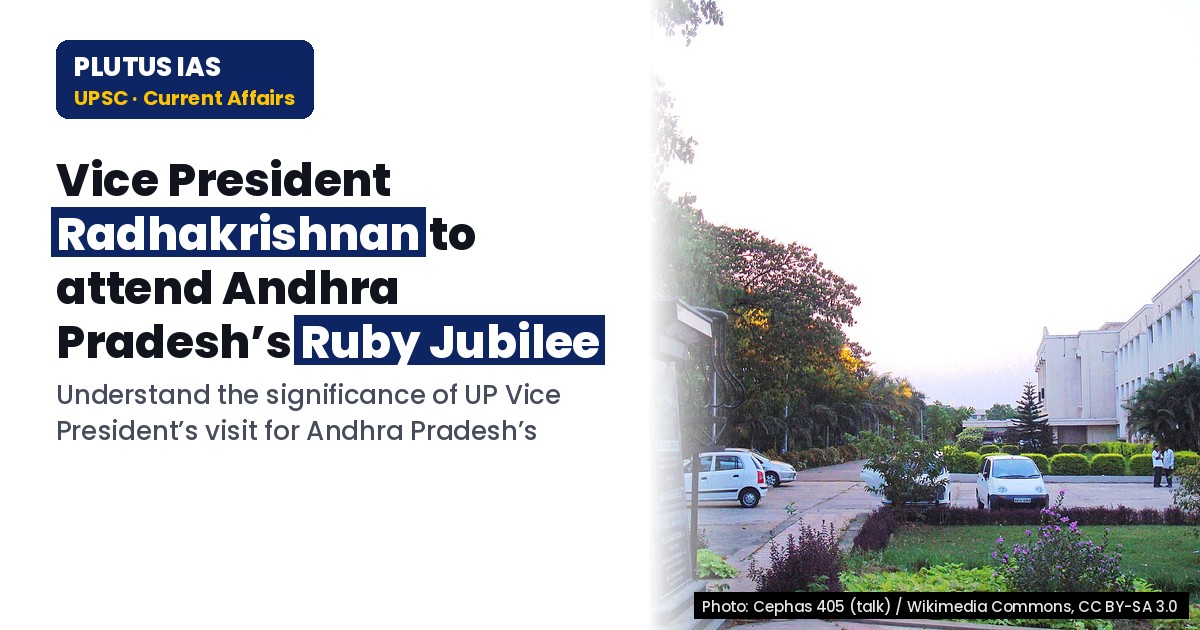
25 Oct UP Vice President to attend Andhra Pradesh’s Ruby Jubilee event
✎ The Vice-President of India is the ex-officio Chairman of the Rajya Sabha and serves as a constitutional link between the Union and the States, with responsibilities extending to parliamentary duties, institutional engagements…
Subject Relevance — Where This Topic Fits
- GS Paper II — Polity and Governance: Role and Functions of the Vice-President of India | GS Paper II — Constitutional and Statutory Bodies
- Prelims: Vice-President of India, Article 63, Article 64, Rajya Sabha Chairmanship, Protocol and State Visits, Tirupati Balaji Temple, Dr. NTR University of Health Sciences
- Essay: The significance of constitutional offices in strengthening federalism and inter-state relations, The role of cultural and religious institutions in national integration
Quick Revision: The Vice-President of India is the ex-officio Chairman of the Rajya Sabha and serves as a constitutional link between the Union and the States, with responsibilities extending to parliamentary duties, institutional engagements, and national integration.
Why is this in the news?
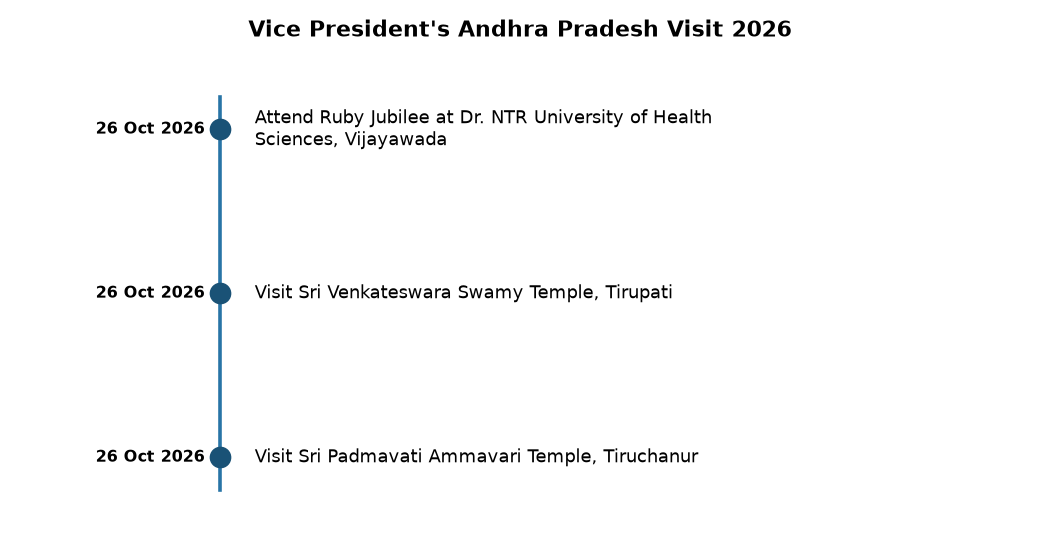
The Vice-President of India, Shri C.P. Radhakrishnan, will undertake a two-day visit to Andhra Pradesh on 26–27 October 2026. The visit is noteworthy as it includes participation in the Ruby Jubilee (40th anniversary) celebrations of Dr. NTR University of Health Sciences in Vijayawada and visits to the Sri Venkateswara Swamy Temple in Tirupati and Sri Padmavati Ammavari Temple in Tiruchanur. Such visits underscore the constitutional and symbolic functions of the Vice-President as the ex-officio Chairman of the Rajya Sabha and a key institutional link between the Union and the States.
Background
- The Vice-President of India is the second-highest constitutional authority, serving as the ex-officio Chairman of the Rajya Sabha, which ensures continuity in parliamentary proceedings and represents the federal structure of the Union Parliament.
- Dr. NTR University of Health Sciences, Vijayawada, was established in 1986 and is a prominent institution in the field of medical education and research in Andhra Pradesh, named after the former Chief Minister of the state, Dr. N.T. Rama Rao.
- Sri Venkateswara Swamy Temple in Tirupati is one of the most visited pilgrimage centres in India and is managed by the Tirumala Tirupati Devasthanams (TTD), a statutory body under the Andhra Pradesh government.
- Sri Padmavati Ammavari Temple in Tiruchanur is a significant Vaishnavite shrine dedicated to Goddess Padmavati, consort of Lord Venkateswara, and is also administered by the TTD.
- The Vice-President’s visits to religious and cultural institutions are part of the constitutional practice of promoting national integration and acknowledging the diversity of India’s spiritual and cultural heritage.
Constitutional and Institutional Framework of the Vice-President’s Role
- The Vice-President of India is elected by an electoral college consisting of members of both Houses of Parliament, in accordance with Article 66 of the Constitution.
- Article 63 of the Constitution states that there shall be a Vice-President of India, who serves as the ex-officio Chairman of the Rajya Sabha, ensuring the smooth functioning of the Upper House of Parliament.
- As Chairman of the Rajya Sabha, the Vice-President presides over its sittings, maintains order, and ensures adherence to the rules of procedure, thereby upholding the dignity and decorum of the House.
- The Vice-President also acts as the President of India in the event of the latter’s absence, resignation, or inability to discharge duties, as stipulated under Article 65 of the Constitution.
- The Vice-President’s role extends beyond parliamentary duties to include representing India in international forums and undertaking state visits to foster inter-state and inter-institutional cooperation.
- Visits to educational institutions, such as Dr. NTR University of Health Sciences, highlight the Vice-President’s engagement with academic and research institutions, thereby promoting the development of human resources in critical sectors.
- Religious and cultural visits, such as those to the Sri Venkateswara Swamy Temple and Sri Padmavati Ammavari Temple, reflect the constitutional ethos of secularism while acknowledging the cultural and spiritual fabric of the nation.
- The Vice-President’s participation in state-level events, such as the Ruby Jubilee celebrations of a university, underscores the importance of federal cooperation in governance and the celebration of institutional milestones.
Key Features
| Feature | Significance |
|---|---|
| Official State Visit by Vice-President | Demonstrates constitutional role of the Vice-President as the ex-officio Chairman of the Rajya Sabha and representative of the Union Government in state functions. |
| Participation in University Ruby Jubilee Celebration | Highlights the Vice-President’s engagement with academic institutions, reinforcing the constitutional emphasis on education and research as state subjects under the Seventh Schedule. |
| Religious Observance at Tirupati and Tiruchanur Temples | Reflects the Vice-President’s role in upholding cultural and religious harmony, a directive principle under Article 51A (Fundamental Duties). |
| Multi-Day State Tour | Underscores the Vice-President’s constitutional function of fostering inter-state relations and national integration through official engagements. |
Why it Matters
Constitutional and Institutional
- The Vice-President’s participation in a state-level event underscores the federal structure of governance, where the Union and State Governments collaborate on matters of national importance such as health education.
- The event at Dr. NTR University of Health Sciences aligns with the constitutional mandate under Article 41 (Directive Principles of State Policy) to improve public health infrastructure.
- Religious observances during official tours highlight the secular ethos of the Indian Constitution, balancing personal faith with constitutional duties.
Administrative and Governance
- The Vice-President’s presence at a university’s ruby jubilee provides an opportunity for interaction with academic stakeholders, reinforcing the role of higher education in national development.
- Such engagements facilitate dialogue between central institutions and state authorities, ensuring alignment with national policies on education and health.
Cultural and Social
- Visits to Tirupati and Tiruchanur temples symbolize respect for India’s pluralistic religious traditions and the constitutional guarantee of religious freedom under Article 25-28.
- The tour demonstrates the Vice-President’s role in promoting social cohesion and cultural unity, a key aspect of India’s soft power diplomacy.
Challenges
1. Ensuring Constitutional Balance in Religious Engagements
- Balancing official duties with religious observances requires adherence to the principle of secularism enshrined in the Preamble and Articles 25-28 of the Constitution.
- Ensuring that such engagements do not compromise the impartiality of constitutional offices.
UPSC Link: Preamble, Articles 25-28
2. Federal Coordination in Health Education
- Coordinating between central and state authorities to align health education policies with national health goals, such as the National Health Policy 2017.
- Addressing disparities in health infrastructure across states.
UPSC Link: Seventh Schedule, Article 41
3. Maintaining Protocol and Security During State Visits
- Ensuring seamless logistical arrangements for high-profile constitutional dignitaries.
- Balancing public engagement with security protocols.
UPSC Link: Constitution of India, Part V
Challenges — UPSC Perspective
| Issue | Concern |
|---|---|
| Secularism in Official Engagements | Ensuring religious observances do not infringe upon the constitutional principle of secularism. |
| Inter-State Health Infrastructure Gaps | Addressing disparities in health education and service delivery between states. |
| Logistical and Security Constraints | Managing protocol and security during multi-state tours. |
| Alignment of State and Central Policies | Ensuring state-level initiatives align with national health and education goals. |
Way Forward
- The Vice-President’s office should issue guidelines for constitutional dignitaries to balance official duties with cultural and religious engagements, ensuring adherence to secular principles.
- State governments should leverage such high-profile visits to expedite infrastructure development in health and education sectors.
- Academic institutions hosting such events should use the platform to showcase research and innovation in health sciences.
- Security agencies must streamline protocols for multi-location tours to ensure safety without compromising public interaction.
- The Union Government should facilitate inter-state coordination to align state-level health education policies with national frameworks.
- Constitutional literacy programs should be initiated in universities to educate students on the role of constitutional offices in governance.
- Media coverage of such events should emphasize the constitutional and governance aspects rather than political narratives.
UPSC Value Addition
Keywords for Mains Answer-Writing
Vice-President of India · constitutional position of Vice-President · Dr. NTR University of Health Sciences · Ruby Jubilee celebrations · institutional visits by constitutional authorities · religious and cultural sites of Andhra Pradesh · role of constitutional posts in public engagement · federal structure and inter-state relations · cultural diplomacy through constitutional offices · public institutions and their significance in governance
Constitutional & Policy Linkages
- Article 64: The Vice-President as ex-officio Chairman of the Rajya Sabha.
- Article 65: Duties of the Vice-President in the absence of the President.
- Article 25: Freedom of conscience and free profession, practice, and propagation of religion.
- Article 26: Freedom to manage religious affairs.
- Article 28: Freedom from attending religious instruction or worship in certain educational institutions.
Concept Flow
Constitutional role of Vice-President → Engagement in state functions → Reinforcement of federal structure → Promotion of health education and cultural harmony. → Vice-President’s official visit → Participation in university event → Alignment with national health education policies → Addressing inter-state disparities. → Religious observances during tour → Upholding secular principles → Balancing constitutional duties with cultural practices → Promoting social cohesion. → State visit logistics → Ensuring security and protocol → Facilitating seamless governance → Strengthening inter-state relations. → Academic engagement → Showcasing research and innovation → Enhancing health sciences education → Contributing to national development.
Prelims Practice Questions
Q1. Consider the following statements regarding the constitutional position of the Vice-President of India:
1. The Vice-President is the ex-officio Chairman of the Rajya Sabha.
2. The Vice-President is elected by an electoral college consisting of members of both Houses of Parliament.
3. The Vice-President holds office for a term of five years.
4. The Vice-President can be removed from office by a resolution of the Lok Sabha.
How many of the above statements are correct?
- Only one
- Only two
- Only three
- All
Answer: Only three — Statements 1 and 2 are correct. The Vice-President is the ex-officio Chairman of the Rajya Sabha and is elected by an electoral college consisting of members of both Houses of Parliament. Statement 3 is incorrect as the term of office is five years, but it is not fixed and can be terminated earlier by resignation or removal. Statement 4 is incorrect as the Vice-President can be removed by a resolution of the Rajya Sabha, not the Lok Sabha.
Q2. Assertion (A): The Vice-President of India is elected by an electoral college comprising only the elected members of both Houses of Parliament.
Reason (R): The Vice-President’s election process is designed to ensure representation from both the Lok Sabha and the Rajya Sabha.
In the context of the above two statements, which one of the following is correct?
- Both A and R are true, and R is the correct explanation of A.
- Both A and R are true, but R is not the correct explanation of A.
- A is true, but R is false.
- A is false, but R is true.
Answer: A is true, but R is false. — Assertion (A) is false because the Vice-President is elected by an electoral college consisting of both elected and nominated members of both Houses of Parliament. Reason (R) is true as the election process is designed to ensure representation from both Houses, but it does not correctly explain the assertion.
Q3. Match the following constitutional posts with their respective ex-officio roles:
Column I (Constitutional Post) | Column II (Ex-officio Role)
1. President of India | A. Chairman of the Rajya Sabha
2. Vice-President of India | B. Supreme Commander of the Armed Forces
3. Prime Minister of India | C. Leader of the Opposition in the Lok Sabha
4. Speaker of the Lok Sabha | D. Head of the Council of Ministers
Select the correct match:
- 1-B, 2-A, 3-D, 4-C
- 1-A, 2-B, 3-C, 4-D
- 1-D, 2-A, 3-B, 4-C
- 1-B, 2-D, 3-A, 4-C
Answer: 1-B, 2-A, 3-D, 4-C — The correct matches are: 1-B (President of India is the Supreme Commander of the Armed Forces), 2-A (Vice-President of India is the ex-officio Chairman of the Rajya Sabha), 3-D (Prime Minister of India is the Head of the Council of Ministers), and 4-C (Speaker of the Lok Sabha is the Leader of the Opposition in the Lok Sabha).
Mains Practice Question
✍ The Vice-President of India serves as a bridge between the executive and the legislature, while also acting as the ex-officio Chairman of the Rajya Sabha. In light of the Vice-President’s recent visit to Andhra Pradesh for the Ruby Jubilee celebrations of Dr. NTR University of Health Sciences and participation in religious ceremonies at Tirupati and Tiruchanoor, critically examine the role of constitutional posts in fostering public engagement and institutional outreach. (15 Marks)
Approach: MODEL-ANSWER SKELETON:
1. **Constitutional Position and Role of the Vice-President**:
– Examine the constitutional provisions governing the Vice-President’s office (Articles 63, 64, 65, and 66 of the Constitution of India).
– Highlight the dual role as ex-officio Chairman of the Rajya Sabha and constitutional authority.
– Discuss the significance of the Vice-President’s role in maintaining the balance between the executive and legislature.
2. **Public Engagement and Institutional Outreach**:
– Analyse the purpose of institutional visits by constitutional authorities: fostering inter-state relations, promoting cultural diplomacy, and enhancing the visibility of public institutions.
– Discuss the role of the Vice-President’s participation in the Ruby Jubilee celebrations of Dr. NTR University of Health Sciences as an example of institutional outreach.
– Examine the symbolic and practical significance of visiting religious and cultural sites (e.g., Sri Venkateswara Swamy Temple and Sri Padmavati Ammavari Temple) in the context of constitutional neutrality and cultural diplomacy.
3. **Federal Structure and Inter-State Relations**:
– Discuss how such visits strengthen the federal structure by promoting cooperation between the Union and state governments.
– Highlight the role of constitutional posts in addressing regional aspirations and fostering national integration.
4. **Critique and Challenges**:
– Critically evaluate the limitations of constitutional posts in public engagement, including potential perceptions of partisan influence or overreach.
– Discuss the balance between constitutional neutrality and the symbolic role of constitutional authorities in cultural and religious contexts.
5. **Conclusion**:
– Summarise the importance of institutional outreach by constitutional posts in enhancing governance, cultural diplomacy, and national integration.
Source: PIB (Press Information Bureau)
Andhra Pradesh PCS (APPSC) — State PCS Practice
Prelims: Which of the following is NOT a primary objective of Vice President C.P. Radhakrishnan’s upcoming visit to Andhra Pradesh on October 26-27?
- A. Inauguration of a new educational institution in Visakhapatnam
- B. Reviewing the implementation of the Andhra Pradesh Reorganisation Act, 2014
- C. Addressing a joint session of the Andhra Pradesh Legislative Assembly
- D. Launching a state-wide digital literacy campaign
Answer: D. Launching a state-wide digital literacy campaign — The visit is focused on educational and developmental initiatives, not a digital literacy campaign.
Mains: Discuss the significance of Vice President C.P. Radhakrishnan’s visit to Andhra Pradesh in the context of the state’s post-bifurcation development challenges and opportunities. (150 words)
Generated by AanyaAi for educational purpose.
Related guides on our sites

- UP Vice President to attend Andhra Pradesh’s Ruby Jubilee event - October 25, 2026
- मोदी सरकार का बड़ा ड्रग्स विरोधी अभियान: ऑपरेशन ट्राइडेंट से 18 गिरफ्तार - October 25, 2026
- National Urban Conference 2026: Odisha’s Bhubaneswar Hosts Key Urban Development Summit - October 25, 2026

No Comments