


25 Oct UP’s New Age Verification Rules to Curb POCSO Act Misuse
✎ The Allahabad High Court’s intervention highlights the need for standardised age verification in school admissions to prevent POCSO Act misuse, with Uttar Pradesh proposing mandatory documentary evidence under the RTE framework.
Subject Relevance — Where This Topic Fits
- GS Paper II — Judiciary and Constitutional Framework | GS Paper III — Government Policies and Interventions for Development in Various Sectors
- Prelims: Protection of Children from Sexual Offences (POCSO) Act, 2012, Right of Children to Free and Compulsory Education (RTE) Act, 2009, Uttar Pradesh Right of Children to Free and Compulsory Education Rules, 2011, Allahabad High Court, Age certification in school admissions
- Essay: Judicial activism in safeguarding constitutional rights of children, Balancing child protection and procedural justice in legal frameworks
Quick Revision: The Allahabad High Court’s intervention highlights the need for standardised age verification in school admissions to prevent POCSO Act misuse, with Uttar Pradesh proposing mandatory documentary evidence under the RTE framework.
Why is this in the news?
The Allahabad High Court, while hearing a bail application in a POCSO case, observed instances where falsified age certificates led to the misuse of the POCSO Act, implicating individuals aged 19–20 years in cases meant for minors. In response, the Uttar Pradesh government proposed guidelines mandating specific documents for age verification at school admissions to prevent such misuse, submitting these to the court for finalisation after inter-departmental consultations.
Background
- The Protection of Children from Sexual Offences (POCSO) Act, 2012, defines a child as an individual below 18 years of age, with stringent provisions to protect minors from sexual offences.
- The RTE Act, 2009, guarantees free and compulsory education to children aged 6–14 years, necessitating accurate age documentation for admission.
- Rule 9 of the Uttar Pradesh RTE Rules, 2011, outlines the procedure for age verification during school admissions, though enforcement has been inconsistent.
- Judicial observations in POCSO cases have highlighted systemic gaps in age certification, leading to wrongful prosecutions and erosion of public trust in legal institutions.
- The proposed guidelines aim to standardise age verification processes across schools in Uttar Pradesh, aligning with constitutional and statutory obligations.
- Inter-departmental consultations, including the Department of Law, reflect the need for a coordinated approach to address procedural deficiencies.
What are the proposed guidelines for age verification in school admissions in Uttar Pradesh?
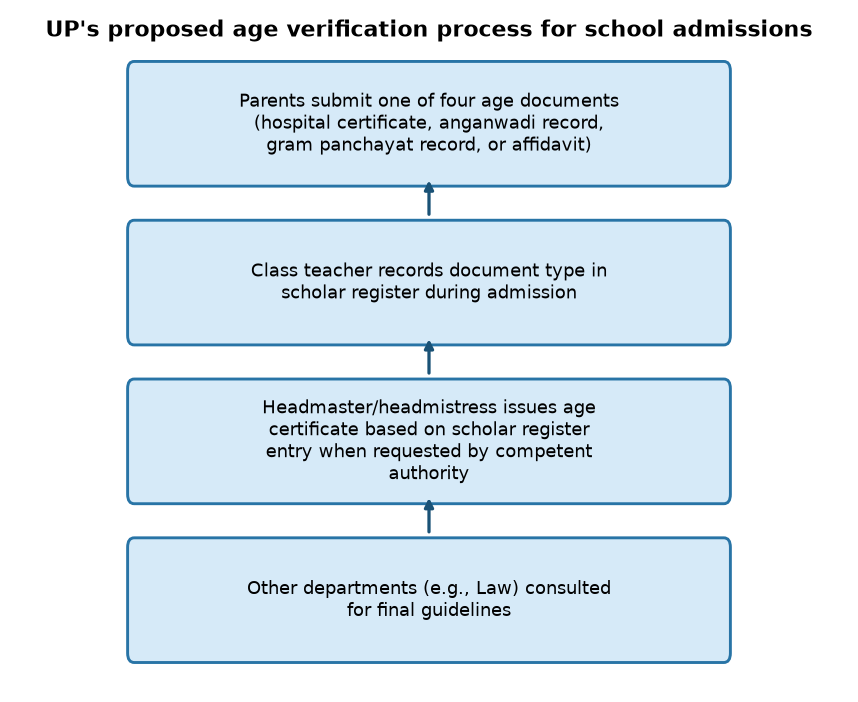
- The guidelines require parents to submit one of four specified documents to establish a child’s age at the time of school admission: (a) a hospital/ANM/midwife-issued certificate, (b) Anganwadi centre records, (c) gram panchayat-maintained birth/death records, or (d) a parent’s affidavit in the absence of other documents.
- During admission, the class teacher must enter the submitted document type in the scholar register, ensuring a verifiable record of age certification.
- School heads (headmasters/headmistresses) are mandated to issue age certificates in a prescribed format based on the scholar register entry, ensuring consistency and accountability.
- The guidelines aim to prevent the misuse of the POCSO Act by ensuring accurate age documentation, thereby reducing wrongful prosecutions of individuals falsely implicated due to incorrect age claims.
- The framework is designed to align with Rule 9 of the Uttar Pradesh RTE Rules, 2011, which governs age verification in admissions.
- Inter-departmental consultations, including the Department of Law, are underway to finalise the guidelines, ensuring legal robustness and procedural clarity.
- The Allahabad High Court has directed all relevant departments to cooperate in the formulation and implementation of these guidelines to enhance transparency and compliance.
- The initiative underscores the judiciary’s role in addressing systemic gaps in governance and reinforcing the rule of law in child protection mechanisms.
Key Features
| Feature | Significance |
|---|---|
| Proposed age-verification documents | Ensures authenticity of a child’s age at school admission, reducing the scope for fraudulent age certificates that could lead to misuse of the POCSO Act. |
| Scholar register entry by class teacher | Creates a verifiable record of the submitted document at the time of admission, enabling traceability and accountability. |
| Headmaster/Headmistress issuance of age certificate | Standardises the process of issuing age certificates based on pre-verified records, ensuring consistency across schools. |
| Inter-departmental consultation (Basic Education, Law) | Facilitates a coordinated approach to address legal and procedural gaps in age verification and POCSO Act implementation. |
| Judicial oversight by Allahabad High Court | Provides a mechanism for judicial review of age-verification practices, ensuring compliance with constitutional and statutory provisions. |
Why it Matters
Judicial and Legal
- The Allahabad High Court’s intervention highlights the judiciary’s role in safeguarding the integrity of age verification processes to prevent misuse of the POCSO Act.
- The proposed guidelines align with the court’s observations on the need for stricter procedural compliance to avoid false implications under the Act.
- The emphasis on documentary evidence reduces reliance on affidavits, which are prone to manipulation, thereby strengthening legal safeguards.
Administrative and Governance
- The initiative demonstrates a proactive approach by the Uttar Pradesh government to address systemic gaps in school admission processes.
- Standardising age verification across schools ensures uniformity in compliance with the Right of Children to Free and Compulsory Education (RTE) Act, 2009.
- The requirement for inter-departmental consultation ensures a holistic solution that integrates legal, educational, and administrative perspectives.
Social and Child Protection
- Preventing false age certificates helps protect genuine victims of child abuse by reducing the dilution of POCSO Act’s intent through frivolous cases.
- Ensuring accurate age records at the time of school admission supports the implementation of child-centric policies under the RTE Act.
- The measure indirectly reinforces the protection of minors by reducing opportunities for exploitation through falsified documentation.
Challenges
1. Documentary Fraud and Verification Gaps
- The reliance on documents such as hospital certificates or gram panchayat records may still be susceptible to forgery or inaccuracies, necessitating robust verification mechanisms.
- The absence of a centralised national database for age verification complicates cross-state validation of records, particularly for migrant children.
- Affidavits, though included as a last resort, remain vulnerable to misuse due to their self-declaratory nature, requiring additional safeguards.
UPSC Link: GS-II: Social Justice – Vulnerable Sections
2. Implementation and Compliance Burden
- The requirement for schools to maintain detailed records and issue age certificates may impose administrative and logistical burdens, particularly in resource-constrained settings.
- Ensuring uniform compliance across all schools, including private and unaided institutions, poses a significant challenge for state authorities.
- The need for inter-departmental coordination may lead to delays in finalising and implementing the guidelines uniformly.
UPSC Link: GS-II: Governance – Institutional Mechanisms
3. Balancing Child Protection and Due Process
- Strict age verification must not inadvertently exclude genuine cases of children who lack formal documentation, particularly those from marginalised communities.
- The process must avoid creating barriers to education for children who may face difficulties in obtaining age-proof documents due to systemic or socio-economic constraints.
- Judicial and administrative safeguards are required to ensure that age verification does not become an instrument of exclusion or discrimination.
UPSC Link: GS-II: Fundamental Rights – Right to Education
4. Judicial Activism vs. Executive Autonomy
- The Allahabad High Court’s proactive stance raises questions about the balance between judicial oversight and executive autonomy in policy formulation.
- While judicial intervention can catalyse reform, it may also risk overreach if not aligned with legislative and executive frameworks.
- The case underscores the need for clear demarcation between judicial review and policy implementation to avoid conflicts in governance.
UPSC Link: GS-II: Judiciary – Judicial Review
Challenges — UPSC Perspective
| Issue | Concern |
|---|---|
| Forgery of age documents | Potential for manipulation of records despite documentary requirements. |
| Lack of centralised verification system | Difficulty in validating records across states, especially for migrant children. |
| Administrative burden on schools | Increased workload for teachers and headmasters in maintaining and verifying records. |
| Exclusion of undocumented children | Risk of denying education to children without formal age-proof documents. |
| Inter-departmental delays | Possible bottlenecks in finalising guidelines due to multi-stakeholder consultations. |
Way Forward
- Finalise and notify the age-verification guidelines after incorporating feedback from all stakeholders, including schools, parents, and legal experts.
- Develop a standardised format for scholar registers and age certificates to ensure uniformity across all educational institutions in Uttar Pradesh.
- Establish a digital verification system to cross-check age records with existing databases, such as the Civil Registration System (CRS) or Aadhaar, where feasible.
- Conduct capacity-building programmes for school authorities to ensure proper implementation of the guidelines and awareness among parents.
- Introduce periodic audits of school records to verify compliance and identify systemic gaps in age verification.
- Collaborate with the Union Ministry of Education to explore the feasibility of a pan-India digital age-verification system under the RTE framework.
- Ensure grievance redressal mechanisms are in place for parents and schools to address disputes or errors in age verification.
- Monitor the impact of the guidelines on POCSO Act cases to assess their effectiveness in reducing false implications while safeguarding genuine victims.
UPSC Value Addition
Keywords for Mains Answer-Writing
Protection of Children from Sexual Offences Act, 2012 · POCSO Act misuse · Age verification in school admissions · Right of Children to Free and Compulsory Education Act, 2009 · Uttar Pradesh Right of Children to Free and Compulsory Education Rules, 2011 · Allahabad High Court directives on age certification · Juvenile Justice (Care and Protection of Children) Act, 2015 · Birth and age certification mechanisms in India · Judicial oversight of executive actions · Inter-departmental coordination in governance · Rule of law and procedural safeguards · Balancing child protection and legal justice
Constitutional & Policy Linkages
- [‘Article 21A – Right to Education’, ‘Guarantees free and compulsory education for children aged 6-14, necessitating accurate age records.’]
- [‘Article 14 – Equality before Law’, ‘Ensures non-discriminatory implementation of age verification processes across all social groups.’]
- [‘Article 15(3) – Special Provisions for Children’, ‘Permits affirmative action to protect children from exploitation and abuse.’]
Concept Flow
Supreme Court’s interpretation of POCSO Act (2012) and its strict provisions for child protection. → Allahabad High Court’s observation of misuse of POCSO Act via false age certificates in bail applications. → Judicial directive to Uttar Pradesh government to formulate age-verification guidelines for school admissions. → Proposal of documentary requirements (hospital records, anganwadi records, etc.) and scholar register entries. → Inter-departmental consultation to finalise guidelines and ensure legal and administrative alignment. → Implementation of standardised age-verification processes across schools in Uttar Pradesh. → Judicial and administrative review to assess effectiveness and address emerging challenges.
Prelims Practice Questions
Q1. Consider the following statements regarding the Protection of Children from Sexual Offences (POCSO) Act, 2012:
1. The Act defines a child as a person below the age of 18 years.
2. The Act mandates the establishment of Special Courts for the trial of offences under it.
3. The Act allows for the death penalty in cases of aggravated penetrative sexual assault.
4. The Act requires mandatory reporting of offences by any person who has knowledge of such offences.
How many of the above statements are correct?
- Only one
- Only two
- Only three
- All
Answer: All — Statements 1, 2, and 4 are correct. Statement 3 is incorrect as the Act prescribes life imprisonment for aggravated penetrative sexual assault, not the death penalty.
Q2. Assertion (A): The Right of Children to Free and Compulsory Education (RTE) Act, 2009, mandates that no child shall be subjected to physical punishment or mental harassment.
Reason (R): The RTE Act, 2009, aims to provide a child-friendly learning environment and prohibits any form of corporal punishment in schools.
Options:
A. Both A and R are true, and R is the correct explanation of A.
B. Both A and R are true, but R is not the correct explanation of A.
C. A is true, but R is false.
D. A is false, but R is true.
Answer: ? — Both Assertion (A) and Reason (R) are true, and R correctly explains A as the RTE Act explicitly prohibits physical punishment and mental harassment to ensure a child-friendly environment.
Q3. Match the following pairs related to age certification and child protection laws in India:
Column I
1. POCSO Act, 2012
2. RTE Act, 2009
3. Juvenile Justice Act, 2015
4. Birth and Death Registration Act, 1969
Column II
A. Mandates age verification for school admissions
B. Defines age of majority for criminal liability
C. Protects children from sexual offences
D. Requires mandatory registration of births and deaths
Options:
1. 1-C, 2-A, 3-B, 4-D
2. 1-A, 2-C, 3-D, 4-B
3. 1-B, 2-D, 3-A, 4-C
4. 1-D, 2-B, 3-C, 4-A
Answer: ? — Correct matches are: 1-C (POCSO Act protects children from sexual offences), 2-A (RTE Act mandates age verification for school admissions), 3-B (Juvenile Justice Act defines age of majority for criminal liability), 4-D (Birth and Death Registration Act requires mandatory registration of births and deaths).
Mains Practice Question
✍ The Allahabad High Court has recently flagged the misuse of the Protection of Children from Sexual Offences (POCSO) Act, 2012, through the submission of false age certificates by individuals aged 19 to 20 years. In this context, critically examine the challenges in age verification for school admissions in India and evaluate the proposed guidelines by the Uttar Pradesh government to address these issues. (15 Marks)
Approach: MODEL-ANSWER SKELETON:
1. **Introduction (2 Marks)**: Briefly outline the POCSO Act, 2012, its objectives, and the issue of false age certificates leading to misuse.
2. **Challenges in Age Verification (5 Marks)**:
– Discuss systemic issues: lack of standardized birth registration, prevalence of affidavits as age proof, and regional disparities in documentation.
– Highlight judicial observations (e.g., Allahabad High Court’s concerns) and the need for procedural safeguards.
– Reference the Right of Children to Free and Compulsory Education (RTE) Act, 2009, and its Rule 9 (Uttar Pradesh Rules, 2011) mandating age verification.
3. **Proposed Guidelines by Uttar Pradesh (5 Marks)**:
– Detail the four documents proposed for age verification (hospital/midwife certificate, anganwadi record, gram panchayat record, parent affidavit).
– Explain the procedural mechanism: entry in scholar register, issuance of age certificates by schools, and inter-departmental coordination.
– Assess the effectiveness of these measures in balancing child protection and legal justice.
4. **Critical Evaluation and Way Forward (3 Marks)**:
– Discuss potential limitations (e.g., affidavits as primary proof, lack of universal birth registration).
– Suggest reforms: universal birth registration under the Registration of Births and Deaths Act, 1969, and digital integration of records.
– Conclude with the importance of multi-stakeholder collaboration (education, law, local governance) to ensure robust age verification.
Source: The Indian Express
Uttar Pradesh PCS (UPPSC) — State PCS Practice
Prelims: The Allahabad High Court recently flagged misuse of the POCSO Act in Uttar Pradesh, leading to proposals for stricter verification of children’s age records. Which of the following BEST aligns with the administrative intent behind this proposal?
- A. To prevent false cases under the POCSO Act by ensuring accurate age verification of victims.
- B. To expedite trials in POCSO cases by reducing the burden on courts through stricter age verification.
- C. To enhance protection for children by mandating age verification for all welfare schemes under the UP government.
- D. To align UP’s legal framework with the Juvenile Justice Act by prioritizing age verification in adoption cases.
Answer: A. To prevent false cases under the POCSO Act by ensuring accurate age verification of victims. — The proposal aims to curb false cases under the POCSO Act by ensuring accurate age verification of victims, reducing misuse of the stringent provisions.
Mains: Discuss the administrative and legal challenges faced by the Uttar Pradesh government in verifying children’s age records under the POCSO Act. Suggest measures to strengthen the verification process while ensuring justice for genuine victims. (UP-specific context required)
Generated by AanyaAi for educational purpose.
Related guides on our sites
- Anthropology VS PSIR
- Best PSIR optional coaching
- Best PSIR optional coaching online
- Best PSIR optional teacher

- UP’s New Age Verification Rules to Curb POCSO Act Misuse - October 25, 2026
- ब्रिक्स संसदीय मंच का 12वाँ सत्र कल शुरू होगा: प्रमुख बिंदु - October 25, 2026
- UPSC Alert: Chhattisgarh hikes wildlife attack compensation to ₹12 lakh - October 25, 2026

No Comments