


11 Aug UPSC 2026: Strengthening SC Students’ Access to Foreign Scholarships
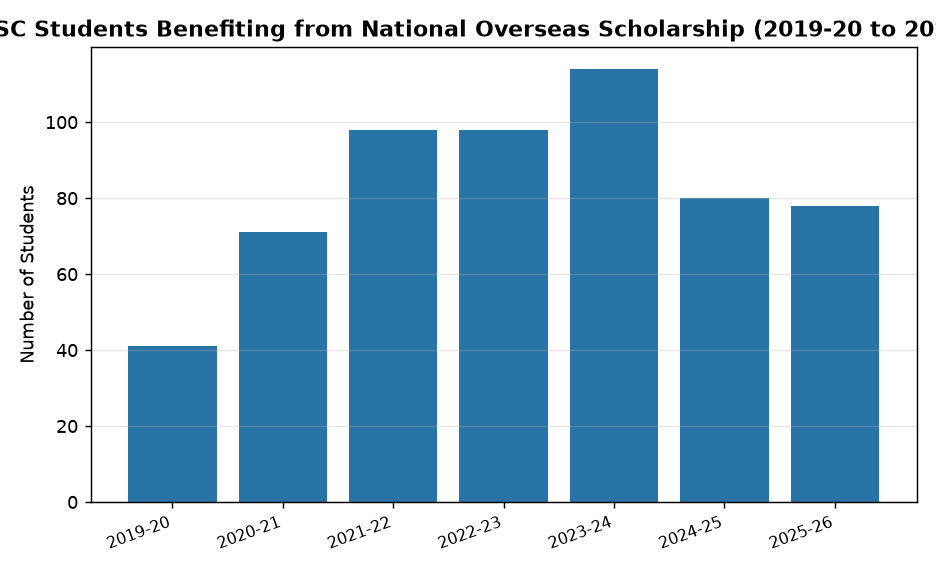
✎ The National Overseas Scholarship (NOS) scheme is a flagship initiative by the Ministry of Social Justice and Empowerment to enable Scheduled Caste students to pursue higher education abroad, with 580 beneficiaries recorded…
Subject Relevance — Where This Topic Fits
- GS Paper II — Welfare Schemes for Vulnerable Sections of the Population and Issues Relating to Development and Management of Social Sector/Services | GS Paper II — International Relations (Scholarships for Higher Education Abroad)
- Prelims: National Overseas Scholarship (NOS), Scheduled Castes (SCs), Social Justice and Empowerment Ministry, Integrated Empowerment (Sashaktikaran) Portal, Foreign Education Loans, Higher Education Abroad, Digital Governance in Scholarships
- Essay: Equitable Access to Education: Bridging the Divide for Marginalised Communities, Digital Public Infrastructure and Inclusive Governance: Transforming Welfare Delivery
Quick Revision: The National Overseas Scholarship (NOS) scheme is a flagship initiative by the Ministry of Social Justice and Empowerment to enable Scheduled Caste students to pursue higher education abroad, with 580 beneficiaries recorded between 2019–20 and 2025–26, facilitated through digital governance and multi-stakeholder coordination.
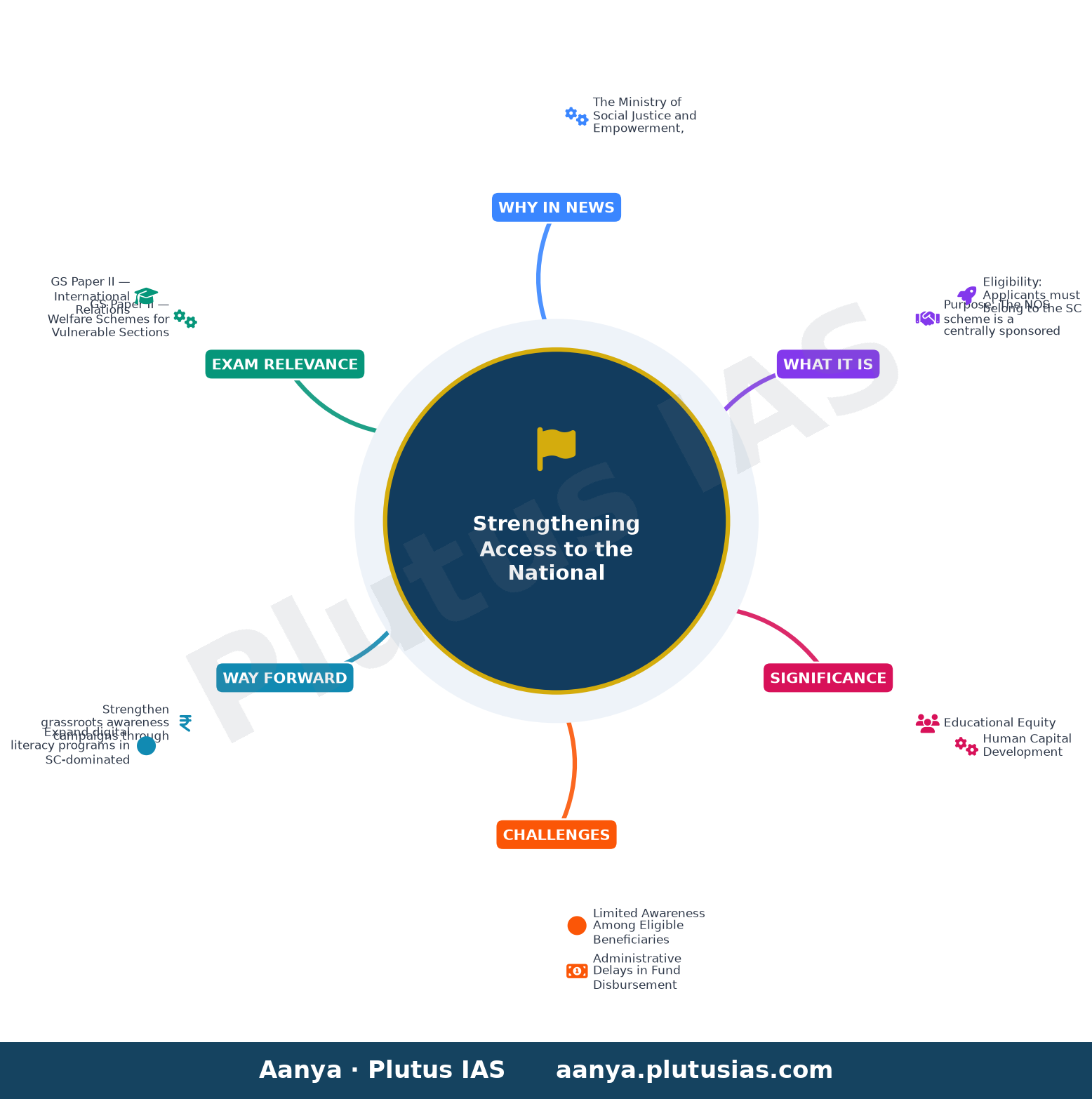
Why is this in the news?
The Ministry of Social Justice and Empowerment, Government of India, has reported that under the National Overseas Scholarship (NOS) scheme for Scheduled Caste (SC) students, a total of 580 beneficiaries were provided scholarship and admitted abroad between 2019–20 and 2025–26. This development highlights the government’s efforts to enhance accessibility, streamline processes, and expand outreach for marginalised students seeking higher education opportunities overseas, while also underscoring the role of digital governance in welfare delivery.
Background
- The National Overseas Scholarship (NOS) scheme was established to provide financial assistance to meritorious SC students for pursuing master’s and PhD programmes in foreign universities, thereby promoting educational equity and global exposure.
- The scheme is implemented by the Ministry of Social Justice and Empowerment.
- Historically, SC students have faced systemic barriers in accessing higher education abroad due to financial constraints and lack of awareness, necessitating targeted interventions like the NOS.
- The scheme aligns with constitutional provisions under Articles 15(4) and 46, which mandate the state to promote educational and economic interests of weaker sections of society.
- Over the years, the NOS has evolved to incorporate digital tools for application, monitoring, and fund disbursement, reflecting broader trends in e-governance and inclusive policy design.
- State-level implementation involves coordination with state welfare departments, Indian missions abroad, and educational institutions to ensure seamless execution.
What is the National Overseas Scholarship (NOS) Scheme?
- Purpose: The NOS scheme is a centrally sponsored initiative designed to provide financial support to Scheduled Caste (SC) students for pursuing master’s and PhD programmes in top-ranked foreign universities.
- Eligibility: Applicants must belong to the SC category, meet specified academic merit criteria, and secure admission to a recognised foreign university for a full-time course.
- Financial Assistance: The scholarship covers tuition fees, maintenance allowance, contingency allowance, and airfare, subject to annual ceilings and government norms.
- Scope: The scheme is open for studies in all disciplines, with priority often given to fields aligned with national development priorities such as science, technology, engineering, and medicine.
- Selection Process: Applications are scrutinised based on academic performance, financial need, and adherence to eligibility criteria. Shortlisted candidates undergo a rigorous evaluation before final selection.
- Implementation Mechanism: The scheme operates through a multi-stakeholder framework involving the Ministry of Social Justice and Empowerment, Indian missions abroad, state welfare departments, and designated portals for digital governance.
- Monitoring and Evaluation: Progress is tracked through the Integrated Inclusion (Single Access Mechanism for all areas of Empowerment and Social Harmony) Portal, which streamlines application processing, fund disbursement, and beneficiary management.
- Awareness and Outreach: The government employs multi-channel strategies, including newspaper advertisements, departmental websites, and state-level coordination, to enhance awareness among potential beneficiaries.
Key Features
| Feature | Significance |
|---|---|
| Objective of the Scheme | Facilitates access to higher education abroad for Scheduled Caste (SC) students, aligning with constitutional provisions for educational equity (Article 15(4) and Article 46). |
| Digital Integration via e-Samavesh Portal | Streamlines application, scrutiny, and fund disbursement processes, reducing administrative delays and enhancing transparency. |
| Multi-Channel Awareness Campaigns | Utilizes departmental websites, newspaper advertisements, and coordination with state/UT welfare departments to improve outreach and inclusivity. |
| Advance Fund Release Mechanism | Ensures timely disbursement of scholarship funds through Indian Missions/Embassies, mitigating financial barriers for students. |
| State-Level Implementation Data (Andhra Pradesh) | Demonstrates targeted outreach in specific districts, highlighting the scheme’s adaptability to regional disparities in awareness and participation. |
Why it Matters
Educational Equity
- Promotes social justice by providing equitable opportunities for SC students to pursue foreign education, addressing historical educational disadvantages.
- Supports the Right to Education (RTE) Act’s spirit by extending educational opportunities beyond national boundaries.
- Contributes to reducing the urban-rural and inter-state disparities in access to global academic resources.
Human Capital Development
- Enhances the skill set of SC students, fostering a globally competitive workforce for India’s socio-economic growth.
- Encourages return migration and knowledge transfer, benefiting domestic sectors through diaspora engagement.
- Aligns with the National Education Policy (NEP) 2020’s emphasis on international exposure and research collaboration.
Administrative Efficiency
- Leverages digital governance (e-Samavesh) to minimize bureaucratic hurdles, ensuring timely scholarship disbursement and reducing leakages.
- Standardizes processes across states/UTs, ensuring uniformity in selection and disbursement criteria.
Regional Inclusivity
- Shows targeted implementation in states like Andhra Pradesh, demonstrating adaptability to local socio-economic conditions.
- Highlights the role of state welfare departments in bridging awareness gaps at the grassroots level.
Challenges
1. Limited Awareness Among Eligible Beneficiaries
- Despite multi-channel campaigns, awareness remains a critical bottleneck, especially in remote and marginalized communities.
- Language barriers and digital literacy gaps may hinder effective dissemination of scheme details.
UPSC Link: GS-II: Welfare schemes for vulnerable sections
2. Administrative Delays in Fund Disbursement
- Despite advance fund release mechanisms, delays in claim processing by universities or students can disrupt academic timelines.
- Coordination gaps between Indian Missions, universities, and students may lead to procedural inefficiencies.
UPSC Link: GS-II: Government policies and interventions
3. Regional Disparities in Participation
- States like Andhra Pradesh show lower participation compared to national averages, indicating uneven outreach.
- Urban-centric awareness campaigns may overlook rural SC students with limited access to information.
UPSC Link: GS-I: Regional disparities in development
4. Sustainability of Scholarship Coverage
- The scheme’s long-term viability depends on budgetary allocations and economic conditions, which may fluctuate.
- Increasing demand for foreign education may outpace available resources, necessitating periodic reviews.
UPSC Link: GS-III: Economic development and planning
5. Monitoring and Evaluation Gaps
- Lack of real-time tracking of beneficiaries post-disbursement limits assessment of long-term impact on career trajectories.
- Data silos between central and state agencies may hinder comprehensive impact analysis.
UPSC Link: GS-II: Governance and accountability
Challenges — UPSC Perspective
| Issue | Concern |
|---|---|
| Awareness Gaps | Limited reach in remote and rural SC communities due to language and digital literacy barriers. |
| Fund Disbursement Delays | Procedural inefficiencies in claim processing may disrupt academic timelines for students. |
| Regional Imbalance | Uneven participation across states, with some regions showing significantly lower uptake. |
| Resource Constraints | Potential mismatch between scholarship demand and available budgetary allocations. |
| Monitoring Deficits | Absence of robust post-disbursement tracking to evaluate scheme effectiveness. |
Government Initiatives — Must-Memorise for Prelims
- National Overseas Scholarship (NOS) for Scheduled Castes
Way Forward
- Strengthen grassroots awareness campaigns through local self-government institutions (Panchayati Raj) and community leaders.
- Expand digital literacy programs in SC-dominated districts to improve access to online application portals.
- Establish a real-time monitoring dashboard to track scholarship disbursement and beneficiary progress post-disbursement.
- Conduct periodic reviews of state-wise participation to identify and address regional disparities in outreach.
- Enhance coordination between Indian Missions, universities, and state welfare departments to streamline fund disbursement.
- Introduce a mentorship program pairing past beneficiaries with prospective applicants to demystify the application process.
- Explore public-private partnerships to augment scholarship funds and reduce dependency on central allocations.
- Publish annual impact assessment reports to evaluate the scheme’s contribution to SC students’ career trajectories.
UPSC Value Addition
Keywords for Mains Answer-Writing
Scheduled Castes · National Overseas Scholarship Scheme · Social Justice and Empowerment · Digital Governance · Inclusive Education · Affirmative Action · Foreign Education Access · Union Budget Allocation · E-Governance Initiatives · SC Sub-Plan · Higher Education Policy · Access to Opportunities
Constitutional & Policy Linkages
- Article 15(4): Special provisions for the advancement of socially and educationally backward classes.
- Article 46: Promotion of educational and economic interests of Scheduled Castes and Scheduled Tribes.
Concept Flow
Identification of educational disparities among SC students → Formulation of NOS scheme under Social Justice and Empowerment Ministry → Digital integration via e-Samavesh portal → Multi-channel awareness campaigns → State-level implementation and monitoring → Beneficiary selection and advance fund release → Academic admission abroad → Post-disbursement tracking and impact assessment.
Prelims Practice Questions
Q1. Consider the following statements regarding the National Overseas Scholarship (NOS) Scheme for Scheduled Castes:
1. The NOS Scheme is implemented by the Ministry of Education.
2. The scheme provides financial assistance to SC students for pursuing higher education abroad.
3. The scheme was launched in the year 2020.
4. Under the NOS Scheme, funds are released directly to the Indian Missions abroad for disbursement to students.
How many of the above statements are correct?
- Only one
- Only two
- Only three
- All four
Answer: Only three — Statements 2 and 4 are correct. Statement 1 is incorrect as the NOS Scheme is implemented by the Ministry of Social Justice and Empowerment. Statement 3 is incorrect as the scheme predates 2020.
Q2. Assertion (A): The National Overseas Scholarship Scheme for Scheduled Castes is a centrally sponsored scheme.
Reason (R): The scheme is funded entirely by the Central Government and implemented through State Governments and Union Territories.
In the context of the above two statements, which one of the following is correct?
- Both A and R are true, and R is the correct explanation of A
- Both A and R are true, but R is not the correct explanation of A
- A is true, but R is false
- A is false, but R is true
Answer: A is false, but R is true — Assertion (A) is true as the scheme is centrally sponsored. However, Reason (R) is false because the scheme is implemented directly by the Ministry of Social Justice and Empowerment, not through State Governments and Union Territories.
Q3. Match the following pairs related to the National Overseas Scholarship Scheme:
Column I (Feature) Column II (Description)
A. Eligibility Criteria 1. Must be below 35 years of age
B. Selection Process 2. Merit-cum-means basis
C. Scholarship Amount 3. Up to USD 15,000 per annum
D. Implementation Authority 4. Ministry of Social Justice and Empowerment
Select the correct match:
- A-1, B-2, C-3, D-4
- A-2, B-1, C-3, D-4
- A-1, B-3, C-2, D-4
- A-2, B-1, C-4, D-3
Answer: A-2, B-1, C-3, D-4 — The correct matches are: A-1 (Eligibility Criteria: Must be below 35 years of age), B-2 (Selection Process: Merit-cum-means basis), C-3 (Scholarship Amount: Up to USD 15,000 per annum), and D-4 (Implementation Authority: Ministry of Social Justice and Empowerment).
Mains Practice Question
✍ The National Overseas Scholarship (NOS) Scheme for Scheduled Castes represents a significant policy intervention to enhance access to global higher education for marginalised communities. Critically examine the scheme’s design, implementation challenges, and its role in promoting social justice in India. (15 Marks)
Approach: MODEL-ANSWER SKELETON:
1. **Introduction (2 marks)**
– Define the NOS Scheme: A centrally sponsored initiative under the Ministry of Social Justice and Empowerment, launched to provide financial assistance to SC students for pursuing higher education abroad.
– Objective: To bridge the educational divide and promote social mobility among SC communities.
2. **Design and Features (4 marks)**
– **Eligibility**: Age limit (below 35 years), income ceiling, and academic merit.
– **Scholarship Components**: Covers tuition fees, living expenses, and travel costs (up to USD 15,000 per annum).
– **Selection Process**: Merit-cum-means basis, with a focus on inclusive representation across states.
– **Implementation Mechanism**: Digital portal integration with the ‘SAMARTH’ platform for streamlined application and disbursement.
3. **Implementation Challenges (4 marks)**
– **Awareness Gap**: Limited reach in rural and remote SC communities, despite digital and print media campaigns.
– **Bureaucratic Delays**: Slow disbursement of funds due to procedural bottlenecks in Indian Missions abroad.
– **Geographical Disparities**: Underrepresentation from certain states (e.g., Andhra Pradesh’s low participation despite high SC population).
– **Quality of Institutions**: Ensuring scholarships are utilised for reputed global universities.
4. **Role in Promoting Social Justice (3 marks)**
– **Affirmative Action**: Aligns with constitutional provisions (Articles 15(4), 16(4), and 46) to address historical injustices.
– **Human Capital Development**: Enhances employability and leadership potential among SC youth.
– **Intersectionality**: Addresses caste-based discrimination in higher education access, complementing reservations in domestic institutions.
5. **Critique and Way Forward (2 marks)**
– **Critique**: Limited scalability due to budgetary constraints; need for greater state-level coordination.
– **Recommendations**: Expand scholarship amounts, introduce mentorship programs, and leverage alumni networks for peer support.
**Balanced Conclusion**: The NOS Scheme is a progressive step but requires systemic improvements to realise its full potential in fostering social justice.
Source: PIB (Press Information Bureau)
Generated by AanyaAi for educational purpose.


No Comments