


18 Sep UPSC Alert: ₹16,750 Crore State Govt Securities Auction on Sept 22, 2026
✎ State Government Securities (SGS) are auctioned by the RBI on behalf of state governments to mobilise resources, with competitive and non-competitive bidding facilitated through the E-Kuber system and Retail Direct Portal…
Subject Relevance — Where This Topic Fits
- GS Paper III — Indian Economy: Issues relating to Public Finance and Debt Management, Government Budgeting
- Prelims: State Development Loans (SDLs), Non-Competitive Bidding Facility, RBI Core Banking Solution (E-Kuber), Retail Direct Portal, Public Debt Office, yield-based auction, price-based auction, half-yearly coupon payments, aggregate notified amount
- Essay: Fiscal federalism and cooperative financial governance in India, The role of institutional mechanisms in ensuring efficient capital market access for sub-national governments
Quick Revision: State Government Securities (SGS) are auctioned by the RBI on behalf of state governments to mobilise resources, with competitive and non-competitive bidding facilitated through the E-Kuber system and Retail Direct Portal, respectively, ensuring transparency and broad investor participation.
Why is this in the news?
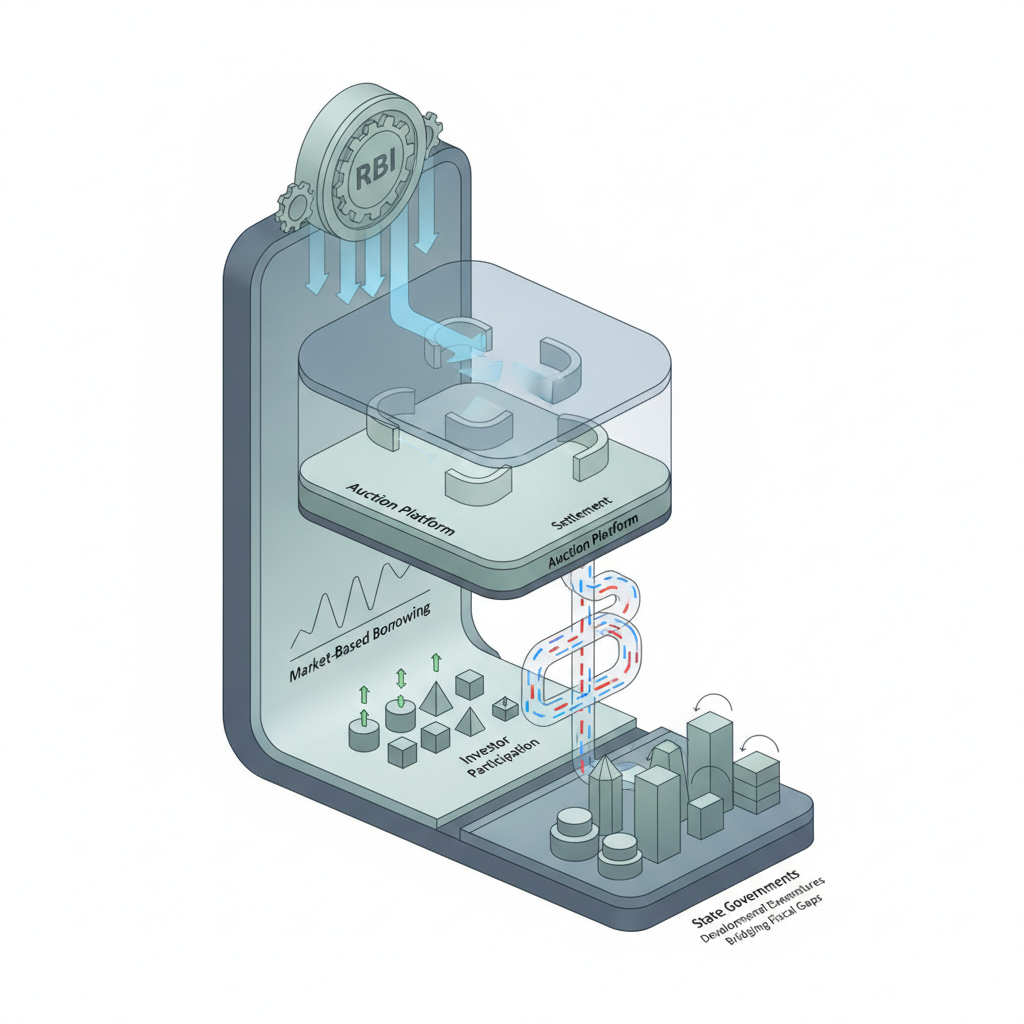
The Reserve Bank of India (RBI) has announced the auction of State Government Securities (SGS) on September 22, 2026, for an aggregate face value of ₹16,750 crore across seven states and one union territory. This auction exemplifies the operationalisation of India’s public debt management architecture for sub-national governments, highlighting the institutional frameworks for market-based borrowing, investor participation, and settlement mechanisms. The event is significant for understanding the interface between fiscal federalism, monetary policy, and capital market regulation in India.
Background
- The issuance of State Government Securities (SGS) or State Development Loans (SDLs) is a key instrument through which state governments mobilise resources from the market to finance developmental expenditures and bridge fiscal gaps.
- The RBI, acting as the debt manager for state governments, conducts auctions for SGS on behalf of state governments to ensure transparency, price discovery, and efficient allocation of capital.
- The auction mechanism for SGS includes both competitive and non-competitive bidding, with the latter facilitating retail investor participation, thereby broadening the investor base and enhancing financial inclusion.
- The RBI’s Core Banking Solution (E-Kuber) system serves as the digital platform for conducting these auctions, ensuring real-time processing, settlement, and transparency in the bidding and allotment process.
What are State Government Securities (SGS) and how are they auctioned?
- State Government Securities (SGS), also known as State Development Loans (SDLs), are debt instruments issued by state governments to raise funds from the market for developmental and capital expenditure.
- The auction process for SGS is conducted by the RBI on behalf of state governments and includes two types of bidding: competitive and non-competitive.
- Competitive bids are submitted by institutional investors, banks, and other market participants, who specify the yield or price at which they are willing to subscribe. The RBI accepts bids based on the cut-off yield or price, ensuring efficient price discovery.
- Non-competitive bids are reserved for retail investors, including individuals and small institutions, who are allotted securities up to 10% of the notified amount for each stock, subject to a maximum limit of 1% of the notified amount per bid per stock.
- The RBI’s Retail Direct Portal allows individual investors to participate in non-competitive bidding for SGS, providing a direct and accessible channel for retail participation in government securities.
- The RBI’s Core Banking Solution (E-Kuber) system is the digital platform for conducting auctions, ensuring secure, transparent, and real-time processing of bids, allotments, and settlements.
Key Features
| Feature | Significance |
|---|---|
| Aggregate Issue Size (₹16,750 Crore) | Represents the total face value of State Government Securities (SGS) being auctioned, reflecting the borrowing requirements of participating states for fiscal management. |
| Tenor Range (5 to 15 years) | Indicates the maturity period of the securities, influencing investor preference based on risk-return trade-offs and liquidity considerations. |
| Competitive and Non-Competitive Bidding | Enables participation from institutional investors (via competitive bids) and retail investors (via non-competitive bids), ensuring broad market accessibility. |
| Electronic Bidding via E-Kuber System | Facilitates transparent, efficient, and real-time auction processes, reducing operational delays and enhancing bid submission integrity. |
| Retail Direct Portal Integration | Provides individual investors a direct platform to participate in government securities auctions, democratising access to sovereign debt instruments. |
| Yield/Price Determination by RBI | Ensures market-driven pricing of securities, aligning with macroeconomic conditions and investor demand. |
| Half-Yearly Interest Payments | Standardised coupon payment schedule (March 23 and September 23) enhances predictability for investors and aligns with global sovereign bond conventions. |
| Minimum Investment Threshold (₹10,000) | Lowers entry barriers for retail investors while maintaining operational feasibility for institutional participants. |
Why it Matters
Macroeconomic Impact
- State borrowing through SGS augments fiscal resources for developmental expenditures, including infrastructure, health, and education.
- The auction size (₹16,750 Crore) contributes to the overall liquidity in the government securities market, influencing benchmark yields and monetary policy transmission.
- Diversification of investor base through competitive and non-competitive routes stabilises demand for state securities, reducing rollover risks.
- Tenor structure (5–15 years) supports long-term project financing while balancing short-term fiscal flexibility.
Investor Perspective
- Institutional investors (banks, insurance companies) utilise SGS for asset-liability management and statutory liquidity ratio (SLR) compliance.
- Retail investors gain access to risk-free sovereign debt instruments with assured returns, enhancing financial inclusion.
- Yield/price transparency in auctions ensures fair valuation, reducing information asymmetry in secondary markets.
- Non-competitive bidding facility (up to 10% of notified amount) provides small investors a simplified participation route.
Market Development
- Auctions conducted via E-Kuber system exemplify digital governance in public finance, reducing manual errors and processing time.
- Integration with Retail Direct Portal aligns with RBI’s objective of expanding retail participation in government securities.
- Standardised coupon payment cycles enhance secondary market liquidity and price discovery for state securities.
- Benchmarking state yields against central government securities (G-Secs) provides a reference for credit risk assessment.
Fiscal Federalism
- State governments utilise SGS to finance developmental schemes without compromising fiscal prudence, adhering to FRBM Act limits.
- Differential tenors and yields across states reflect regional economic conditions, investment climate, and fiscal health.
- Auction results influence state borrowing costs, impacting future fiscal planning and debt sustainability.
Challenges
1. Liquidity Constraints in Secondary Markets
- State securities often exhibit lower liquidity compared to central government bonds, deterring institutional investors.
- Narrow investor base limits depth of secondary market trading, increasing bid-ask spreads and volatility.
UPSC Link: GS-III: Financial Markets
2. Interest Rate Risk
- Prolonged low-interest-rate regimes may reduce investor appetite for long-tenor securities, affecting state borrowing costs.
- Unexpected RBI policy shifts (e.g., repo rate hikes) can lead to yield spikes, increasing debt servicing burdens for states.
UPSC Link: GS-III: Monetary Policy
3. Fiscal Discipline and Debt Sustainability
- States with high fiscal deficits may face higher borrowing costs, exacerbating debt sustainability concerns.
- Dependence on market borrowings exposes states to refinancing risks, particularly during economic downturns.
UPSC Link: GS-II: Centre-State Relations
4. Operational and Technical Risks
- System failures in E-Kuber or Retail Direct Portal could disrupt auction processes, delaying fund mobilisation.
- Cybersecurity threats targeting digital auction platforms pose risks to bid integrity and data confidentiality.
UPSC Link: GS-III: E-Governance
5. Regulatory Compliance Burden
- States must adhere to RBI guidelines on SGS issuance, including limits on non-competitive bidding and minimum investment thresholds.
- Frequent changes in auction timings or formats may create confusion among bidders, affecting participation rates.
UPSC Link: GS-II: Constitutional Provisions
Challenges — UPSC Perspective
| Issue | Concern |
|---|---|
| Secondary Market Depth | Limited trading volume in state securities increases bid-ask spreads and reduces investor confidence. |
| Interest Rate Volatility | Sudden shifts in RBI policy can lead to unpredictable yield movements, affecting state borrowing costs. |
| Debt Sustainability | High fiscal deficits may erode investor trust, leading to higher risk premiums on state securities. |
| Digital Infrastructure Risks | System outages or cyber threats in auction platforms could disrupt fund mobilisation timelines. |
| Regulatory Overreach | Strict RBI guidelines on bidding limits may inadvertently restrict retail participation. |
| Macroeconomic Uncertainty | Global economic shocks (e.g., recessions, geopolitical tensions) can dampen investor appetite for long-tenor securities. |
Way Forward
- Enhance secondary market liquidity for state securities through RBI’s Open Market Operations (OMOs) and Standing Deposit Facility (SDF).
- Expand retail investor participation via awareness campaigns on the Retail Direct Portal and simplified bidding processes.
- Introduce staggered auction timings to accommodate diverse investor time zones and reduce system load.
- Strengthen cybersecurity protocols for E-Kuber and Retail Direct Portal to mitigate digital risks.
- Rationalise non-competitive bidding limits to balance retail accessibility with market stability.
- Promote state-specific credit enhancement mechanisms (e.g., partial guarantees) to reduce borrowing costs for fiscally weaker states.
- Integrate state securities with government securities (G-Sec) indices to improve benchmarking and investor confidence.
- Conduct periodic reviews of auction formats to align with evolving market dynamics and investor feedback.
UPSC Value Addition
Keywords for Mains Answer-Writing
State Development Loans · State Government Securities auction · E-Kuber platform · Non-competitive bidding facility · Reserve Bank of India Core Banking Solution · Fiscal federalism · Sub-national borrowing · Public debt management · Interest rate determination · Retail Direct portal · Auction mechanism for government securities · Debt servicing obligations · Fiscal sustainability of states · Auction yield · Primary market for government securities
Concept Flow
State governments assess fiscal requirements and determine borrowing needs within FRBM Act limits. → RBI conducts pre-auction consultations with states to finalise issue size, tenor, and auction methodology. → States submit securities for re-issue or new issuance, specifying face value, coupon rates, and maturity dates. → RBI announces auction details (date, time, bidding modalities) via official channels and press releases. → Investors submit competitive (yield/price-based) or non-competitive bids via E-Kuber/Retail Direct Portal. → RBI evaluates bids, determines cut-off yield/price, and allots securities to successful bidders. → Successful bidders make payments, and securities are credited to their demat accounts on settlement date. → Secondary market trading commences, with yields influencing future auction pricing and state borrowing costs.
Prelims Practice Questions
Q1. Consider the following statements about the auction of State Government Securities (SGS) in India:
1. State Governments can auction their securities through the Reserve Bank of India’s Core Banking Solution (E-Kuber) system.
2. The auction of SGS is conducted exclusively for competitive bidders, with no provision for non-competitive bidding.
3. The Retail Direct portal allows individual investors to place non-competitive bids for State Government Securities.
4. The minimum nominal amount for investment in SGS is ₹1,000, and investments can be made in multiples of ₹1,000 thereafter.
How many of the above statements are correct?
- Only one
- Only two
- Only three
- All
Answer: Only three — Statements 1 and 3 are correct as the auction of SGS is conducted via the E-Kuber system and the Retail Direct portal facilitates non-competitive bidding. Statements 2 and 4 are incorrect: non-competitive bidding is permitted, and the minimum nominal amount is ₹10,000, not ₹1,000.
Q2. Assertion (A): The auction of State Government Securities (SGS) is conducted by the Reserve Bank of India (RBI) to manage the public debt of state governments.
Reason (R): The RBI acts as the debt manager for both the central and state governments in India, ensuring efficient borrowing and debt servicing.
Options:
A. Both A and R are true, and R is the correct explanation of A.
B. Both A and R are true, but R is not the correct explanation of A.
C. A is true, but R is false.
D. A is false, but R is true.
Answer: ? — Both the assertion and reason are true. The RBI conducts auctions of SGS as part of its role in managing public debt for state governments, ensuring transparency and efficiency in borrowing.
Q3. Match the following columns regarding the auction of State Government Securities (SGS):
Column I (State/UT) | Column II (Tenor in Years)
1. Andhra Pradesh | A. 15
2. Goa | B. 5
3. Punjab | C. 15
4. Rajasthan | D. 2039
Options:
A. 1-D, 2-A, 3-B, 4-C
B. 1-C, 2-A, 3-B, 4-D
C. 1-D, 2-B, 3-A, 4-C
D. 1-A, 2-D, 3-C, 4-B
Answer: ? — The correct matches are: 1. Andhra Pradesh – D (2039), 2. Goa – A (15), 3. Punjab – B (5), 4. Rajasthan – C (15).
Mains Practice Question
✍ The auction of State Government Securities (SGS) serves as a critical instrument for managing sub-national debt and fiscal federalism in India. Critically examine the role of the Reserve Bank of India (RBI) in this process, with reference to the auction mechanism, the non-competitive bidding facility, and the implications for fiscal sustainability of state governments. (15 Marks)
Approach: MODEL-ANSWER SKELETON:
1. **Introduction**: Define SGS and their significance in sub-national borrowing within India’s fiscal federal structure.
2. **RBI’s Role in Auction Mechanism**:
– Explain the RBI’s mandate under the RBI Act, 1934, and the FRBM Act, 2003, in managing public debt for states.
– Describe the auction process via the E-Kuber platform, including competitive and non-competitive bidding windows.
– Highlight the transparency and efficiency objectives of the auction mechanism.
3. **Non-Competitive Bidding Facility**:
– Explain the Scheme for Non-competitive Bidding Facility, its purpose, and beneficiaries (e.g., retail investors).
– Discuss the Retail Direct portal as a digital interface for individual investors.
– Analyse how this facility democratises access to government securities and promotes financial inclusion.
4. **Implications for Fiscal Sustainability**:
– Discuss how SGS auctions help states manage their fiscal deficits and borrowing costs.
– Examine the role of yield determination in reflecting market confidence and state creditworthiness.
– Critically assess potential challenges, such as debt traps, moral hazard, or inter-state disparities in borrowing costs.
5. **Fiscal Federalism Considerations**:
– Analyse the RBI’s balancing act between ensuring fiscal discipline and accommodating state-specific developmental needs.
– Refer to constitutional provisions (e.g., Article 293) and the Twelfth Finance Commission’s recommendations on state borrowing.
6. **Conclusion**: Summarise the RBI’s pivotal role in balancing market efficiency, fiscal federalism, and debt sustainability, while suggesting measures for further improvement.
Source: RBI
Generated by AanyaAi for educational purpose.
Related guides on our sites
- Current affairs for upsc 2026
- Best economics optional coaching for upsc
- Best economics optional teacher for upsc
- How to prepare for GS paper 1 for UPSC CSE mains exam

- एनसीएल द्वारा शुरू हुआ ‘विशेष अभियान 6.0’: स्वच्छता और ई-कचरा प्रबंधन पर जोर - September 19, 2026
- NCERT & NCL Launch ‘Special Campaign 6.0’ for Clean Governance: Key Details for UPSC - September 19, 2026
- ‘नशा मुक्त युवा अभियान’: 100 सप्ताह के राष्ट्रव्यापी अभियान का शुभारंभ, जानिए प्रमुख तथ्य - September 19, 2026

No Comments