


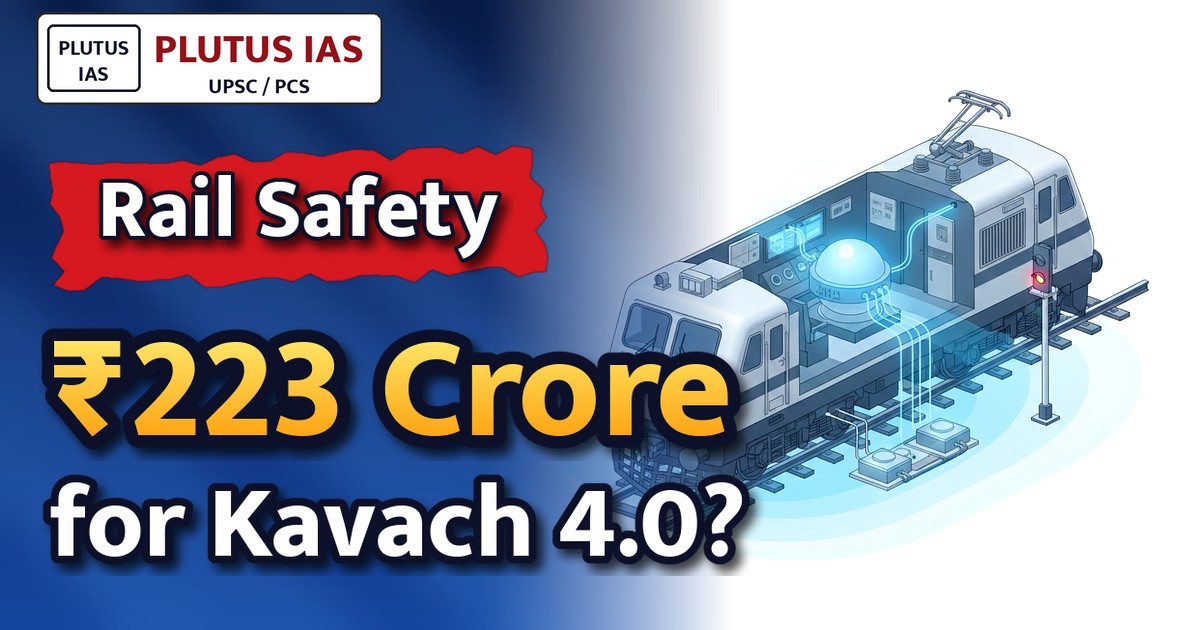
29 Sep UPSC Alert: ₹223 Crore Approved for Kavach 4.0 on Varanasi Division’s 614.75 km Track
✎ KAVACH 4.0 is an indigenous Automatic Train Protection System designed to prevent collisions by automatically applying brakes when a train approaches a danger signal or exceeds speed limits, thereby enhancing railway safety.
Subject Relevance — Where This Topic Fits
- GS Paper III — Science and Technology (Indigenous Technologies, Railway Safety Systems) | GS Paper III — Infrastructure (Transportation Systems)
- Prelims: KAVACH 4.0, Automatic Train Protection System (ATPS), Signalling Systems in Railways, Railway Safety, Indigenous Technology Development
Quick Revision: KAVACH 4.0 is an indigenous Automatic Train Protection System designed to prevent collisions by automatically applying brakes when a train approaches a danger signal or exceeds speed limits, thereby enhancing railway safety.
Why is this in the news?
The Press Information Bureau (PIB) released a statement on 28 September 2026, announcing the sanctioning of ₹223 crore by the Ministry of Railways for the implementation of KAVACH 4.0 on 614.75 kilometres of the Varanasi Division under the North Eastern Railway. This initiative marks a significant step in strengthening railway safety infrastructure through indigenously developed technology, aimed at preventing Signal Passing at Danger (SPAD) incidents and enhancing operational reliability.
Background
- KAVACH is an indigenous Automatic Train Protection (ATP) system developed by the Indian Railways in collaboration with Research Designs and Standards Organisation (RDSO) and private sector partners.
- The system is designed to prevent collisions by automatically applying brakes when a train approaches a danger signal or exceeds permissible speed limits.
- The Varanasi Division, part of the North Eastern Railway, is a critical route connecting major urban centres in Uttar Pradesh and Bihar, necessitating robust safety measures.
- The project aligns with the Indian Railways’ broader objective of achieving zero accidents and improving passenger safety through technological interventions.
- KAVACH has been tested on various routes, including the Lingampalli-Wadi and Secunderabad-Manmad sections, demonstrating its efficacy in reducing SPAD incidents.
What is KAVACH 4.0?
- KAVACH 4.0 is an indigenously developed Automatic Train Protection System (ATPS) designed to enhance railway safety by preventing collisions and overspeeding.
- Key features include automatic braking when a train approaches a danger signal or exceeds the permissible speed limit, thereby mitigating the risk of Signal Passing at Danger (SPAD).
- The technology is part of the Indian Railways’ broader strategy to reduce accidents and improve passenger safety through indigenous innovation.
Key Features
| Feature | Significance |
|---|---|
| Automatic Train Protection (ATP) System | Eliminates human error in signal interpretation, reducing risk of Signal Passing at Danger (SPAD) incidents. |
| Real-time Monitoring | Continuously tracks train movement, speed, and track occupancy to prevent collisions. |
| Auto-Braking Mechanism | Automatically applies brakes if a train approaches a red signal or exceeds safe speed limits. |
| Indigenous Development | Leverages India’s technological self-reliance, reducing dependence on foreign systems like ETCS or CBTC. |
| Scalability | Modular design allows phased deployment across high-density and high-risk rail corridors. |
| Integration with Existing Infrastructure | Compatible with conventional signalling systems, ensuring seamless adoption without major overhauls. |
Why it Matters
Safety Enhancement
- Reduces the probability of accidents caused by human error, fatigue, or miscommunication in signal operations.
- Mitigates risks in dense rail networks like the Varanasi Division, where multiple trains operate in close proximity.
- Provides a fail-safe mechanism to prevent catastrophic collisions, especially in high-traffic zones.
Operational Efficiency
- Minimises unscheduled stops and delays by ensuring trains adhere to safe speed limits and signal protocols.
- Reduces the need for manual intervention, allowing for smoother and more predictable train schedules.
- Enhances asset utilisation by preventing damage to rolling stock and track infrastructure due to accidents.
Strategic Autonomy
- Strengthens India’s position in the global rail safety technology market by promoting indigenous innovation.
- Reduces reliance on imported safety systems, thereby saving foreign exchange and enhancing national security.
- Encourages R&D in railway safety technologies, fostering a self-sustaining ecosystem of domestic manufacturers.
Economic Impact
- Lowers long-term costs by preventing accidents, which incur high financial and human losses.
- Boosts passenger and freight confidence, potentially increasing rail traffic and revenue.
- Creates employment opportunities in manufacturing, installation, and maintenance of KAVACH systems.
Policy Alignment
- Supports the objectives of the National Rail Safety Policy (2018) by prioritising accident prevention.
- Complements the ‘Make in India’ initiative by promoting domestic technological solutions.
- Aligns with the Atmanirbhar Bharat vision by reducing dependence on foreign technologies.
Challenges
1. Technological Integration
- Ensuring compatibility with existing signalling systems across diverse rail networks.
- Addressing latency issues in real-time data processing to avoid false alarms or delayed responses.
UPSC Link: GS3 Science & Tech
2. Cost and Funding
- Managing the high initial capital expenditure for large-scale deployment across multiple divisions.
- Balancing budgetary allocations between safety upgrades and other operational priorities.
UPSC Link: GS3 Infrastructure
3. Manpower Training
- Training railway staff, including drivers, signal operators, and maintenance teams, on KAVACH operations.
- Overcoming resistance to adoption due to unfamiliarity with new technology.
UPSC Link: GS3 Human Resource
4. Regulatory and Compliance
- Ensuring adherence to safety standards and certifications for indigenous systems.
- Streamlining approval processes for technology deployment without compromising safety.
UPSC Link: GS2 Governance
5. Geographical and Climatic Factors
- Adapting KAVACH to operate reliably in diverse terrains, including hilly and flood-prone regions of the Varanasi Division.
- Mitigating the impact of extreme weather conditions on system performance.
UPSC Link: GS3 Disaster Management
Challenges — UPSC Perspective
| Issue | Concern |
|---|---|
| High Initial Cost | Limited budget allocation may delay full-scale deployment across all rail divisions. |
| System Reliability | Potential for false positives or system failures in extreme conditions. |
| Staff Resistance | Lack of awareness or training may hinder smooth adoption and utilisation. |
| Infrastructure Compatibility | Existing signalling systems may require modifications for seamless integration. |
| Maintenance Challenges | Ensuring long-term upkeep and repairs without disrupting rail operations. |
| Regulatory Delays | Bureaucratic hurdles in approvals and certifications may slow down implementation. |
Way Forward
- Conduct phased pilot projects in high-risk corridors to validate KAVACH’s performance before full-scale rollout.
- Establish dedicated training programmes for railway staff to ensure operational readiness and reduce resistance to adoption.
- Allocate dedicated budgetary provisions for safety upgrades, prioritising accident-prone and high-density rail routes.
- Collaborate with academic and research institutions to refine KAVACH’s algorithms and address integration challenges.
- Strengthen regulatory frameworks to expedite certifications and ensure compliance with national safety standards.
- Promote public-private partnerships to accelerate technology adoption and reduce financial burdens.
- Develop a national roadmap for indigenous safety systems, integrating KAVACH with future rail modernisation plans.
- Monitor and evaluate system performance regularly to identify gaps and implement corrective measures.
UPSC Value Addition
Keywords for Mains Answer-Writing
Kavach 4.0 · Automatic Train Protection System (ATPS) · Indigenous Rail Safety Technology · Signal Passing at Danger (SPAD) · Railway Safety Mission · North Eastern Railway (NER) · Varanasi Division · Railway Safety Fund · Self-Reliance in Defence Production · Railway Accident Prevention · Train Collision Avoidance System · Railway Infrastructure Modernisation · Make in India in Railways · Railway Safety Regulations
Concept Flow
Railway accidents due to human error or signal failures → Development of indigenous Automatic Train Protection System (KAVACH) → Approval for deployment in high-risk corridors (e.g., Varanasi Division) → Integration with existing signalling infrastructure → Real-time monitoring and auto-braking mechanisms → Reduction in Signal Passing at Danger (SPAD) incidents → Enhanced passenger and freight safety → Increased operational efficiency and reduced delays → Long-term cost savings and strategic autonomy in rail safety technology.
Prelims Practice Questions
Q1. Consider the following statements regarding the ‘Kavach 4.0’ system recently approved by the Indian Railways:
1. Kavach is an indigenous Automatic Train Protection System designed to prevent ‘Signal Passing at Danger’.
2. It automatically applies brakes when required to ensure safe train movement.
3. The system is currently operational across all railway divisions in India without exception.
How many of the above statements are correct?
- Only one
- Only two
- All
- None
Answer: Only two — Statement 1 and 2 are correct as Kavach 4.0 is an indigenous ATPS designed to prevent SPAD and applies brakes automatically. Statement 3 is incorrect as the system is being progressively implemented and is not yet operational across all divisions.
Q2. Assertion (A): The ‘Kavach 4.0’ system is a critical component of India’s self-reliance in defence production.
Reason (R): The system is entirely developed and manufactured within India using indigenous technology.
Options:
A. Both A and R are true, and R is the correct explanation of A.
B. Both A and R are true, but R is not the correct explanation of A.
C. A is true, but R is false.
D. A is false, but R is true.
Answer: ? — Both Assertion (A) and Reason (R) are true. Kavach 4.0 is indeed a critical component of India’s self-reliance in defence production as it is an indigenous system. The Reason (R) correctly explains the Assertion (A).
Q3. Match the following railway safety initiatives with their primary objectives:
Column I (Initiative) Column II (Objective)
A. Kavach 4.0 1. Prevention of Signal Passing at Danger
B. Train Collision Avoidance System (TCAS) 2. Real-time monitoring of train operations
C. Anti-Collision Device (ACD) 3. Collision avoidance through GPS and RFID
D. Train Protection and Warning System (TPWS) 4. Automatic braking to prevent collisions
Options:
A. A-1, B-3, C-4, D-2
B. A-2, B-1, C-3, D-4
C. A-4, B-3, C-1, D-2
D. A-1, B-2, C-3, D-4
- A
- B
- C
- D
Answer: A — Kavach 4.0 (A) is designed to prevent SPAD (1). TCAS (B) uses GPS and RFID for collision avoidance (3). ACD (C) applies automatic braking (4). TPWS (D) monitors train operations in real-time (2).
Mains Practice Question
✍ The deployment of ‘Kavach 4.0’, India’s indigenous Automatic Train Protection System, represents a significant stride in enhancing railway safety and operational efficiency. Critically examine the technological, economic, and strategic dimensions of this initiative. Also, analyse how such indigenous safety systems contribute to India’s broader goals of self-reliance in defence and critical infrastructure. (15 Marks)
Approach: MODEL-ANSWER SKELETON:
1. **Technological Dimensions (4 Marks)**
– Define Kavach 4.0 as an indigenous Automatic Train Protection System (ATPS) and its core functionalities (prevention of SPAD, automatic braking, real-time monitoring).
– Explain the technological advancements in Kavach 4.0 over previous versions (e.g., Kavach 3.0), including improved algorithms, integration with signalling systems, and compatibility with existing railway infrastructure.
– Discuss the role of indigenous R&D institutions (e.g., Research Designs and Standards Organisation (RDSO), Indian Railways) in developing and testing the system.
2. **Economic Dimensions (4 Marks)**
– Analyse the cost-effectiveness of indigenous systems compared to imported alternatives (e.g., European Train Control System (ETCS), Japanese ATACS).
– Discuss the economic impact of deploying Kavach 4.0 across railway divisions, including job creation in the defence and railway sectors, and potential savings from reduced accidents and disruptions.
– Highlight the ‘Make in India’ initiative and how such projects align with the government’s push for self-reliance in critical infrastructure.
3. **Strategic Dimensions (4 Marks)**
– Examine the strategic importance of indigenous safety systems in reducing dependence on foreign technology, particularly in the context of geopolitical uncertainties.
– Discuss how such systems enhance India’s defence preparedness by ensuring the security of critical rail networks, including those used for military logistics.
– Analyse the broader implications for India’s role as a global leader in affordable and scalable railway safety solutions.
4. **Challenges and Way Forward (3 Marks)**
– Identify challenges in the widespread adoption of Kavach 4.0, such as high initial costs, integration with legacy systems, and training requirements for railway staff.
– Suggest measures to accelerate deployment, including phased rollout, public-private partnerships, and incentivising adoption through policy frameworks.
– Conclude with a balanced view on how Kavach 4.0 exemplifies India’s progress toward self-reliance in critical infrastructure while addressing operational and strategic needs.
Source: PIB (Press Information Bureau)
Uttar Pradesh PCS (UPPSC) — State PCS Practice
Prelims: Under the ‘Kavach 4.0’ initiative, the Uttar Pradesh government has approved a budget of ₹223 crore for the installation of automatic train protection systems on which of the following railway divisions?
- A. Lucknow Division
- B. Varanasi Division
- C. Agra Division
- D. Prayagraj Division
Answer: B. Varanasi Division — The ₹223 crore allocation under ‘Kavach 4.0’ is specifically for the Varanasi Division, covering a 614.75 km route to enhance railway safety in Uttar Pradesh.
Mains: Discuss the significance of the ‘Kavach 4.0’ initiative for the Varanasi Division in Uttar Pradesh, highlighting its impact on railway safety, passenger convenience, and the state’s broader transportation infrastructure. Elaborate on the administrative and economic implications for the region.
Generated by AanyaAi for educational purpose.
Related guides on our sites
- How to prepare for GS paper 1 for UPSC CSE mains exam
- Best UPSC coaching for IFOS exam
- Best mentorship programme for upsc
- UPSC+BA degree

- फरीदाबाद में श्रम संहिता पर ज़िला जागरूकता कार्यक्रम: ‘श्रम संवाद’ पहल का विस्तार - September 29, 2026
- UPSC Alert: ₹223 Crore Approved for Kavach 4.0 on Varanasi Division’s 614.75 km Track - September 29, 2026
- भारतीय रेलवे ने आंध्र प्रदेश में मछलीपट्टनम-कुरनूल के लिए नई त्रि-साप्ताहिक ट्रेन शुरू की - September 29, 2026

No Comments