


24 Jul UPSC Alert: 13,550 SC Students in Karnataka Benefit from Central Scholarships 2025-26
Subject Relevance — Where This Topic Fits
- GS Paper II — Welfare Schemes for Vulnerable Sections of the population by the Centre and States and the Performance of these Schemes | GS Paper III — Government Budgeting and Resource Mobilisation for Social Sector Schemes
- Prelims: Scheduled Castes (SC) Sub-Plan, Direct Benefit Transfer (DBT), Post-Matric Scholarship Scheme for SCs, Pre-Matric Scholarship Scheme for SCs, Shreyas Scheme for SCs, National Commission for Scheduled Castes (NCSC), Union Ministry of Social Justice and Empowerment, Karnataka State
- Essay: Inclusive Education as a Tool for Social Justice, Role of Technology in Reducing Inequality in Access to Public Services
Quick Revision: The Post-Matric and Pre-Matric Scholarship Schemes for SCs, implemented via Direct Benefit Transfer, aim to reduce financial barriers in education and are monitored through NITI Aayog evaluations to assess their impact on dropout rates.
Why is this in the news?
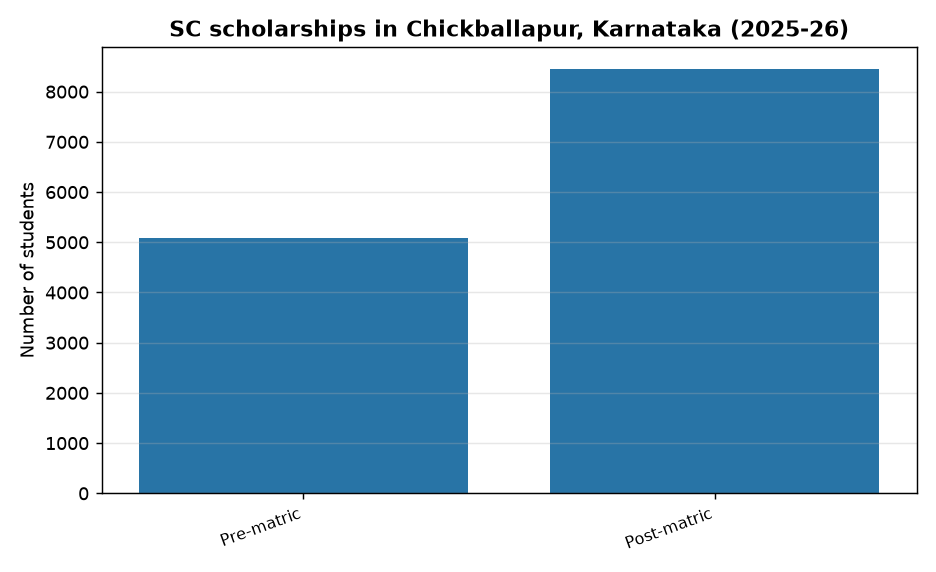
The Ministry of Social Justice and Empowerment, in a written reply to the Lok Sabha, reported that over 13,550 Scheduled Caste (SC) students in Chikkaballapura district, Karnataka, benefited from central scholarship schemes during the academic year 2025-26. This development underscores the government’s commitment to reducing economic barriers in education for marginalised communities and highlights the role of Direct Benefit Transfer (DBT) in ensuring timely and transparent disbursement of scholarships.
Background
- The Government of India, through the Ministry of Social Justice and Empowerment, administers multiple centrally sponsored scholarship schemes aimed at enhancing educational access and retention for Scheduled Caste (SC) students.
- These schemes are designed to address financial constraints that often impede SC students from pursuing higher education, thereby promoting social justice and inclusive growth.
- The implementation of these schemes is governed by the Scheduled Castes Sub-Plan (SCSP), which mandates the allocation of resources for the socio-economic development of SC communities.
- The transition to Direct Benefit Transfer (DBT) systems, initiated in 2021-22 for the Pre-Matric Scholarship Scheme and in 2022-23 for the Post-Matric Scholarship Scheme, has significantly improved the efficiency, transparency, and timeliness of scholarship disbursement.
- Chikkaballapura district in Karnataka, with a significant SC population, serves as a microcosm for assessing the reach and impact of these centrally sponsored schemes.
- Policy evaluations by bodies such as NITI Aayog have indicated that scholarship schemes have contributed to reducing dropout rates among SC students by alleviating financial burdens and incentivising continued education.
Central Scholarship Schemes for Scheduled Caste Students: Structure, Objectives, and Implementation
- The Ministry of Social Justice and Empowerment administers three major scholarship schemes for SC students: ‘अनुसूचित जाति के लिए मैट्रिक-पश्चात् छात्रवृत्ति (पीएमएस-एससी)’, ‘अनुसूचित जाति और अन्य के लिए मैट्रिक-पूर्व छात्रवृत्ति’ and ‘अनुसूचित जाति के लिए युवा अचीवर्स योजना के तहत उच्च शिक्षा के लिए योजना (श्रेयस-एससी योजना)’.
- The Post-Matric Scholarship Scheme (पीएमएस-एससी) supports SC students enrolled in classes 11 to postgraduate levels, providing financial assistance for tuition, maintenance, and other academic expenses to enable higher education.
- The Pre-Matric Scholarship Scheme targets SC students from classes 9 to 10, offering financial support to cover tuition fees, books, and maintenance allowances, thereby reducing dropout rates at the secondary level.
- The श्रेयस-एससी योजना, though not utilised in Chikkaballapura during 2025-26, is designed to provide quality residential education to meritorious SC students in reputed private institutions for classes 9 to 12.
- Direct Benefit Transfer (DBT) ensures that scholarship amounts are credited directly to the bank accounts of beneficiaries, linked to their Aadhaar numbers, thereby eliminating intermediaries and reducing delays.
- The schemes are monitored through periodic reviews, third-party evaluations, and grievance redressal mechanisms to ensure accountability, transparency, and continuous improvement in service delivery.
Key Features
| Feature | Significance |
|---|---|
| Direct Benefit Transfer (DBT) | Eliminates intermediaries, reduces delays, and ensures transparent, timely disbursement of scholarship funds directly to beneficiaries’ bank accounts linked with Aadhaar. |
| Technology-based Service Delivery | Enhances efficiency through digital platforms, reducing duplication, fraud, and administrative bottlenecks in scholarship distribution. |
| Pre-Matric and Post-Matric Scholarships | Covers educational expenses from primary to higher education, addressing financial barriers at critical stages of academic progression. |
| Maintenance Allowance Component | Provides recurring financial support to cover living expenses, thereby reducing dropout rates among Scheduled Caste (SC) students. |
| Monitoring and Evaluation Framework | Institutionalizes periodic assessments (e.g., by NITI Aayog) to evaluate impact, identify gaps, and refine implementation strategies. |
Why it Matters
Educational Equity
- Bridges the socio-economic divide by providing financial assistance to SC students, enabling equitable access to quality education across rural and urban regions.
- Reduces dropout rates by addressing immediate financial constraints, particularly in higher education where opportunity costs are significant.
- Promotes social mobility by fostering academic achievement and skill development among marginalized communities.
Administrative Efficiency
- DBT system minimizes leakages and administrative delays, ensuring that 100% of allocated funds reach intended beneficiaries.
- Digital governance streamlines verification, disbursement, and monitoring, reducing human intervention and corruption risks.
- Centralized data management facilitates evidence-based policymaking and targeted interventions.
Policy Coherence
- Aligns with constitutional directives under Articles 15(4) and 46, which mandate affirmative action for socially and educationally backward classes.
- Supports the Sustainable Development Goal 4 (Quality Education) by enhancing inclusive and equitable learning opportunities.
- Complements other welfare schemes (e.g., PM-KISAN, Ayushman Bharat) by addressing structural barriers to human capital development.
Economic Impact
- Invests in human capital development, which is critical for long-term economic growth and poverty reduction.
- Reduces intergenerational poverty by breaking the cycle of deprivation through educational empowerment.
- Enhances employability and productivity of SC communities, contributing to inclusive economic growth.
Challenges
1. Digital Divide and Accessibility
- Rural and semi-urban SC students may face challenges in accessing digital platforms for application and verification, exacerbating existing inequalities.
- Limited digital literacy among beneficiaries and stakeholders can hinder effective utilization of technology-driven schemes.
UPSC Link: GS-II: Welfare schemes for vulnerable sections
2. Leakage and Fraud
- Despite DBT, instances of identity fraud or duplicate applications may persist, necessitating robust grievance redressal mechanisms.
- Inadequate verification processes at the state level can lead to misallocation of funds or exclusion of eligible beneficiaries.
UPSC Link: GS-II: Transparency & Accountability in Governance
3. Inadequate Awareness
- Low awareness among SC communities about scholarship schemes and their eligibility criteria limits participation, particularly in remote areas.
- Lack of targeted outreach programs in local languages and dialects reduces scheme penetration.
UPSC Link: GS-II: Social Sector Services Delivery
4. Funding Constraints
- Insufficient budgetary allocation may lead to partial coverage of eligible beneficiaries, defeating the purpose of universal access.
- Delays in fund release from the central government to state implementing agencies can disrupt disbursement cycles.
UPSC Link: GS-III: Resource Mobilization
5. Monitoring and Evaluation Gaps
- Limited real-time data on beneficiary outcomes (e.g., dropout rates, academic performance) hampers evidence-based policymaking.
- Inadequate coordination between central and state agencies may result in disjointed implementation and oversight.
UPSC Link: GS-II: Role of Civil Services in Policy Implementation
Challenges — UPSC Perspective
| Issue | Concern |
|---|---|
| Digital Literacy | Low awareness and skills among beneficiaries hinder effective use of online platforms for scholarship applications and disbursements. |
| Identity Verification | Aadhaar-linked bank accounts may face authentication failures, leading to delays or exclusion of eligible students. |
| State-Level Coordination | Inconsistent implementation across states due to varying administrative capacities and political priorities. |
| Fund Disbursement Delays | Bureaucratic bottlenecks in fund release from central to state agencies disrupt timely scholarship payments. |
| Grievance Redressal | Inadequate mechanisms for addressing beneficiary complaints, leading to unresolved issues and distrust in the system. |
| Coverage Gaps | Eligible SC students in certain districts or categories (e.g., transgender SC) may remain unserved due to lack of targeted outreach. |
Government Initiatives — Must-Memorise for Prelims
- Pre-Matric Scholarship for Scheduled Castes (PMSC)
- Post-Matric Scholarship for Scheduled Castes (PMS-SC)
- Top Class Education Scheme for Scheduled Castes
Way Forward
- Strengthen digital infrastructure in rural and semi-urban areas to ensure seamless access to scholarship portals and Aadhaar-based authentication.
- Launch multi-lingual awareness campaigns in collaboration with local NGOs, schools, and panchayats to enhance scheme penetration among SC communities.
- Establish real-time monitoring dashboards to track fund disbursement, beneficiary uptake, and grievance redressal, with periodic audits by independent agencies.
- Increase budgetary allocations for scholarship schemes and ensure timely release of funds to state agencies to prevent disruptions in disbursement cycles.
- Develop standardized training programs for state officials and implementing agencies to improve administrative efficiency and reduce implementation gaps.
- Introduce targeted scholarship sub-schemes for marginalized SC sub-groups (e.g., women, persons with disabilities) to address intersectional disparities.
- Enhance grievance redressal mechanisms by integrating AI-driven chatbots and dedicated helplines for beneficiaries to report issues promptly.
- Conduct periodic impact assessments in collaboration with NITI Aayog or third-party evaluators to assess the scheme’s effectiveness and identify areas for reform.
UPSC Value Addition
Keywords for Mains Answer-Writing
Scheduled Caste (SC) Welfare · Central Sector Scholarship Schemes · Direct Benefit Transfer (DBT) · Pre-Matric Scholarship for SCs · Post-Matric Scholarship for SCs · Social Justice and Empowerment · Educational Equity · Digital Governance in Welfare Delivery · Dropout Rate Reduction · Inclusive Education Policies
Constitutional & Policy Linkages
- Article 15(4): Special provisions for socially and educationally backward classes
- Article 46: Promotion of educational and economic interests of weaker sections
Concept Flow
Constitutional mandate for affirmative action (Articles 15(4), 46) → → Policy formulation: Central Sector Scholarship Schemes for SC students → → Implementation challenges: Digital divide, funding constraints, awareness gaps → → Operational mechanism: DBT, Aadhaar linkage, state coordination → → Impact: Increased enrollment, reduced dropout rates, enhanced social mobility → → Monitoring and evaluation: NITI Aayog assessments, real-time data tracking → → Feedback loop: Policy refinements based on empirical evidence and beneficiary feedback
Prelims Practice Questions
Q1. Which of the following is NOT one of the three major scholarship schemes for Scheduled Castes (SCs) implemented by the Ministry of Social Justice and Empowerment?
- Pre-Matric Scholarship for SCs
- Post-Matric Scholarship for SCs
- Scholarship for SC Students under the Young Achievers Scheme
- National Overseas Scholarship for SCs
Answer: National Overseas Scholarship for SCs — The three major SC scholarship schemes are Pre-Matric, Post-Matric, and the Scholarship for SC Students under the Young Achievers Scheme. The National Overseas Scholarship for SCs is a separate scheme not covered under these three.
Q2. What is the primary objective of implementing the Direct Benefit Transfer (DBT) system in SC scholarship schemes?
- To reduce administrative delays and ensure timely disbursal of funds
- To increase the quantum of scholarship amounts
- To replace all scholarship schemes with cash transfers
- To decentralize scholarship distribution to state governments
Answer: To reduce administrative delays and ensure timely disbursal of funds — The DBT system was introduced to improve transparency, reduce duplication, and ensure timely transfer of scholarship funds directly to beneficiaries’ bank accounts, particularly benefiting rural and semi-urban students.
Q3. Which of the following statements is correct regarding the Pre-Matric and Post-Matric Scholarship Schemes for SCs?
- Both schemes were launched in the same academic year.
- The Post-Matric Scholarship Scheme was launched in 2021-22, while the Pre-Matric Scheme was launched in 2022-23.
- The Pre-Matric Scholarship Scheme was launched in 2021-22, while the Post-Matric Scheme was launched in 2022-23.
- Neither scheme has been launched yet.
Answer: The Pre-Matric Scholarship Scheme was launched in 2021-22, while the Post-Matric Scheme was launched in 2022-23. — The Pre-Matric Scholarship Scheme for SCs was launched in 2021-22, and the Post-Matric Scholarship Scheme was launched in 2022-23, as stated in the PIB release.
Mains Practice Question
✍ Examine the role of centrally sponsored scholarship schemes for Scheduled Castes (SCs) in reducing educational inequalities and promoting social justice in India. Critically assess the effectiveness of these schemes in addressing dropout rates among SC students.
Approach: Begin by outlining the constitutional and policy framework (Articles 15(4), 17, 46, and the Scheduled Castes and Scheduled Tribes (Prevention of Atrocities) Act, 1989) that mandate affirmative action for SCs. Discuss the three major scholarship schemes—Pre-Matric, Post-Matric, and Young Achievers—highlighting their objectives, coverage, and financial outlay. Analyze the implementation challenges, such as delays in disbursement, low awareness, and administrative bottlenecks, while emphasizing the transformative impact of the Direct Benefit Transfer (DBT) system. Evaluate the effectiveness of these schemes in reducing dropout rates, citing data from the NITI Aayog’s assessment and the PIB release. Conclude by suggesting measures for further improvement, such as enhanced monitoring, digital literacy initiatives, and multi-stakeholder collaboration.
Source: PIB (Press Information Bureau)
Generated by AanyaAi for educational purpose.

- हिमाचल में डिजिटल भुगतान क्रांति: बिलासपुर अव्वल, महिलाओं की भागीदारी 93% तक पहुंची - September 23, 2026
- Himachal Pradesh Leads in Digital Payments: Bilaspur Tops, Women’s Role Rises - September 23, 2026
- केरल लोक सेवा आयोग ने उच्च न्यायालय में दायर किया मामला, सदस्यों के खिलाफ मामला रद्द करने की मांग - September 23, 2026

No Comments