


25 Sep UPSC Alert: 166.5 Crore ROB in Vadodara Division to Boost Connectivity
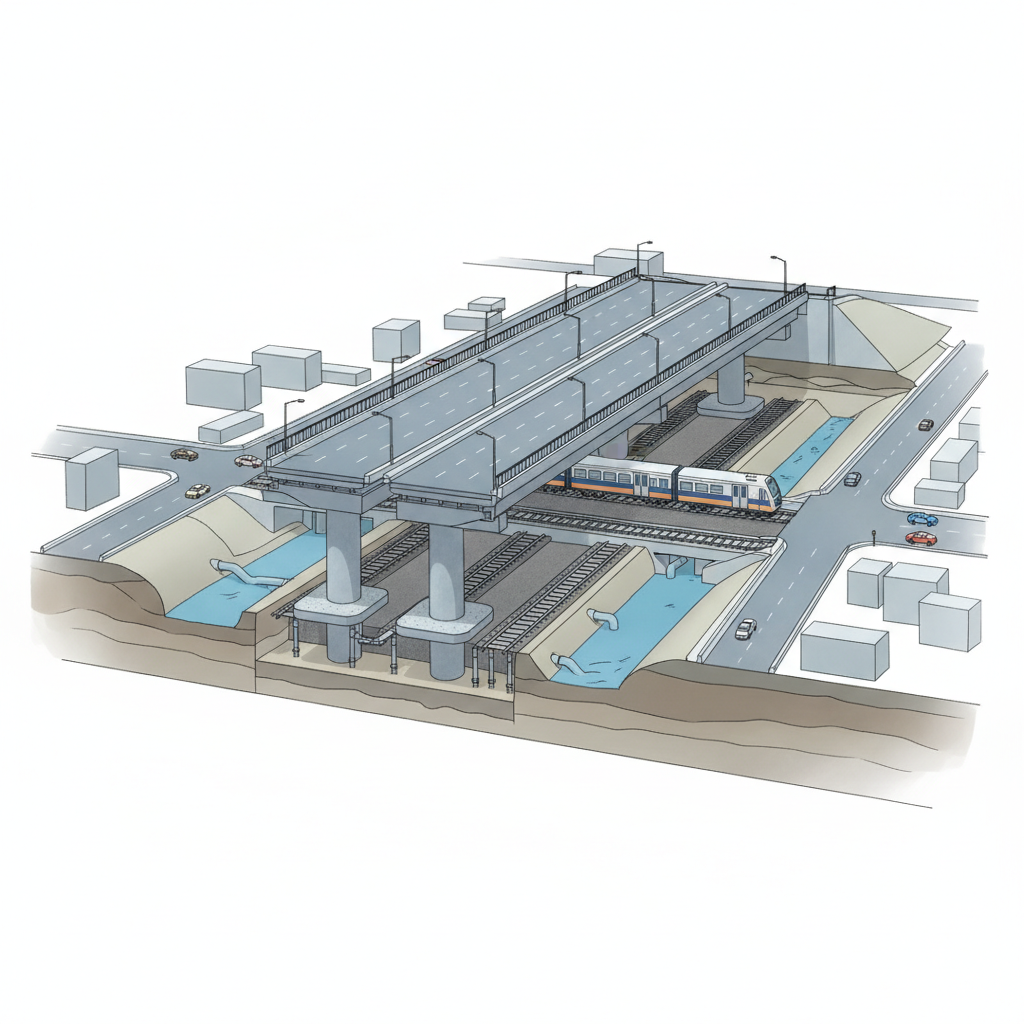
✎ A Road Over Bridge (ROB) is a grade-separated infrastructure designed to eliminate railway crossings, reduce traffic congestion, and enhance multi-modal transport integration in urban areas.
Subject Relevance — Where This Topic Fits
- GS Paper II — Governance, Constitution, Polity, Social Justice and International Relations (Sub-national Governance and Urban Infrastructure) | GS Paper III — Infrastructure: Energy, Ports, Roads, Airports, Railways and their Financing
- Prelims: Road Over Bridge (ROB), Grade Separated Facility, Passenger Car Unit (PCU), Underbridge, Vadodara Division, Western Railway, Cost Sharing Mechanism, Urban Traffic Congestion, Monsoon Waterlogging
- Essay: Urban Infrastructure Development: Balancing Growth and Sustainability, Public-Private Partnerships in Infrastructure: A Model for Efficient Resource Utilisation
Quick Revision: A Road Over Bridge (ROB) is a grade-separated infrastructure designed to eliminate railway crossings, reduce traffic congestion, and enhance multi-modal transport integration in urban areas.
Why is this in the news?
The Union Ministry of Railways has approved the construction of a four-lane Road Over Bridge (ROB) at Alkapuri in the Vadodara Division of Western Railway at an estimated cost of ₹166.5 crore. This project, to be implemented through equal cost-sharing between the Indian Railways and the Gujarat state government, aims to address critical urban transport bottlenecks, including traffic congestion, waterlogging during monsoons, and restricted vehicular movement due to the low clearance of the existing underbridge.
Background
- Urban transport infrastructure in India faces significant challenges due to rapid urbanisation, increasing vehicular density, and limited road capacity, particularly in metropolitan areas.
- The Vadodara Division of Western Railway is a critical rail corridor connecting major urban centres in Gujarat, including Vadodara city, which is a hub for education, commerce, and industrial activity.
- Existing underbridges in urban areas often suffer from inadequate vertical clearance, leading to traffic disruptions, safety hazards, and inefficiencies in multi-modal transport integration.
- The Ministry of Railways has been progressively adopting grade-separated facilities (e.g., ROBs and flyovers) to eliminate railway crossings, reduce congestion, and improve traffic flow in urban agglomerations.
What is a Road Over Bridge (ROB)?
- A Road Over Bridge (ROB) is a grade-separated structure that allows vehicular traffic to pass over railway tracks, eliminating conflicts between rail and road traffic at level crossings.
- ROBs are designed to enhance traffic safety, reduce congestion, and improve the efficiency of both rail and road transport networks in urban and peri-urban areas.
- The proposed ROB at Alkapuri will be a four-lane facility, ensuring sufficient capacity to accommodate projected traffic growth, including heavy vehicles and public transport buses.
- Grade separation eliminates the need for vehicles to stop at railway crossings, thereby reducing travel time and fuel consumption, and improving overall logistics efficiency.
- The ROB will integrate with existing and upcoming transport hubs, including the Vadodara Railway Station, the Gujarat State Road Transport Corporation (GSRTC) bus terminal, and the upcoming High-Speed Rail (Bullet Train) station, fostering multi-modal connectivity.
- The project includes provisions for pedestrian facilities, drainage systems to mitigate waterlogging, and traffic management measures to ensure seamless operation post-construction.
- The cost-sharing model between the Indian Railways and the state government exemplifies cooperative federalism in infrastructure development, ensuring equitable burden-sharing and efficient resource utilisation.
Key Features
| Feature | Significance |
|---|---|
| Four-lane Grade-Separated Road Over Bridge (ROB) | Eliminates at-grade rail-road crossings, enhancing traffic flow and safety by removing conflicts between vehicular and rail traffic. |
| Cost-sharing mechanism (50:50 between Indian Railways and Gujarat Government) | Ensures equitable financial burden distribution while leveraging central and state resources for critical infrastructure development. |
| Height clearance of 5.5 metres (approx.) | Facilitates unrestricted movement of large vehicles, including buses and trucks, addressing current height restrictions (~3 metres) at the existing underbridge. |
| Drainage and waterlogging mitigation | Reduces recurring waterlogging during monsoons, which currently disrupts traffic and poses operational challenges. |
| Integration with high-speed rail (Bullet Train) station | Provides seamless connectivity to the proposed Mumbai-Ahmedabad High-Speed Rail corridor, enhancing multimodal transport linkages. |
Why it Matters
Urban Mobility and Infrastructure
- Addresses critical traffic bottlenecks in Vadodara’s Alkapuri-Kalaghoda corridor, a key east-west arterial route connecting major residential and commercial zones.
- Reduces travel time and fuel consumption by eliminating delays at the existing underbridge, which experiences peak-hour traffic of over 1,600 PCU/hour.
- Improves pedestrian safety by segregating vehicular and foot traffic, addressing the current lack of adequate pedestrian facilities.
Economic Integration
- Enhances connectivity to Vadodara Railway Station, Gujarat State Road Transport Corporation (GSRTC) bus terminal, and proposed high-speed rail station, fostering economic synergy between transport modes.
- Supports regional trade and commerce by ensuring uninterrupted movement of goods, particularly for industries in and around Vadodara.
- Stimulates real estate and commercial development in the vicinity due to improved accessibility and reduced congestion.
Sustainable Urban Planning
- Promotes the adoption of grade-separated infrastructure, reducing accidents and emissions associated with idling traffic at rail crossings.
- Aligns with the Smart Cities Mission’s objectives by integrating multimodal transport hubs and improving last-mile connectivity.
- Mitigates environmental degradation from recurring waterlogging, which poses health and economic risks in urban areas.
Operational Efficiency of Indian Railways
- Eliminates delays in train operations caused by road traffic congestion at the existing underbridge, improving punctuality and reliability of rail services.
- Reduces the need for manual intervention at level crossings, enhancing safety and reducing the burden on railway staff.
- Supports the expansion of rail freight and passenger services by ensuring seamless integration with road networks.
Challenges
1. Land Acquisition and Right-of-Way
- Potential delays in acquiring land for the ROB and associated approach roads, particularly in densely populated urban areas.
- Compensation disputes with landowners may arise, requiring adherence to the Right to Fair Compensation and Transparency in Land Acquisition, Rehabilitation and Resettlement (RFCTLARR) Act, 2013.
UPSC Link: Land Reforms & RFCTLARR Act
2. Environmental and Social Impact
- Risk of ecological disruption during construction, necessitating compliance with the Environmental Impact Assessment (EIA) Notification, 2006.
- Noise and air pollution during construction may affect nearby residential and commercial areas, requiring mitigation measures.
UPSC Link: EIA Notification & Urban Pollution
3. Technical and Engineering Challenges
- Ensuring structural integrity of the ROB to withstand seismic activity, given Vadodara’s location in Seismic Zone III.
- Managing drainage systems to prevent waterlogging in the surrounding area post-construction.
UPSC Link: Seismic Zoning & Urban Drainage
4. Funding and Cost Overruns
- Risk of cost escalation due to inflation, material price volatility, or unforeseen geotechnical conditions.
- Ensuring timely disbursement of funds from both the central and state governments to avoid project delays.
UPSC Link: Infrastructure Financing & PPP Models
5. Stakeholder Coordination
- Coordination between Indian Railways, Gujarat Government, local authorities, and utility providers (e.g., water, electricity, telecom) for seamless execution.
- Public resistance or opposition to the project due to perceived disruptions during construction.
UPSC Link: Inter-Ministerial Coordination
Challenges — UPSC Perspective
| Issue | Concern |
|---|---|
| Land Acquisition | Delays due to compensation disputes or legal challenges under RFCTLARR Act. |
| Environmental Clearances | Compliance with EIA Notification may delay project timelines. |
| Traffic Diversion | Managing traffic during construction to minimize disruptions in a high-density urban area. |
| Structural Safety | Ensuring the ROB’s design accounts for seismic activity and heavy vehicular loads. |
| Funding Disbursement | Timely release of funds from both central and state governments to avoid cost overruns. |
Way Forward
- Constitute a multi-stakeholder project monitoring committee comprising representatives from Indian Railways, Gujarat Government, and local authorities to oversee timelines and address bottlenecks.
- Undertake detailed geotechnical surveys and structural engineering assessments to finalize the ROB’s design, ensuring compliance with seismic and load-bearing standards.
- Initiate public consultations to address concerns and ensure transparency in land acquisition and compensation processes.
- Develop a traffic management plan for construction phases to minimize disruptions, including phased road closures and alternative route signage.
- Leverage the Smart Cities Mission framework to integrate the ROB with broader urban mobility plans, including pedestrian infrastructure and last-mile connectivity solutions.
- Ensure strict adherence to environmental safeguards as per the EIA Notification, 2006, including noise pollution mitigation and waste management during construction.
- Explore Public-Private Partnership (PPP) models for post-construction maintenance to ensure long-term sustainability of the infrastructure.
UPSC Value Addition
Keywords for Mains Answer-Writing
Infrastructure financing models in India · Cooperative federalism in infrastructure projects · Grade-separated road over-bridge · Rail-road connectivity · Cost-sharing mechanisms between Centre and State · Urban traffic congestion mitigation · Multi-modal transport integration · Public-Private Partnership (PPP) vs. Government-led infrastructure · Traffic capacity enhancement · Logistics efficiency in urban areas · National Rail Plan 2030 · Western Railway Zone · Vadodara Division · Gujarat Urban Development · Sustainable urban mobility · Traffic flow optimization · Crossing capacity augmentation · Cost-benefit analysis of infrastructure projects
Concept Flow
Urban Traffic Congestion → Existing Underbridge Limitations (height, waterlogging, capacity) → Need for Grade-Separated Infrastructure → Proposal for ROB → Cost-Sharing Mechanism (50:50) → Environmental and Land Acquisition Clearances → Construction and Traffic Diversion Management → Operational Efficiency Gains → Enhanced Multimodal Connectivity.
Prelims Practice Questions
Q1. Consider the following statements about the Road Over Bridge (ROB) proposed in Vadodara:
1. The ROB will be a four-lane grade-separated facility.
2. The project cost will be equally shared between the Indian Railways and the Gujarat State Government.
3. The ROB aims to replace an existing under-bridge with a height of approximately 5 metres.
4. The ROB will integrate with the upcoming High-Speed Rail (Bullet Train) station in Vadodara.
How many of the above statements are correct?
- Only one
- Only two
- Only three
- All four
Answer: Only three — Statements 1, 2, and 4 are correct. Statement 3 is incorrect because the existing under-bridge has a height of approximately 3 metres, not 5 metres.
Q2. Assertion (A): Grade-separated road over bridges are primarily constructed to eliminate conflicts between rail and road traffic.
Reason (R): Such structures enhance traffic flow by separating vehicular and rail movements at grade crossings.
Options:
A. Both A and R are true, and R is the correct explanation of A.
B. Both A and R are true, but R is not the correct explanation of A.
C. A is true, but R is false.
D. A is false, but R is true.
Answer: ? — Both Assertion (A) and Reason (R) are true, and Reason (R) correctly explains Assertion (A). Grade-separated structures are designed to eliminate conflicts at rail-road crossings, thereby improving traffic flow.
Q3. Match the following pairs related to infrastructure financing in India:
Column I (Financing Model)
A. Cost-sharing between Centre and State
B. Public-Private Partnership (PPP)
C. Government-led funding
D. Hybrid Annuity Model
Column II (Example)
1. Mumbai Trans Harbour Link
2. Delhi Metro Phase IV
3. Vadodara ROB Project
4. National Highways Development Project (NHDP)
Options:
A-3, B-1, C-4, D-2
A-2, B-3, C-1, D-4
A-3, B-2, C-4, D-1
A-1, B-4, C-2, D-3
Answer: ? — A-3: Vadodara ROB Project involves cost-sharing between the Centre (Indian Railways) and the State Government. B-1: Mumbai Trans Harbour Link is a PPP project. C-4: NHDP was primarily government-led. D-2: Delhi Metro Phase IV is being implemented under the Hybrid Annuity Model.
Mains Practice Question
✍ The construction of grade-separated road over bridges (ROBs) is increasingly being adopted as a solution to urban traffic congestion and rail-road conflicts. In this context, critically examine the role of cooperative federalism in the financing and execution of such infrastructure projects in India. Substantiate your answer with reference to the Vadodara ROB project and discuss its implications for multi-modal transport integration and urban mobility. (15 Marks)
Approach: MODEL-ANSWER SKELETON:
1. **Introduction (2 Marks)**
– Define grade-separated ROBs and their purpose in mitigating rail-road conflicts and traffic congestion.
– Highlight the significance of such projects in urban areas with high traffic density (e.g., Vadodara).
2. **Cooperative Federalism in Infrastructure Financing (4 Marks)**
– Explain the concept of cooperative federalism in the context of infrastructure projects (Article 246, 7th Schedule, NITI Aayog’s role).
– Discuss the cost-sharing mechanism between the Centre (Indian Railways) and State Government (Gujarat) in the Vadodara ROB project (50:50 ratio).
– Compare with other models (e.g., PPP, Hybrid Annuity Model) and justify why cost-sharing is preferable in this case.
3. **Multi-Modal Transport Integration (4 Marks)**
– Explain how the ROB will integrate with key transport hubs (Vadodara Railway Station, Gujarat State Road Transport Corporation Bus Station, and upcoming High-Speed Rail Station).
– Discuss the broader implications for multi-modal transport integration in urban areas (e.g., seamless connectivity, reduced travel time).
– Reference the National Rail Plan 2030 and its emphasis on rail-road integration.
4. **Urban Mobility and Sustainability (3 Marks)**
– Discuss how the ROB will address traffic congestion, reduce accidents, and improve pedestrian safety in Vadodara.
– Highlight the role of such projects in achieving Sustainable Development Goal 11 (Sustainable Cities and Communities).
– Mention potential challenges (e.g., land acquisition, environmental impact, maintenance costs).
5. **Conclusion (2 Marks)**
– Summarize the importance of cooperative federalism and multi-modal integration in urban infrastructure development.
– Provide a forward-looking statement on the need for such projects in other congested urban areas.
Source: PIB (Press Information Bureau)
Gujarat PCS (GPSC) — State PCS Practice
Prelims: Under the Gujarat State-PCS perspective, which of the following is a key objective of constructing a Road Over Bridge (ROB) at Alkapuri in Vadodara Division by Indian Railways at a cost of ₹166.5 crore?
- A. To eliminate railway crossing-related accidents and improve traffic flow in Vadodara city
- B. To promote tourism by connecting Alkapuri with heritage sites in Vadodara
- C. To reduce the operational cost of Indian Railways by replacing old bridges
- D. To facilitate faster movement of goods trains between Gujarat and Maharashtra
Answer: A. To eliminate railway crossing-related accidents and improve traffic flow in Vadodara city — The primary purpose of constructing a ROB is to eliminate railway crossings, thereby enhancing road safety and improving traffic efficiency in urban areas like Vadodara.
Mains: Examine the socio-economic and environmental impacts of constructing a ₹166.5 crore Road Over Bridge (ROB) at Alkapuri in Vadodara Division. Discuss how such infrastructure projects align with Gujarat’s urban development and transport policy priorities.
Generated by AanyaAi for educational purpose.
Related guides on our sites
- Current affairs for upsc 2026
- How to prepare for GS paper 1 for UPSC CSE mains exam
- Best UPSC coaching for IFOS exam
- Best mentorship programme for upsc

- PM Modi Praises Youth-Led Nasha Mukt Yuva Abhiyan Momentum - September 27, 2026
- राजनाथ सिंह का बड़ा बयान: भारत किसी की ज़मीन कब्ज़ा नहीं करेगा, लेकिन सुरक्षा पर होगा कठोर - September 27, 2026
- Exercise Tarang Shakti 2026: India’s Mega Multi-Nation Air Power Showcase - September 27, 2026

No Comments