


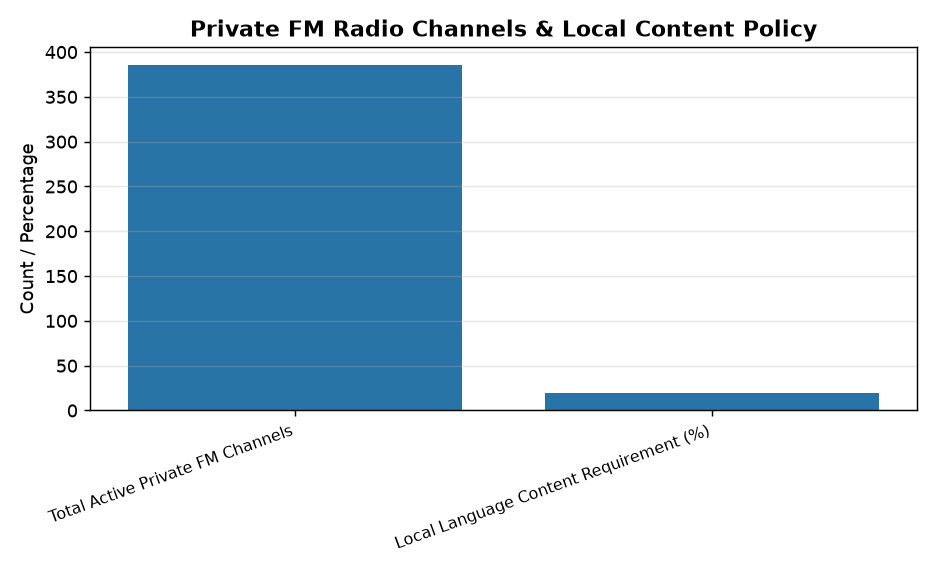
24 Jul UPSC Alert: 20% Local Content Rule for 386 Private FM Radio Channels
Subject Relevance — Where This Topic Fits
- GS Paper III — Infrastructure: Energy, Ports, Roads, Airports, Railways and Human Resources | GS Paper III — Information and Communications Technology (ICT) and Digital Initiatives | GS Paper IV — Role of Media in Governance and Ethical Concerns
- Prelims: Private FM Radio Policy, Prasar Bharati, E-auction of FM channels, Local Content Quota, Aspirational Districts, Letter of Intent (LOI), Grant of Permission Agreement (GOPA), Public Service Announcements (PSAs), LWE-affected districts
- Essay: The role of media in preserving cultural identity and promoting social cohesion, Digital transformation of public service delivery through convergence of traditional and new media
Quick Revision: Private FM radio in India operates under a phased policy framework with mandatory 20% local-language content to promote regional culture, while recent expansions via e-auctions and Prasar Bharati infrastructure access aim to enhance reach and public service delivery.
Why is this in the news?
The Press Information Bureau (PIB) released data on 24 July 2026 confirming that 386 private FM radio channels are operational in India, governed by a policy mandating a minimum 20% local-language content to promote regional culture, traditions, and folk music. This development is significant as it highlights the government’s ongoing efforts to expand FM radio reach to 234 new cities through transparent e-auctions, while ensuring public service delivery and crisis communication through coordinated broadcaster engagement.
Background
- Private FM radio broadcasting in India commenced in 2001 under the Phase I policy, with 108 channels in 40 cities.
- The Phase II policy (2005–2009) expanded coverage to 83 cities with 230 channels, introducing a revenue-sharing model.
- The Phase III policy (2015 onwards) introduced e-auctions for transparency, expanded coverage to 234 new cities, and allowed private broadcasters access to Prasar Bharati’s transmission infrastructure.
- The policy mandates a minimum 20% local-language content to preserve regional cultural heritage and enhance community engagement.
- The Union Ministry of Information and Broadcasting (MIB) regulates FM radio through periodic policy reviews.
- FM radio serves as a critical medium for public service announcements (PSAs), government schemes, and emergency communication, especially in Left-Wing Extremism (LWE)-affected and aspirational districts.
What is the Private FM Radio Policy in India?
- **Legal and Regulatory Framework**: Private FM radio in India operates under the Wireless Telegraphy Act, 1933, and the Indian Telegraph Act, 1885, with policy guidelines issued by the Ministry of Information and Broadcasting (MIB).
- **Phase-wise Expansion**: The policy has evolved through three phases—Phase I (2001), Phase II (2005–2009), and Phase III (2015 onwards)—each expanding coverage and introducing regulatory reforms.
- **Local Content Quota**: Broadcasters must ensure at least 20% of daily content is in the local language, including programs on regional culture, traditions, folklore, and folk music to foster cultural preservation.
- **Transmission Infrastructure**: Phase III allows private broadcasters to use Prasar Bharati’s transmission towers and sites, reducing setup costs and accelerating channel launch timelines.
- **E-auction Mechanism**: Since 2015, the government conducts transparent e-auctions to allocate FM radio frequencies, ensuring fair competition and revenue maximization for the exchequer.
- **Licensing Process**: The government issues a Letter of Intent (LOI) followed by the execution of a Grant of Permission Agreement (GOPA), which includes compliance timelines, especially for LWE-affected and aspirational districts.
- **Public Service Mandate**: Broadcasters are required to air PSAs and government schemes, ensuring multi-dimensional public engagement and awareness.
- **Emergency Communication**: During crises or critical campaigns, the government coordinates closely with broadcasters to ensure timely dissemination of verified information.
Key Features
| Feature | Significance |
|---|---|
| Local language content mandate (20% minimum) | Ensures preservation and promotion of regional culture, traditions, and linguistic diversity through structured broadcasting policies. |
| Third Phase of Private FM Policy | Facilitates rapid deployment of FM channels by granting access to Prasar Bharati’s infrastructure, reducing operational delays. |
| Transparent e-auction mechanism (July 2025) | Promotes fair competition, equitable resource allocation, and prevents monopolistic practices in the FM radio sector. |
| Government oversight on public service announcements | Ensures timely dissemination of verified information during emergencies and critical campaigns, enhancing public safety. |
| Aspirational Districts and LWE region focus | Aligns broadcasting infrastructure with socio-economic development goals, bridging digital and cultural divides in underserved areas. |
Why it Matters
Cultural Preservation & Linguistic Diversity
- Mandates 20% local language content to safeguard regional cultures, traditions, and folk music against homogenisation.
- Supports the constitutional directive under Article 29(1) to protect the interests of minorities and their cultural expressions.
- Enhances grassroots participation in media by empowering local artists, storytellers, and community voices.
Economic & Industrial Impact
- Stimulates the local entertainment and media industry by creating demand for regional content creators, producers, and technicians.
- Generates employment in broadcasting, production, and allied sectors through the expansion of FM radio networks.
- Encourages investment in regional media infrastructure, particularly in Tier-II and Tier-III cities.
Governance & Public Policy
- Strengthens the role of FM radio as a tool for public awareness, particularly for government schemes and welfare announcements.
- Facilitates real-time communication during emergencies, aligning with the Disaster Management Act, 2005.
- Promotes transparency in resource allocation via competitive e-auctions, reducing policy arbitrage.
Social Inclusion & Aspirational Districts
- Bridges the digital divide by prioritising FM radio access in Aspirational Districts and Left-Wing Extremism-affected regions.
- Provides a low-cost, high-reach medium for marginalised communities to access information and cultural content.
- Supports the National Education Policy 2020’s emphasis on multilingual education and localised learning.
Challenges
1. Enforcement of Local Content Mandate
- Risk of superficial compliance where broadcasters meet the 20% quota but dilute the cultural authenticity of content.
- Lack of standardised metrics to measure ‘local content’ quality, leading to ambiguity in policy implementation.
- Potential resistance from commercial broadcasters prioritising national or global content over regional programming.
UPSC Link: GS Paper 2: Governance, GS Paper 3: Media & Communication
2. Infrastructure & Accessibility Gaps
- Dependence on Prasar Bharati’s infrastructure may create bottlenecks, especially in remote or conflict-prone areas.
- High operational costs in Aspirational Districts and LWE regions may deter private broadcasters despite policy incentives.
- Limited reach in tribal and hilly regions due to terrain constraints and low advertising revenue potential.
UPSC Link: GS Paper 2: Governance, GS Paper 3: Infrastructure
3. Monetisation & Sustainability Concerns
- Regional content often yields lower advertising revenue compared to national or urban-focused programming.
- High auction prices for FM frequencies may burden small and medium broadcasters, limiting their viability.
- Dependence on government advertisements for sustainability may compromise editorial independence.
UPSC Link: GS Paper 3: Economic Development
4. Technological & Digital Divide
- FM radio’s limited interactivity compared to digital platforms may reduce its relevance among younger demographics.
- Lack of integration with OTT and social media ecosystems limits cross-platform reach and engagement.
- Digital literacy gaps in rural areas may hinder the effective utilisation of FM radio as a public information tool.
UPSC Link: GS Paper 3: Science & Technology
5. Policy Coherence & Inter-Ministerial Coordination
- Overlap between the Ministry of Information and Broadcasting and other ministries (e.g., Ministry of Culture, Ministry of Tribal Affairs) may lead to fragmented implementation.
- Inconsistent enforcement of content guidelines across states due to varying local priorities and political considerations.
- Need for periodic review of policies to adapt to evolving media consumption patterns and technological advancements.
UPSC Link: GS Paper 2: Governance
Challenges — UPSC Perspective
| Issue | Concern |
|---|---|
| Compliance ambiguity | Unclear definitions of ‘local content’ may lead to tokenistic adherence to the 20% mandate. |
| High auction costs | Expensive frequency auctions may deter small broadcasters, reducing market diversity. |
| Infrastructure bottlenecks | Dependence on Prasar Bharati’s towers may delay channel launches in remote areas. |
| Revenue sustainability | Low advertising potential in regional content may threaten the financial viability of FM stations. |
| Digital integration lag | Failure to integrate with digital platforms may limit FM radio’s long-term relevance. |
| Policy fragmentation | Lack of coordination between central and state governments may dilute the policy’s impact. |
Way Forward
- Establish a standardised framework for measuring ‘local content’ quality, including metrics for cultural authenticity and community engagement.
- Introduce graded incentives (e.g., tax rebates, subsidies) for broadcasters exceeding the 20% local content mandate.
- Expand Prasar Bharati’s infrastructure-sharing model to include private broadcasters in a phased manner, with priority for Aspirational Districts.
- Promote public-private partnerships to develop low-cost, high-reach FM radio networks in underserved regions.
- Encourage integration of FM radio with digital platforms (e.g., podcasts, social media) to enhance interactivity and reach.
- Conduct periodic audits to ensure compliance with local content guidelines, with penalties for tokenistic adherence.
- Develop a national-level digital repository of regional cultural content to support broadcasters in meeting the mandate.
- Strengthen inter-ministerial coordination to align broadcasting policies with cultural preservation and socio-economic development goals.
UPSC Value Addition
Keywords for Mains Answer-Writing
Private FM Radio Policy · Regional Content Mandate · Cultural Promotion through Media · Prasar Bharati Infrastructure Sharing · E-auction of FM Radio Channels · Aspirational Districts and LWE Areas · Public Service Broadcasting · Local Language Content Regulation
Constitutional & Policy Linkages
- Article 29(1): Protection of interests of minorities in matters of culture, language, and script.
- Article 350A: Facilities for instruction in mother-tongue at primary stage.
Concept Flow
Policy formulation (Third Phase of Private FM Policy) → Infrastructure access (Prasar Bharati towers) → Content mandate (20% local language) → Enforcement (audits, penalties) → Cultural preservation (regional traditions, folk music) → Socio-economic impact (employment, local industry growth) → Public service delivery (government schemes, emergency communication)
Prelims Practice Questions
Q1. Which of the following is a key provision of the Private FM Radio Policy in India as per the latest update?
- A. Mandatory broadcasting of 20% content in local language
- B. Exclusive use of government-owned transmitters for private FM channels
- C. Prohibition on broadcasting of government schemes
- D. Compulsory subscription to DD Free Dish
Answer: A. Mandatory broadcasting of 20% content in local language — The Private FM Radio Policy mandates that broadcasters must ensure at least 20% of daily content is in the local language to promote regional culture, traditions, and folk music.
Q2. Under the Private FM Radio Policy, which of the following is NOT a requirement for broadcasters operating in Aspirational Districts or LWE-affected areas?
- A. Adherence to a specified timeline for operations
- B. Compliance with local language content norms
- C. Mandatory sharing of infrastructure with Prasar Bharati
- D. Broadcasting of emergency information without verification
Answer: D. Broadcasting of emergency information without verification — While broadcasters must adhere to timelines and share infrastructure where available, they are required to coordinate with the government for verified dissemination of emergency information, not broadcast unverified data.
Q3. What was the primary objective of the e-auction conducted by the Government for FM radio channels in July 2025?
- A. To privatise all government-owned radio stations
- B. To expand FM radio coverage to 234 new cities
- C. To merge private FM channels with All India Radio
- D. To impose stricter content regulations on private broadcasters
Answer: B. To expand FM radio coverage to 234 new cities — The e-auction aimed to expand FM radio coverage by allocating 730 FM channels across 234 new cities, ensuring broader access to private FM radio services.
Mains Practice Question
✍ Critically examine the role of private FM radio in promoting regional culture and linguistic diversity in India. Assess the effectiveness of the 20% local language content mandate in achieving its stated objectives.
Approach: Begin by outlining the constitutional and policy framework governing media and cultural promotion in India, including Article 19(1)(a) and the National Policy on Culture. Discuss the significance of regional languages and cultural diversity in nation-building. Analyse the Private FM Radio Policy, particularly the 20% local language content mandate, as a tool for cultural preservation and promotion. Evaluate its implementation challenges, such as monitoring compliance, ensuring quality content, and balancing commercial viability with public service obligations. Conclude with recommendations to enhance the policy’s effectiveness, such as strengthening regulatory oversight, incentivising local content production, and leveraging technology for wider reach.
Source: PIB (Press Information Bureau)
Generated by AanyaAi for educational purpose.

- Harivansh Leads India at 153rd IPU Assembly in Tanzania - October 3, 2026
- अमेरिका में व्यापार मिशन: भारत की बड़ी योजना, जानिए क्या है सरकार की रणनीति - October 3, 2026
- Nasha Mukt Bharat: Youth Role in Polity & Governance for UPSC & PCS - October 3, 2026

No Comments