


27 Jul UPSC Alert: 3-Month Drive to Clear 16,033 Pending Labour Cases by Aug 2026
Subject Relevance — Where This Topic Fits
- GS Paper II — Governance, Administration and Challenges | GS Paper III — Labour, Industrial Relations and Social Security
- Prelims: Industrial Disputes Act, 1947, Payment of Gratuity Act, 1972, Maternity Benefit (Amendment) Act, 2017, Central Industrial Relations Machinery, Labour Courts and Industrial Tribunals, Minimum Wages Act, 1948
- Essay: The Role of Administrative Efficiency in Ensuring Social Justice: A Case Study of Labour Dispute Resolution, Balancing Industrial Growth with Worker Rights: Policy Imperatives in the 21st Century
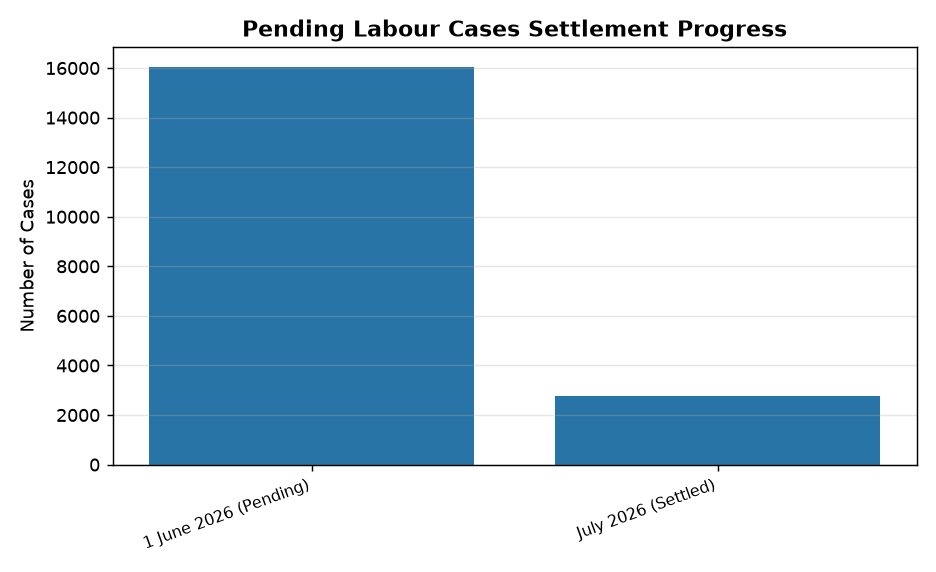
Quick Revision: The Special Campaign for Disposal of Pending Labour Disputes (2026) is a three-month initiative to resolve 16,033 pending cases, including those under the Industrial Disputes Act, 1947, and the Payment of Gratuity Act, 1972, with 2,769 cases disposed of in the first month.
Why is this in the news?
By the end of the first month, 2,769 cases were resolved, highlighting the government’s commitment to reducing pendency in labour adjudication systems. This initiative is significant for aspirants as it intersects with constitutional provisions (Article 39, 42, 43) and statutory frameworks governing labour rights and industrial harmony.
Background
- The Indian labour adjudication system operates under the Industrial Disputes Act, 1947, which mandates the resolution of disputes through Labour Courts, Industrial Tribunals, and Conciliation Officers to prevent industrial unrest and ensure social justice.
- Pending labour disputes have historically contributed to delayed justice, economic inefficiencies, and worker dissatisfaction, particularly in sectors such as manufacturing, construction, and services.
- The Constitution of India (Directive Principles of State Policy: Articles 39, 42, 43) obligates the state to secure just and humane conditions of work and a living wage for workers, necessitating timely dispute resolution.
- The Central Industrial Relations Machinery (CIRM), comprising the Chief Labour Commissioner (Central) and Regional Labour Commissioners, functions as the primary enforcement agency for labour laws and dispute resolution.
- The COVID-19 pandemic exacerbated pendency in labour courts due to disruptions in judicial and administrative processes, necessitating targeted interventions like the current special drive.
- The Payment of Gratuity Act, 1972, and the Maternity Benefit (Amendment) Act, 2017, are critical statutes underpinning the rights addressed in pending disputes, ensuring financial security and workplace protections for workers.
What is the Special Campaign for Disposal of Pending Labour Disputes?
- The focus areas include industrial disputes, wage arrears, gratuity claims, maternity benefits, and other statutory entitlements owed to workers under labour laws.
- The campaign leverages the existing infrastructure of Labour Courts, Industrial Tribunals, and Conciliation Officers, with enhanced monitoring and expedited hearings to ensure swift disposal.
- As of 1 June 2026, 16,033 cases were pending across regional offices, reflecting systemic delays in dispute resolution prior to the campaign.
- In the first month of the campaign, 2,769 cases were disposed of, demonstrating measurable progress in reducing pendency and delivering justice to workers.
- The initiative aligns with the government’s broader objective of improving ease of doing business while safeguarding worker rights, as mandated by constitutional and statutory provisions.
- The campaign underscores the role of administrative efficiency in bridging the gap between labour laws and their on-ground implementation, particularly in sectors with high informal employment.
- The Ministry’s press release (PIB Release ID: 2290014) highlights the campaign as a proactive measure to address the backlog and restore confidence in the labour adjudication system.
Key Features
| Feature | Significance |
|---|---|
| Duration | A three-month campaign (1 June 2026 – 31 August 2026) to expedite the resolution of pending labour cases, ensuring timely justice and reducing backlog. |
| Scope | Covers industrial disputes, wage claims, gratuity, maternity benefits, and other statutory dues across all regional labour offices in India. |
| Target | 16,033 pending cases as of 1 June 2026, with 2,769 resolved in the first month, demonstrating measurable progress. |
| Governance | Led by the Central Office of the Chief Labour Commissioner, ensuring uniformity and accountability in implementation. |
| Transparency | Progress reported through written replies in Parliament, enhancing credibility and public oversight. |
Why it Matters
Judicial and Labour Rights
- Ensures timely redressal of workers’ grievances, upholding Article 21 (Right to Life and Personal Liberty) and Article 39 (Directive Principles of State Policy on workers’ welfare).
- Reduces exploitation by addressing wage disputes, gratuity claims, and maternity benefits, thereby protecting labour rights enshrined in the Constitution.
- Promotes social justice by ensuring that statutory entitlements are disbursed without undue delay, fostering trust in the legal and administrative framework.
Economic Productivity
- Resolves disputes that may otherwise disrupt industrial operations, thereby enhancing business environment stability and investor confidence.
- Facilitates the timely payment of wages and benefits, which directly impacts consumer demand and economic stability.
- Reduces litigation costs for both employers and employees, freeing resources for productive economic activities.
Administrative Efficiency
- Demonstrates the government’s commitment to administrative reform and judicial efficiency, aligning with the vision of ‘Minimum Government, Maximum Governance’.
- Highlights the role of the Chief Labour Commissioner’s office in monitoring and expediting case resolution, setting a precedent for similar initiatives.
- Encourages proactive measures to prevent future backlogs, such as digital case management and periodic reviews.
Policy and Legal Framework
- Reinforces the implementation of labour laws such as the Industrial Disputes Act, 1947, Payment of Gratuity Act, 1972, and Maternity Benefit Act, 1961.
- Serves as a model for addressing pendency in other judicial and quasi-judicial bodies, including labour courts and tribunals.
- Strengthens the enforcement of statutory rights, ensuring compliance with national and international labour standards.
Challenges
1. JUDICIAL PENDENCY AND BACKLOG
- Chronic understaffing in labour courts and regional offices, leading to delayed hearings and prolonged dispute resolution.
- Complexity of industrial disputes, often involving multiple stakeholders (employers, unions, and workers), which complicates case management.
- Lack of digital infrastructure in some regional offices, hindering efficient case tracking and resolution.
UPSC Link: Judicial Pendency (Constitutional Framework)
2. AWARENESS AND ACCESSIBILITY
- Limited awareness among workers about their legal rights and the process for filing claims, leading to underutilisation of statutory benefits.
- Geographical disparities in access to labour offices, particularly in remote and rural areas, delaying case registration and resolution.
- Language barriers and lack of legal literacy among workers, especially migrant labourers, impede their ability to pursue claims effectively.
UPSC Link: Article 19(1)(g) and Labour Rights
3. COORDINATION AND MONITORING
- Fragmented governance between central and state authorities, leading to inconsistencies in case resolution and enforcement.
- Inadequate real-time monitoring mechanisms to track progress and identify bottlenecks in the resolution process.
- Resistance from employers or unions to comply with orders, necessitating stronger enforcement mechanisms.
UPSC Link: Centre-State Relations (Cooperative Federalism)
4. RESOURCE CONSTRAINTS
- Limited financial and human resources allocated to labour departments, affecting their capacity to handle large caseloads.
- Insufficient training for labour officers and judges on modern dispute resolution techniques and digital tools.
- Dependence on physical records and manual processes in some offices, increasing the risk of errors and delays.
UPSC Link: Public Administration and Governance
5. LEGAL AND PROCEDURAL DELAYS
- Cumbersome procedural requirements, such as multiple hearings and adjournments, prolonging case resolution.
- Lack of specialised labour courts in some regions, forcing cases to be heard in general civil courts, which are already overburdened.
- Appeal mechanisms that allow for prolonged litigation, further delaying final resolution.
UPSC Link: Judicial Reforms and Case Management
Challenges — UPSC Perspective
| Issue | Concern |
|---|---|
| Understaffing in Labour Courts | Leads to delayed hearings and prolonged dispute resolution, exacerbating pendency. |
| Complexity of Industrial Disputes | Involves multiple stakeholders, complicating case management and resolution. |
| Digital Infrastructure Gaps | Hinders efficient case tracking and resolution, particularly in rural areas. |
| Limited Worker Awareness | Results in underutilisation of statutory benefits and delayed claim filings. |
| Geographical Disparities | Delays case registration and resolution in remote and rural regions. |
| Fragmented Governance | Causes inconsistencies in enforcement and resolution across states. |
Way Forward
- Strengthen digital infrastructure in regional labour offices, including case management systems and online dispute resolution platforms.
- Increase staffing and training for labour officers and judges, focusing on modern dispute resolution techniques and digital tools.
- Launch targeted awareness campaigns in regional languages to educate workers about their rights and the claims process.
- Establish specialised labour courts in regions with high pendency to expedite dispute resolution.
- Enhance coordination between central and state authorities through regular reviews and shared databases.
- Implement real-time monitoring mechanisms to track progress and identify bottlenecks in case resolution.
- Introduce incentives for employers to comply with labour laws and expedite dispute resolution.
- Expand outreach to migrant labourers through mobile units and partnerships with NGOs and trade unions.
UPSC Value Addition
Keywords for Mains Answer-Writing
Industrial Disputes Act, 1947 · Labour adjudication mechanisms · Grievance redressal in labour sector · Wage and gratuity claims · Maternity Benefit Act, 1961 · Labour welfare administration · Judicial efficiency in labour disputes · Constitutional provisions for labour rights (Article 21, 39, 43) · Labour reforms and dispute resolution · Role of Chief Labour Commissioner · Statutory claims under labour laws · Labour court and tribunal system · Ease of doing business and labour compliance · Social security for organised and unorganised workers
Constitutional & Policy Linkages
- Article 21 (Right to Life and Personal Liberty) – Ensures timely justice and protection of workers’ livelihoods.
- Article 39 (Directive Principles of State Policy) – Mandates workers’ welfare and equitable distribution of resources.
- Article 41 (Right to Work and Public Assistance) – Guarantees social security and protection for workers.
Concept Flow
Pending labour cases → Judicial and administrative backlog → Economic and social disruptions → Government initiates special campaign → Targeted resolution of cases → Enhanced worker welfare and business environment stability → Reinforcement of constitutional rights and labour laws.
Prelims Practice Questions
Q1. Which of the following is NOT a statutory claim that the special campaign aims to expedite under the Industrial Disputes Act, 1947?
- A. Wage disputes
- B. Gratuity claims
- C. Maternity benefits
- D. Provident Fund contributions
Answer: D. Provident Fund contributions — The special campaign targets statutory claims such as wages, gratuity, and maternity benefits under the Industrial Disputes Act, 1947. Provident Fund contributions fall under the Employees’ Provident Funds and Miscellaneous Provisions Act, 1952, and are not explicitly mentioned in the campaign.
Q2. The Chief Labour Commissioner’s special campaign for labour dispute resolution is being conducted for a period of:
- A. One month
- B. Two months
- C. Three months
- D. Six months
Answer: C. Three months — The campaign, as stated in the PIB release, is a three-month initiative starting from 1 June 2026 to 31 August 2026 to expedite the resolution of pending labour cases.
Q3. Which constitutional provision is most directly related to the timely resolution of labour disputes and the protection of workers’ rights?
- A. Article 19(1)(g)
- B. Article 21
- C. Article 32
- D. Article 43
Answer: B. Article 21 — Article 19(1)(g) guarantees the right to practise any profession or to carry on any occupation, trade, or business, which includes the right of workers to seek redressal for disputes affecting their employment. Article 21 (right to life and personal liberty) and Article 43 (directive principles of state policy) are also relevant but less directly so in the context of dispute resolution mechanisms.
Mains Practice Question
✍ Critically examine the efficacy of the special campaign launched by the Chief Labour Commissioner for the expedited resolution of pending labour disputes in India. How does this initiative align with the broader objectives of labour welfare and ease of doing business in the country?
Approach: The candidate should first contextualise the campaign within the framework of the Industrial Disputes Act, 1947, and the role of labour adjudication mechanisms such as labour courts and tribunals. Analyse the significance of timely resolution of disputes for workers’ rights, particularly in relation to wages, gratuity, and maternity benefits. Discuss the impact on ease of doing business by reducing legal uncertainties for employers. Evaluate the campaign’s potential to address systemic delays in the labour justice system and its alignment with constitutional provisions like Article 43 (Directive Principles of State Policy) and Article 21 (right to life and livelihood). Conclude by assessing whether the campaign is a short-term measure or a step towards systemic reform in labour dispute resolution.
Source: PIB (Press Information Bureau)
Generated by AanyaAi for educational purpose.

- महिला किसानों के एफपीओ ने खेत में बनाया 1 मेगावाट का सौर ऊर्जा संयंत्र - September 18, 2026
- Odisha Women’s FPO Launches Dual-Use Solar Farm on 13 Acres - September 18, 2026
- AI हथियारीकरण का खतरा: क्या सचमुच डराने-धमकाने की रणनीति? - September 18, 2026

No Comments