


07 Aug UPSC Alert: 48 PLI Projects Approved for Bulk Drug Production Boost
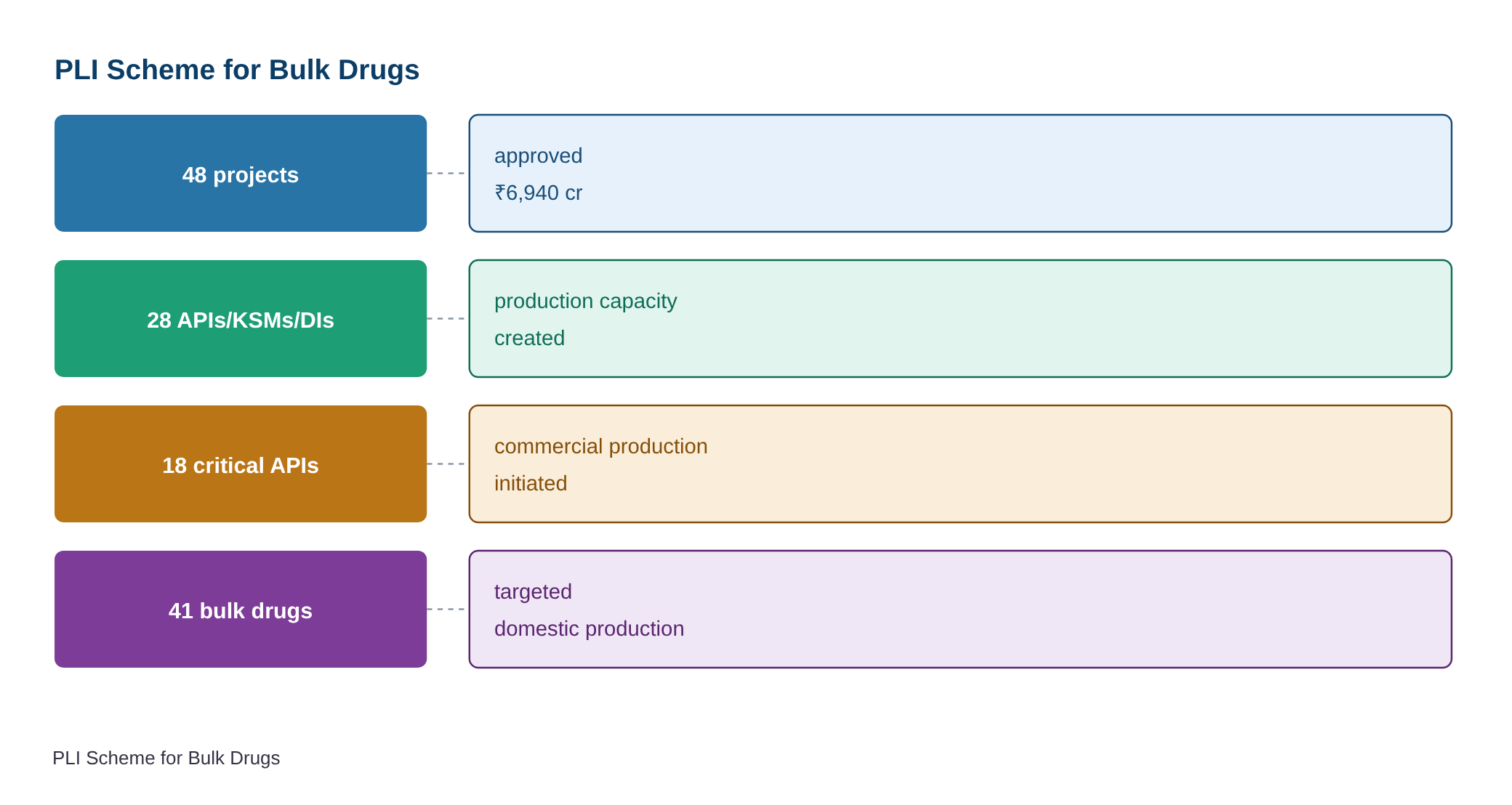
✎ The PLI Scheme for bulk drugs incentivises domestic production of 41 critical APIs/KSMs/DIs with a ₹6,940 crore outlay, aiming to reduce import dependence and enhance self-reliance in India’s pharmaceutical sector.
Subject Relevance — Where This Topic Fits
- GS Paper II — Government Policies and Interventions for Development in various sectors | GS Paper III — Indian Economy and Issues Relating to Planning, Mobilisation of Resources, Growth, Development and Employment | GS Paper III — Effects of Liberalisation on the Economy, Changes in Industrial Policy and their Effects on Industrial Growth
- Prelims: Production-Linked Incentive (PLI) Scheme, Active Pharmaceutical Ingredients (APIs), Key Starting Materials (KSMs), Drug Intermediates (DI), Pharmaceutical Policy, Atmanirbhar Bharat, Import Substitution, FDI in Pharmaceutical Sector
- Essay: The Imperative of Self-Reliance in Critical Pharmaceutical Manufacturing: Balancing Globalisation and Domestic Capacity, India’s Pharmaceutical Sector: From Global Supplier to Self-Sufficient Producer
Quick Revision: The PLI Scheme for bulk drugs incentivises domestic production of 41 critical APIs/KSMs/DIs with a ₹6,940 crore outlay, aiming to reduce import dependence and enhance self-reliance in India’s pharmaceutical sector.
Why is this in the news?
The Union Minister of State for Chemicals and Fertilizers, Shri Pankaj Chaudhary, recently provided written answers in the Lok Sabha regarding the progress of the Production-Linked Incentive (PLI) Scheme for bulk drugs, highlighting the approval of 48 projects with a sanctioned outlay of ₹6,940 crore, the creation of production capacity for 28 APIs/KSMs/DIs, and the initiation of commercial production for 18 critical active pharmaceutical ingredients, thereby reducing import dependence in the pharmaceutical sector.
Background
- The PLI Scheme for bulk drugs was launched as part of the broader ‘Atmanirbhar Bharat’ initiative to reduce India’s reliance on imports for critical pharmaceutical ingredients, particularly APIs, KSMs, and DIs, which are essential for domestic drug manufacturing.
- India is the world’s third-largest pharmaceutical market by volume but remains heavily dependent on imports for APIs, with over 60% of its requirements sourced from China, making the sector vulnerable to supply chain disruptions.
- The scheme aims to incentivise domestic production of 41 identified bulk drugs, including antibiotics, steroids, and cardiovascular medications, to enhance self-sufficiency and strengthen India’s position as the ‘Pharmacy of the World’.
- The PLI Scheme for bulk drugs is one of several sector-specific PLI schemes introduced by the Government of India to boost domestic manufacturing across critical industries, including pharmaceuticals, electronics, and automobiles.
- The scheme aligns with the National Pharmaceutical Pricing Authority (NPPA) guidelines and the Drugs and Cosmetics Act, 1940, to ensure quality, affordability, and accessibility of essential medicines.
- The pharmaceutical sector in India contributes significantly to the country’s GDP and employment, with over 3,000 drug manufacturing units and a robust export market worth approximately ₹2.5 lakh crore annually.
What is the Production-Linked Incentive (PLI) Scheme for Bulk Drugs?
- The PLI Scheme for bulk drugs is a financial incentive mechanism introduced by the Government of India in 2020 to promote domestic manufacturing of active pharmaceutical ingredients (APIs), key starting materials (KSMs), and drug intermediates (DIs).
- The scheme offers performance-linked incentives to eligible pharmaceutical manufacturers based on their production volumes, sales, and investment in plant and machinery, with incentives ranging from 5% to 20% of incremental sales over a five-year period.
- The scheme targets 41 identified bulk drugs, including critical APIs such as Penicillin G, Dexamethasone, Atorvastatin, and Levofloxacin, which are essential for the production of life-saving and commonly used medicines.
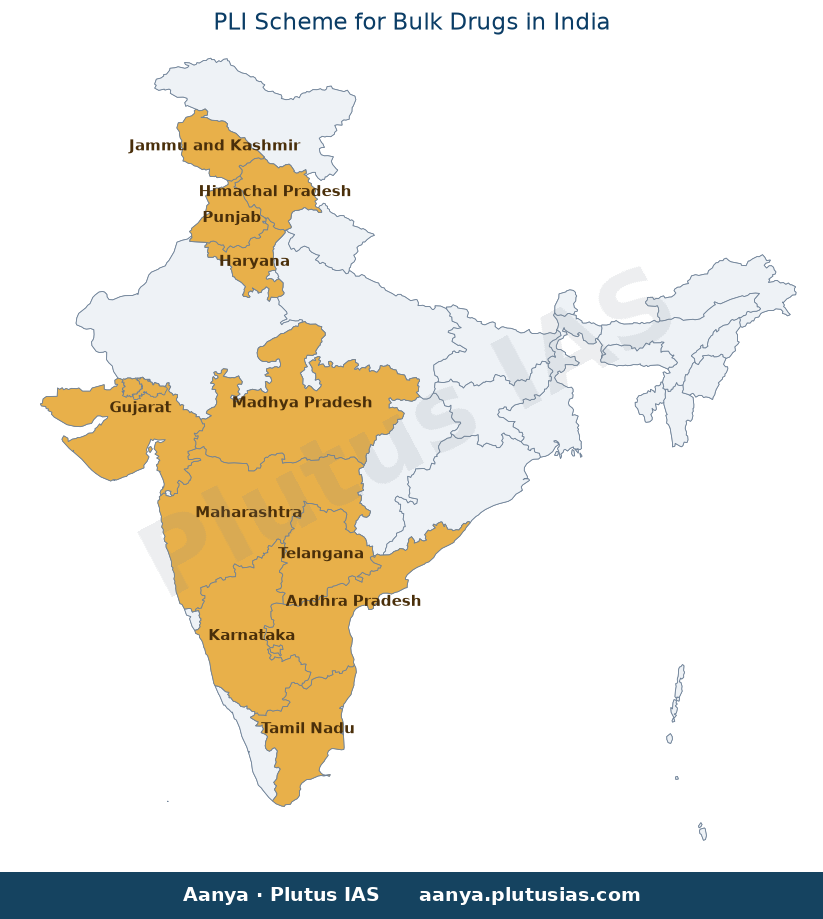
- The total outlay for the scheme is ₹6,940 crore, with funds allocated for both greenfield and brownfield projects, including those in states like Andhra Pradesh, Gujarat, Maharashtra, and Tamil Nadu, which have emerged as key pharmaceutical manufacturing hubs.
- The scheme is administered by the Department of Pharmaceuticals under the Ministry of Chemicals and Fertilizers, in collaboration with the NITI Aayog and state governments, to ensure streamlined implementation and monitoring.
- The PLI Scheme for bulk drugs is part of India’s broader strategy to reduce import dependency in critical sectors, enhance export competitiveness, and align with global standards of pharmaceutical manufacturing.
Key Features
| Feature | Significance |
|---|---|
| Total approved projects | 48 projects under the PLI scheme for bulk drugs to enhance domestic production of KSMs/DIs/APIs. |
| Financial outlay | ₹6,940 crore approved, with ₹87.70 crore disbursed as incentives by March 2026. |
| Investment mobilised | ₹5,070.45 crore invested against a commitment of ₹4,329.95 crore, indicating robust private sector participation. |
| Production capacity | 28 KSMs/DIs/APIs production capacities created, with 10 yet to achieve commercial production. |
| Import substitution | 18 APIs (e.g., Penicillin G, Dexamethasone, Atorvastatin) now produced domestically, reducing import dependency. |
Why it Matters
Economic
- Reduces India’s reliance on imports for critical pharmaceutical intermediates and APIs, improving trade balance.
- Boosts domestic pharmaceutical manufacturing, aligning with the ‘Atmanirbhar Bharat’ initiative.
- Enhances value addition in the pharmaceutical sector, contributing to GDP growth and employment generation.
Strategic
- Strengthens India’s self-sufficiency in essential drugs, crucial for public health resilience during global supply chain disruptions.
- Supports the production of life-saving drugs (e.g., Artemisunate, Lopinavir) and high-demand APIs for chronic diseases.
- Reduces vulnerability to geopolitical risks in the supply of critical pharmaceutical ingredients.
Industrial
- Encourages investment in high-technology pharmaceutical manufacturing, fostering innovation and R&D.
- Promotes regional industrial development, with projects approved across 8 states (e.g., Andhra Pradesh, Gujarat, Maharashtra).
- Creates backward linkages with the chemical industry, enhancing the entire pharmaceutical value chain.
Policy
- Demonstrates the effectiveness of production-linked incentive schemes in achieving industrial policy objectives.
- Provides a model for similar schemes in other sectors (e.g., medical devices, electronics) to drive domestic manufacturing.
- Aligns with the National Pharmaceutical Policy 2023 and the Pharma Vision 2030.
Challenges
1. Technology and R&D Gaps
- Limited indigenous capability in high-end fermentation-based APIs (e.g., Penicillin G) necessitates continued reliance on imported strains.
- Need for sustained investment in R&D to develop cost-competitive processes for complex APIs like Meropenem and Ritonavir.
UPSC Link: GS3: Industrial Policy & Technology
2. Market Competition
- Intense competition from low-cost producers in China and other Asian countries may pressure domestic manufacturers.
- Price volatility in raw material markets (e.g., para-aminophenol) could impact profitability and investment stability.
UPSC Link: GS3: Industrial Competitiveness
3. Regulatory and Compliance
- Stringent global regulatory standards (e.g., USFDA, EMA) require continuous compliance, adding to operational costs.
- Delays in environmental clearance and land acquisition for manufacturing units may hinder project timelines.
UPSC Link: GS2: Government Policies
4. Infrastructure Bottlenecks
- Inadequate logistics and warehousing infrastructure in some states (e.g., Himachal Pradesh, Jammu & Kashmir) may affect supply chains.
- Dependence on imported key starting materials (KSMs) for certain APIs limits full self-sufficiency.
UPSC Link: GS3: Infrastructure
5. Skill Development
- Shortage of skilled manpower in advanced pharmaceutical manufacturing techniques (e.g., bioprocessing, chiral synthesis).
- Need for industry-academia collaboration to bridge the skill gap and foster innovation.
UPSC Link: GS2: Education & Skill Development
6. Financial Viability
- High initial capital expenditure for setting up fermentation-based and chemical synthesis-based plants may deter small players.
- Ensuring long-term financial sustainability post-incentive period remains a challenge for investors.
UPSC Link: GS3: Financial Inclusion
Challenges — UPSC Perspective
| Issue | Concern |
|---|---|
| High capital costs | Limits participation of MSMEs and startups in bulk drug manufacturing. |
| Regulatory delays | Environmental clearances and land acquisition can delay project implementation. |
| Import dependency | Continued reliance on imported KSMs for certain APIs undermines full self-sufficiency. |
| Global competition | Low-cost producers in China may undercut domestic prices, affecting market share. |
| Skill shortages | Lack of trained workforce in advanced pharmaceutical technologies hampers growth. |
| Supply chain risks | Disruptions in raw material supply can impact production continuity. |
Way Forward
- Strengthen R&D collaboration between industry and institutions like CSIR and IITs to develop indigenous processes for high-end APIs.
- Expand the scope of the PLI scheme to include medical devices and diagnostics, leveraging existing pharmaceutical infrastructure.
- Enhance logistics and warehousing infrastructure in states with approved projects to reduce supply chain inefficiencies.
- Introduce targeted skill development programs in collaboration with industry to address the shortage of trained manpower.
- Simplify regulatory processes for environmental clearances and land acquisition to expedite project implementation.
- Encourage public-private partnerships for the development of common effluent treatment plants (CETPs) to ensure sustainable manufacturing.
- Monitor and evaluate the performance of approved projects to identify bottlenecks and implement corrective measures.
- Promote export-oriented manufacturing of bulk drugs by aligning with global regulatory standards (e.g., USFDA, WHO-GMP).
UPSC Value Addition
Keywords for Mains Answer-Writing
Production-Linked Incentive Scheme · Bulk Drugs · Active Pharmaceutical Ingredients (APIs) · Key Starting Materials (KSMs) · Drug Intermediates (DIs) · Pharmaceutical Sector · Import Dependence Reduction · Domestic Manufacturing · Atmanirbhar Bharat · Economic Growth · Healthcare Security · Public Health
Concept Flow
Government identifies strategic need for self-sufficiency in bulk drugs → → Cabinet approves PLI scheme for bulk drugs with ₹6,940 crore outlay → → Department of Pharmaceuticals invites applications and approves 48 projects → → Private sector invests ₹5,070.45 crore, creating production capacities for 28 KSMs/DIs/APIs → → Domestic production of 18 APIs begins, reducing import dependency → → Economic benefits: trade balance improvement, employment generation, GDP growth → → Strategic benefits: public health resilience, reduced geopolitical risks, enhanced industrial base.
Prelims Practice Questions
Q1. Consider the following statements regarding the Production-Linked Incentive (PLI) Scheme for Bulk Drugs:
1. The scheme aims to promote domestic manufacturing of Key Starting Materials (KSMs), Drug Intermediates (DIs), and Active Pharmaceutical Ingredients (APIs).
2. The total approved outlay for the scheme is ₹6,940 crore.
3. As of March 2026, the scheme has led to the commencement of commercial production for 18 specific APIs, reducing import dependency.
How many of the above statements are correct?
- Only one
- Only two
- Only three
- None
Answer: Only three — Statement 1 is correct: The scheme’s primary objective is to boost domestic production of KSMs, DIs, and APIs. Statement 2 is correct: The approved outlay for the scheme is indeed ₹6,940 crore. Statement 3 is correct: The press release explicitly mentions that 18 APIs have commenced production, thereby reducing import dependence.
Q2. Which of the following is NOT a fermentation-based Key Starting Material (KSM) / Drug Intermediate (DI) / API approved under the PLI Scheme for Bulk Drugs?
- Penicillin G
- Clavulanic Acid
- Dicyandiamide (DCDA)
- Erythromycin Thiocyanate (TIOC)
Answer: Dicyandiamide (DCDA) — Penicillin G, Clavulanic Acid, and Erythromycin Thiocyanate (TIOC) are listed under ‘Fermentation-based Key KSM / Drug Intermediates’ or ‘Fermentation-based Specific KSM / Drug Intermediates / APIs’. Dicyandiamide (DCDA) is listed under ‘Major Chemical Synthesis based KSM / Drug Intermediates’.
Mains Practice Question
✍ The Production-Linked Incentive (PLI) Scheme for Bulk Drugs aims to bolster India’s pharmaceutical manufacturing capabilities and reduce import dependence. Discuss the strategic significance of this initiative for India’s healthcare security and economic resilience. (15 Marks)
Approach: MODEL-ANSWER SKELETON:
1. **Introduction**: Briefly introduce the PLI Scheme for Bulk Drugs, its objective (promoting domestic manufacturing of KSMs, DIs, APIs), and its context (reducing import dependence).
2. **Strategic Significance for Healthcare Security**:
* **Self-reliance in essential medicines**: Discuss how domestic production of APIs and KSMs ensures a stable supply of critical drugs, especially during global supply chain disruptions (e.g., pandemics, geopolitical tensions).
* **Reduced vulnerability**: Explain how dependence on imports for crucial drug components creates strategic vulnerabilities, and the PLI scheme mitigates this risk.
* **Quality control and affordability**: Mention potential benefits in terms of maintaining quality standards and influencing drug prices through domestic production.
* **Public health preparedness**: Link the scheme to India’s overall preparedness for health crises by securing the pharmaceutical supply chain.
3. **Strategic Significance for Economic Resilience**:
* **’Atmanirbhar Bharat’ initiative**: Connect the scheme to the broader goal of self-reliant India, fostering domestic industries.
* **Investment and employment generation**: Highlight the committed and actual investment (e.g., ₹5,070.45 crore achieved against ₹4,329.95 crore committed) and its role in creating jobs and economic activity.
* **Export potential**: Discuss how a robust domestic manufacturing base can transform India from a bulk drug importer to an exporter, enhancing foreign exchange earnings.
* **Value chain integration**: Explain how the scheme encourages backward integration in the pharmaceutical value chain, strengthening the entire sector.
* **Technological advancement and R&D**: Mention the potential for fostering innovation and research in pharmaceutical manufacturing.
4. **Challenges and Way Forward (Briefly)**:
* Acknowledge challenges such as achieving full commercial production for all approved products and sustaining competitiveness.
* Suggest measures like continued policy support, R&D incentives, and skill development.
5. **Conclusion**: Summarize the dual benefits of the PLI scheme for Bulk Drugs in enhancing both healthcare security and economic resilience, positioning India as a global pharmaceutical hub.
Source: PIB (Press Information Bureau)
Generated by AanyaAi for educational purpose.

- महाराष्ट्र में त्योहार जुलूसों पर बॉम्बे हाईकोर्ट का बड़ा फैसला: पटाखे, लेजर और संगीत पर रोक - September 24, 2026
- Bombay HC Bans Firecrackers, Music in Maharashtra Processions: Key UPSC Analysis - September 24, 2026
- तमिलनाडु में महिला कर्मचारियों के लिए सवैतनिक माहवारी अवकाश नीति पर HC का आदेश - September 24, 2026

No Comments