


12 Aug UPSC Alert: 580 SC Students Benefit from National Overseas Scholarship Scheme (2019-26)
✎ The National Overseas Scholarship (NOS) scheme is a flagship initiative of the Ministry of Social Justice and Empowerment to promote equitable access to global higher education for Scheduled Caste students.
Subject Relevance — Where This Topic Fits
- GS Paper II — Welfare Schemes for Vulnerable Sections of the population by the Centre and States and the Performance of these Schemes | GS Paper III — Issues relating to Development and Management of Social Sector/Services relating to Education
- Prelims: National Overseas Scholarship (NOS), Scheduled Castes (SCs), Social Justice and Empowerment Ministry, Integrated Access Mechanism (IAM), Foreign Education Policy
- Essay: Higher Education as a Catalyst for Social Mobility: Balancing Access, Equity, and Global Competitiveness
Quick Revision: The National Overseas Scholarship (NOS) scheme is a flagship initiative of the Ministry of Social Justice and Empowerment to promote equitable access to global higher education for Scheduled Caste students.
Why is this in the news?
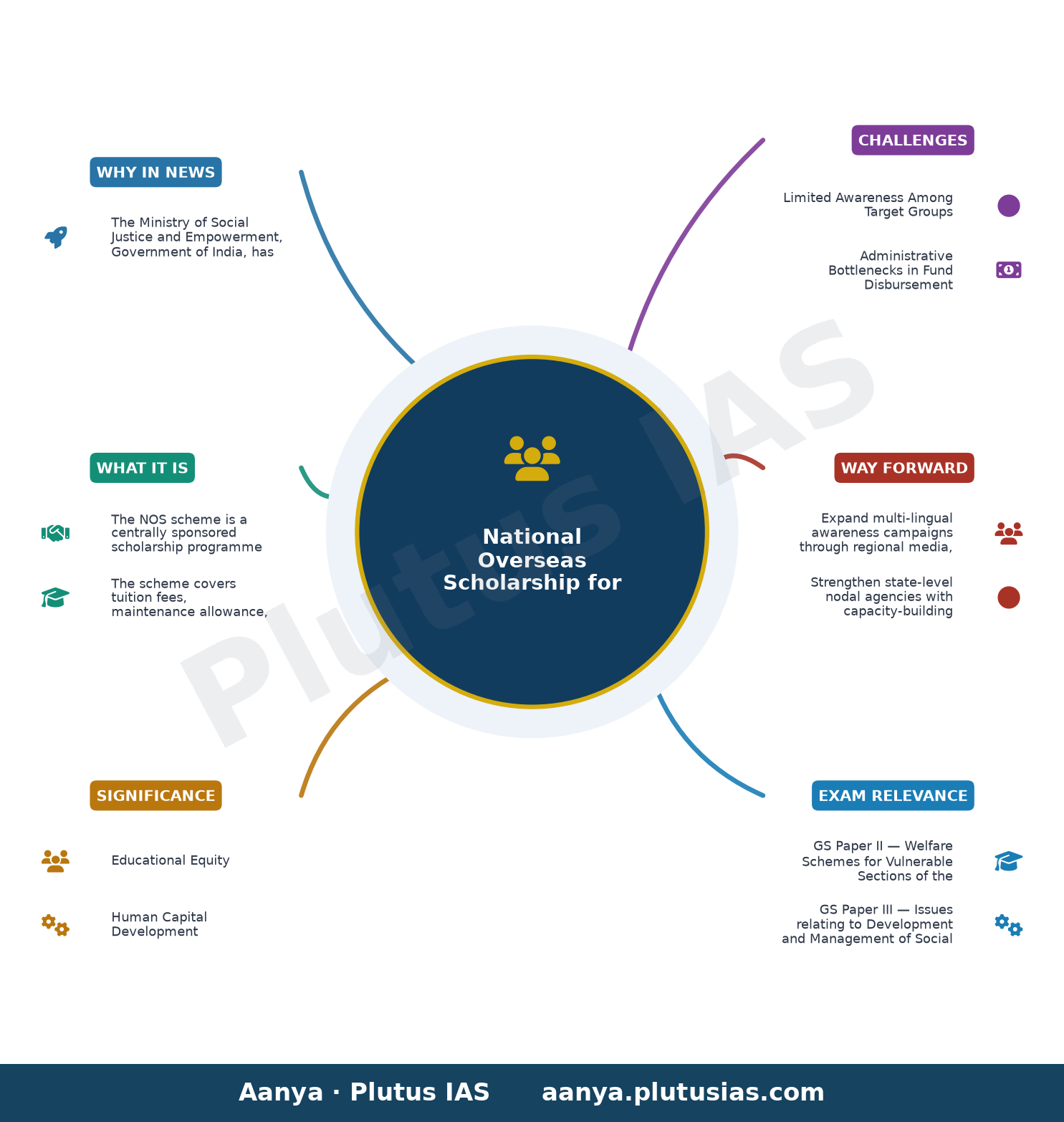
The Ministry of Social Justice and Empowerment, Government of India, has highlighted the progress of the National Overseas Scholarship (NOS) scheme for Scheduled Caste (SC) students from 2019–20 to 2025–26, reporting that 580 students have availed the scholarship and secured admission in foreign universities. The government’s emphasis on digitalisation, awareness campaigns, and streamlined disbursement mechanisms underscores the scheme’s evolving institutional architecture and its role in enhancing equitable access to global higher education for marginalised communities.
Background
- The National Overseas Scholarship (NOS) scheme was launched by the Government of India to provide financial assistance to meritorious SC students for pursuing higher education abroad, thereby promoting social equity and inclusion in global academic spaces.
- The scheme is administered by the Ministry of Social Justice and Empowerment, with the objective of reducing disparities in access to international education for SC students who face systemic socio-economic barriers.
- Prior to 2019, the scheme had limited outreach and faced challenges in timely disbursement of funds and awareness generation among target beneficiaries.
- The scheme aligns with constitutional provisions under Article 15(4) and Article 46, which mandate the state to promote educational and economic interests of the weaker sections of society.
- The NOS scheme is distinct from other scholarship schemes such as the Maulana Azad National Fellowship or the Post-Matric Scholarship for SCs, as it specifically targets overseas education for SC students.
What is the National Overseas Scholarship (NOS) Scheme?
- The NOS scheme is a centrally sponsored scholarship programme designed to provide financial assistance to Scheduled Caste (SC) students for pursuing Master’s, Ph.D., and Post-Doctoral programmes in foreign universities.
- The scheme covers tuition fees, maintenance allowance, visa fees, travel expenses, and other contingencies, subject to specified ceilings and norms.
- Eligibility criteria include: (a) the student must belong to the SC category; (b) annual family income must not exceed ₹8,00,000; (c) the student must have secured admission in a foreign university ranked among the top 500 in the QS World University Rankings or equivalent.
- Selection is based on merit, with a focus on academic excellence and socio-economic need, and is conducted through a transparent process managed by the Ministry of Social Justice and Empowerment.
- Funds are released in advance to Indian Missions/Embassies abroad via Letters of Authority (LoAs), enabling timely disbursement to students and universities upon receipt of claims.
- The scheme includes provisions for awareness generation through departmental websites, newspaper advertisements, and coordination with state governments and Union Territories to ensure wider outreach.
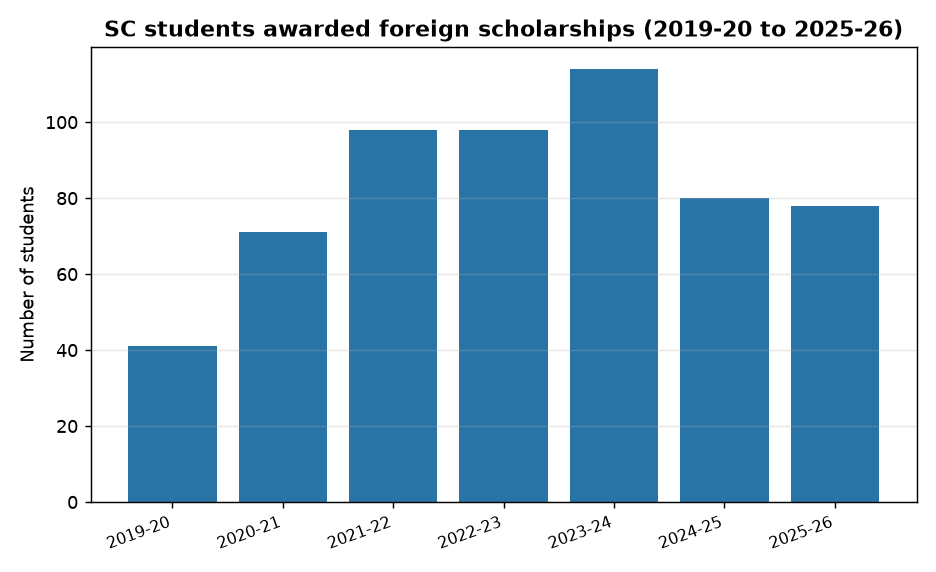
- Since 2019–20, the scheme has facilitated the participation of 580 SC students in foreign education, with a progressive increase in the number of beneficiaries over the years.
Key Features
| Feature | Significance |
|---|---|
| Digital Integration via e-Samavesh Portal | Streamlines application, verification, and fund disbursement processes, reducing bureaucratic delays and enhancing transparency for SC students pursuing higher education abroad. |
| Proactive Outreach Mechanisms | Includes departmental website disclosures, newspaper advertisements, and direct communication with state/UT welfare departments to improve awareness among eligible SC students. |
| Advance Fund Release to Missions/Embassies | Ensures timely financial allocation to Indian missions abroad for disbursement to universities and students, minimizing procedural bottlenecks. |
| State-wise Data Tracking (e.g., Andhra Pradesh) | Enables evidence-based policy refinement by monitoring beneficiary distribution across districts, facilitating targeted interventions for underrepresented regions. |
| Year-wise Distribution of Scholarships (2019-20 to 2025-26) | Demonstrates progressive scaling of the scheme, with fluctuations in allocation reflecting adaptive policy responses to demand and administrative capacity. |
Why it Matters
Educational Equity
- Facilitates access to global higher education for Scheduled Caste students, addressing historical disparities in educational opportunities.
- Promotes upward social mobility by enabling advanced academic pursuits in international institutions, thereby breaking intergenerational cycles of disadvantage.
- Supports the Union Government’s constitutional mandate under Article 46 to promote educational advancement among weaker sections.
Human Capital Development
- Enhances India’s knowledge capital by fostering globally competitive talent from marginalized communities, contributing to national innovation ecosystems.
- Encourages return migration of skilled professionals, potentially benefiting India’s socio-economic development through diaspora engagement.
- Aligns with Sustainable Development Goal 4 (Quality Education) by expanding access to tertiary education for underrepresented groups.
Administrative Efficiency
- Digital transformation of scholarship processes reduces corruption risks and improves accountability in fund utilization.
- Centralized data management via e-Samavesh enables real-time monitoring of scheme performance and beneficiary outcomes.
- Advance fund release mechanism ensures uninterrupted financial support, mitigating delays in student admissions abroad.
Challenges
1. Limited Awareness Among Target Groups
- Despite outreach efforts, many eligible SC students remain unaware of the scheme due to linguistic barriers, digital divide, or socio-economic constraints.
- Rural and remote areas, particularly in states like Andhra Pradesh, may experience lower participation due to inadequate dissemination of information.
UPSC Link: GS-II: Welfare schemes for vulnerable sections
2. Administrative Bottlenecks in Fund Disbursement
- Delays in fund release to missions/embassies or universities can disrupt student admissions, despite the advance mechanism.
- Complexity in verifying eligibility criteria and academic credentials may lead to procedural hurdles for applicants.
UPSC Link: GS-II: Public service delivery mechanisms
3. Geographical Disparities in Beneficiary Distribution
- Uneven distribution of scholarships across states and districts reflects systemic inequities in access to information and institutional support.
- States with weaker administrative capacity may struggle to identify and assist potential beneficiaries effectively.
UPSC Link: GS-II: Centre-State relations
4. Sustainability of Funding and Scalability
- Long-term viability of the scheme depends on consistent budgetary allocations amid competing fiscal priorities.
- Scaling up the scheme to accommodate higher demand may require enhanced coordination between central ministries and state agencies.
UPSC Link: GS-III: Resource mobilization
5. Monitoring and Impact Assessment
- Lack of robust mechanisms to track post-scholarship outcomes (e.g., graduation rates, career trajectories) limits evidence-based policy refinement.
- Data on return migration and employment outcomes of beneficiaries remains underutilized for assessing the scheme’s long-term impact.
UPSC Link: GS-II: Governance and accountability
Challenges — UPSC Perspective
| Issue | Concern |
|---|---|
| Awareness Gaps | Low participation due to inadequate dissemination of scheme details in regional languages or inaccessible formats. |
| Fund Disbursement Delays | Potential disruption in student admissions abroad due to procedural or logistical inefficiencies. |
| Geographical Imbalances | Concentration of beneficiaries in select states/districts, leaving others underrepresented. |
| Administrative Capacity | State/UT-level variations in implementing the scheme effectively, affecting outreach and verification. |
| Sustainability Risks | Dependence on annual budgetary allocations may limit the scheme’s scalability and long-term impact. |
| Outcome Tracking | Absence of systematic follow-up to measure the scheme’s effectiveness in achieving its educational equity goals. |
Government Initiatives — Must-Memorise for Prelims
- National Overseas Scholarship Scheme for Scheduled Castes (NOS-SC)
Way Forward
- Expand multi-lingual awareness campaigns through regional media, community leaders, and educational institutions to reach underserved SC students.
- Strengthen state-level nodal agencies with capacity-building programs to improve identification and facilitation of eligible beneficiaries.
- Integrate the scheme with existing skill development initiatives (e.g., PMKVY) to create a continuum of support for SC students from vocational to higher education.
- Establish a dedicated grievance redressal mechanism to address delays in fund disbursement or application processing.
- Pilot a mentorship program pairing past beneficiaries with prospective applicants to demystify the application process and reduce anxiety.
- Develop a real-time dashboard to monitor beneficiary distribution, fund utilization, and post-scholarship outcomes across states.
- Collaborate with Indian missions abroad to streamline university admissions and visa processes for NOS-SC recipients.
- Conduct periodic impact assessments to evaluate the scheme’s contribution to educational equity and socio-economic mobility.
UPSC Value Addition
Keywords for Mains Answer-Writing
National Overseas Scholarship Scheme · Scheduled Caste students · foreign education · social justice policy · educational equity · digital governance · inclusive education · Union Budget allocation for SC welfare · PMO’s role in scholarship disbursement · Article 46 of the Constitution · Ministry of Social Justice and Empowerment · e-governance in welfare schemes · international higher education access · financial inclusion of marginalised groups
Constitutional & Policy Linkages
- Article 46 (Directive Principles of State Policy): Promotion of educational and economic interests of weaker sections
Concept Flow
Identification of educational disparities among SC communities → Design of NOS-SC to bridge gaps → Digital integration via e-Samavesh for efficiency → Proactive outreach to enhance awareness → Timely fund disbursement to missions/universities → Admission and completion of higher education abroad → Return migration and knowledge transfer → Long-term socio-economic upliftment.
Prelims Practice Questions
Q1. Consider the following statements regarding the National Overseas Scholarship (NOS) Scheme for Scheduled Caste students:
1. The scheme is implemented by the Ministry of Education.
2. The scholarship covers tuition fees, maintenance allowance, and return airfare for studies abroad.
3. The scheme was launched in 2019.
4. The selection process is conducted through a dedicated online portal integrated with the e-Samarth platform.
How many of the above statements are correct?
- Only one
- Only two
- Only three
- All four
Answer: Only three — Statements 2 and 4 are correct. Statement 1 is incorrect as the scheme is implemented by the Ministry of Social Justice and Empowerment. Statement 3 is incorrect as the scheme predates 2019.
Q2. Assertion (A): The National Overseas Scholarship Scheme for Scheduled Caste students is designed to ensure equitable access to international higher education.
Reason (R): The scheme provides financial assistance exclusively to students from economically weaker sections within the Scheduled Caste category.
Code:
- Both A and R are true, and R is the correct explanation of A
- Both A and R are true, but R is NOT the correct explanation of A
- A is true but R is false
- A is false but R is true
Answer: A is false but R is true — Assertion (A) is true as the scheme aims to promote equitable access to international education for SC students. Reason (R) is false because the scheme does not restrict eligibility to economically weaker sections alone; it targets meritorious SC students regardless of economic background.
Q3. Match the following columns with respect to the National Overseas Scholarship Scheme:
Column I (Feature) | Column II (Description)
— | —
A. Eligibility Criteria | 1. Students must secure admission in top 500 global universities
B. Funding Components | 2. Includes tuition fees, maintenance allowance, and airfare
C. Selection Process | 3. Integrated with e-Samarth portal for digital applications
D. Implementation Authority | 4. Ministry of Social Justice and Empowerment
Choose the correct match:
- A-1, B-2, C-3, D-4
- A-3, B-1, C-2, D-4
- A-4, B-2, C-1, D-3
- A-2, B-3, C-1, D-4
Answer: A-1, B-2, C-3, D-4 — The correct matches are: A-1 (Eligibility criteria include admission in top 500 global universities), B-2 (Funding includes tuition fees, maintenance allowance, and airfare), C-3 (Selection process is integrated with the e-Samarth portal), D-4 (Implemented by the Ministry of Social Justice and Empowerment).
Mains Practice Question
✍ Critically examine the role of the National Overseas Scholarship (NOS) Scheme in promoting educational equity for Scheduled Caste students in India. How far has the scheme succeeded in bridging the socio-economic divide in access to international higher education? (15 Marks)
Approach: MODEL-ANSWER SKELETON:
1. **Introduction (2 Marks)**
– Briefly define the NOS Scheme: A centrally sponsored scheme under the Ministry of Social Justice and Empowerment, launched to provide financial assistance to meritorious Scheduled Caste students for pursuing higher education abroad.
– Constitutional and policy basis: Article 46 of the Constitution (Directive Principles of State Policy) mandates the State to promote educational and economic interests of weaker sections, including Scheduled Castes.
2. **Objectives and Mechanism (3 Marks)**
– Primary objectives: To enhance access to international higher education for SC students, reduce socio-economic disparities, and foster global exposure.
– Key features: Covers tuition fees, maintenance allowance, and return airfare; eligibility includes securing admission in top 500 global universities; integrated with e-Samarth portal for digital applications.
– Recent enhancements: Integration with e-Samarth platform (2024-25) to streamline application, verification, and disbursement processes.
3. **Achievements and Data (3 Marks)**
– Quantitative impact: From 2019-20 to 2025-26, 580 students benefited; year-wise distribution (41, 71, 98, 98, 114, 80, 78) shows increasing awareness and participation.
– State-wise distribution: Highlight data from Andhra Pradesh (18 beneficiaries) to illustrate regional inclusivity.
– Awareness campaigns: Use of departmental websites, newspaper advertisements, and coordination with state welfare departments.
4. **Challenges and Limitations (4 Marks)**
– **Structural barriers**: High cost of international education, limited awareness among rural SC communities, and competition from domestic opportunities.
– **Implementation gaps**: Delay in disbursement of funds (highlighted by the use of advance release of funds to Indian missions), bureaucratic hurdles in verification processes.
– **Sustainability concerns**: Dependency on central funding; lack of long-term mentorship or post-graduation support for beneficiaries.
– **Equity concerns**: Whether the scheme disproportionately benefits urban, already privileged SC students, exacerbating intra-caste disparities.
5. **Comparative Perspective (2 Marks)**
– Compare with other scholarship schemes (e.g., Maulana Azad National Fellowship for minority students, INSPIRE for ST students) to highlight the NOS Scheme’s unique focus on international education.
– Reference to global best practices: Cite examples of countries (e.g., China, Brazil) where government-sponsored international scholarships have successfully bridged educational divides.
6. **Way Forward (1 Mark)**
– Suggest measures: Expand the scope to include ST and OBC students; introduce a mentorship program; leverage public-private partnerships for additional funding; and conduct periodic impact assessments.
**Balanced Conclusion**: While the NOS Scheme has made significant strides in promoting educational equity for SC students, its success is constrained by structural, implementation, and equity challenges. A multi-dimensional approach—combining financial assistance, awareness campaigns, and post-scholarship support—is essential for sustained impact.
Source: PIB (Press Information Bureau)
Generated by AanyaAi for educational purpose.

- संसदीय कार्य मंत्री ने 2026 में ‘स्वच्छता ही सेवा’ अभियान के तहत श्रमदान किया - October 1, 2026
- TDB halts Research Innovation Scheme invitations: Key reasons explained - October 1, 2026
- कर्नाटक में 1971 के बाद सबसे खराब मानसून: 35% बारिश की कमी, जानें पूरा मामला - October 1, 2026

No Comments