


11 Aug UPSC Alert: 580 SC Students Benefit from National Overseas Scholarship Scheme (2019-26)
✎ The National Overseas Scholarship (NOS) scheme, implemented by the Ministry of Social Justice and Empowerment, provides financial assistance to Scheduled Caste students for higher education abroad, with 580 beneficiaries between…
Subject Relevance — Where This Topic Fits
- GS Paper II — Governance, Transparency and Accountability (Public Policy and Schemes) | GS Paper II — Social Justice and Empowerment (Welfare Schemes for Marginalised Groups) | GS Paper III — Human Resource Development and Skill Development
- Prelims: National Overseas Scholarship (NOS), Scheduled Castes (SCs), Social Justice and Empowerment Ministry, Integrated Inclusion Portal (IIP), Foreign Education LoCs (Letters of Credit), Digital Governance, Awareness Campaigns for Welfare Schemes
- Essay: Equity in Education: Bridging the Global Divide for Marginalised Communities, Digital Governance and Inclusive Development: Transforming Access to Opportunities
Quick Revision: The National Overseas Scholarship (NOS) scheme, implemented by the Ministry of Social Justice and Empowerment, provides financial assistance to Scheduled Caste students for higher education abroad, with 580 beneficiaries between 2019-20 and 2025-26, and is now integrated into the Integrated Inclusion Portal (IIP) for streamlined governance.
Why is this in the news?
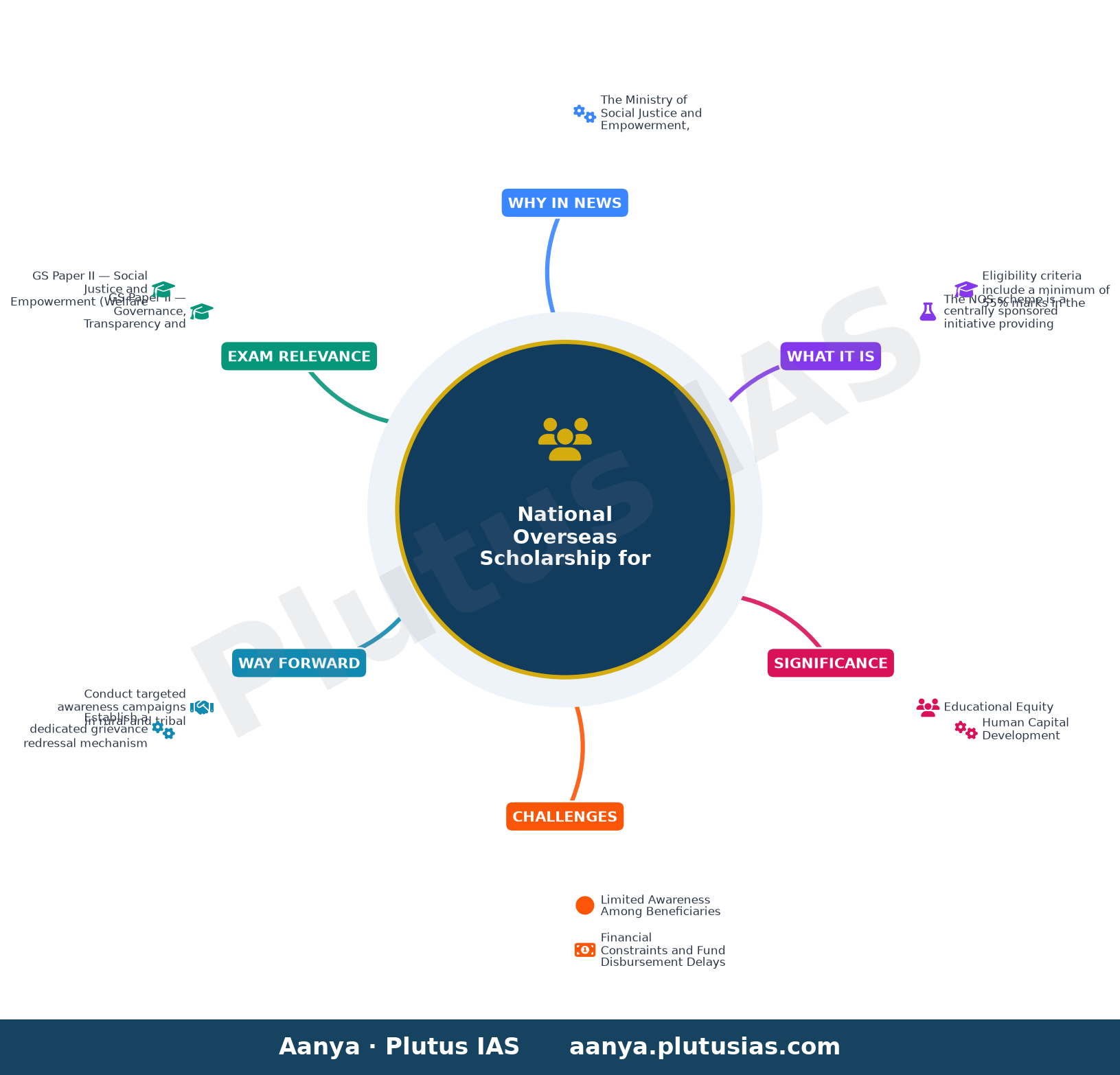
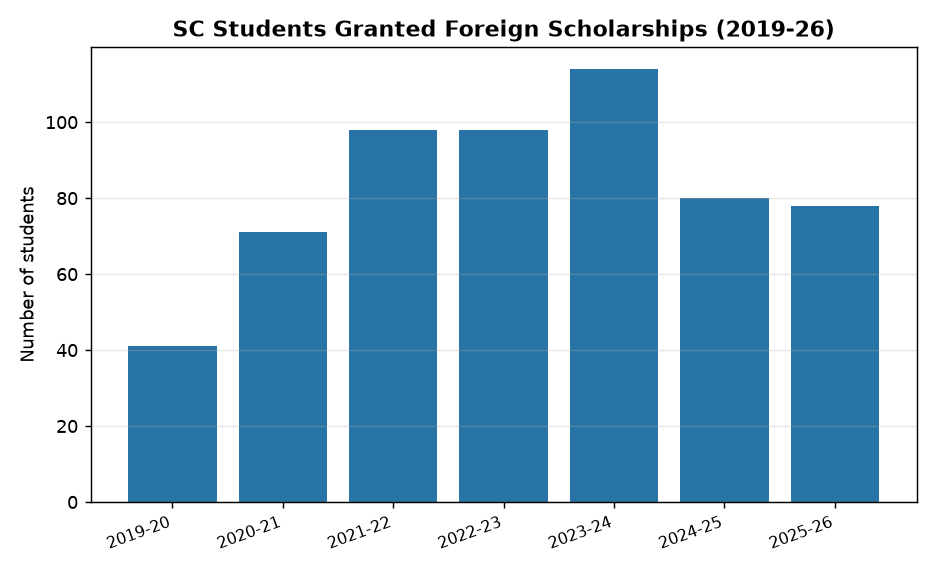
The Ministry of Social Justice and Empowerment, Government of India, has highlighted the expansion of access to the National Overseas Scholarship (NOS) for Scheduled Caste (SC) students through enhanced digital governance, streamlined processes, and targeted awareness campaigns. Between 2019-20 and 2025-26, 580 SC students availed the scholarship to pursue higher education abroad, with a notable increase in beneficiaries year-on-year. The integration of the NOS scheme into the Integrated Inclusion Portal (IIP) and the adoption of advanced digital tools underscore the government’s commitment to inclusive development and equitable access to global educational opportunities.
Background
- The National Overseas Scholarship (NOS) scheme was launched to provide financial assistance to meritorious Scheduled Caste (SC) students for pursuing higher education abroad, addressing historical disparities in access to global educational opportunities.
- The scheme is implemented by the Ministry of Social Justice and Empowerment, Government of India, and aligns with constitutional provisions under Article 15(4) and Article 46, which mandate the promotion of educational and economic interests of weaker sections of society.
- Prior to the digital integration, the application, verification, and fund disbursement processes were fragmented, leading to delays and inefficiencies in reaching eligible beneficiaries.
- The scheme is part of a broader framework of affirmative action policies aimed at reducing socio-economic inequalities and fostering social mobility among marginalised communities.
- The NOS scheme complements domestic scholarships and reservation policies, ensuring that SC students are not disadvantaged in the pursuit of international education due to financial constraints.
- The integration of the NOS scheme into the Integrated Inclusion Portal (IIP) reflects a shift towards unified, citizen-centric governance, leveraging technology to enhance transparency and accessibility.
What is the National Overseas Scholarship (NOS) Scheme?
- The NOS scheme is a centrally sponsored initiative providing financial assistance to Scheduled Caste (SC) students for pursuing Master’s, PhD, or post-doctoral studies abroad in specified fields such as Engineering, Pure Sciences, Agriculture, Medicine, and Social Sciences.
- Eligibility criteria include a minimum of 55% marks in the qualifying examination, an annual family income not exceeding ₹8.00 lakh, and age limits prescribed for different levels of study (typically up to 35 years for Master’s and 40 years for PhD).
- The scholarship covers tuition fees, maintenance allowance, contingency allowance, visa fees, and airfare, with the quantum of financial support varying based on the level of study and the country of study.
- The selection process is merit-based, with a reservation of 50% for women candidates to promote gender inclusivity within the SC community.
- Since 2024-25, the NOS scheme has been integrated into the Integrated Inclusion Portal (IIP), a unified digital platform designed to streamline application, verification, fund management, and monitoring processes.
- Awareness campaigns, including advertisements in print media and outreach to state welfare departments, are conducted to ensure that eligible SC students are informed about the scheme’s provisions and application procedures.
- The scheme’s implementation is monitored through a robust data management system to track beneficiaries, disbursements, and outcomes, ensuring accountability and transparency in fund utilisation.
Key Features
| Feature | Significance |
|---|---|
| Target beneficiaries | Exclusively for Scheduled Caste (SC) students, addressing historical educational disparities and promoting equitable access to global higher education opportunities. |
| Digital application portal | Streamlines the application, verification, and disbursement process, reducing bureaucratic delays and enhancing transparency for SC students. |
| Integrated Samavesh Portal inclusion | Centralises data management, eligibility checks, and fund disbursement, ensuring efficient and accountable implementation of the scheme. |
| Pre-authorisation of funds to Indian Missions/Embassies | Enables timely release of scholarship amounts to foreign universities, mitigating financial barriers for SC students pursuing education abroad. |
| Multi-channel awareness campaigns | Uses departmental websites, newspaper advertisements, and state/UT welfare departments to disseminate scheme details, increasing reach and participation among SC students. |
Why it Matters
Educational Equity
- Bridges the educational divide by providing SC students with access to international academic institutions, fostering skill development and global exposure.
- Complements affirmative action policies under Articles 15(4) and 16(4) of the Constitution, ensuring substantive equality in higher education.
- Encourages upward mobility and socio-economic upliftment of marginalised communities through quality foreign education.
Human Capital Development
- Enhances the quality of India’s human resource base by enabling SC students to acquire advanced technical, scientific, and managerial skills abroad.
- Promotes research collaboration and knowledge transfer between Indian and foreign institutions, benefiting the broader academic ecosystem.
- Supports India’s goal of becoming a global knowledge hub by nurturing a globally competitive workforce.
Governance and Transparency
- Demonstrates the efficacy of digital governance in welfare delivery, reducing leakages and ensuring targeted fund utilisation.
- Sets a precedent for integrating welfare schemes with centralised portals (e.g., Samavesh), improving inter-departmental coordination.
- Enhances accountability through pre-authorisation of funds and real-time tracking of scholarship disbursement.
Social Inclusion
- Strengthens social cohesion by providing equal opportunities for SC students to participate in global educational platforms.
- Reduces caste-based educational disparities, aligning with the objectives of the Constitution’s Preamble and Directive Principles (Article 46).
- Fosters a more inclusive higher education ecosystem, reducing exclusionary practices in elite foreign institutions.
Challenges
1. Limited Awareness Among Beneficiaries
- Despite multi-channel campaigns, awareness gaps persist, particularly in rural and remote SC communities.
- Language barriers and digital illiteracy may hinder effective dissemination of scheme details.
- Need for targeted outreach in SC-concentrated districts to ensure equitable participation.
UPSC Link: GS2: Welfare Schemes
2. Financial Constraints and Fund Disbursement Delays
- Pre-authorisation of funds to Missions/Embassies may face administrative bottlenecks, delaying scholarship disbursement.
- Fluctuations in foreign exchange rates can impact the purchasing power of scholarship amounts.
- Requires robust financial planning to ensure uninterrupted disbursement over multi-year periods.
UPSC Link: GS3: Financial Inclusion
3. Quality Assurance in Foreign Institutions
- Ensuring the credibility and academic rigour of foreign universities selected by beneficiaries remains a challenge.
- Lack of standardised recognition mechanisms for foreign degrees in India may limit post-graduation opportunities.
- Requires collaboration with foreign accreditation bodies to validate institutional quality.
UPSC Link: GS2: Education
4. Sustainability and Scalability
- Scaling the scheme to accommodate a larger number of SC students may strain budgetary allocations.
- Long-term sustainability depends on periodic reviews of scholarship amounts and eligibility criteria.
- Need for public-private partnerships to augment funding and expand the scope of the scheme.
UPSC Link: GS3: Economic Development
5. Monitoring and Evaluation
- Tracking the post-graduation outcomes of scholarship recipients (e.g., employment, entrepreneurship) is critical but often overlooked.
- Lack of a centralised database for alumni networks limits longitudinal impact assessment.
- Requires a robust MIS system to measure scheme effectiveness and identify areas for improvement.
UPSC Link: GS2: Governance
Challenges — UPSC Perspective
| Issue | Concern |
|---|---|
| Low participation from rural SC students | Limited internet access and digital literacy in rural areas hinder application processes. |
| Bureaucratic delays in fund disbursement | Administrative hurdles in pre-authorisation and transfer of funds to Missions/Embassies. |
| Lack of standardised recognition of foreign degrees | Potential barriers to career progression post-graduation due to non-recognition of degrees in India. |
| Inadequate post-scholarship support | Absence of mentorship or career guidance for scholarship recipients after completing foreign education. |
| Geographical imbalances in beneficiary distribution | Concentration of beneficiaries in select states/UTs (e.g., Maharashtra, Delhi) with limited representation from underrepresented regions. |
| Dependence on foreign exchange fluctuations | Volatility in currency exchange rates may reduce the real value of scholarship amounts. |
Government Initiatives — Must-Memorise for Prelims
- National Overseas Scholarship (NOS) for Scheduled Castes
- Integrated Samavesh Portal (Ministry of Social Justice and Empowerment)
- Post-Matric Scholarship Scheme for SCs (for domestic higher education)
Way Forward
- Conduct targeted awareness campaigns in rural and tribal SC communities through local self-government bodies (Panchayats, Municipalities).
- Establish a dedicated grievance redressal mechanism for scholarship applicants to address delays and discrepancies.
- Collaborate with the Ministry of External Affairs to streamline fund disbursement to Indian Missions/Embassies via digital channels.
- Introduce a standardised recognition framework for foreign degrees obtained under the NOS scheme to facilitate career progression.
- Expand the scope of the scheme to include short-term research fellowships and exchange programmes for SC students.
- Develop a centralised alumni network for NOS beneficiaries to foster peer learning and mentorship.
- Integrate the NOS scheme with skill development initiatives under the Skill India Mission for holistic career support.
- Conduct periodic impact assessments to evaluate the socio-economic outcomes of scholarship recipients and refine eligibility criteria.
UPSC Value Addition
Keywords for Mains Answer-Writing
Scheduled Castes · National Overseas Scholarship (NOS) Scheme · Social Justice and Empowerment Ministry · Foreign Education · Digital Governance · Digital Public Infrastructure · Inclusive Access · Affirmative Action · Higher Education Policy · Scheduled Caste Welfare · E-governance in Scholarships · International Mobility of Students
Constitutional & Policy Linkages
- Article 15(4): Special provisions for the advancement of socially and educationally backward classes.
- Article 16(4): Reservation in services for backward classes.
- Article 46: Promotion of educational and economic interests of Scheduled Castes.
- Preamble: Justice, Liberty, Equality, and Fraternity (social justice dimension).
Concept Flow
Historical educational disparities → Constitutional mandate for social justice (Articles 15(4), 46) → Policy intervention: National Overseas Scholarship (NOS) scheme → Digital governance integration (Samavesh Portal) → Targeted awareness and outreach → Application and selection process → Fund disbursement to Missions/Embassies → Enrolment in foreign universities → Post-graduation outcomes (employment, entrepreneurship) → Socio-economic upliftment and national human capital development.
Prelims Practice Questions
Q1. Consider the following statements regarding the National Overseas Scholarship (NOS) Scheme for Scheduled Castes:
1. The NOS Scheme provides financial assistance to SC students for pursuing higher education abroad.
2. The scheme is implemented by the Ministry of Education.
3. The application process for the scheme is entirely online.
4. The scheme mandates that funds are disbursed to students through their respective Indian Missions/Embassies.
How many of the above statements are correct?
- Only one
- Only two
- Only three
- All four
Answer: All four — Statements 1, 3, and 4 are correct. Statement 2 is incorrect as the NOS Scheme is implemented by the Ministry of Social Justice and Empowerment, not the Ministry of Education.
Q2. Assertion (A): The National Overseas Scholarship (NOS) Scheme for Scheduled Castes includes provisions for advance disbursement of funds to Indian Missions/Embassies.
Reason (R): This mechanism ensures timely financial support to students for securing admissions in foreign universities.
In the context of the above two statements, which one of the following is correct?
- Both A and R are true, and R is the correct explanation of A
- Both A and R are true, but R is not the correct explanation of A
- A is true, but R is false
- A is false, but R is true
Answer: Both A and R are true, but R is not the correct explanation of A — Both the Assertion (A) and Reason (R) are true, and R correctly explains A. The NOS Scheme provides for advance disbursement of funds to Indian Missions/Embassies to ensure timely financial support to students.
Q3. Match the following columns related to the National Overseas Scholarship (NOS) Scheme:
Column I (Year) | Column II (Number of Beneficiaries)
—————-|——————————-
A. 2019-20 | 1. 114
B. 2020-21 | 2. 41
C. 2022-23 | 3. 71
D. 2023-24 | 4. 98
Select the correct match:
- A-2, B-3, C-4, D-1
- A-1, B-2, C-3, D-4
- A-3, B-1, C-2, D-4
- A-4, B-3, C-1, D-2
Answer: A-2, B-3, C-4, D-1 — The correct matches are: A (2019-20) – 41 beneficiaries, B (2020-21) – 71 beneficiaries, C (2022-23) – 98 beneficiaries, D (2023-24) – 114 beneficiaries.
Mains Practice Question
✍ The National Overseas Scholarship (NOS) Scheme for Scheduled Castes represents a significant intervention in promoting inclusive access to higher education abroad. Critically examine the scheme’s objectives, operational mechanisms, and its role in addressing socio-economic disparities. Also, analyse the challenges in its implementation and suggest measures to enhance its efficacy. (15 Marks)
Approach: MODEL-ANSWER SKELETON:
1. **Objectives of the NOS Scheme**
– Primary objective: To provide financial assistance to Scheduled Caste students for pursuing higher education abroad in specified fields (e.g., engineering, management, pure sciences, applied sciences, medicine, international business, economics, and social sciences).
– Broader goal: To reduce socio-economic disparities by enabling access to global educational opportunities, thereby enhancing employability and socio-economic mobility.
– Alignment with constitutional provisions: Articles 15(4), 16(4), and 46 of the Indian Constitution, which mandate affirmative action for socially and educationally backward classes.
2. **Operational Mechanisms**
– **Eligibility Criteria**: Age limit (35 years for PhD, 30 years for Master’s), income ceiling (₹6.0 lakh per annum for the family), and academic qualifications (minimum 55% marks in qualifying degree).
– **Selection Process**: Merit-based selection through a transparent process, including shortlisting and interviews.
– **Digital Governance**: Online application portal, integration with the ‘E-Saksham’ (now ‘Integrated Samavesh’) portal for streamlined processes, and real-time tracking of applications.
– **Fund Disbursement**: Advance disbursement of funds to Indian Missions/Embassies, which act as nodal agencies for further distribution to students and universities.
– **Awareness and Outreach**: Multi-channel dissemination (departmental website, newspaper advertisements, coordination with state governments, and social media).
3. **Role in Addressing Socio-Economic Disparities**
– **Empirical Evidence**: Data from 2019-20 to 2025-26 shows 580 beneficiaries, with a gradual increase in the number of awardees, indicating growing awareness and participation.
– **Geographical Spread**: Beneficiaries from states like Andhra Pradesh, Maharashtra, Tamil Nadu, and others, reflecting inclusive reach across regions.
– **Field of Study**: Focus on STEM and professional courses, aligning with global demand and enhancing skill sets for India’s development.
4. **Challenges in Implementation**
– **Awareness Gaps**: Limited reach in rural and remote areas, despite efforts like newspaper advertisements and state-level coordination.
– **Digital Divide**: Dependence on online processes may exclude students from digitally disadvantaged backgrounds.
– **Timely Disbursement**: Delays in fund disbursement can hinder students’ ability to secure admissions or visas.
– **Bureaucratic Hurdles**: Complexities in coordination between central ministries, state governments, and Indian Missions.
– **Sustainability**: Long-term funding and scalability to accommodate increasing demand.
5. **Measures to Enhance Efficacy**
– **Grassroots Awareness**: Leveraging local bodies (panchayats, municipal corporations) and NGOs to disseminate information in regional languages.
– **Digital Inclusion**: Offline application support centers in collaboration with post offices, Common Service Centers (CSCs), and educational institutions.
– **Simplified Processes**: Reducing documentation requirements and introducing AI-driven pre-screening to expedite selection.
– **Monitoring and Evaluation**: Real-time tracking of fund disbursement and beneficiary feedback to address bottlenecks.
– **Partnerships**: Collaborations with foreign universities, alumni networks, and corporate sponsors to provide additional support (e.g., tuition fee waivers, mentorship).
6. **Conclusion**
– The NOS Scheme is a pivotal tool for social justice and inclusive growth, but its success hinges on addressing implementation challenges through multi-stakeholder collaboration and adaptive governance.
Source: PIB (Press Information Bureau)
Generated by AanyaAi for educational purpose.

- झारखंड हाईकोर्ट ने रांची के जलाशयों पर अतिक्रमण पर लिया सख्त रुख, सरकार से रिपोर्ट मांगी - October 1, 2026
- Andhra’s ₹76,000 Cr Pension Expenditure: UPSC Economy Insights - October 1, 2026
- आंध्र प्रदेश सरकार 34% पिछड़ा वर्ग आरक्षण पर सुप्रीम कोर्ट जाएगी, मुख्यमंत्री बोले- लड़ाई खत्म नहीं हुई - October 1, 2026

No Comments