


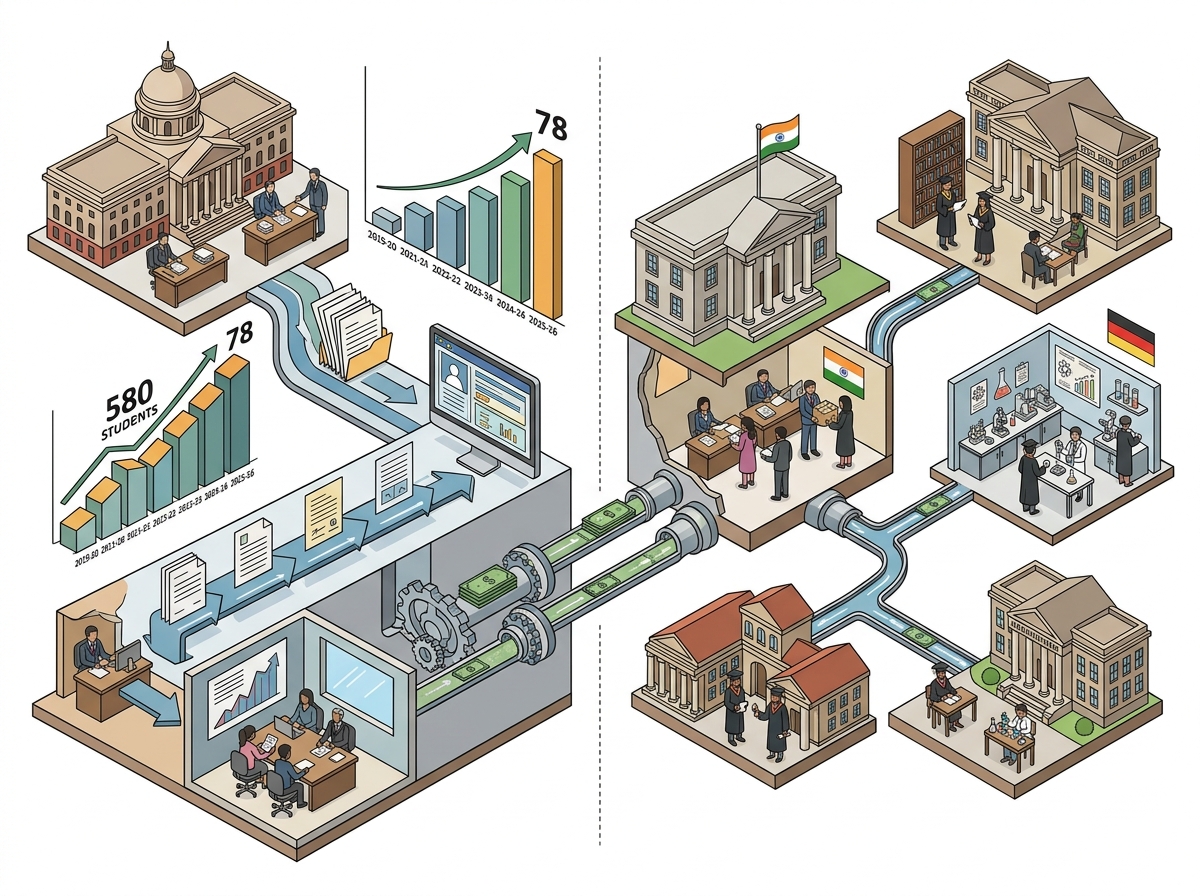
11 Aug UPSC Alert: 580 SC Students Benefited from National Overseas Scholarship Scheme (2019-26)
✎ The National Overseas Scholarship (NOS) scheme, administered by the Ministry of Social Justice and Empowerment, provides financial assistance to Scheduled Caste students for higher education abroad, with 580 beneficiaries…
Subject Relevance — Where This Topic Fits
- GS Paper II — Social Justice and Empowerment | GS Paper II — Welfare Schemes for Vulnerable Sections
- Prelims: Scheduled Castes and Scheduled Tribes (Prevention of Atrocities) Act, 1989, National Overseas Scholarship (NOS), Social Justice and Empowerment Ministry, Digital Public Infrastructure, Direct Benefit Transfer (DBT), Lok Sabha Questions, Press Information Bureau (PIB), Integrated Samavesh Portal
- Essay: Inclusive growth and equitable access to global education: A case study of India’s affirmative action policies
Quick Revision: The National Overseas Scholarship (NOS) scheme, administered by the Ministry of Social Justice and Empowerment, provides financial assistance to Scheduled Caste students for higher education abroad, with 580 beneficiaries recorded between 2019–20 and 2025–26, facilitated by digital governance reforms and streamlined fund disbursement mechanisms.
Why is this in the news?
The Union Ministry of Social Justice and Empowerment, in a written reply to a Lok Sabha question on 11 August 2026, reported that 580 Scheduled Caste (SC) students had availed the National Overseas Scholarship (NOS) between 2019–20 and 2025–26, with 78 students benefiting in the final year of the reporting period. The government highlighted measures to streamline application, disbursement, and outreach to improve access to foreign higher education for SC students, including integration with the Integrated Samavesh Portal and advance release of funds to Indian missions for timely distribution.
Background
- The National Overseas Scholarship (NOS) scheme was launched to provide financial assistance to meritorious Scheduled Caste students for pursuing higher education abroad, thereby promoting social inclusion and equitable access to global academic opportunities.
- Prior to 2019, the NOS scheme had limited outreach, with fewer than 50 beneficiaries annually, reflecting systemic barriers in awareness, application processes, and fund disbursement.
- The government has progressively increased the allocation and outreach of the NOS scheme, aligning it with the Digital India initiative to enhance transparency and efficiency in service delivery.
- The Integrated Samavesh Portal, launched as part of the government’s digital governance reforms, serves as a unified platform for multiple welfare schemes, including NOS, to simplify access and reduce procedural delays.
- State governments and Union Territory administrations play a critical role in identifying eligible candidates and disseminating information about the scheme through their welfare departments.
What is the National Overseas Scholarship (NOS) Scheme?
- The NOS scheme is aimed at providing financial support to Scheduled Caste students for pursuing master’s, PhD, or post-doctoral studies abroad in specified fields of study.
- Eligible fields of study include Engineering, Pure Sciences, Agricultural Sciences, Medicine, Commerce, Accounting, and Management, among others, as notified by the Ministry from time to time.
- The scholarship covers tuition fees, maintenance allowance, contingency allowance, and airfare, subject to prescribed ceilings and guidelines.
- The scheme is open to Scheduled Caste students who have secured admission in a foreign university ranked within the top 500 globally or in an institution of repute as specified by the Ministry.
- Selection is based on academic merit, financial need, and the relevance of the proposed course to India’s developmental priorities, with a preference for students from economically weaker sections.
- The application process is entirely online, with documents verified digitally to ensure transparency and reduce manual interference.
- Funds are disbursed directly to Indian missions abroad, which then transfer the amount to the concerned universities or students within stipulated timelines to avoid delays.
- The scheme also includes provisions for pre-departure orientation and post-award support to ensure smooth academic and cultural transition for beneficiaries.
Key Features
| Feature | Significance |
|---|---|
| Digitalisation of application and disbursement process | Enhances transparency, reduces delays, and ensures equitable access through a single-window portal (e-Integrated Samavesh Portal). |
| Pre-authorisation of funds to Indian Missions/Embassies | Facilitates prompt disbursement of scholarship amounts to students and universities upon receipt of claims, minimising financial bottlenecks. |
| Multi-channel awareness campaigns | Includes departmental website disclosures, newspaper advertisements, and coordination with state/UT welfare departments to ensure wide reach among SC students. |
| Year-wise scholarship distribution data | Demonstrates progressive increase in beneficiaries from 41 (2019-20) to 114 (2023-24), reflecting scaled-up implementation and outreach. |
| State-specific beneficiary tracking (e.g., Andhra Pradesh) | Illustrates targeted implementation and regional distribution of scholarships, aiding policy evaluation and corrective measures. |
Why it Matters
Social Inclusion and Equity
- Advances constitutional mandate under Article 15(4) and Article 46 to promote educational opportunities for Scheduled Castes by enabling access to global higher education.
- Reduces socio-economic disparities by providing financial support for advanced studies abroad, thereby enhancing human capital formation within marginalised communities.
- Aligns with Sustainable Development Goal 4 (Quality Education) and Goal 10 (Reduced Inequalities) by addressing structural barriers to international education.
Human Capital Development
- Facilitates acquisition of cutting-edge knowledge and skills by SC students, which can be repatriated to contribute to India’s innovation ecosystem.
- Encourages return migration or diaspora engagement, fostering knowledge transfer and international collaboration in research and development.
- Supports India’s strategic goals of becoming a global knowledge hub by nurturing a globally competitive talent pool from all social segments.
Governance and Administrative Efficiency
- Demonstrates the efficacy of digital governance (e.g., e-Samavesh Portal) in streamlining welfare delivery, reducing leakages, and improving service delivery timelines.
- Highlights inter-departmental coordination between the Ministry of Social Justice and Empowerment, Indian Missions, and state welfare departments for seamless implementation.
- Provides a replicable model for other centrally sponsored scholarship schemes targeting marginalised groups.
Challenges
1. Limited Awareness and Outreach
- Despite multi-channel campaigns, awareness gaps persist among eligible SC students, particularly in remote and rural areas, leading to underutilisation of the scheme.
- Dependence on state/UT departments for dissemination may result in uneven outreach due to varying administrative capacities.
UPSC Link: GS-II: Welfare Schemes for Vulnerable Sections
2. Financial and Administrative Delays
- Pre-authorisation of funds to missions does not eliminate all procedural delays, especially in cases of delayed claim submissions or documentation requirements.
- Exchange rate fluctuations and inflation in host countries may erode the real value of fixed scholarship amounts over time.
UPSC Link: GS-III: Public Finance and Budgetary Process
3. Eligibility and Selection Rigor
- Stringent eligibility criteria (e.g., income thresholds, academic merit) may inadvertently exclude deserving candidates from economically weaker sections within SC communities.
- Lack of standardised selection processes across states could lead to inconsistencies in beneficiary identification.
UPSC Link: GS-II: Reservation Policies and Affirmative Action
4. Return and Utilisation Commitments
- No enforceable mechanism exists to ensure beneficiaries return to India post-graduation or utilise acquired skills domestically, risking brain drain.
- Limited tracking of alumni outcomes hampers assessment of the scheme’s long-term impact on career trajectories and social mobility.
UPSC Link: GS-III: Skill Development and Employment
5. Geographical Disparities in Beneficiary Distribution
- Concentration of beneficiaries in select states (e.g., Andhra Pradesh) suggests regional imbalances in access, possibly due to local awareness campaigns or pre-existing educational infrastructure.
- Underrepresentation of SC students from North-Eastern states and Union Territories indicates systemic gaps in outreach.
UPSC Link: GS-II: Regional Disparities in Development
Challenges — UPSC Perspective
| Issue | Concern |
|---|---|
| Awareness Gaps | Uneven dissemination of scheme details, leading to suboptimal participation rates among eligible SC students. |
| Procedural Delays | Administrative bottlenecks in fund disbursement and claim processing, affecting timely support to students. |
| Eligibility Constraints | Rigid income and merit criteria may exclude marginalised SC students with high potential but limited prior exposure to competitive education systems. |
| Brain Drain Risk | Absence of binding return commitments post-graduation, raising concerns about long-term loss of skilled human capital. |
| Regional Imbalances | Disproportionate beneficiary distribution across states, reflecting disparities in local administrative capacity and awareness. |
| Monitoring and Evaluation | Limited post-scholarship tracking of alumni outcomes, impeding evidence-based policy refinement. |
Government Initiatives — Must-Memorise for Prelims
- National Overseas Scholarship (NOS) for Scheduled Castes
Way Forward
- Expand multi-lingual and hyper-local awareness campaigns in collaboration with SC communities, NGOs, and educational institutions to bridge outreach gaps.
- Introduce dynamic scholarship amounts indexed to inflation and exchange rates to preserve the real value of financial support over time.
- Develop a centralised alumni network for beneficiaries to track career progression, facilitate return migration, and leverage diaspora networks for knowledge exchange.
- Standardise eligibility and selection criteria across states while incorporating flexibility for economically weaker sections within SC communities.
- Strengthen inter-ministerial coordination with the Ministry of External Affairs and state welfare departments to ensure seamless fund disbursement and reduce procedural delays.
- Pilot a ‘bond-to-serve’ mechanism for high-value scholarships, with provisions for repayment or service obligations in critical sectors upon return to India.
- Enhance monitoring through real-time dashboards and third-party evaluations to assess the scheme’s impact on social mobility, employment, and skill utilisation.
- Establish regional hubs in underrepresented states to provide pre-departure orientation, mentorship, and post-graduation support to SC students.
UPSC Value Addition
Keywords for Mains Answer-Writing
National Overseas Scholarship (NOS) Scheme · Scheduled Castes (SC) students · Foreign education scholarships · Social Justice and Empowerment Ministry · Digital governance in scholarships · Integrated Samavesh Portal · Equity in higher education · Foreign university admissions · Scheduled Castes Welfare · Digital access to welfare schemes
Constitutional & Policy Linkages
- Article 15(4): Special provisions for advancement of socially and educationally backward classes.
- Article 46: Promotion of educational and economic interests of Scheduled Castes.
Concept Flow
Constitutional mandate for social justice (Article 15(4), Article 46) → Policy formulation of NOS scheme → Digitalisation of application and disbursement (e-Samavesh Portal) → Multi-channel awareness campaigns → Beneficiary selection and fund pre-authorisation → Disbursement to Indian Missions → Timely funding to students/universities → Access to global higher education for SC students → Potential for knowledge repatriation and skill utilisation → Long-term impact on social mobility and equity.
Prelims Practice Questions
Q1. Consider the following statements regarding the National Overseas Scholarship (NOS) Scheme for Scheduled Castes (SC) students:
1. The NOS Scheme is administered by the Ministry of Social Justice and Empowerment.
2. The scheme provides financial assistance for SC students to pursue higher education abroad.
3. The application process for the NOS Scheme is entirely offline.
4. The scheme includes provisions for advance release of funds to Indian Missions/Embassies.
How many of the above statements are correct?
- Only one
- Only two
- Only three
- All four
Answer: Only three — Statements 1, 2, and 4 are correct. Statement 3 is incorrect as the application process is conducted through an online portal, including the recently integrated Samavesh Portal.
Q2. Which of the following is the primary objective of the Integrated Samavesh Portal in the context of the National Overseas Scholarship (NOS) Scheme?
- A. To provide a single-window platform for all welfare schemes under the Ministry of Social Justice and Empowerment
- B. To streamline the application, verification, and fund disbursement processes for the NOS Scheme
- C. To facilitate direct admission of SC students in foreign universities
- D. To conduct entrance examinations for SC students seeking foreign education
Answer: B. To streamline the application, verification, and fund disbursement processes for the NOS Scheme — The Integrated Samavesh Portal serves as a unified access mechanism to streamline processes such as application, verification, data management, and fund disbursement for the NOS Scheme.
Q3. Assertion (A): The National Overseas Scholarship (NOS) Scheme mandates advance release of funds to Indian Missions/Embassies for disbursement to students.
Reason (R): This mechanism ensures timely financial support to SC students for foreign education.
Code:
- Both A and R are true, and R is the correct explanation of A.
- Both A and R are true, but R is not the correct explanation of A.
- A is true, but R is false.
- A is false, but R is true.
Answer: Both A and R are true, and R is the correct explanation of A. — Both the assertion and reason are true. The advance release of funds to Indian Missions/Embassies is a designed mechanism to ensure timely financial support to SC students, making R the correct explanation of A.
Mains Practice Question
✍ Critically examine the role of the National Overseas Scholarship (NOS) Scheme in promoting equity in higher education for Scheduled Castes (SC) students. Also, evaluate the effectiveness of the Integrated Samavesh Portal in enhancing accessibility and efficiency of the scheme. (15 Marks)
Approach: MODEL-ANSWER SKELETON:
1. **Introduction (2 Marks)**
– Define the NOS Scheme: A centrally sponsored scheme under the Ministry of Social Justice and Empowerment for SC students to pursue master’s and PhD degrees abroad.
– Objective: To provide financial assistance for tuition, maintenance, and travel expenses to reduce disparities in access to global educational opportunities.
2. **Role in Promoting Equity (6 Marks)**
– **Access to Global Education**: Highlight the scheme’s contribution to bridging the gap between SC students and their peers from privileged backgrounds in accessing foreign education.
– **Financial Barriers**: Discuss how the scheme addresses economic constraints faced by SC students, enabling them to compete on par with other candidates.
– **Data Evidence**: Reference the provided data (580 students from 2019-20 to 2025-26) to illustrate the scheme’s reach and impact.
– **State-wise Distribution**: Mention the inclusion of states like Andhra Pradesh and the distribution across districts to demonstrate geographical equity.
– **Limitations**: Critique the scheme’s coverage—only 580 students over 7 years—highlighting the need for expansion to meet the demand.
3. **Integrated Samavesh Portal: Effectiveness (5 Marks)**
– **Streamlining Processes**: Explain how the portal integrates application, verification, and fund disbursement, reducing bureaucratic delays.
– **Digital Governance**: Discuss the role of digital platforms in improving transparency, accessibility, and reducing corruption.
– **Awareness and Outreach**: Acknowledge the portal’s role in disseminating guidelines and facilitating applications, though note that offline methods (newspaper ads, state government coordination) still play a role.
– **Challenges**: Potential issues like digital divide, internet accessibility in rural areas, and the need for continuous monitoring.
4. **Conclusion (2 Marks)**
– Summarize the scheme’s contribution to equity in higher education.
– Emphasize the need for scalability, digital inclusivity, and periodic reviews to enhance the scheme’s effectiveness. Address any unintended consequences or gaps in implementation.
Source: PIB (Press Information Bureau)
Generated by AanyaAi for educational purpose.


No Comments