


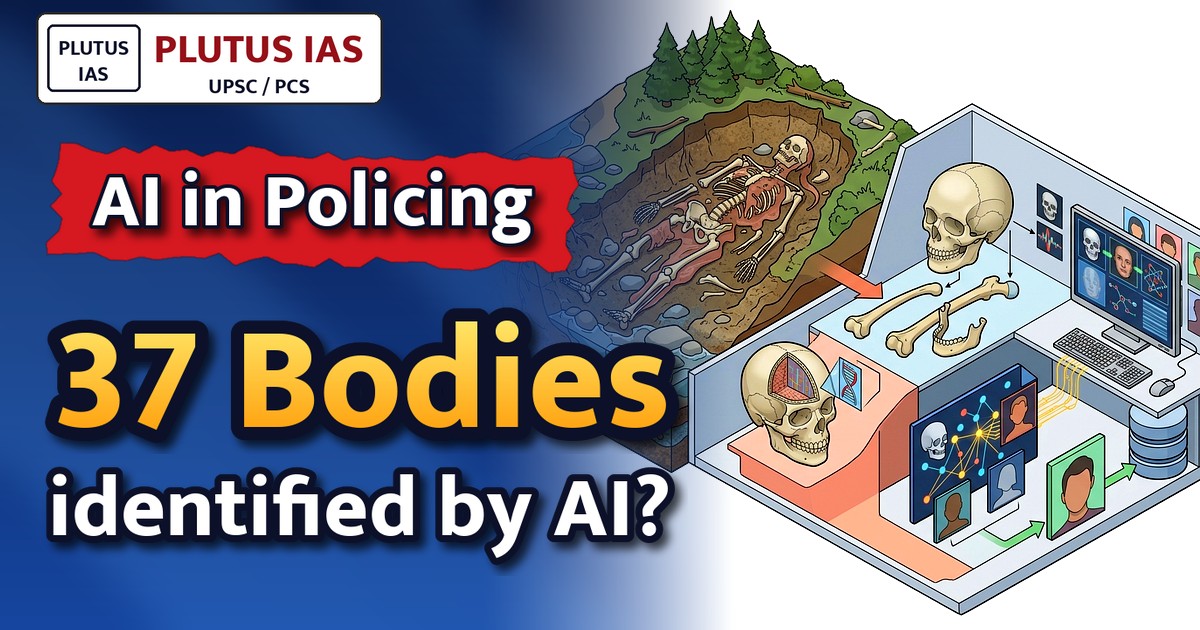
29 Sep UPSC Alert: AI App RAIDS Identifies 37 Unclaimed Bodies Using Facial Reconstruction
✎ The RAIDS application utilises AI-assisted facial reconstruction to generate multiple scientifically guided variations of a person’s face from degraded images or skeletal remains, significantly enhancing the identification of…
Subject Relevance — Where This Topic Fits
- GS Paper III — Science and Technology — Developments and their Applications and Effects in Everyday Life | GS Paper III — Internal Security — Challenges related to Cyber Security | GS Paper IV — Ethical Concerns in Use of Technology
- Prelims: Artificial Intelligence (AI), Facial Reconstruction, Forensic Science, Biometric Identification, Cyber Security, e-Governance Award, Maharashtra Police, Unidentified Human Remains, Decomposed Bodies, Skeletal Remains
- Essay: The Role of Technology in Modern Policing: Balancing Innovation with Ethical and Privacy Concerns, Ethical Governance of Artificial Intelligence: Safeguarding Human Dignity in Law Enforcement
Quick Revision: The RAIDS application utilises AI-assisted facial reconstruction to generate multiple scientifically guided variations of a person’s face from degraded images or skeletal remains, significantly enhancing the identification of unidentified human remains in forensic investigations.
Why is this in the news?
The deployment of the RAIDS (Rapid AI Driven Investigation and Detection System) application by the Maharashtra Police, developed under the leadership of Ratnagiri Superintendent of Police Nitin Bagate, has enabled the identification of 37 previously unidentified human remains, including decomposed and skeletal bodies. This initiative highlights the integration of artificial intelligence in forensic science to address challenges in criminal investigations and missing person cases, particularly in coastal and forest regions where decomposition and mutilation hinder traditional identification methods.
Background
- The identification of human remains is a critical challenge in forensic investigations, especially when bodies are decomposed, burnt, mutilated, or reduced to skeletal remains, as commonly encountered in coastal and forest regions of India.
- Coastal districts such as Sindhudurg and Ratnagiri in Maharashtra frequently recover bodies washed ashore or found in forest areas, where prolonged exposure to environmental elements destroys facial features and other identifiable characteristics.
- Traditional methods of identification, such as visual recognition, fingerprint analysis, or DNA profiling, often fail in cases of advanced decomposition or skeletal remains, leading to prolonged investigations and unresolved cases.
- The use of technology in forensic science has evolved significantly, with advancements in biometric identification, facial reconstruction, and artificial intelligence offering new avenues to assist law enforcement agencies.
- The Maharashtra Police’s adoption of AI-driven tools reflects a broader trend of integrating digital technologies in governance to enhance efficiency, accuracy, and responsiveness in public service delivery.
What is the RAIDS Application?
- The RAIDS (Rapid AI Driven Investigation and Detection System) is an artificial intelligence-based application developed by the Maharashtra Police to assist in the identification of unidentified human remains, including decomposed and skeletal bodies.
- The application employs AI-assisted facial reconstruction to generate scientifically guided variations of a person’s possible facial appearance from damaged photographs, witness sketches, partial images, or skeletal references.
- RAIDS consists of two specialised modules: (i) Dev Drishti, which generates controlled variations of a known face using forensic prompts and identity lock constraints, and (ii) Dev Roop Rekha, which reconstructs faces from witness sketches, degraded photographs, partial images, or skeletal references.
- From a single reconstruction, the application can generate up to 108 scientifically guided variations, increasing the likelihood of recognition by investigators, relatives, or the public.
- The AI-driven system enhances the efficiency of criminal investigations by providing leads in missing person cases, long-pending criminal cases, and absconding accused, thereby improving the overall efficacy of law enforcement.
- The initiative aligns with broader efforts to leverage technology for public safety and governance, particularly in addressing challenges unique to regions with high rates of unidentified human remains.
Key Features
| Feature | Significance |
|---|---|
| AI-assisted facial reconstruction | Generates scientifically guided facial variations from damaged photographs, witness sketches, partial images, and skeletal references, increasing the probability of identification. |
| Dev Drishti module | Produces controlled variations of a known face using forensic prompts and identity lock constraints to refine matches. |
| Dev Roop Rekha module | Reconstructs faces from degraded photographs, partial images, witness sketches, and skeletal remains for identification. |
| High-output reconstruction | From a single input, up to 108 scientifically generated facial variations are produced to aid recognition by investigators, relatives, or the public. |
| Integration with police workflow | Embedded within the RAIDS application, it streamlines the identification process in cases involving decomposed or skeletal remains. |
Why it Matters
Forensic Science and Criminal Justice
- Transforms traditionally intractable cases of unidentified bodies into solvable investigations by leveraging AI-driven forensic tools.
- Enhances the closure rate for missing person cases and strengthens the evidentiary value of skeletal or decomposed remains.
- Reduces the investigative burden on police by automating and standardising facial reconstruction from fragmented visual data.
Public Administration and Governance
- Demonstrates the application of emerging technologies (AI) in public safety and disaster response, aligning with the Digital India vision.
- Highlights the role of district-level leadership in innovation adoption, contributing to effective local governance.
- Sets a precedent for scalable AI solutions in law enforcement, potentially replicable across states facing similar challenges.
Humanitarian and Social Impact
- Provides closure to families of missing persons by facilitating the identification of deceased individuals.
- Mitigates emotional distress for relatives by reducing uncertainty in cases involving unidentified bodies.
- Supports the ethical obligation of the state to ensure dignity in death and justice for the deceased.
Technological Innovation in Public Sector
- Showcases the potential of AI in addressing real-world problems within the constraints of public sector resources.
- Illustrates the importance of cross-disciplinary collaboration (forensic science, AI, law enforcement) in developing practical solutions.
- Highlights the role of e-governance awards in incentivising and recognising grassroots innovation in governance.
Challenges
1. Data Quality and Availability
- Dependence on high-quality input data (e.g., photographs, sketches) for accurate AI reconstruction, which may not always be available.
- Risk of bias in AI-generated reconstructions if training data lacks diversity in facial features or demographic representation.
UPSC Link: GS3: Science and Technology
2. Ethical and Privacy Concerns
- Potential misuse of reconstructed images for purposes beyond identification, such as surveillance or profiling.
- Need for strict protocols to ensure the ethical use of AI in forensic applications and protection of personal data.
UPSC Link: GS4: Ethics and Integrity
3. Institutional Capacity and Training
- Requirement for specialised training of law enforcement personnel to effectively utilise AI tools.
- Need for continuous updating of AI models to adapt to evolving forensic challenges and new types of remains.
UPSC Link: GS2: Governance
4. Resource Constraints
- High computational and financial costs associated with developing and maintaining AI-driven forensic systems.
- Limited access to advanced technology in resource-constrained districts or states.
UPSC Link: GS3: Technology and Development
5. Legal and Procedural Hurdles
- Admissibility of AI-generated evidence in courts, requiring robust validation and legal frameworks.
- Need for standardised protocols for the collection, processing, and storage of forensic data.
UPSC Link: GS2: Judiciary and Legal System
Challenges — UPSC Perspective
| Issue | Concern |
|---|---|
| Input Data Quality | Dependence on high-quality photographs or sketches for accurate AI reconstruction. |
| AI Bias | Risk of biased reconstructions due to underrepresentation in training datasets. |
| Ethical Use | Potential misuse of reconstructed images for surveillance or profiling. |
| Training Gaps | Need for specialised training of law enforcement to utilise AI tools effectively. |
| Resource Intensity | High computational and financial costs for developing and maintaining AI systems. |
| Legal Admissibility | Challenges in ensuring AI-generated evidence is admissible in courts. |
Way Forward
- Establish a national-level AI forensic framework to standardise AI-driven identification processes across states.
- Develop training modules for police personnel on the ethical and technical use of AI in forensic investigations.
- Create a centralised database of missing persons, skeletal remains, and degraded photographs to enhance AI model training.
- Introduce legal guidelines for the admissibility of AI-generated forensic evidence in courts.
- Invest in public-private partnerships to reduce the cost and computational barriers of AI adoption in forensic science.
- Conduct periodic audits of AI systems to identify and mitigate biases in facial reconstruction outputs.
- Promote inter-state collaboration to share best practices and replicate successful AI forensic tools.
- Integrate AI forensic tools with existing police databases (e.g., FIR systems) for seamless workflow integration.
UPSC Value Addition
Keywords for Mains Answer-Writing
Artificial Intelligence in policing · Forensic technology and identification · Unidentified bodies and criminal investigations · AI-assisted facial reconstruction · Digital forensics in criminal justice · Ethical implications of AI in law enforcement · Maharashtra Police innovations · Forensic science and constitutional rights · E-governance and AI adoption · Data privacy in AI applications
Concept Flow
Decomposition or mutilation of bodies → Loss of identifiable facial features → Traditional identification methods fail → Need for AI-assisted forensic tools → AI facial reconstruction generates scientifically guided variations of possible faces → Inputs include damaged photographs, sketches, or skeletal references → Variations are cross-referenced with missing person databases and public recognition → Potential matches are identified → Identified matches are validated through forensic and circumstantial evidence → Identity of the deceased is established → Closure is provided to families, and investigative leads are generated for missing person or criminal cases → Justice is facilitated
Prelims Practice Questions
Q1. Consider the following statements about the RAIDS application developed by Maharashtra Police:
1. RAIDS uses AI-assisted facial reconstruction to identify decomposed or skeletal remains.
2. The application generates up to 108 scientifically guided variations from a single reconstruction.
3. RAIDS was developed exclusively by officers of the Maharashtra Police without external assistance.
4. The application has been recognised by the Maharashtra government with an e-Governance Award.
How many of the above statements are correct?
- Only one
- Only two
- Only three
- All four
Answer: All four — Statements 1, 2, and 4 are correct. Statement 3 is incorrect as the application was developed with the help of external engineers.
Q2. Assertion (A): AI-assisted facial reconstruction in forensic investigations can generate multiple facial variations from a single input.
Reason (R): The RAIDS application uses forensic prompts and identity lock constraints to control the variations generated.
Options:
A. Both A and R are true, and R is the correct explanation of A.
B. Both A and R are true, but R is not the correct explanation of A.
C. A is true, but R is false.
D. A is false, but R is true.
Answer: ? — Both A and R are true, and R correctly explains A as the application’s methodology involves generating controlled variations using forensic prompts.
Q3. Match the following columns related to forensic technologies:
Column I (Technology) | Column II (Application)
1. AI-assisted facial reconstruction | A. Identifying decomposed bodies
2. DNA profiling | B. Establishing paternity
3. Ballistics analysis | C. Matching bullet casings to firearms
4. Fingerprint analysis | D. Matching fingerprints to suspects
Options:
A. 1-A, 2-B, 3-C, 4-D
B. 1-A, 2-C, 3-B, 4-D
C. 1-D, 2-B, 3-C, 4-A
D. 1-C, 2-A, 3-D, 4-B
Answer: ? — 1-A (AI-assisted facial reconstruction is used for identifying decomposed bodies), 2-B (DNA profiling is used for establishing paternity), 3-C (Ballistics analysis matches bullet casings to firearms), 4-D (Fingerprint analysis matches fingerprints to suspects).
Mains Practice Question
✍ Artificial Intelligence is increasingly being integrated into forensic investigations to address challenges in identifying decomposed or mutilated bodies. Critically examine the ethical, legal, and operational dimensions of deploying AI in criminal justice systems, with reference to initiatives like the RAIDS application. Also, assess the implications for data privacy and constitutional rights. (15 Marks)
Approach: MODEL-ANSWER SKELETON:
1. **Introduction (2 marks)**
– Define AI in forensic science and its role in facial reconstruction (cite RAIDS as an example).
– State the broader context: rising cases of unidentified bodies and the need for technological solutions.
2. **Operational Advantages (3 marks)**
– Discuss the efficiency gains: rapid generation of facial variations, reduced time for identification.
– Highlight the application’s success in Maharashtra (37 identifications) and its recognition via e-Governance Award.
– Mention the dual modules (Dev Drishti and Dev Roop Rekha) and their forensic constraints.
3. **Ethical and Legal Dimensions (4 marks)**
– **Ethical concerns**: Potential for misuse (e.g., surveillance, bias in reconstruction algorithms).
– **Legal framework**: Compliance with the Information Technology Act, 2000, and the Personal Data Protection Bill (if enacted).
– **Constitutional rights**: Right to privacy (Puttaswamy judgment) and the balance with state interest in crime investigation.
– **Accountability**: Who bears responsibility for errors in AI-generated reconstructions?
4. **Data Privacy and Security (3 marks)**
– Risks of data breaches in storing facial images and skeletal references.
– Need for strict protocols under Section 43A of the IT Act and the proposed Data Protection Authority.
– Comparison with global standards (e.g., GDPR, NIST guidelines for forensic AI).
5. **Challenges and Limitations (2 marks)**
– Accuracy concerns: AI reconstructions may not always align with ground realities.
– Resource constraints: High computational costs and training requirements for law enforcement agencies.
– Public trust: Ensuring transparency in AI-driven investigations to avoid erosion of confidence.
6. **Conclusion (1 mark)**
– Reiterate the transformative potential of AI in forensic science while advocating for robust safeguards.
– Emphasise the need for a balanced approach that leverages technology without compromising constitutional and ethical norms.
Source: The Indian Express
Generated by AanyaAi for educational purpose.
Related guides on our sites
- Current affairs for upsc 2026
- How to prepare for GS paper 1 for UPSC CSE mains exam
- Best UPSC coaching for IFOS exam
- Best mentorship programme for upsc

- Great Indian Bustard Reintroduction: 10-Year Effort Bears Fruit in Rajasthan - October 3, 2026
- AI एजेंटों की स्वतंत्रता: कंपनियां कैसे रखती हैं नियंत्रण? जानिए पूरी प्रक्रिया - October 3, 2026
- Harivansh Leads India at 153rd IPU Assembly in Tanzania - October 3, 2026

No Comments