


02 Nov UPSC Alert: Allahabad HC Orders Panchayat Elections in 3 Months
✎ The State Election Commission, not the State Government, is constitutionally mandated to conduct panchayat elections, and any delay beyond constitutional timelines may invite judicial intervention under Article 226.
Subject Relevance — Where This Topic Fits
- GS Paper II — Constitutional and Statutory Bodies (State Legislatures and Panchayati Raj Institutions) | GS Paper III — Decentralisation and Local Governance
- Prelims: Panchayati Raj System, Article 243B, Article 243K, State Election Commission, Reservation in Panchayats, Backward Classes Commission, Constitutional Amendment 73rd, Election Timelines, Judicial Review of Administrative Action
- Essay: Decentralisation as a Pillar of Democratic Governance: Challenges and Reforms, Judicial Activism and Executive Accountability in Public Administration
Quick Revision: The State Election Commission, not the State Government, is constitutionally mandated to conduct panchayat elections, and any delay beyond constitutional timelines may invite judicial intervention under Article 226.
Why is this in the news?
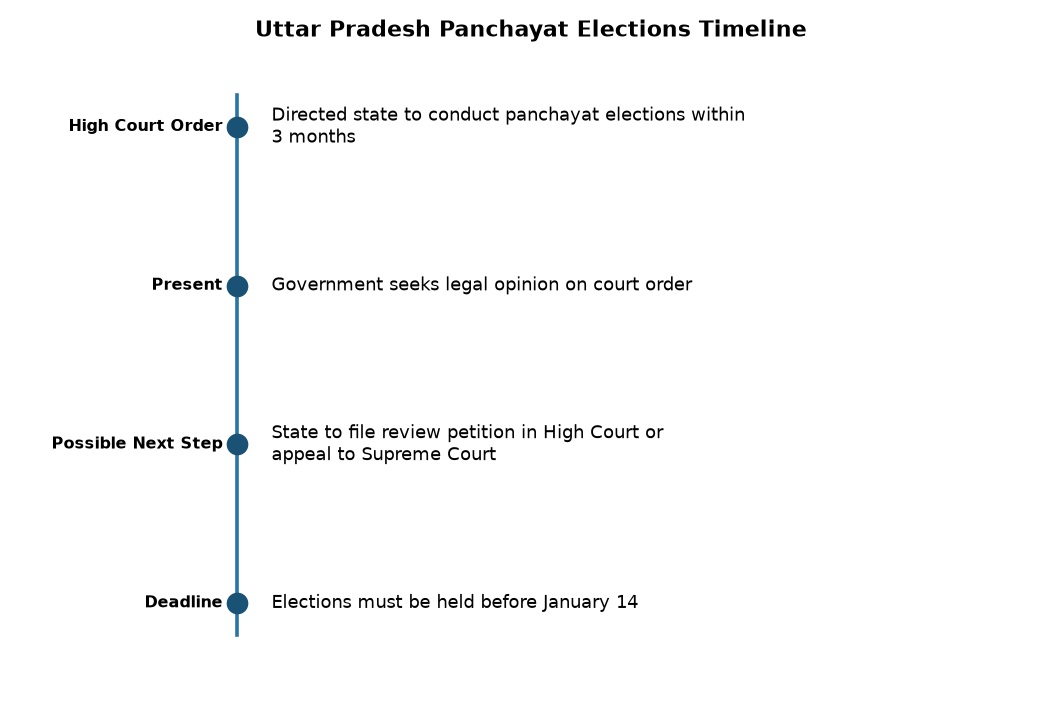
The Allahabad High Court has directed the Uttar Pradesh government to conduct three-tier panchayat elections within three months, setting a deadline of 14 January 2027. This judicial directive has prompted the state administration to seek legal opinions on the feasibility of compliance, given concurrent administrative constraints such as pending Backward Classes Commission reports, census operations, examination schedules, and legislative assembly elections. The matter now stands at the intersection of constitutional mandates, administrative capacity, and judicial oversight.
Background
- Panchayati Raj Institutions (PRIs) were constitutionally recognised through the 73rd Constitutional Amendment Act, 1992, which inserted Articles 243 to 243-O into the Constitution, establishing a framework for decentralised governance.
- Article 243K mandates that elections to PRIs shall be conducted by the State Election Commission, ensuring autonomy from the State Government to prevent executive interference.
- The Uttar Pradesh Panchayat Raj Act, 1947, read with the 73rd Amendment, governs the conduct of panchayat elections, including reservation provisions for Scheduled Castes, Scheduled Tribes, women, and other backward classes.
- Reservation in panchayats is periodically revised based on the latest census data and socio-economic surveys, with the Backward Classes Commission playing a pivotal role in identifying eligible groups and determining quotas.
- The State Election Commission of Uttar Pradesh is the constitutional authority responsible for the preparation of electoral rolls and the conduct of panchayat elections, independent of the State Government’s administrative machinery.
- Judicial interventions in panchayat elections often arise from delays in conducting polls, disputes over reservation policies, or failures to adhere to constitutional timelines, invoking the jurisdiction of High Courts under Article 226 of the Constitution.
What are Panchayat Elections and Their Constitutional Significance?
- Panchayat elections are conducted at three levels—Gram Panchayat (village), Panchayat Samiti (block), and Zila Parishad (district)—to ensure grassroots democratic representation.
- The 73rd Constitutional Amendment Act, 1992, introduced Part IX to the Constitution, mandating the establishment of PRIs in every state and providing for their functioning, powers, and responsibilities.
- Article 243B ensures that every state shall constitute PRIs as institutions of self-government, with Article 243C detailing the composition and powers of these bodies.
- Article 243K guarantees the independence of the State Election Commission by vesting it with the power to superintend, direct, and control the preparation of electoral rolls and the conduct of elections to PRIs.
- Reservation in panchayats is a constitutional mandate under Article 243D, which requires seats to be reserved for Scheduled Castes, Scheduled Tribes, and women, with provisions for rotation to ensure inclusivity.
- The Backward Classes Commission, constituted under Article 340 of the Constitution, plays a critical role in identifying socially and educationally backward classes and recommending reservation policies for panchayats.
- Delays in conducting panchayat elections can lead to administrative vacuums, disrupting local governance and impeding the implementation of welfare schemes at the grassroots level.
- Judicial review of panchayat election timelines ensures adherence to constitutional timelines, reinforcing the principle of participatory democracy and preventing executive inaction.
Key Features
| Feature | Significance |
|---|---|
| Judicial Directive on Panchayat Elections | The Allahabad High Court has directed the Uttar Pradesh government to conduct three-tier panchayat elections within three months, setting a deadline of 14 January, thereby ensuring constitutional compliance with Article 243K and 243Z of the Constitution. |
| Legal Opinion Sought by State Government | The state administration has sought legal counsel on the High Court’s directive, indicating a procedural response to judicial orders while assessing the feasibility of compliance within stipulated timelines. |
| Reservation Framework for Panchayats | The reservation policy for panchayat elections, including provisions for Scheduled Castes, Scheduled Tribes, and women, remains a critical component of the electoral process, necessitating adherence to constitutional mandates. |
| Administrative Constraints | The government faces operational challenges due to concurrent engagements such as census activities, examinations, and legislative assembly elections, which may impede the timely conduct of panchayat polls. |
| Judicial Review Mechanism | The High Court’s intervention underscores the role of the judiciary in enforcing constitutional provisions related to local self-government, particularly in ensuring timely electoral processes. |
Why it Matters
Constitutional and Legal
- The High Court’s directive reinforces the constitutional guarantee under Article 243K and 243Z, which mandates regular elections to panchayats and ensures democratic decentralisation in rural governance.
- The judicial intervention highlights the principle of judicial review in upholding constitutional provisions, particularly in local self-government institutions.
- The state’s response to the directive reflects the interplay between executive action, judicial orders, and constitutional obligations in governance.
Governance and Institutional
- Timely conduct of panchayat elections is essential for maintaining the functional integrity of the three-tier panchayati raj system, which serves as the foundation of rural local governance in India.
- The administrative logistical challenges underscore the need for robust planning and resource allocation to ensure smooth electoral processes, especially in large states like Uttar Pradesh.
- The state’s decision to seek legal opinion demonstrates adherence to due process and the rule of law, even when faced with operational constraints.
Societal and Political
- Panchayat elections are pivotal in ensuring grassroots democracy, providing representation to marginalised sections, including women, Scheduled Castes, and Scheduled Tribes, as mandated by the 73rd Constitutional Amendment Act, 1992.
- The reservation framework in panchayat elections is a tool for inclusive governance, ensuring equitable participation of historically underrepresented communities in rural decision-making processes.
Challenges
1. Administrative and Logistical Constraints
- Concurrent engagements such as the census, examinations, and legislative assembly elections may divert administrative and financial resources, delaying the conduct of panchayat elections.
- The absence of a finalised report from the Backward Classes Commission regarding reservation quotas for Other Backward Classes (OBCs) in panchayat elections creates uncertainty and potential legal complications.
- Ensuring the availability of polling staff, security personnel, and electoral infrastructure within a compressed timeline poses a significant operational challenge.
UPSC Link: GS-II: Constitutional and Statutory Bodies
2. Legal and Procedural Challenges
- The state government’s decision to seek legal opinion on the High Court’s directive may lead to further judicial proceedings, including a review petition or an appeal to the Supreme Court, prolonging the resolution of the matter.
- The ambiguity surrounding the feasibility of conducting elections within the stipulated three-month period raises questions about the judicial versus executive balance in governance.
- Potential delays in the electoral process could undermine public trust in local governance institutions and the electoral system.
UPSC Link: GS-II: Judiciary and Constitutional Framework
3. Socio-Political Challenges
- Ensuring fair and inclusive representation in panchayat elections requires meticulous implementation of reservation policies, which can be contentious and subject to legal scrutiny.
- The involvement of multiple stakeholders, including political parties, local leaders, and community groups, may lead to disputes or delays in the electoral process.
- The need to balance developmental priorities with electoral timelines may strain administrative resources and focus.
UPSC Link: GS-II: Local Governance and Panchayati Raj
4. Financial and Resource Constraints
- Conducting panchayat elections involves significant financial expenditure, including expenditure on polling stations, security, voter education, and administrative logistics.
- The state’s budgetary allocations for local governance may be constrained by competing demands, such as healthcare, education, and infrastructure development.
UPSC Link: GS-III: Government Budgets and Fiscal Policy
Challenges — UPSC Perspective
| Issue | Concern |
|---|---|
| Concurrent Administrative Engagements | Diversion of administrative and financial resources due to census, examinations, and legislative assembly elections may delay panchayat polls. |
| Reservation Framework Uncertainty | Absence of a finalised Backward Classes Commission report on OBC reservations creates legal and procedural ambiguity. |
| Operational Logistics | Ensuring availability of polling staff, security, and electoral infrastructure within a compressed timeline poses significant challenges. |
| Judicial-Executive Interface | State’s decision to seek legal opinion may lead to further judicial proceedings, prolonging the resolution of the matter. |
| Public Trust and Governance | Delays in conducting panchayat elections could undermine public confidence in local governance institutions and the electoral process. |
| Financial Constraints | Significant expenditure required for conducting panchayat elections may strain the state’s budgetary allocations for local governance. |
Way Forward
- Constitute a high-powered committee comprising representatives from the Election Commission, Panchayati Raj Department, and Legal Affairs Department to strategise the conduct of panchayat elections within the stipulated timeline.
- Accelerate the finalisation of the Backward Classes Commission report on OBC reservations to ensure clarity and compliance with constitutional provisions.
- Allocate dedicated administrative and financial resources for the conduct of panchayat elections, ensuring minimal disruption to concurrent engagements like the census and examinations.
- Engage with the Election Commission of India to seek technical and logistical support, including the deployment of polling staff and security personnel.
- Initiate voter education and awareness campaigns to ensure maximum voter participation and reduce the likelihood of disputes or delays.
- Explore the feasibility of conducting elections in phases or clusters to manage logistical constraints and ensure a smooth electoral process.
- Ensure transparency in the electoral process by adhering to the Model Code of Conduct and conducting elections in a fair and impartial manner.
UPSC Value Addition
Keywords for Mains Answer-Writing
Panchayati Raj Institutions · Constitutional provisions for local governance · Article 243 to 243-O · State Election Commission · Judicial review of administrative actions · Constitutional timelines for elections · Reservation in Panchayati Raj Institutions · Backward Classes Commission · Judicial activism in governance · Federalism and local self-government
Constitutional & Policy Linkages
- Article 243K: Elections to Panchayats
- Article 243Z: Duration of Panchayats
- 73rd Constitutional Amendment Act, 1992: Establishment of Panchayati Raj Institutions
Concept Flow
Constitutional Mandate for Panchayat Elections → Delay in Conduct → Judicial Intervention (High Court Directive) → State Government’s Response (Legal Opinion Sought) → Administrative and Logistical Challenges → Potential Judicial Review or Appeal → Resolution of Electoral Process → Reservation Framework for Panchayats → Backward Classes Commission Report Pending → Legal Ambiguity → High Court Directive → State’s Response → Impact on Electoral Timelines → Concurrent Administrative Engagements (Census, Examinations, Legislative Assembly Elections) → Resource Diversion → Delay in Panchayat Elections → Judicial Intervention → State’s Response → Operational Challenges → Judicial Review Mechanism → High Court’s Directive → State’s Legal Opinion Sought → Potential Review Petition or Supreme Court Appeal → Balance Between Judicial and Executive Functions → Panchayati Raj System → Three-Tier Structure → Regular Elections → Democratic Decentralisation → Judicial Enforcement of Constitutional Provisions → Public Trust in Governance → Timely Conduct of Panchayat Elections → Inclusive Representation → Socio-Political Stability → Governance Effectiveness
Prelims Practice Questions
Q1. Consider the following statements regarding Panchayati Raj Institutions (PRIs) in India:
1. PRIs are constitutional bodies established under Part IX of the Constitution.
2. The State Election Commission is responsible for the conduct of elections to PRIs.
3. Reservation for women in PRIs is mandated by the 73rd Constitutional Amendment Act.
4. The tenure of Panchayats is fixed at five years from the date of their first meeting.
How many of the above statements are correct?
- Only one
- Only two
- Only three
- All four
Answer: All four — Statements 1, 2, and 3 are correct. Statement 4 is incorrect as the tenure of Panchayats is five years from the date of notification for the first election, not from the date of their first meeting.
Q2. Assertion (A): The State Election Commission is a constitutional body with powers similar to the Election Commission of India for conducting elections to local bodies.
Reason (R): The 73rd and 74th Constitutional Amendment Acts empowered the State Election Commissions to supervise, direct, and control the preparation of electoral rolls and the conduct of elections to Panchayats and Municipalities.
Options:
A. Both A and R are true, and R is the correct explanation of A.
B. Both A and R are true, but R is not the correct explanation of A.
C. A is true, but R is false.
D. A is false, but R is true.
Answer: ? — Both Assertion (A) and Reason (R) are true, and R correctly explains A. The 73rd and 74th Amendments explicitly granted the State Election Commissions these powers.
Mains Practice Question
✍ The High Court of Uttar Pradesh has directed the State Government to conduct Panchayat elections within three months, citing the constitutional mandate for timely elections. Critically examine the constitutional framework governing Panchayati Raj Institutions (PRIs) and the challenges in ensuring timely elections. Also, discuss the role of judicial intervention in upholding constitutional timelines for local governance. (15 Marks)
Approach: MODEL-ANSWER SKELETON:
1. **Constitutional Framework (4 marks)**
– Mention Part IX of the Constitution (Articles 243 to 243-O) and the 73rd Amendment Act, 1992.
– Highlight key provisions: establishment of PRIs, reservation for SCs, STs, OBCs, and women (Art. 243-D), and the tenure of Panchayats (Art. 243-E).
– State the role of the State Election Commission (Art. 243-K) in conducting elections.
2. **Challenges in Timely Elections (5 marks)**
– Discuss administrative bottlenecks: delays in delimitation, reservation calculations, and report submissions by commissions (e.g., Backward Classes Commission).
– Highlight competing priorities: simultaneous conduct of census, examinations, and other elections.
– Address issues of political will, resource constraints, and legal complexities in implementing reservations.
3. **Judicial Intervention and Constitutional Timelines (4 marks)**
– Cite judicial precedents where courts have intervened to ensure timely elections (e.g., cases on delayed elections in local bodies).
– Discuss the balance between judicial activism and separation of powers, citing the doctrine of judicial review.
– Explain how judicial directives uphold the constitutional mandate of regular and timely elections.
4. **Conclusion (2 marks)**
– Summarise the need for systemic reforms to streamline election processes.
– Emphasise the importance of cooperative federalism and inter-institutional coordination to ensure constitutional compliance.
Source: amarujala.com
Generated by AanyaAi for educational purpose.
Related guides on our sites
- Current affairs for upsc 2026
- Best PSIR optional coaching for upsc
- Best PSIR optional teacher for upsc
- Best teacher of PSIR optional for upsc

- UPSC Alert: Allahabad HC Orders Panchayat Elections in 3 Months - November 2, 2026
- गृह क्रेताओं तक जीएसटी लाभ पहुंचाने का आह्वान: किशन रेड्डी - November 1, 2026
- CM Mass Marriage Scheme: 97 Couples Wed in Kanpur Under Uttar Pradesh Government Initiative - November 1, 2026

No Comments