


22 Sep UPSC Alert: Andaman & Nicobar LG Meets PM on 22 Sep 2026
✎ The Lieutenant Governor of a Union Territory is a constitutional functionary appointed by the President under Article 239, responsible for the administration of the territory in accordance with the directions of the Union…
Subject Relevance — Where This Topic Fits
- GS Paper II — Polity and Governance: Constitutional Framework for Union Territories | GS Paper II — Polity and Governance: Role of Constitutional and Statutory Bodies
- Prelims: Lieutenant Governor, Union Territory, Article 239, Andaman and Nicobar Islands, Administrative Reforms Commission, Constitutional provisions for UTs
- Essay: Federalism and the governance of Union Territories: Balancing autonomy and integration, The role of constitutional functionaries in ensuring effective administration
Quick Revision: The Lieutenant Governor of a Union Territory is a constitutional functionary appointed by the President under Article 239, responsible for the administration of the territory in accordance with the directions of the Union Government.
Why is this in the news?
The meeting between the Lieutenant Governor of Andaman and Nicobar Islands and the Prime Minister highlights the institutional interface between the Union Government and the Union Territory administration. This interaction underscores the constitutional framework governing the functioning of Lieutenant Governors in Union Territories and their role in policy coordination, governance oversight, and implementation of centrally sponsored schemes in the region.
Background
- The Andaman and Nicobar Islands are a Union Territory of India, governed under the provisions of Article 239 of the Constitution, which empowers the President to appoint an Administrator (Lieutenant Governor) for Union Territories.
- Union Territories, unlike States, do not have an elected legislature by default.
- The Lieutenant Governor acts as the constitutional head of the Union Territory and is responsible for the administration of the territory in accordance with the directions issued by the President or the Union Government.
- The Union Territory administration operates under the aegis of the Ministry of Home Affairs, which oversees the governance and developmental activities of all Union Territories.
- The Lieutenant Governor’s role includes ensuring the implementation of centrally sponsored schemes, maintaining law and order, and facilitating developmental projects in the region.
- The Andaman and Nicobar Islands hold strategic importance due to their geographical location in the Bay of Bengal, proximity to Southeast Asia, and their role in India’s maritime security and blue economy.
What is the Constitutional Role of the Lieutenant Governor in Union Territories?
- The Lieutenant Governor is a constitutional functionary appointed by the President under Article 239 of the Constitution to administer a Union Territory.
- The Lieutenant Governor acts as the representative of the President and the Union Government in the Union Territory and is responsible for the overall administration of the territory.
- The Lieutenant Governor’s powers and functions are exercised in accordance with the provisions of the Constitution, the Government of Union Territories Act, 1963, and any other relevant laws.
- The Lieutenant Governor is empowered to issue directions to the local administration, approve major administrative decisions, and ensure the implementation of centrally sponsored schemes and policies.
- The Lieutenant Governor also plays a crucial role in maintaining law and order, coordinating with central agencies, and facilitating developmental activities in the Union Territory.
- The Lieutenant Governor is assisted by a Council of Ministers, headed by a Chief Minister in Union Territories with a legislature, though the Lieutenant Governor retains the final authority in matters of governance.
- The Lieutenant Governor’s role is distinct from that of a State Governor, as Union Territories do not have the same degree of legislative and executive autonomy as States.
- The Lieutenant Governor’s functions are subject to the supervision and control of the Union Government, particularly the Ministry of Home Affairs, which provides policy guidance and administrative oversight.
Key Features
| Feature | Significance |
|---|---|
| Meeting between Lieutenant Governor and Prime Minister | Signifies the constitutional role of the Lieutenant Governor as the President’s representative in the Union Territory, ensuring direct communication with the Union Government for administrative and developmental matters. |
| Union Territory status of Andaman and Nicobar Islands | Highlights the unique governance structure under Article 239 of the Constitution, where the Lieutenant Governor acts as the administrative head, distinct from state governance. |
| Strategic location of the islands | The islands’ proximity to Southeast Asia and the Indian Ocean underscores their geopolitical importance for maritime security, trade routes, and regional stability. |
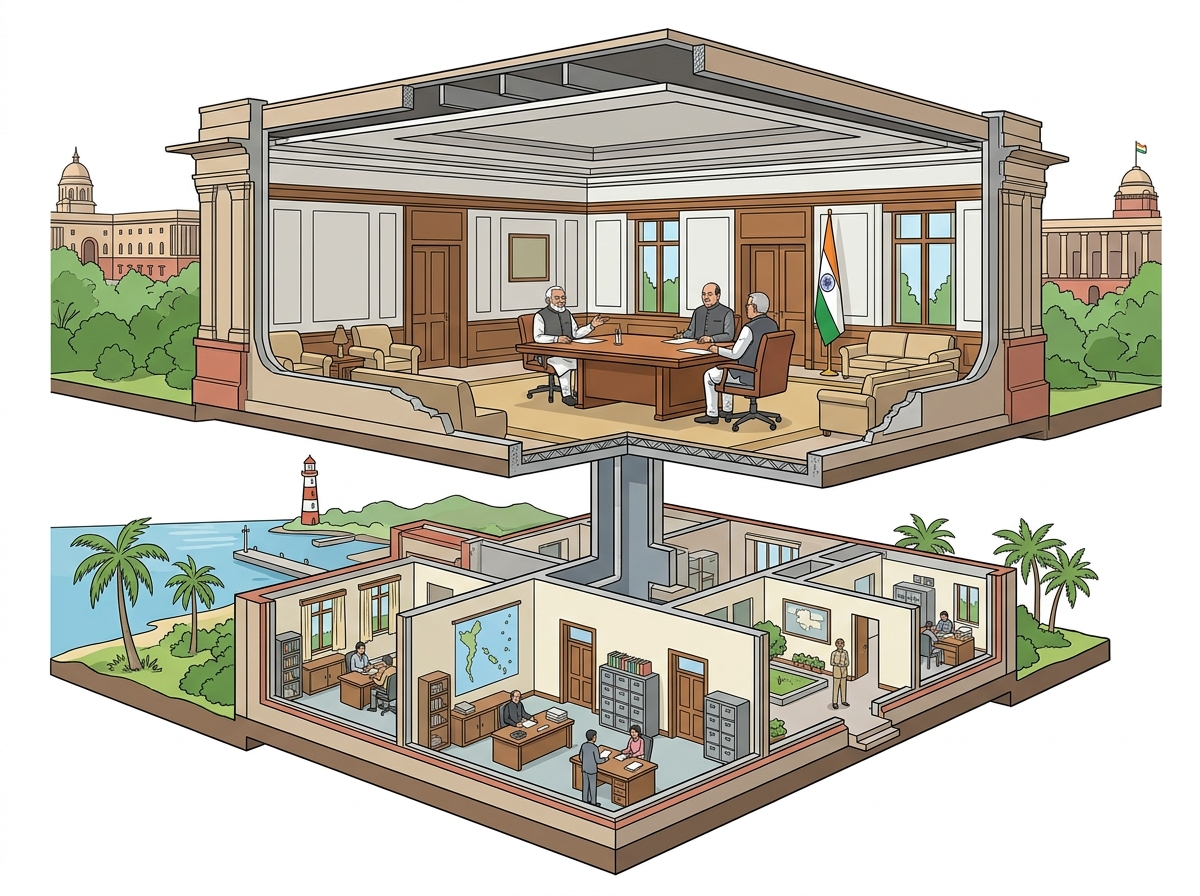
| Administrative reporting mechanism | Demonstrates the hierarchical reporting structure within the Union Territory administration, culminating in the Union Government for policy direction and resource allocation. |
Why it Matters
Strategic and Geopolitical
- The Andaman and Nicobar Islands serve as India’s eastern maritime gateway, critical for monitoring the Indian Ocean Region (IOR) and countering maritime threats.
- The islands host key military bases, including INS Kohassa, which enhances India’s operational reach in the Bay of Bengal and beyond.
- Strengthening infrastructure and connectivity in the islands supports India’s Act East Policy and regional engagement with ASEAN nations.
Administrative and Governance
- The Lieutenant Governor’s role is pivotal in ensuring the implementation of Union Government policies in the Union Territory, distinct from state-level governance.
- Direct interaction with the Prime Minister facilitates expeditious decision-making for developmental projects and security-related initiatives.
- The Union Territory status allows for centralized planning and resource allocation, bypassing state-level bureaucratic delays.
Economic and Infrastructure Development
- The islands are earmarked for significant infrastructure projects, including ports, airports, and tourism, to boost economic growth and employment.
- Developmental initiatives align with the Sagarmala Programme, aimed at modernizing ports and enhancing coastal shipping.
- Tourism potential, particularly in ecologically sensitive areas, requires balanced development to preserve biodiversity.
Environmental and Ecological
- The islands are part of the Bay of Bengal Biosphere Reserve, necessitating sustainable development practices to protect marine and terrestrial ecosystems.
- Climate change impacts, such as rising sea levels, pose existential threats to low-lying islands, requiring adaptive governance frameworks.
Challenges
1. Geographical Remoteness and Connectivity
- Limited air and sea connectivity hampers rapid deployment of personnel, resources, and emergency response teams.
- Dependence on mainland India for critical supplies increases logistical costs and delays in development projects.
UPSC Link: Geographical constraints in UT governance
2. Environmental Vulnerability
- The islands are susceptible to natural disasters such as cyclones, tsunamis, and earthquakes, necessitating robust disaster management systems.
- Unregulated tourism and infrastructure development threaten fragile ecosystems, including coral reefs and mangroves.
UPSC Link: Disaster resilience in coastal UTs
3. Security Challenges
- The islands’ strategic location makes them vulnerable to illegal activities such as smuggling, poaching, and unauthorized maritime incursions.
- Ensuring cybersecurity for critical military and civilian infrastructure remains a persistent challenge.
UPSC Link: Maritime security in IOR
4. Administrative Bottlenecks
- Delays in decision-making due to hierarchical reporting structures between the Lieutenant Governor, Union Government, and local bodies.
- Coordination challenges between multiple agencies, including the Indian Navy, Coast Guard, and civil administration.
UPSC Link: Governance of Union Territories
5. Socio-Economic Disparities
- High dependence on mainland India for employment and economic opportunities limits local skill development and entrepreneurship.
- Indigenous communities face challenges in preserving cultural identity amid rapid modernization and infrastructure projects.
UPSC Link: Tribal welfare in UTs
Challenges — UPSC Perspective
| Issue | Concern |
|---|---|
| Geographical Remoteness | Limited connectivity increases logistical costs and delays in development. |
| Environmental Degradation | Unregulated tourism and infrastructure threaten biodiversity and ecosystem services. |
| Security Vulnerabilities | Strategic location exposes the islands to illegal activities and maritime threats. |
| Administrative Delays | Hierarchical governance structures slow down policy implementation and project execution. |
| Socio-Economic Inequality | Dependence on mainland India limits local economic growth and skill development. |
Way Forward
- Enhance air and sea connectivity through public-private partnerships to reduce logistical bottlenecks.
- Strengthen disaster management infrastructure with early warning systems and rapid response teams.
- Implement sustainable tourism policies to balance economic growth with environmental conservation.
- Accelerate infrastructure projects under the Sagarmala Programme to modernize ports and coastal shipping.
- Establish a dedicated cybersecurity framework for critical military and civilian infrastructure.
- Promote skill development programs to reduce dependence on mainland India for employment.
- Foster coordination between the Indian Navy, Coast Guard, and civil administration for maritime security.
- Conduct regular environmental impact assessments for all developmental projects.
UPSC Value Addition
Keywords for Mains Answer-Writing
Union Territories · Lieutenant Governor · Andaman and Nicobar Islands · Union Territories Administration · Constitutional provisions for UTs · Role of Lieutenant Governor · Administrative hierarchy in UTs · Union Government-Lieutenant Governor relations · Constitutional status of UTs · Governor vs Lieutenant Governor · Union Territories Act, 1963 · Administrative reforms in UTs · Centre-UT coordination · Constitutional governance in UTs
Constitutional & Policy Linkages
- {‘Article 239’: ‘Governance of Union Territories by Lieutenant Governor.’}
- {‘Article 239A’: ‘Special provisions for the administration of Union Territories.’}
Concept Flow
Constitutional provision (Article 239) → Establishment of Union Territory → Appointment of Lieutenant Governor → Administrative reporting to Union Government → Policy implementation and resource allocation → Developmental and strategic initiatives in the islands.
Prelims Practice Questions
Q1. Consider the following statements regarding the Lieutenant Governor of a Union Territory in India:
1. The Lieutenant Governor is appointed by the President of India.
2. The Lieutenant Governor exercises powers similar to those of a Governor in a State.
3. The Lieutenant Governor is subordinate to the Chief Minister of the Union Territory.
4. The Lieutenant Governor’s role is primarily advisory in nature.
How many of the above statements are correct?
- Only one
- Only two
- Only three
- All four
Answer: Only two — Only statement 1 is correct. The Lieutenant Governor is appointed by the President under Article 239. While the Lieutenant Governor has certain executive powers, they are not fully subordinate to the Chief Minister, and their role is not merely advisory.
Q2. Assertion (A): The Lieutenant Governor of a Union Territory has the power to promulgate ordinances under Article 239B of the Constitution.
Reason (R): The Lieutenant Governor is the constitutional head of the Union Territory and exercises powers similar to the Governor of a State.
In the context of the above two statements, which of the following is correct?
- Both A and R are true, and R is the correct explanation of A.
- Both A and R are true, but R is not the correct explanation of A.
- A is true, but R is false.
- A is false, but R is true.
Answer: Both A and R are true, but R is not the correct explanation of A. — Both the assertion and reason are true. The Lieutenant Governor can promulgate ordinances under Article 239B, and the reason correctly explains this power as part of their constitutional role, though their powers are not identical to a State Governor.
Q3. Match the following Union Territories with their respective Lieutenant Governors (as of September 2026):
Column I (Union Territory) | Column II (Lieutenant Governor)
—————————|——————————-
A. Andaman and Nicobar Islands | 1. Praful Patel
B. Delhi | 2. Dr. Dinesh Sharma
C. Puducherry | 3. Vinai Kumar Saxena
D. Ladakh | 4. B.D. Mishra
Select the correct match:
- A-2, B-3, C-1, D-4
- A-1, B-2, C-3, D-4
- A-3, B-1, C-2, D-4
- A-4, B-3, C-1, D-2
Answer: A-2, B-3, C-1, D-4 — The correct matches are: A-2 (Dr. Dinesh Sharma for Andaman and Nicobar Islands), B-3 (Vinai Kumar Saxena for Delhi), C-1 (Praful Patel for Puducherry), and D-4 (B.D. Mishra for Ladakh).
Mains Practice Question
✍ The Lieutenant Governor of a Union Territory occupies a unique constitutional position that balances central oversight with local administration. In this context, critically examine the constitutional framework governing the role of the Lieutenant Governor, with particular reference to the Andaman and Nicobar Islands. Also, analyse the implications of the recent meeting between the Lieutenant Governor of Andaman and Nicobar Islands and the Prime Minister for the Centre-UT administrative dynamics. (15 Marks)
Approach: MODEL-ANSWER SKELETON:
1. **Constitutional Framework**:
– Article 239: Appointment and powers of Lieutenant Governors.
– Article 239A: Special provisions for Delhi (distinct from other UTs like Andaman and Nicobar Islands).
– Article 239B: Power to promulgate ordinances.
– Union Territories Act, 1963: Administrative structure and governance.
2. **Role of Lieutenant Governor**:
– Executive head of the UT, but with powers delegated by the President.
– Dual role: Representing the Union Government and ensuring constitutional governance.
– Distinction between Lieutenant Governor and Governor of a State (no elected legislature in UTs like Andaman and Nicobar Islands).
3. **Andaman and Nicobar Islands Context**:
– Strategic importance: Geopolitical and security considerations.
– Administrative challenges: Remote geography, tribal populations, and infrastructure constraints.
– Role of Lieutenant Governor in policy coordination with the Centre.
4. **Recent Meeting with Prime Minister**:
– Significance of the meeting: Highlighting Centre-UT coordination in governance and development.
– Possible agenda: Infrastructure projects, tribal welfare, security, and tourism development.
– Implications for administrative efficiency and policy implementation.
5. **Centre-UT Administrative Dynamics**:
– Tensions between elected representatives (if any) and the Lieutenant Governor.
– Role of the Home Ministry in overseeing UT administration.
– Need for balanced governance: Central oversight vs. local autonomy.
6. **Conclusion**:
– The Lieutenant Governor’s role is pivotal in ensuring effective governance in UTs.
– The recent meeting underscores the importance of Centre-UT collaboration in addressing challenges and leveraging opportunities in Andaman and Nicobar Islands.
Source: PIB (Press Information Bureau)
Delhi PCS (DSSSB) — State PCS Practice
Prelims: Which of the following Union Territories in India has a Lieutenant Governor as its constitutional head, similar to the Andaman and Nicobar Islands?
- A. Delhi
- B. Puducherry
- C. Chandigarh
- D. Jammu and Kashmir
Answer: A. Delhi — Delhi is a Union Territory with a Lieutenant Governor as its constitutional head, similar to the Andaman and Nicobar Islands. The Lieutenant Governor represents the President of India in these UTs.
Mains: Discuss the constitutional provisions and administrative structure governing the Lieutenant Governor’s role in the Union Territory of Delhi, highlighting the differences from the Andaman and Nicobar Islands.
Generated by AanyaAi for educational purpose.
Related guides on our sites
- Current affairs for upsc 2026
- Best PSIR optional coaching for upsc
- Best PSIR optional teacher for upsc
- Best teacher of PSIR optional for upsc

- UPSC Alert: Andaman & Nicobar LG Meets PM on 22 Sep 2026 - September 22, 2026
- आंध्र प्रदेश पुलिस ने शुरू किया AI आधारित ड्रोन निगरानी और SafeStay एप, जानिए कैसे करेगा मदद - September 22, 2026
- AI-Drone Monitoring & SafeStay AP: UPSC’s Tech-Driven Policing Initiative Explained - September 22, 2026

No Comments