


11 Sep UPSC Alert: Bengaluru’s ₹156 Crore MSME Tech Hub to Train 10,000 Youth
✎ Technology Centres (TCs) under the MSME Ministry are institutional hubs that provide technical training, prototyping, and production support to MSMEs, thereby enhancing their competitiveness and contributing to India’s industrial…
Subject Relevance — Where This Topic Fits
- GS Paper III — Growth & Development, Industrial Policy, Skill Development
- Prelims: MSMED Act, 2006, Technology Centres (TCs), ESDM Sector, Credit Guarantee Scheme for MSMEs, TReDS Platform, Self-Reliant India (Atmanirbhar Bharat), Startup India
- Essay: Role of MSMEs in India’s economic development, Skill development and employment generation through institutional mechanisms
Quick Revision: Technology Centres (TCs) under the MSME Ministry are institutional hubs that provide technical training, prototyping, and production support to MSMEs, thereby enhancing their competitiveness and contributing to India’s industrial self-reliance.
Why is this in the news?
The inauguration of a Technology Centre (TC) in Devanahalli, Bengaluru by the Ministry of Micro, Small and Medium Enterprises (MSME) on 10 September 2026 underscores the government’s ongoing efforts to enhance the technological and manufacturing capabilities of MSMEs, particularly in the Electronics System Design and Manufacturing (ESDM) sector. This initiative aligns with broader policy objectives to foster innovation, skill development, and industrial competitiveness within the MSME ecosystem, as part of the Atmanirbhar Bharat vision.
Background
- The MSME sector contributes approximately 31% to India’s GDP and employs over 41.6 crore people, making it a critical pillar of the national economy.
- The Ministry of MSME operates a network of Technology Centres (TCs) across India to provide technical infrastructure, training, and innovation support to MSMEs.
- The Electronics System Design and Manufacturing (ESDM) sector is a strategic focus area due to its high growth potential, export competitiveness, and role in digital transformation.
- Initiatives such as the Trade Receivables Discounting System (TReDS) and Credit Guarantee Scheme for MSMEs (CGTMSE) have been introduced to improve financial inclusion and reduce credit constraints.
- The Atmanirbhar Bharat initiative emphasizes self-reliance in critical sectors, with MSMEs positioned as key enablers of domestic manufacturing and innovation.
What are Technology Centres (TCs) under the MSME Ministry?
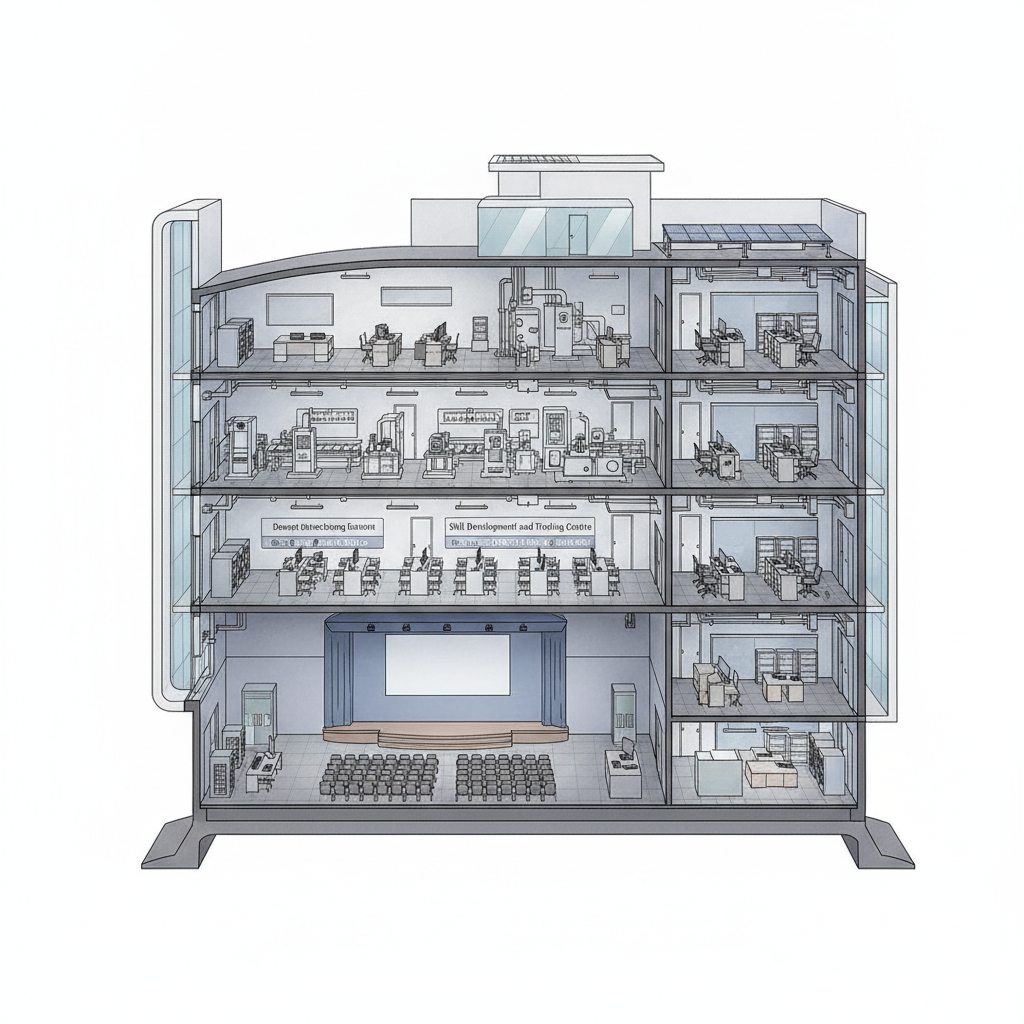
- Technology Centres (TCs) are state-of-the-art institutional facilities established by the Ministry of MSME to provide technical, design, prototyping, testing, and production support to MSMEs.
- These centres are equipped with advanced machinery, software, and laboratories to facilitate high-end manufacturing processes, particularly in emerging sectors like ESDM, aerospace, and precision engineering.
- The TCs offer industry-oriented training programmes to enhance the technical skills of entrepreneurs, workers, and students, thereby bridging the skill gap in the MSME ecosystem.
- Each TC is designed to train approximately 10,000 individuals annually, fostering a pipeline of skilled human resources for the manufacturing sector.
- The centres also support MSMEs in product development, process optimization, and compliance with international quality standards, thereby enhancing their global competitiveness.
- The TC network operates under the administrative oversight of the MSME Ministry, with funding and operational autonomy to ensure efficiency and relevance.
- The TC in Bengaluru’s Devanahalli is the latest addition to this network, with a specific focus on the ESDM sector, which is pivotal for India’s digital economy and electronics manufacturing.
Key Features
| Feature | Significance |
|---|---|
| Location and Investment | The Technology Centre (TC) in Devanahalli, Bengaluru, Karnataka, is developed over 10 acres with an investment of ₹156 crore, demonstrating the government’s commitment to regional industrial development and infrastructure augmentation. |
| Training Capacity | The centre is designed to train 10,000 trainees annually, addressing the skill deficit in the Electronics System Design and Manufacturing (ESDM) sector, a critical component of India’s digital and manufacturing ecosystem. |
| Focus Sector | The TC specialises in Electronics System Design and Manufacturing (ESDM), aligning with India’s strategic push for self-reliance in electronics and semiconductor manufacturing under initiatives like the Production-Linked Incentive (PLI) scheme. |
| Institutional Network | Part of a broader network of Technology Centres operated by the Ministry of Micro, Small and Medium Enterprises (MSME), this facility enhances the existing ecosystem of technical training and innovation support for MSMEs across India. |
| Public-Private Synergy | The inauguration event included an exhibition showcasing contributions of Indian MSMEs in aerospace and ESDM sectors, highlighting the role of such centres in fostering industry-academia linkages and promoting indigenous innovation. |
Why it Matters
Economic Contribution of MSMEs
- MSMEs contribute approximately 31% to India’s GDP and employ over 41.6 crore individuals, underscoring their role as a critical engine of economic growth and employment generation.
- The establishment of such centres directly supports the MSME sector’s expansion by enhancing technical capabilities, thereby improving productivity and global competitiveness.
- The focus on ESDM aligns with India’s ambition to become a global hub for electronics manufacturing, reducing import dependency and boosting export potential.
Skill Development and Youth Empowerment
- The TC will train 10,000 individuals annually, equipping them with advanced technical skills in high-demand sectors like ESDM, thereby addressing the skill gap in India’s workforce.
- Such initiatives are pivotal in nurturing a skilled talent pool that can contribute to India’s vision of an ‘Atmanirbhar Bharat’ (Self-Reliant India) and a ‘Viksit Bharat’ (Developed India) by 2047.
- The centre’s role in fostering entrepreneurship aligns with the government’s emphasis on startups and innovation as drivers of economic transformation.
Strategic Industrial Policy
- The TC’s focus on ESDM supports India’s broader industrial policy objectives, including the PLI scheme for electronics manufacturing, which aims to attract investments and reduce import dependence.
- By providing state-of-the-art infrastructure and training, the centre enhances the competitiveness of MSMEs in high-tech sectors, fostering a conducive environment for innovation and scaling.
- The establishment of similar centres across India, such as the upcoming TC in Belagavi (₹178 crore), demonstrates a scalable model for regional industrial development and decentralised skill enhancement.
Governance and Institutional Strengthening
- The MSME Ministry’s network of Technology Centres exemplifies a structured approach to addressing the technical and skill-related challenges faced by MSMEs, ensuring equitable access to resources across regions.
- Recent amendments to the MSME Development (MSMED) Act, 2026, as highlighted by the Secretary, MSME Ministry, aim to further strengthen the sector by improving access to finance, technology, and markets for MSMEs.
- Such centres serve as hubs for policy implementation, bridging the gap between government initiatives and ground-level execution, thereby enhancing the efficacy of industrial development programmes.
Challenges
1. Skill Mismatch in High-Tech Sectors
- India faces a significant skill gap in advanced manufacturing sectors like ESDM, with a lack of trained professionals capable of meeting industry demands for innovation and production.
- The TC addresses this by providing specialised training, but scaling such initiatives to meet nationwide demand remains a challenge due to resource constraints and regional disparities.
UPSC Link: GS3: Skill Development
2. Access to Finance and Technology for MSMEs
- Despite government schemes like the Credit Guarantee Scheme and TReDS, MSMEs continue to face challenges in accessing affordable finance and modern technology, limiting their growth potential.
- The TC provides technical support, but broader systemic issues such as collateral requirements and bureaucratic hurdles persist in the financial ecosystem.
UPSC Link: GS3: MSMEs and Financial Inclusion
3. Regional Disparities in Industrial Development
- While centres like the one in Bengaluru are well-equipped, many regions, particularly rural and semi-urban areas, lack access to such advanced facilities, exacerbating regional economic imbalances.
- The upcoming TC in Belagavi is a step toward redressing this, but ensuring equitable distribution of such infrastructure across the country remains a long-term challenge.
UPSC Link: GS2: Regional Development
4. Integration with Global Supply Chains
- To compete globally, Indian MSMEs must integrate with international supply chains, which requires adherence to global standards, certifications, and compliance with trade regulations.
- The TC’s focus on ESDM can facilitate this, but sustained efforts are needed to ensure that Indian products meet international quality benchmarks and regulatory requirements.
UPSC Link: GS3: Globalisation and MSMEs
5. Sustainability and Green Manufacturing
- The ESDM sector, like other manufacturing industries, faces pressure to adopt sustainable practices, including energy efficiency, waste management, and carbon footprint reduction.
- The TC can play a role in promoting green manufacturing, but integrating sustainability into training programmes and industry practices requires coordinated efforts from policymakers, industry, and academia.
UPSC Link: GS3: Sustainable Development
Challenges — UPSC Perspective
| Issue | Concern |
|---|---|
| Limited Industry-Academia Collaboration | Insufficient linkages between technical institutions and industries hinder the translation of research into market-ready products and technologies. |
| High Cost of Advanced Technology | MSMEs often lack the financial capacity to invest in cutting-edge machinery and software, limiting their ability to innovate and compete. |
| Regulatory and Compliance Burdens | Complex regulatory frameworks and compliance requirements can deter MSMEs from expanding or adopting new technologies. |
| Digital Divide in Rural Areas | A lack of digital infrastructure in rural and semi-urban regions restricts access to online training and digital tools essential for modern manufacturing. |
| Intellectual Property Challenges | MSMEs face difficulties in protecting their innovations, which discourages investment in R&D and limits their growth potential. |
Government Initiatives — Must-Memorise for Prelims
- {‘name’: ‘Technology Centres (TCs) Network’, ‘description’: ‘A nationwide network of Technology Centres operated by the MSME Ministry, providing technical training, prototyping, testing, and consultancy services to MSMEs to enhance their competitiveness.’}
- {‘name’: ‘Credit Guarantee Scheme for MSMEs’, ‘description’: ‘A scheme that provides collateral-free credit to MSMEs, reducing their dependence on traditional collateral and facilitating easier access to finance.’}
- {‘name’: ‘Trade Receivables Discounting System (TReDS)’, ‘description’: ‘An electronic platform for facilitating the financing of trade receivables of MSMEs, improving their liquidity and cash flow management.’}
Way Forward
- Strengthen industry-academia linkages to ensure that training programmes are aligned with industry needs and foster innovation.
- Expand the network of Technology Centres to underserved regions, ensuring equitable access to advanced training and technical support for MSMEs across India.
- Enhance financial inclusion for MSMEs by simplifying access to credit, subsidies, and grants, and promoting the adoption of digital lending platforms like TReDS.
- Integrate sustainability and green manufacturing principles into training programmes and industry practices to align with global standards and environmental goals.
- Promote entrepreneurship and startup culture among trainees by providing mentorship, incubation support, and access to seed funding through government schemes.
- Leverage public-private partnerships to augment resources and expertise, enabling faster scaling of Technology Centres and their programmes.
- Monitor and evaluate the performance of Technology Centres regularly to identify gaps, measure impact, and implement corrective measures for continuous improvement.
- Encourage MSMEs to adopt advanced technologies such as AI, IoT, and automation by providing subsidies, tax incentives, and technical assistance through the TC network.
UPSC Value Addition
Keywords for Mains Answer-Writing
MSME sector · Technology Centres · Electronics System Design and Manufacturing (ESDM) · Skill Development for MSMEs · Atmanirbhar Bharat · MSMED Act 2026 · Entrepreneurship Ecosystem · Industrial Training Institutes · Make in India · Vocal for Local · Technology Upgradation · MSME Contribution to GDP · Employment Generation by MSMEs · MSME Ministry Initiatives · Skill India Mission
Concept Flow
Government identifies skill gaps in high-tech sectors like ESDM and formulates policies to address them → MSME Ministry establishes Technology Centres (TCs) to provide specialised training and technical support → TCs collaborate with industries to align training with market demands → Trainees acquire advanced skills and become employable in high-growth sectors → MSMEs benefit from a skilled workforce, enhancing their productivity and global competitiveness → Economic growth is driven by a more skilled and innovative MSME sector, contributing to India’s vision of self-reliance and development.
Prelims Practice Questions
Q1. Consider the following statements regarding the Technology Centres (TCs) established by the Ministry of Micro, Small and Medium Enterprises (MSME):
1. These centres are established to enhance the technological capabilities and competitiveness of MSMEs.
2. The TCs provide training, design, prototyping, testing, and production support to MSMEs.
3. The TCs are exclusively focused on the textile manufacturing sector.
4. The TCs are mandated to train approximately 10,000 trainees annually.
How many of the above statements are correct?
- Only one
- Only two
- Only three
- All
Answer: Only three — Statements 1, 2, and 4 are correct as per the official mandate of the Technology Centres. Statement 3 is incorrect because the TCs are not exclusively focused on the textile sector; they cater to diverse sectors including Electronics System Design and Manufacturing (ESDM).
Q2. Assertion (A): The Ministry of MSME has recently amended the MSMED Act, 2026 to further strengthen the sector.
Reason (R): The amendments aim to enhance the ease of doing business and improve access to finance and technology for MSMEs.
- Both A and R are true, and R is the correct explanation of A.
- Both A and R are true, but R is not the correct explanation of A.
- A is true, but R is false.
- A is false, but R is true.
Answer: Both A and R are true, but R is not the correct explanation of A. — The assertion is true as the MSMED Act, 2026 has been amended to strengthen the sector. The reason correctly explains the purpose of these amendments, which include improving ease of doing business and access to finance and technology.
Q3. Match the following initiatives of the Ministry of MSME with their respective objectives:
Column I (Initiative) | Column II (Objective)
——————————————-|——————————————-
1. Technology Centres (TCs) | A. Providing credit guarantees to MSMEs
2. TReDS (Trade Receivables Discounting System) | B. Facilitating technology upgradation and skill development
3. Credit Guarantee Scheme | C. Enabling financing through invoice discounting
4. MSME Samadhaan Portal | D. Resolving delayed payment disputes
Select the correct match:
- 1-B, 2-C, 3-A, 4-D
- 1-A, 2-B, 3-C, 4-D
- 1-D, 2-A, 3-B, 4-C
- 1-C, 2-D, 3-A, 4-B
Answer: 1-B, 2-C, 3-A, 4-D — The correct matches are: 1-B (TCs focus on technology upgradation and skill development), 2-C (TReDS enables financing through invoice discounting), 3-A (Credit Guarantee Scheme provides credit guarantees), and 4-D (MSME Samadhaan Portal resolves delayed payment disputes).
Mains Practice Question
✍ The establishment of Technology Centres (TCs) by the Ministry of Micro, Small and Medium Enterprises (MSME) is a critical intervention in India’s industrial and skill development ecosystem. Critically examine the role of these centres in fostering innovation, skill development, and competitiveness within the MSME sector. Also, analyse how such initiatives align with the broader objectives of ‘Atmanirbhar Bharat’ and ‘Vocal for Local’. (15 Marks)
Approach: MODEL-ANSWER SKELETON:
1. **Introduction (2 Marks)**
– Define MSMEs and their significance in India’s economy (contribution to GDP, employment generation).
– State the objective of Technology Centres (TCs) as per the MSME Ministry: enhancing technological capabilities, providing industry-level training, and supporting prototyping, testing, and production.
2. **Role of TCs in Innovation and Skill Development (5 Marks)**
– **Technology Upgradation**: Explain how TCs provide access to advanced machinery, testing facilities, and design tools (e.g., CAD/CAM) to MSMEs, enabling them to adopt Industry 4.0 technologies.
– **Skill Development**: Highlight the annual training capacity (e.g., 10,000 trainees at the Bengaluru TC) and the focus on Electronics System Design and Manufacturing (ESDM), aligning with India’s push for semiconductor and electronics manufacturing.
– **Industry-Academia Linkages**: Discuss how TCs bridge the gap between academic training and industry requirements, fostering employability and entrepreneurship.
3. **Enhancing Competitiveness of MSMEs (4 Marks)**
– **Cost Efficiency**: Explain how TCs reduce the cost of technology adoption for MSMEs by providing shared infrastructure and resources.
– **Quality and Compliance**: Discuss the role of TCs in helping MSMEs meet national and international standards (e.g., ISO certifications), thereby enhancing their market access.
– **Export Promotion**: Highlight how improved competitiveness through TCs can boost India’s exports, particularly in sectors like ESDM.
4. **Alignment with ‘Atmanirbhar Bharat’ and ‘Vocal for Local’ (3 Marks)**
– **Atmanirbhar Bharat**: Discuss how TCs support self-reliance by reducing dependence on imported technologies and fostering indigenous innovation.
– **Vocal for Local**: Explain how TCs enable MSMEs to produce high-quality, locally manufactured goods, thereby promoting domestic industries and reducing imports.
– **Employment Generation**: Emphasise the role of TCs in creating skilled jobs, particularly in tier-2 and tier-3 cities, aligning with the goal of inclusive growth.
5. **Challenges and Way Forward (1 Mark)**
– Acknowledge challenges such as limited awareness among MSMEs, geographical disparities in access, and the need for continuous upgradation of infrastructure.
– Suggest measures like expanding the TC network, leveraging digital platforms for outreach, and strengthening public-private partnerships.
Source: PIB (Press Information Bureau)
Karnataka PCS (KPSC) — State PCS Practice
Prelims: Which Union Minister recently inaugurated a Technology Center in Devanahalli, Bengaluru, Karnataka, under the Ministry of Micro, Small and Medium Enterprises (MSME)?
- A. Shri Narayan Rane
- B. Smt. Shobha Karandlaje
- C. Shri B. L. Santosh
- D. Smt. Meenakshi Lekhi
Answer: B. Smt. Shobha Karandlaje — Smt. Shobha Karandlaje is the Union Minister of State for Micro, Small and Medium Enterprises (MSME) who inaugurated the Technology Center in Devanahalli, Bengaluru.
Mains: Analyze the significance of establishing a Technology Center by the Ministry of MSME in Devanahalli, Bengaluru, for Karnataka’s industrial and entrepreneurial ecosystem. Discuss its potential impact on skill development, innovation, and MSME growth in the state.
Generated by AanyaAi for educational purpose.
Related guides on our sites
- Current affairs for upsc 2026
- How to prepare for GS paper 1 for UPSC CSE mains exam
- Best UPSC coaching for IFOS exam
- Best mentorship programme for upsc

- एनएचआरसी ने हरियाणा में बच्ची की मैनहोल गिरने से मृत्यु पर लिया स्वत: संज्ञान - September 18, 2026
- NHRC Takes Suo Motu Cognizance of 4-Year-Old Girl’s Death in Open Manhole, Palwal - September 18, 2026
- सीसीआई ने तीन प्रमुख क्रिकेट फ्रेंचाइजी के अधिग्रहण को दी मंजूरी, जानिए पूरा मामला - September 18, 2026

No Comments