


08 Aug UPSC Alert: Bill Proposes Ban on Social Media Accounts for Kids Under 13
✎ The SHIELD Bill, 2025, proposes mandatory parental consent for minors under 13 to create digital accounts and bans personalised advertising targeting children, reflecting a global shift toward child-centric digital governance.
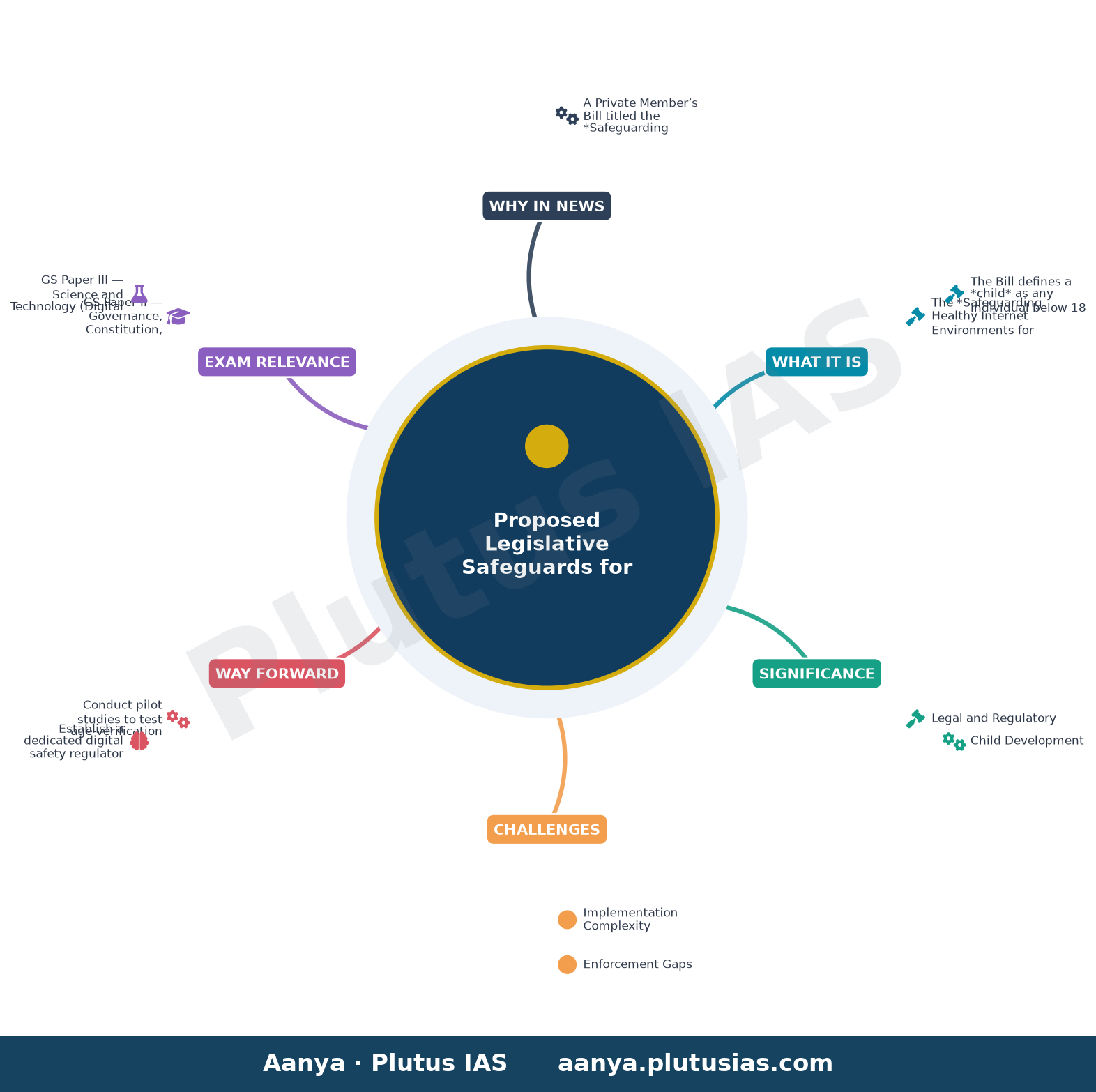
Subject Relevance — Where This Topic Fits
- GS Paper II — Governance, Constitution, Polity, Social Justice and International Relations (Digital Governance, Fundamental Rights, Child Rights) | GS Paper III — Science and Technology (Digital Technologies, Cyber Security, Data Protection)
- Prelims: Digital Personal Data Protection Act, 2023, Information Technology (Intermediary Guidelines and Digital Media Ethics Code) Rules, 2021, Section 69A of the IT Act, UN Convention on the Rights of the Child, Age Verification Systems, Personalised Advertising, Dark Patterns in Digital Platforms, Gaming (Regulation) Bill, 2022 (Draft), Pornography Regulation, Extremist Content Online
- Essay: The Role of Technology in Shaping Childhood: Balancing Innovation and Protection, Ethical Governance of Digital Platforms: A Framework for Accountability
Quick Revision: The SHIELD Bill, 2025, proposes mandatory parental consent for minors under 13 to create digital accounts and bans personalised advertising targeting children, reflecting a global shift toward child-centric digital governance.
Why is this in the news?
A Private Member’s Bill titled the *Safeguarding Healthy Internet Environments for Little Digital-Natives (SHIELD) Bill, 2025*, introduced by BJP MP Baijayant Panda, seeks to prohibit children under the age of 13 from creating accounts on social media and online gaming platforms without verified parental consent. The Bill also proposes stringent restrictions on personalised advertising targeting minors, mandatory age-verification systems, and parental-control dashboards to monitor and restrict digital exposure. This legislative initiative reflects growing parliamentary and societal concerns over the unregulated digital exposure of minors, particularly in light of rising cases of online abuse, addiction, and exposure to harmful content.
Background
- The proliferation of social media and gaming platforms has significantly increased digital engagement among minors, raising concerns over privacy, mental health, and exposure to inappropriate content.
- India’s digital ecosystem has witnessed exponential growth post-2015, with over 800 million internet users, including a substantial proportion of minors below 18 years of age.
- Existing regulatory frameworks, such as the *Information Technology (Intermediary Guidelines and Digital Media Ethics Code) Rules, 2021*, impose obligations on intermediaries to ensure user safety but lack specific provisions for child protection.
- The *Digital Personal Data Protection Act, 2023*, while addressing data privacy, does not comprehensively cover the protection of minors in digital environments.
- International precedents, such as the *Children’s Online Privacy Protection Act (COPPA)* in the United States and the *General Data Protection Regulation (GDPR)* in the EU, mandate parental consent for data processing of minors under 13 and 16 years, respectively.
- Private Member’s Bills in India rarely translate into law due to procedural constraints, with only about a dozen such Bills passed since Independence, underscoring the need for broader political consensus.
What is the SHIELD Bill, 2025?
- The *Safeguarding Healthy Internet Environments for Little Digital-Natives (SHIELD) Bill, 2025* is a Private Member’s Bill introduced in Parliament to regulate the digital exposure of minors in India.
- The Bill defines a *child* as any individual below 18 years of age, aligning with the *UN Convention on the Rights of the Child*, which India ratified in 1992.
- It proposes a *three-tiered regulatory framework*: (a) mandatory age verification for minors accessing digital platforms, (b) parental consent for account creation by children under 13, and (c) restrictions on personalised advertising targeting minors.
- Platforms such as social media, online gaming, and other digital intermediaries would be required to implement *parental-control dashboards* enabling guardians to monitor activity, manage privacy settings, and restrict screen time.
- The Bill prohibits platforms from tracking, profiling, or targeting minors with personalised advertising, addressing concerns over data exploitation and manipulative algorithms.
- It mandates platforms to prevent exposure of minors to harmful content, including pornography, gambling, extremist material, violent content, and drug-related information.
- The Bill also seeks to align India’s digital governance with global standards, drawing inspiration from frameworks like COPPA (USA) and GDPR (EU).
Key Features
| Feature | Significance |
|---|---|
| Age-verification systems | Mandates platforms to verify user age, ensuring compliance with child safety norms and preventing underage access without parental consent. |
| Parental-control dashboards | Empowers guardians to monitor online activity, manage privacy settings, and impose screen-time restrictions, fostering responsible digital parenting. |
| Prohibition on personalised advertising for minors | Restricts targeted advertising to children, reducing exposure to manipulative marketing and safeguarding their cognitive development. |
| Content moderation obligations | Requires platforms to prevent exposure to pornography, gambling, extremist material, and drug-related content, aligning with societal and legal standards. |
| Penalties and enforcement mechanisms | Institutes fines up to ₹10 crore and potential service suspension under Section 69A of the IT Act for violations, ensuring accountability and deterrence. |
Why it Matters
Legal and Regulatory
- Introduces a structured framework for child safety in digital spaces, addressing gaps in existing IT Act provisions.
Child Development
- Protects minors from harmful online content and manipulative advertising, supporting cognitive and emotional well-being.
Platform Accountability
- Shifts responsibility to digital intermediaries for safeguarding child users, promoting ethical business practices.
Parental Rights
- Enhances parental oversight through mandatory consent and monitoring tools, reinforcing family-centric digital governance.
Challenges
1. Implementation Complexity
- Age-verification systems may face technical hurdles, including privacy concerns and user resistance to mandatory verification.
UPSC Link: GS2 Governance
2. Enforcement Gaps
- Private member’s bills rarely become law, raising questions about the bill’s eventual passage and effective implementation.
UPSC Link: GS2 Parliament
3. Platform Compliance Burden
- Social media and gaming platforms may struggle with compliance costs, especially smaller entities with limited resources.
UPSC Link: GS3 Digital Economy
4. Data Privacy Risks
- Mandatory age verification could lead to increased data collection, raising concerns under the Personal Data Protection Act, 2023.
UPSC Link: GS2 Fundamental Rights
5. Cross-platform Coordination
- Ensuring uniform enforcement across diverse digital platforms (social media, gaming, streaming) poses logistical challenges.
UPSC Link: GS2 Centre-State Relations
Challenges — UPSC Perspective
| Issue | Concern |
|---|---|
| Age Verification | Risk of privacy breaches due to mandatory data collection for verification purposes. |
| Parental Consent | Potential for fraudulent consent or lack of awareness among guardians about digital safety. |
| Content Moderation | Difficulty in real-time monitoring to prevent exposure to harmful content across global platforms. |
| Platform Compliance | Economic burden on smaller platforms to implement age-verification and moderation systems. |
| Enforcement | Lack of dedicated regulatory authority to oversee compliance and penalise violations. |
| User Resistance | Possible backlash from minors and parents regarding perceived overreach or inconvenience. |
Way Forward
- Conduct pilot studies to test age-verification systems and parental-control dashboards before nationwide rollout.
- Establish a dedicated digital safety regulator under the Ministry of Electronics and Information Technology (MeitY) to oversee compliance.
- Develop standardised guidelines for content moderation to ensure consistency across platforms.
- Launch public awareness campaigns to educate parents and guardians on digital safety tools and risks.
- Amend the Information Technology (Intermediary Guidelines and Digital Media Ethics Code) Rules, 2021, to align with the proposed bill’s provisions.
- Encourage industry-led self-regulation mechanisms to supplement government oversight.
- Strengthen data protection frameworks to mitigate privacy risks associated with age verification.
UPSC Value Addition
Keywords for Mains Answer-Writing
Digital Personal Data Protection Act 2023 · Age verification mechanisms · Parental consent for minors · Personalised advertising restrictions · Safeguarding Healthy Internet Environments for Little Digital-Natives (SHIELD) Bill 2025 · Online gaming and social media regulation · Information Technology (Intermediary Guidelines and Digital Media Ethics Code) Rules 2021 · Right to Privacy under Article 21 · UN Convention on the Rights of the Child · Data localisation and cybersecurity · Section 69A of the Information Technology Act · Parental control dashboards
Concept Flow
Digital platforms (social media, gaming) → Exposure to harmful content/advertising → Child safety concerns → Proposed SHIELD Bill → Age verification & parental controls → Compliance by platforms → Enforcement via penalties → Reduced harm to minors
Prelims Practice Questions
Q1. Consider the following statements regarding the Safeguarding Healthy Internet Environments for Little Digital-Natives (SHIELD) Bill, 2025:
1. The Bill proposes to bar children under 13 from creating accounts on social media and gaming platforms without verified parental consent.
2. The Bill defines a child as anyone below 18 years of age.
3. Platforms violating the proposed law could face penalties of up to ₹10 crore and suspension under Section 69A of the Information Technology Act.
How many of the above statements are correct?
- Only one
- Only two
- All three
- None
Answer: All three — Statements 1 and 3 are correct as per the Bill’s provisions. Statement 2 is incorrect because the Bill defines a child as anyone below 18, not under 13.
Q2. Assertion (A): The SHIELD Bill, 2025, seeks to prohibit platforms from tracking, profiling, or using personalised advertising for children.
Reason (R): The Bill aims to safeguard children from exposure to harmful content and manipulative advertising practices.
Options:
A. Both A and R are true, and R is the correct explanation of A.
B. Both A and R are true, but R is not the correct explanation of A.
C. A is true, but R is false.
D. A is false, but R is true.
Answer: ? — Both the Assertion and Reason are true, and the Reason correctly explains the Assertion as the Bill’s provisions directly target tracking and personalised advertising to protect minors.
Q3. Match the following provisions of the SHIELD Bill, 2025, with their respective objectives:
Column I (Provision) | Column II (Objective)
1. Mandatory age-verification systems | A. Prevent exposure to harmful content such as pornography and gambling
2. Parental-control dashboards | B. Ensure platforms obtain verified parental consent for account creation
3. Prohibition on personalised advertising | C. Allow guardians to monitor activity and manage privacy settings
4. Penalties for violations | D. Protect children from targeted advertising based on profiling
- 1-B, 2-C, 3-D, 4-A; 1-B, 2-A, 3-D, 4-C; 1-D, 2-C, 3-B, 4-A; 1-A, 2-B, 3-C, 4-D
Answer: 1-B, 2-C, 3-D, 4-A; 1-B, 2-A, 3-D, 4-C; 1-D, 2-C, 3-B, 4-A; 1-A, 2-B, 3-C, 4-D — The correct match is: 1-B (age-verification ensures parental consent), 2-C (dashboards for monitoring), 3-D (prohibition on personalised ads), 4-A (penalties for harmful content exposure).
Mains Practice Question
✍ The proposed Safeguarding Healthy Internet Environments for Little Digital-Natives (SHIELD) Bill, 2025, seeks to regulate social media, gaming platforms, and digital intermediaries to protect minors in the digital ecosystem. Critically analyse the constitutional and statutory framework underpinning such regulation. Also, examine the potential challenges in its implementation and the balance between child protection and digital rights. (15 Marks)
Approach: MODEL-ANSWER SKELETON:
1. Constitutional Framework:
– Right to Privacy (Article 21) and its balance with state regulation.
– Directive Principles of State Policy (Article 39(f)) on child protection.
– Fundamental Duties (Article 51A) to safeguard children’s interests.
– Reference to the Puttaswamy judgment (2017) on privacy and state action.
2. Statutory and Policy Context:
– Digital Personal Data Protection Act 2023 and its provisions on data processing.
– Information Technology (Intermediary Guidelines and Digital Media Ethics Code) Rules 2021.
– UN Convention on the Rights of the Child (1989) and India’s obligations.
– Section 69A of the IT Act for blocking content.
3. Provisions of the SHIELD Bill:
– Age verification and parental consent mechanisms.
– Restrictions on personalised advertising and harmful content exposure.
– Parental-control dashboards and penalties for violations.
4. Challenges in Implementation:
– Technological feasibility of age verification (e.g., biometric verification vs. self-declaration).
– Privacy concerns in mandatory data collection for verification.
– Enforcement across diverse digital platforms and jurisdictional issues.
– Potential for over-regulation and stifling of digital innovation.
5. Balancing Child Protection and Digital Rights:
– Arguments for stricter regulation: protecting minors from exploitation, addiction, and harmful content.
– Arguments against over-regulation: infringement on digital freedoms, chilling effect on free expression, and burden on platforms.
– Role of parents, schools, and digital literacy programs as complementary measures.
6. Comparative Perspective:
– Reference to global models (e.g., COPPA in the US, GDPR in the EU).
– Lessons from India’s experience with intermediary liability rules.
7. Conclusion:
– Need for a balanced, multi-stakeholder approach that prioritises child safety without compromising digital rights.
– Role of judicial review and parliamentary oversight in ensuring proportionality.
Source: Hindustan Times
Generated by AanyaAi for educational purpose.

- राजस्थान पंचायत चुनाव 2026: सरपंच-वार्ड पदों की आरक्षण लॉटरी आज, जानिए आरक्षण तय करने की प्रक्रिया - September 24, 2026
- Rajasthan Panchayat Polls 2026: Reservation Lottery for Sarpanch & Ward Panch Seats Today - September 24, 2026
- यूपी में पहली बार तेंदुओं का बधियाकरण: मानव-वन्यजीव संघर्ष रोकेगा अभियान - September 24, 2026

No Comments