


08 Aug UPSC Alert: Bill Proposes Ban on Social Media Accounts for Minors Under 13
✎ The SHIELD Bill, 2025, prohibits personalised advertising for children, and mandates age-verification systems to restrict exposure to harmful content.
Subject Relevance — Where This Topic Fits
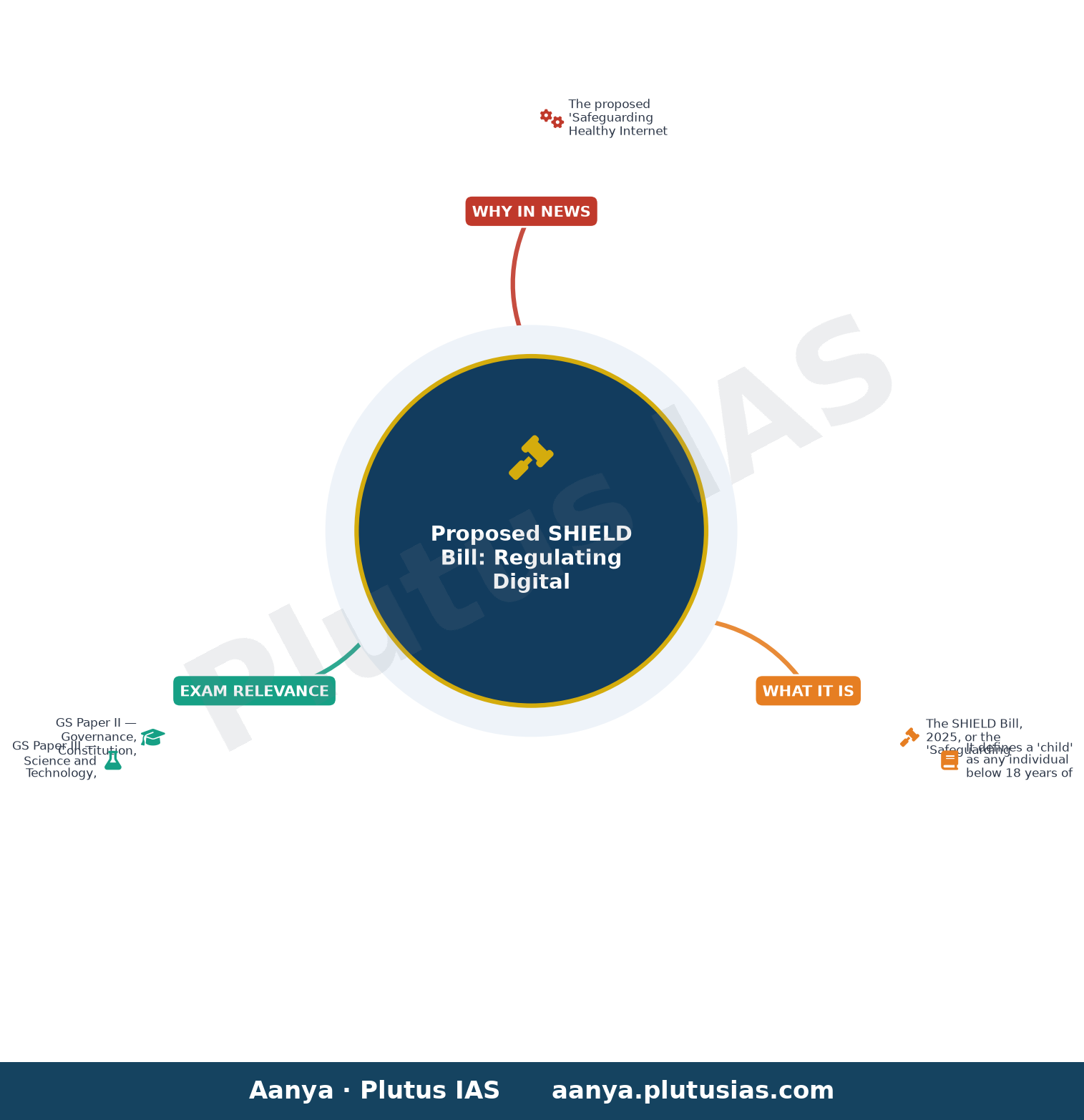
- GS Paper II — Governance, Constitution, Polity, Social Justice and International Relations | GS Paper III — Science and Technology, including IT and Digital Governance
- Prelims: Digital Personal Data Protection Act, 2023, Information Technology (Intermediary Guidelines and Digital Media Ethics Code) Rules, 2021, Section 69A of the IT Act, Age verification mechanisms, Personalised advertising restrictions, Online gaming regulations, Pornography and extremist content moderation
- Essay: The ethical imperative of balancing technological innovation with child protection in the digital age, Regulating cyberspace: The role of legislation in safeguarding vulnerable sections
Quick Revision: The SHIELD Bill, 2025, prohibits personalised advertising for children, and mandates age-verification systems to restrict exposure to harmful content.
Why is this in the news?
The proposed ‘Safeguarding Healthy Internet Environments for Little Digital-Natives (SHIELD) Bill, 2025’ seeks to introduce stringent safeguards for minors on social media and online gaming platforms, including age verification, parental consent requirements, and restrictions on personalised advertising. Introduced as a private member’s bill by BJP MP Baijayant Panda, the proposal reflects growing legislative concerns over the unregulated exposure of children to harmful digital content and predatory algorithms. Though unlikely to pass in its current form, the bill underscores the urgent need for a robust regulatory framework to protect minors in the digital ecosystem, aligning with global trends such as the EU’s Digital Services Act and the UK’s Online Safety Act.
Background
- The exponential growth of social media and online gaming has led to increased exposure of minors to unregulated digital environments, raising concerns about mental health, privacy, and safety.
- Existing legal frameworks, such as the Information Technology (Intermediary Guidelines and Digital Media Ethics Code) Rules, 2021, and the Digital Personal Data Protection Act, 2023, provide limited safeguards for minors, focusing primarily on data privacy rather than systemic risks like addiction or exposure to harmful content.
- The Digital Personal Data Protection Act, 2023, recognises the vulnerability of children and mandates data fiduciaries to obtain parental consent for processing their data, but enforcement remains inconsistent.
- Section 69A of the IT Act empowers the government to block or suspend platforms for violating public order or sovereignty, though its application in the context of child protection is not explicitly defined.
- Global precedents, such as the EU’s General Data Protection Regulation (GDPR) and the UK’s Age Appropriate Design Code, have set benchmarks for protecting minors online, including age verification and default privacy settings.
- Private member’s bills in India rarely become law, with only about a dozen passing since Independence, highlighting the procedural challenges in legislative reform.
What is the SHIELD Bill, 2025?
- The SHIELD Bill, 2025, or the ‘Safeguarding Healthy Internet Environments for Little Digital-Natives Bill,’ is a private member’s bill introduced to regulate digital platforms accessible to minors, including social media, online gaming, and other intermediaries.
- It defines a ‘child’ as any individual below 18 years of age, expanding the scope beyond the traditional definition of 13 years often used in global regulations like the US Children’s Online Privacy Protection Act (COPPA).
- It prohibits platforms from tracking, profiling, or targeting minors with personalised advertising, addressing concerns about algorithmic manipulation and data exploitation.
- Platforms must implement age-verification systems to restrict access to age-inappropriate content, including pornography, gambling, extremist material, and drug-related content.
- The bill introduces parental-control dashboards, enabling guardians to monitor activity, manage privacy settings, and restrict screen time, fostering collaborative digital parenting.
- Non-compliance with the proposed law could result in penalties up to ₹10 crore, with repeated violations leading to temporary suspension or blocking of services under Section 69A of the IT Act.
- The bill aligns with global best practices, such as the EU’s Digital Services Act and the UK’s Online Safety Act, which prioritise child protection and systemic risk mitigation in digital spaces.
UPSC Value Addition
Keywords for Mains Answer-Writing
Digital Personal Data Protection Act 2023 · Children’s online safety · Parental consent mechanisms · Personalised advertising restrictions · Information Technology Rules 2021 · Section 69A IT Act · Age verification systems · Digital intermediaries obligations · Protective provisions for minors · Data localisation and child rights
Prelims Practice Questions
Q1. Consider the following statements regarding the proposed SHIELD Bill, 2025:
1. The Bill seeks to prohibit social media platforms from tracking or profiling children under 13 years of age.
2. Platforms violating the proposed law could face penalties of up to ₹10 crore.
3. The Bill defines a child as anyone below 18 years of age.
4. The Bill mandates mandatory age-verification systems for all digital platforms accessible to minors.
How many of the above statements are correct?
- Only one
- Only two
- Only three
- All four
Answer: Only three — Statements 1, 2, and 3 are correct as per the Bill’s provisions. Statement 4 is incorrect because the Bill mandates age-verification systems only for platforms accessible to minors, not all digital platforms.
Q2. Assertion (A): The SHIELD Bill, 2025, proposes to impose penalties of up to ₹10 crore on digital platforms for violations related to children’s online safety.
Reason (R): The Bill aims to regulate the misuse of artificial intelligence (AI) to create realistic imitations of people.
- Both A and R are true, and R is the correct explanation of A
- Both A and R are true, but R is not the correct explanation of A
- A is true, but R is false
- A is false, but R is true
Answer: A is true, but R is false — Assertion (A) is true as the Bill proposes penalties of up to ₹10 crore for violations. Reason (R) is true but unrelated to the assertion, as it pertains to a separate AI regulation bill.
Q3. Match the following provisions of the proposed SHIELD Bill, 2025, with their corresponding objectives:
Column I (Provision)
A. Mandatory age-verification systems
B. Parental-control dashboards
C. Prohibition on personalised advertising for children
D. Penalties for violations
Column II (Objective)
1. To monitor and manage children’s online activity
2. To prevent tracking and profiling of minors
3. To ensure platforms verify the age of users
4. To impose financial penalties for non-compliance
- A-3, B-1, C-2, D-4; A-1, B-3, C-4, D-2; A-4, B-2, C-1, D-3; A-2, B-4, C-3, D-1
- answer_string_list_indexes_are_0_based_answer_indexes_are_1_based_so_this_is_ignored
- explain_match_pairs_correctly_in_explain_field
- format
Answer: A-3, B-1, C-2, D-4; A-1, B-3, C-4, D-2; A-4, B-2, C-1, D-3; A-2, B-4, C-3, D-1 — A-3 (Mandatory age-verification systems ensure platforms verify the age of users), B-1 (Parental-control dashboards allow guardians to monitor and manage children’s online activity), C-2 (Prohibition on personalised advertising prevents tracking and profiling of minors), D-4 (Penalties for violations ensure compliance with the proposed law).
Mains Practice Question
✍ Critically examine the efficacy of the proposed SHIELD Bill, 2025, in safeguarding children’s online safety within the framework of the Digital Personal Data Protection Act, 2023. Also, analyse the potential challenges in its implementation, particularly with respect to age-verification systems and parental consent mechanisms. (15 Marks)
Approach: MODEL-ANSWER SKELETON:
1. **Introduction (2 marks)**
– Briefly state the objectives of the SHIELD Bill, 2025, and its alignment with the Digital Personal Data Protection Act, 2023 (DPDP Act).
– Highlight the need for child-specific safeguards in the digital ecosystem.
2. **Efficacy in Safeguarding Children (5 marks)**
– **Provisions for Protection**: Discuss the Bill’s restrictions on personalised advertising, age-verification systems, and parental-control dashboards.
– **Alignment with DPDP Act**: Explain how the Bill complements the DPDP Act’s provisions on data protection and consent, particularly for minors.
– **Preventive Measures**: Analyse the Bill’s approach to restricting exposure to harmful content (pornography, gambling, extremist material).
– **Penalties and Enforcement**: Evaluate the deterrent effect of penalties (up to ₹10 crore) and the role of Section 69A of the IT Act.
3. **Potential Challenges (5 marks)**
– **Age-Verification Systems**: Discuss technical, privacy, and accessibility challenges in implementing robust age-verification mechanisms.
– **Parental Consent Mechanisms**: Critique the feasibility of obtaining verified parental consent, especially in cases of single-parent households or digital literacy gaps.
– **Platform Compliance**: Examine the burden on social media and gaming platforms to implement these measures uniformly.
– **Jurisdictional and Ethical Concerns**: Highlight potential conflicts with privacy rights, data localisation norms, and ethical dilemmas in monitoring children’s online activity.
4. **Conclusion (3 marks)**
– Summarise the Bill’s strengths and weaknesses.
– Offer a balanced view on whether the proposed measures strike the right balance between child safety and digital rights.
– Suggest improvements, such as phased implementation, public awareness campaigns, or collaborations with educational institutions.
Source: Hindustan Times
Generated by AanyaAi for educational purpose.

- यूपी में पहली बार तेंदुओं का बधियाकरण: मानव-वन्यजीव संघर्ष रोकेगा अभियान - September 24, 2026
- UP’s Groundbreaking Leopard Sterilization Plan to Curb Human-Wildlife Conflict - September 24, 2026
- महाराष्ट्र में त्योहार जुलूसों पर बॉम्बे हाईकोर्ट का बड़ा फैसला: पटाखे, लेजर और संगीत पर रोक - September 24, 2026

No Comments