


08 Aug UPSC Alert: Bill Proposes Ban on Social Media Accounts for Minors Under 13
✎ The SHIELD Bill, 2025, aims to enforce age-verification, parental consent, and advertising restrictions to safeguard minors in India’s digital ecosystem.
Subject Relevance — Where This Topic Fits
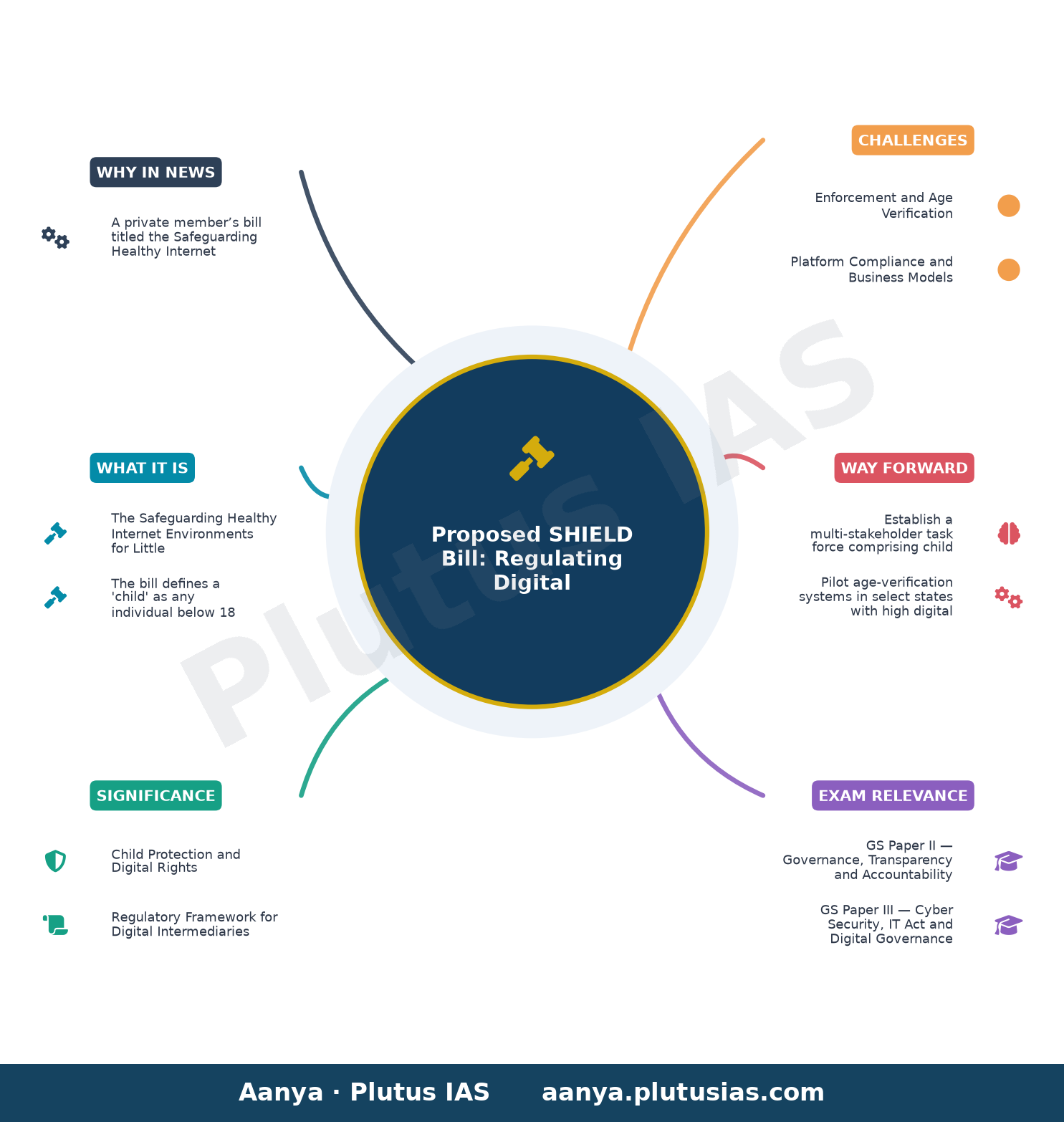
- GS Paper II — Governance, Transparency and Accountability | GS Paper III — Cyber Security, IT Act and Digital Governance
- Prelims: Digital Personal Data Protection Act, 2023, Information Technology (Intermediary Guidelines and Digital Media Ethics Code) Rules, 2021, Section 69A of the IT Act, Age-verification mechanisms, Personalised advertising restrictions, Data localisation and child safety
- Essay: The ethical frontier of digital governance: Balancing innovation and child protection in the age of AI, Regulating the internet without stifling creativity: A framework for responsible digital citizenship
Quick Revision: The SHIELD Bill, 2025, aims to enforce age-verification, parental consent, and advertising restrictions to safeguard minors in India’s digital ecosystem.
Why is this in the news?
A private member’s bill titled the Safeguarding Healthy Internet Environments for Little Digital-Natives (SHIELD) Bill, 2025, has been proposed in Parliament to restrict children under 13 from creating accounts on social media and gaming platforms without verified parental consent. The bill also seeks to prohibit personalised advertising targeting minors and mandates age-verification systems, parental-control dashboards, and stricter content moderation to safeguard children from harmful digital content. This legislative initiative reflects growing concerns over the psychological and developmental impacts of unregulated digital exposure on minors.
Background
- The proliferation of social media and online gaming platforms has raised concerns about the mental health, privacy, and safety of children in digital spaces.
- India’s digital ecosystem has witnessed a surge in internet usage among minors, with studies indicating that over 70% of Indian children aged 9–17 are active on social media platforms.
- Existing regulatory frameworks, such as the Information Technology (Intermediary Guidelines and Digital Media Ethics Code) Rules, 2021, provide limited safeguards for minors, focusing primarily on content removal and grievance redressal rather than proactive protection.
- The Digital Personal Data Protection Act, 2023, introduces obligations for data fiduciaries to process children’s data with heightened care, but gaps remain in addressing online behavioural tracking and personalised advertising.
- The IT Act’s Section 69A empowers the government to block online content in the interest of sovereignty, security, or public order, but lacks specific provisions for child protection in digital environments.
- Global precedents, such as the Children’s Online Privacy Protection Act (COPPA) in the United States and the General Data Protection Regulation (GDPR) in the EU, mandate stricter consent requirements and advertising restrictions for minors.
What is the SHIELD Bill, 2025?
- The Safeguarding Healthy Internet Environments for Little Digital-Natives (SHIELD) Bill, 2025, is a private member’s bill introduced to regulate the digital exposure of minors in India.
- The bill defines a ‘child’ as any individual below 18 years of age, extending protections beyond the current threshold of 13 years in some jurisdictions.
- It proposes a ban on minors under 13 creating accounts on social media and gaming platforms without verified parental consent, ensuring that platforms implement robust age-verification mechanisms.
- The bill mandates parental-control dashboards, enabling guardians to monitor digital activity, manage privacy settings, and restrict screen time, thereby fostering responsible digital parenting.
- It prohibits platforms from tracking, profiling, or targeting minors with personalised advertising, aligning with global best practices to mitigate the risks of behavioural manipulation.
- The bill imposes obligations on platforms to prevent exposure to harmful content, including pornography, gambling, extremist material, and drug-related content, through proactive content moderation.
- The bill reflects a shift towards a ‘safety-by-design’ approach in digital governance, prioritising the protection of minors in the design and operation of online platforms.
Key Features
| Feature | Significance |
|---|---|
| Age Verification System | Mandatory verification to prevent minors below 13 from creating accounts without parental consent, ensuring compliance with child safety norms. |
| Parental Consent Requirement | Platforms must obtain verified parental consent for account creation by children under 13, aligning with global best practices in child protection. |
| Prohibition on Personalised Advertising | Platforms barred from tracking, profiling, or targeting minors with personalised ads, reducing exposure to manipulative content. |
| Parental-Control Dashboards | Guardians granted tools to monitor activity, manage privacy settings, and restrict screen time, enhancing digital parenting. |
| Content Restrictions | Platforms must prevent exposure to pornography, gambling, violent content, extremist material, and drug-related content for minors. |
| Penalties for Non-Compliance | Violations attract penalties up to ₹10 crore, with repeated offences risking suspension or blocking under Section 69A of the IT Act. |
Why it Matters
Child Protection and Digital Rights
- Addresses the vulnerability of minors to online harms, including cyberbullying, grooming, and exposure to inappropriate content.
- Aligns with the UN Convention on the Rights of the Child (1989), which mandates protection from all forms of violence and exploitation.
- Balances digital access with safeguards, ensuring minors are not exploited by data-driven advertising or predatory algorithms.
Regulatory Framework for Digital Intermediaries
- Introduces a dedicated legal framework for social media, gaming, and online platforms, addressing gaps in existing IT Act provisions.
- Shifts responsibility from passive intermediaries to active duty of care, similar to the EU’s Digital Services Act (DSA) and UK’s Online Safety Act.
- Sets a precedent for India’s approach to platform accountability, distinct from self-regulation models.
Public Health and Social Impact
- Mitigates risks of addiction, mental health disorders, and behavioural issues linked to excessive screen time and algorithmic manipulation.
- Reduces exposure to harmful content (e.g., self-harm, extremism), which has been linked to real-world violence and radicalisation.
- Encourages responsible digital citizenship by involving parents in the oversight of minors’ online activities.
Economic and Market Implications
- May compel platforms to redesign algorithms and business models to comply with child safety norms, potentially increasing operational costs.
- Could drive innovation in age-verification technologies (e.g., biometric authentication, AI-based detection) and parental-control tools.
- May influence global tech firms to adopt uniform standards for child safety, enhancing India’s regulatory influence.
Legal and Governance Precedents
- Demonstrates Parliament’s willingness to legislate on emerging digital harms, setting a template for future tech regulations.
- Highlights the role of private member’s bills in shaping policy discourse, despite their low success rate in becoming law.
- Raises questions about the enforceability of age-verification systems and the balance between privacy and surveillance.
Challenges
1. Enforcement and Age Verification
- Risk of false declarations by minors or parents during age verification, undermining the system’s effectiveness.
- Potential privacy concerns arising from mandatory biometric or document-based verification, conflicting with data protection laws.
- Technical challenges in verifying age across diverse platforms (e.g., gaming, social media, messaging) without centralised databases.
UPSC Link: GS2: Fundamental Rights (Right to Privacy)
2. Platform Compliance and Business Models
- Resistance from platforms reliant on data-driven advertising and user engagement, which may view child protection as a cost burden.
- Difficulty in retrofitting existing systems to comply with age restrictions and content moderation requirements.
- Risk of over-blocking content due to automated filters, leading to censorship concerns and stifling free expression.
UPSC Link: GS3: Indian Economy (Digital Economy)
3. Parental Role and Digital Literacy
- Unequal access to digital literacy among parents, particularly in rural or socio-economically disadvantaged households.
- Potential over-reliance on parental dashboards, which may not address systemic issues like algorithmic bias or platform design flaws.
- Cultural variations in parenting styles and digital supervision, complicating uniform enforcement.
UPSC Link: GS1: Social Empowerment (Digital Divide)
4. Jurisdictional and Cross-Border Issues
- Difficulty in regulating foreign platforms operating in India, which may not comply with domestic laws due to jurisdictional barriers.
- Conflict with global regulations (e.g., GDPR, COPPA), requiring harmonisation to avoid compliance burdens for multinational firms.
- Risk of platforms relocating services to jurisdictions with lax child protection laws.
UPSC Link: GS2: International Relations (Digital Sovereignty)
5. Legal and Ethical Dilemmas
- Blurring of age boundaries (e.g., 13 vs. 18) may lead to arbitrary enforcement and public confusion over legal thresholds.
- Potential for misuse of parental consent mechanisms to restrict legitimate access to information or expression.
- Ethical concerns over surveillance-like measures (e.g., monitoring screen time) and their impact on minors’ autonomy.
UPSC Link: GS4: Ethics (Digital Ethics)
6. Technological and Infrastructure Gaps
- Limited digital infrastructure in rural areas may hinder the implementation of age-verification systems and parental-control tools.
- Lack of standardised age-verification protocols across platforms, leading to inconsistencies in enforcement.
- Dependence on third-party verification services, which may themselves pose privacy or security risks.
UPSC Link: GS3: Science and Technology (Digital Infrastructure)
Challenges — UPSC Perspective
| Issue | Concern |
|---|---|
| False Age Declarations | Minors or parents may provide incorrect age information to bypass restrictions. |
| Privacy Risks in Verification | Biometric or document-based verification may compromise minors’ data security. |
| Platform Compliance Burden | High costs and technical challenges for platforms to retrofit systems for child safety. |
| Algorithmic Bias | Automated content moderation may disproportionately restrict legitimate content. |
| Parental Digital Literacy | Unequal access to tools and knowledge among parents to utilise parental-control features. |
| Cross-Border Enforcement | Foreign platforms may evade domestic regulations due to jurisdictional limitations. |
Way Forward
- Establish a multi-stakeholder task force comprising child psychologists, technologists, and legal experts to draft age-verification standards.
- Pilot age-verification systems in select states with high digital penetration to assess feasibility and challenges.
- Amend the IT Rules, 2021, to incorporate child safety provisions, ensuring alignment with the proposed bill.
- Launch nationwide digital literacy campaigns for parents and minors, focusing on safe online practices and platform tools.
- Collaborate with global tech firms to harmonise age-verification protocols and content moderation policies.
- Strengthen grievance redressal mechanisms for minors to report violations, with dedicated helplines and child-friendly interfaces.
- Conduct periodic audits of platforms to assess compliance, with penalties for wilful violations under Section 69A of the IT Act.
UPSC Value Addition
Keywords for Mains Answer-Writing
Digital Personal Data Protection Act 2023 · Protection of Children from Sexual Offences Act 2012 · Information Technology (Intermediary Guidelines and Digital Media Ethics Code) Rules 2021 · Article 19(1)(a) and Article 21 of the Constitution · Age-verification mechanisms · Personalised advertising and profiling · Parental consent and control mechanisms · Section 69A of the Information Technology Act · UN Convention on the Rights of the Child · Data localisation and cross-border data flows · Intermediary liability under IT Rules 2021 · Ethical governance of AI and digital platforms
Constitutional & Policy Linkages
- [‘Article 15(3): Special provisions for children’, ‘Empowers the state to make laws for the protection of children, including digital rights.’]
- [‘Article 21A: Right to Education’, ‘Implicitly includes safe digital learning environments as part of educational rights.’]
- [‘Article 39(f): Directive Principles of State Policy’, ‘Mandates the state to ensure children are protected from exploitation and moral degradation.’]
Concept Flow
Exposure to digital platforms without safeguards → Increased risks of cyberbullying, addiction, and harmful content exposure → Proposed SHIELD Bill introduces age verification and parental consent → Platforms must redesign systems to comply → Implementation of content restrictions and personalised advertising bans → Reduced exposure to manipulative and harmful content → Parental-control dashboards and monitoring tools → Enhanced guardianship over minors’ digital activities → Enforcement via penalties and Section 69A blocking → Deterrence against non-compliance and systemic accountability → Long-term impact on digital culture → Shift towards safer, more regulated online environments for minors
Prelims Practice Questions
Q1. Consider the following statements regarding the proposed SHIELD Bill, 2025:
1. It seeks to prohibit children under 13 from creating social media or gaming accounts without verified parental consent.
2. It mandates platforms to track and profile children for personalised advertising.
3. It defines a child as anyone below 18 years of age.
4. Violations may lead to penalties up to ₹10 crore and suspension of services under Section 69A of the IT Act.
How many of the above statements are correct?
- Only one
- Only two
- Only three
- All four
Answer: Only three — Statements 1, 3, and 4 are correct. Statement 2 is incorrect because the bill prohibits tracking, profiling, and personalised advertising for children.
Q2. Assertion (A): The SHIELD Bill, 2025, proposes age-verification systems for platforms accessible to minors.
Reason (R): It aims to prevent exposure of children to harmful content such as pornography, gambling, and extremist material.
- Both A and R are true, and R is the correct explanation of A
- Both A and R are true, but R is not the correct explanation of A
- A is true, but R is false
- A is false, but R is true
Answer: Both A and R are true, but R is not the correct explanation of A — Both the assertion and reason are true. The bill indeed proposes age-verification systems (A) to achieve the broader goal of protecting children from harmful content (R), making R the correct explanation of A.
Q3. Match the following provisions of the proposed SHIELD Bill, 2025, with their corresponding objectives:
Column I (Provision)
1. Parental-control dashboards
2. Prohibition on personalised advertising
3. Penalties for violations
4. Age-verification systems
Column II (Objective)
A. Prevent profiling and targeting of minors
B. Enable guardians to monitor activity and manage privacy
C. Ensure platforms verify the age of users
D. Impose financial and operational consequences for non-compliance
Select the correct match:
- 1-B, 2-A, 3-D, 4-C
- 1-A, 2-B, 3-C, 4-D
- 1-D, 2-C, 3-B, 4-A
- 1-C, 2-D, 3-A, 4-B
Answer: 1-B, 2-A, 3-D, 4-C — The correct matches are: 1-B (Parental-control dashboards enable guardians to monitor activity), 2-A (Prohibition on personalised advertising prevents profiling), 3-D (Penalties for violations impose consequences), and 4-C (Age-verification systems ensure age verification).
Mains Practice Question
✍ The proposed SHIELD Bill, 2025, seeks to regulate digital platforms accessible to minors by imposing stringent safeguards, including age-verification, parental consent, and restrictions on personalised advertising. Critically examine the constitutional validity and efficacy of these provisions in balancing child protection with the right to free expression under Article 19(1)(a) of the Constitution. Also, discuss the challenges in implementing such measures in a diverse and digitally fragmented society like India. (15 Marks)
Approach: MODEL-ANSWER SKELETON:
1. **Constitutional Validity**:
– **Article 19(1)(a)**: Right to free expression vs. State’s duty to protect minors (Art. 21). Cite *Shreya Singhal v. Union of India* (2015) on reasonable restrictions.
– **Article 21**: Right to privacy and protection from harm; reference *K.S. Puttaswamy v. Union of India* (2017).
– **Proportionality Test**: Assess if the restrictions are narrowly tailored (e.g., age-verification systems as a less restrictive alternative).
2. **Efficacy of Provisions**:
– **Age-Verification**: Discuss technological feasibility, data privacy risks, and potential exclusion of minors from essential services.
– **Parental Consent**: Highlight challenges in verifying parental identity and the risk of over-policing.
– **Personalised Advertising Ban**: Evaluate its impact on platform revenue models and the effectiveness in reducing harmful content exposure.
3. **Challenges in Implementation**:
– **Digital Divide**: Urban-rural disparities in internet access and digital literacy.
– **Platform Compliance**: Enforcement mechanisms under IT Rules 2021 and Section 69A of the IT Act.
– **Cross-Border Data Flows**: Jurisdictional challenges with global platforms.
– **Cultural and Socioeconomic Diversity**: Tailoring measures for India’s pluralistic society.
4. **Comparative Perspective**:
– Reference the **UN Convention on the Rights of the Child** (1989) and global models (e.g., GDPR’s age-verification requirements).
– Contrast with India’s **Protection of Children from Sexual Offences Act (POCSO), 2012** and **Digital Personal Data Protection Act (DPDP), 2023**.
5. **Conclusion**:
– Balance between child protection and fundamental rights; suggest measures like phased implementation, public awareness campaigns, and multi-stakeholder consultations.
Source: Hindustan Times
Generated by AanyaAi for educational purpose.

- महाराष्ट्र में त्योहार जुलूसों पर बॉम्बे हाईकोर्ट का बड़ा फैसला: पटाखे, लेजर और संगीत पर रोक - September 24, 2026
- Bombay HC Bans Firecrackers, Music in Maharashtra Processions: Key UPSC Analysis - September 24, 2026
- तमिलनाडु में महिला कर्मचारियों के लिए सवैतनिक माहवारी अवकाश नीति पर HC का आदेश - September 24, 2026

No Comments