


08 Aug UPSC Alert: Bill Proposes Ban on Social Media Accounts for Under-13s
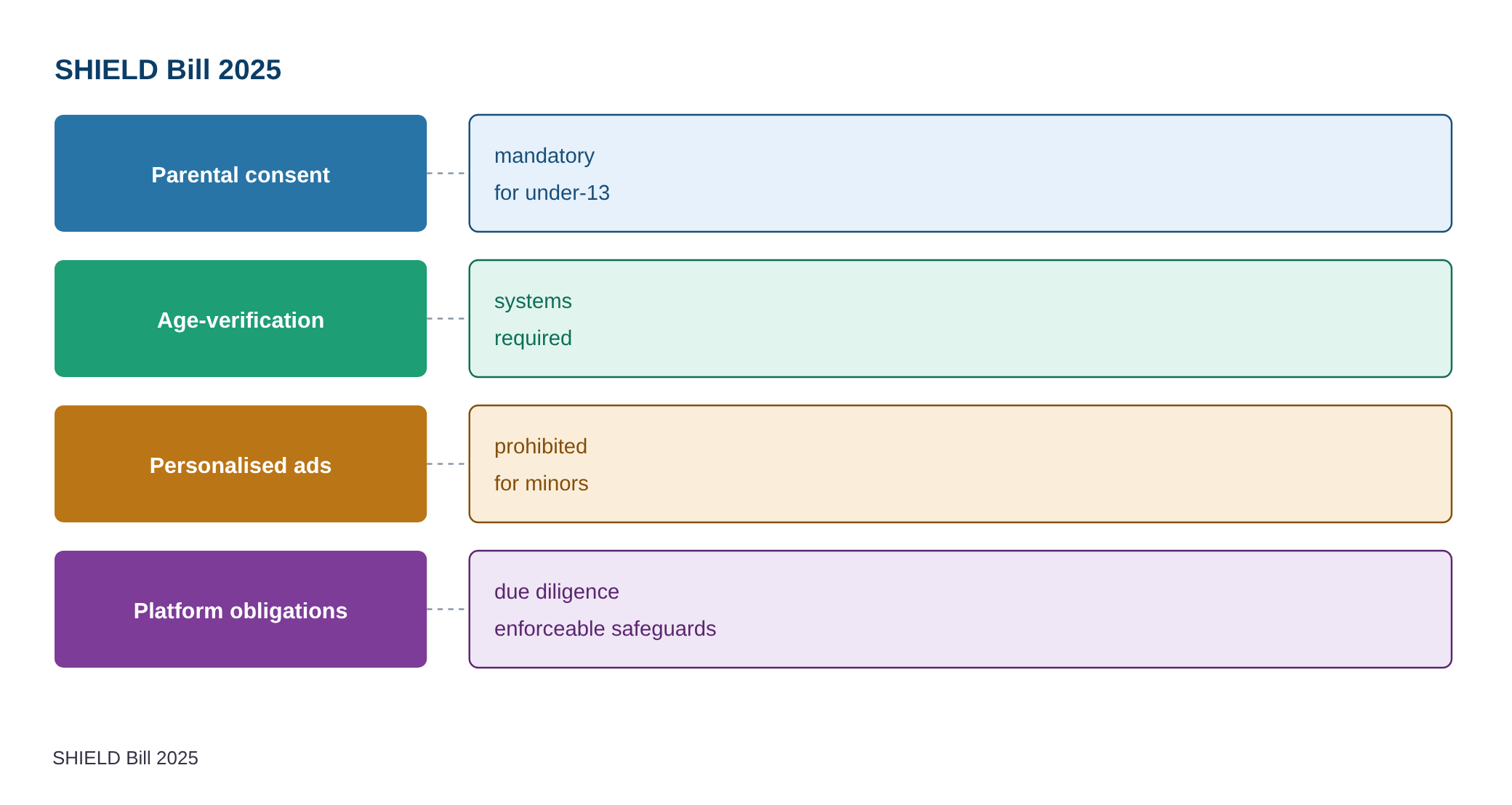
✎ The SHIELD Bill, 2025, proposes mandatory parental consent, age-verification systems, and prohibitions on personalised advertising for minors under 13 on social media and gaming platforms, with penalties up to ₹10 crore for…
Subject Relevance — Where This Topic Fits
- GS Paper II — Governance, Transparency and Accountability | GS Paper III — Cyber Security, Digital Governance and Technology
- Prelims: Digital Personal Data Protection Act, 2023, Information Technology (Intermediary Guidelines and Digital Media Ethics Code) Rules, 2021, Section 69A of the IT Act, Age-verification systems, Personalised advertising, Online gaming platforms, Dark patterns in digital interfaces
- Essay: The ethical governance of technology: Balancing innovation with child protection in the digital age, Parental rights versus state regulation: Where should the line be drawn in digital parenting?
Quick Revision: The SHIELD Bill, 2025, proposes mandatory parental consent, age-verification systems, and prohibitions on personalised advertising for minors under 13 on social media and gaming platforms, with penalties up to ₹10 crore for non-compliance.
Why is this in the news?
A private member’s bill titled the Safeguarding Healthy Internet Environments for Little Digital-Natives (SHIELD) Bill, 2025, has been introduced in Parliament proposing stringent restrictions on social media and gaming platforms for users under 13 years of age, including mandatory parental consent, age-verification systems, and prohibitions on personalised advertising targeting minors. The bill reflects growing legislative concern over the psychological, developmental, and safety risks posed by unregulated digital exposure to children, particularly in the context of India’s expanding digital ecosystem and rising online gaming and social media usage among minors.
Background
- India’s digital user base has surged, with over 800 million internet users, including an estimated 450 million minors who access social media and gaming platforms.
- The Digital Personal Data Protection Act, 2023, introduced obligations for data fiduciaries but did not specifically address age-based restrictions or parental consent mechanisms for minors.
- The Information Technology (Intermediary Guidelines and Digital Media Ethics Code) Rules, 2021, require intermediaries to exercise due diligence but lack enforceable safeguards for minors against personalised advertising or harmful content exposure.
- Studies by UNICEF and other agencies highlight the correlation between excessive screen time, exposure to violent or extremist content, and gambling-related promotions with adverse developmental outcomes in children.
- The proposed bill aligns with global trends, such as the United States’ Children’s Online Privacy Protection Act (COPPA) and the European Union’s Digital Services Act (DSA), which mandate stricter protections for minors in digital spaces.
- Private member’s bills in India rarely become law due to procedural constraints, with only about a dozen having been enacted since Independence, though they often catalyse policy discussions.
What is the Safeguarding Healthy Internet Environments for Little Digital-Natives (SHIELD) Bill, 2025?
- The SHIELD Bill, 2025, is a private member’s legislative proposal introduced by BJP MP Baijayant Panda, aimed at regulating digital platforms to protect minors from harmful content, personalised advertising, and unmonitored online engagement.
- The bill defines a ‘child’ as any individual below 18 years of age, to align with India’s legal majority age.
- It mandates that social media, gaming, and other digital intermediaries implement age-verification systems to verify the age of users, ensuring compliance with the proposed restrictions.
- Platforms would be prohibited from tracking, profiling, or targeting minors with personalised advertising, addressing concerns over data exploitation and manipulative algorithms.
- Parental consent would be mandatory for children under 13 to create accounts, with guardians granted access to parental-control dashboards to monitor activity, manage privacy settings, and restrict screen time.
- The bill imposes obligations on platforms to prevent exposure to harmful content categories, including pornography, gambling, violent or extremist material, and drug-related content.
- Non-compliance could result in penalties up to ₹10 crore, with repeated violations potentially leading to temporary suspension or blocking of services under Section 69A of the Information Technology Act.
- The bill also proposes the establishment of a Digital Child Protection Authority to oversee enforcement, conduct audits, and investigate violations, ensuring systemic accountability.
Key Features
| Feature | Significance |
|---|---|
| Age-verification systems for minors | Ensures compliance with the age threshold (under 13) by mandating verified parental consent before account creation on social media and gaming platforms. |
| Parental-control dashboards | Empowers guardians to monitor digital activity, manage privacy settings, and restrict screen time, aligning with the principle of shared responsibility in child protection. |
| Prohibition of personalised advertising for minors | Prevents exploitative targeting of children through data-driven advertising, reducing the risk of psychological manipulation and commercial exploitation. |
| Safety obligations for digital intermediaries | Imposes statutory duties on social media, gaming, and other platforms to prevent exposure to harmful content such as pornography, gambling, extremist material, and drug-related content. |
| Penalties for non-compliance (up to ₹10 crore) | Acts as a deterrent against lax enforcement of child safety norms, ensuring accountability for platforms that fail to adhere to the proposed safeguards. |
Why it Matters
Child Protection and Digital Rights
- Aligns with the UN Convention on the Rights of the Child (UNCRC), which recognises the right to protection from exploitation and harm in digital spaces.
- Addresses the vulnerability of minors to online predators, cyberbullying, and exposure to age-inappropriate content, thereby upholding their fundamental right to a safe digital environment.
- Reflects a global trend in digital governance, such as the EU’s Digital Services Act and the UK’s Online Safety Act, which prioritise child safety in online ecosystems.
Regulatory Framework for Digital Intermediaries
- Proposes a structured regulatory approach for social media and gaming platforms, filling gaps in the existing Information Technology (Intermediary Guidelines and Digital Media Ethics Code) Rules, 2021.
- Introduces age-verification mechanisms, a critical step in combating the proliferation of fake accounts and ensuring compliance with age-based restrictions.
- Establishes a precedent for balancing innovation with accountability in the digital ecosystem, particularly for platforms with significant minor user bases.
Economic and Commercial Implications
- May reduce advertising revenue for platforms reliant on personalised data from minors, necessitating a shift toward ethical and non-exploitative monetisation strategies.
- Could incentivise the development of child-safe digital products and services, fostering a market for age-appropriate technology solutions.
- Raises questions about the cost of compliance for smaller platforms, potentially creating barriers to entry and consolidating market dominance among larger players.
Parental and Societal Responsibility
- Shifts part of the burden of child safety from parents to platforms, while still emphasising the role of guardians in monitoring and guiding digital behaviour.
- Encourages digital literacy initiatives to empower both children and parents in navigating online spaces responsibly.
- May lead to broader societal discussions on the ethical use of technology, particularly in areas such as data privacy, consent, and the commercialisation of minors’ attention.
Challenges
1. Implementation and Enforcement
- Age-verification systems may face resistance due to privacy concerns, as they require the collection and storage of sensitive personal data.
- The effectiveness of parental-control dashboards depends on the digital literacy of guardians, which varies widely across socio-economic groups.
- Platforms may circumvent regulations by relocating servers or operations to jurisdictions with lax enforcement, necessitating international cooperation.
UPSC Link: GS2: Governance, Transparency & Accountability
2. Technological and Ethical Concerns
- Current age-verification technologies (e.g., biometric scans, ID checks) are prone to errors and may exclude legitimate users, particularly in regions with limited digital infrastructure.
- The prohibition of personalised advertising for minors could conflict with the business models of platforms that rely on data-driven revenue, raising questions about sustainability.
- The definition of a ‘child’ as anyone under 18 (as per the SHIELD Bill) may be inconsistent with existing laws, such as the Protection of Children from Sexual Offences (POCSO) Act, which defines a child as under 18 but sets the age of consent at 18.
UPSC Link: GS3: Science & Technology, Ethics
3. Legal and Jurisdictional Hurdles
- Private member’s bills rarely become law, as they lack government backing and face procedural delays in Parliament, reducing the likelihood of immediate implementation.
- The proposed penalties (up to ₹10 crore) may be insufficient to deter large platforms, which often view fines as a cost of doing business.
- The use of Section 69A of the IT Act to block or suspend services raises concerns about overreach and the potential for misuse by authorities.
UPSC Link: GS2: Parliament & State Legislatures
4. Digital Divide and Accessibility
- Mandatory age-verification systems could disproportionately affect marginalised communities with limited access to digital IDs or parental consent mechanisms.
- Rural and low-income households may lack the resources to implement parental-control tools, exacerbating inequalities in digital safety.
- The focus on age-based restrictions may overlook the needs of older minors (e.g., 16–17 years), who are often equally vulnerable to online harms but excluded from protections.
UPSC Link: GS1: Social Justice, Inclusive Growth
5. Balancing Innovation and Regulation
- Overly restrictive regulations could stifle innovation in India’s burgeoning digital economy, particularly in sectors like gaming, edtech, and social media.
- The bill’s provisions may conflict with global standards, creating compliance challenges for platforms operating across multiple jurisdictions.
- The lack of a clear definition for ‘personalised advertising’ leaves room for ambiguity, potentially leading to inconsistent enforcement.
UPSC Link: GS3: IPR, Start-ups & Innovation
Challenges — UPSC Perspective
| Issue | Concern |
|---|---|
| Privacy vs. Safety | Age-verification systems may infringe on minors’ privacy rights while attempting to protect them from online harms. |
| Digital Literacy Gaps | Parental-control tools are ineffective if guardians lack the digital skills to use them responsibly. |
| Platform Compliance Costs | Smaller platforms may struggle to afford the technological and administrative costs of compliance. |
| Jurisdictional Arbitrage | Platforms may exploit legal loopholes by operating from regions with weaker enforcement. |
| Ethical Advertising Dilemmas | Prohibiting personalised ads for minors may conflict with platforms’ revenue models, raising sustainability concerns. |
| Overreach of Section 69A | The use of IT Act powers to block services risks arbitrary censorship and undermines due process. |
Way Forward
- Conduct a pilot implementation of age-verification systems in select states with high digital penetration to assess feasibility and challenges.
- Develop a national digital literacy programme for parents and children, focusing on safe online practices and the responsible use of parental-control tools.
- Amend the Information Technology (Intermediary Guidelines and Digital Media Ethics Code) Rules, 2021, to incorporate provisions from the SHIELD Bill, ensuring consistency with existing regulations.
- Collaborate with global tech platforms to standardise age-verification technologies and share best practices for child safety in digital spaces.
- Establish an independent regulatory body to oversee compliance, investigate violations, and impose penalties, ensuring transparency and accountability.
- Incorporate the bill’s principles into the National Digital Health Mission and other digital governance frameworks to create a cohesive policy ecosystem.
- Encourage the development of child-safe alternatives to mainstream social media and gaming platforms, fostering a competitive market for ethical digital products.
- Conduct periodic reviews of the bill’s impact on minors’ rights, platform innovation, and economic growth to ensure balanced and adaptive regulation.
UPSC Value Addition
Keywords for Mains Answer-Writing
Digital Personal Data Protection Act 2023 · Protection of Children from Sexual Offences Act 2012 · Information Technology (Intermediary Guidelines and Digital Media Ethics Code) Rules 2021 · United Nations Convention on the Rights of the Child · Parental consent mechanisms · Personalised advertising regulations · Age verification systems · Right to Privacy under Article 21 · Section 69A of the IT Act · Digital intermediaries obligations · Data localisation and cross-border data flows · Child safety online · Regulation of social media platforms · Online gaming regulations · Prohibition of harmful content for minors
Constitutional & Policy Linkages
- [‘Article 14: Equality before law’, ‘Ensures non-discriminatory application of age-based restrictions across digital platforms.’]
- [‘Article 19(1)(a): Freedom of speech’, “Balances minors’ right to expression with the state’s duty to protect them from harm.”]
- [‘Article 21: Right to life and personal liberty’, ‘Extends to the right to a safe digital environment, free from exploitation and psychological harm.’]
- [‘Article 39(f): Directive Principles of State Policy’, “Guides the state in ensuring children’s healthy development in all spheres, including digital spaces.”]
Concept Flow
Rise in online harms targeting minors (cyberbullying, grooming, exposure to harmful content) → Legislative response via private member’s bill (SHIELD Bill, 2025) → Proposal of age-verification systems and parental controls → Debate on feasibility, privacy, and enforcement → Potential amendments to existing IT Rules → Implementation challenges (digital divide, platform resistance) → Long-term impact on digital governance and child protection.
Prelims Practice Questions
Q1. Consider the following statements regarding the proposed SHIELD Bill, 2025:
1. The bill defines a child as any individual below the age of 18.
2. It proposes mandatory age-verification systems for platforms accessible to minors.
3. Platforms violating the proposed law could face penalties of up to ₹5 crore.
4. The bill seeks to prohibit personalised advertising targeted at children.
How many of the above statements are correct?
- Only one
- Only two
- Only three
- All four
Answer: Only three — Statements 1, 2, and 4 are correct as per the bill’s provisions. Statement 3 is incorrect because the penalty proposed is ₹10 crore, not ₹5 crore.
Q2. Assertion (A): The SHIELD Bill, 2025, aims to regulate the misuse of artificial intelligence to create realistic imitations of people.
Reason (R): The bill includes provisions to prevent children from being exposed to pornography, gambling, and extremist material.
In the context of the above two statements, which one of the following is correct?
- Both A and R are true, and R is the correct explanation of A.
- Both A and R are true, but R is not the correct explanation of A.
- A is true, but R is false.
- A is false, but R is true.
Answer: A is true, but R is false. — Assertion (A) is true as the bill includes provisions to regulate AI misuse. Reason (R) is also true but is not the correct explanation of A, as it pertains to child safety provisions unrelated to AI misuse regulation.
Q3. Match the following provisions of the proposed SHIELD Bill, 2025, with their corresponding objectives:
Column I (Provisions)
A. Age verification systems
B. Parental-control dashboards
C. Prohibition of personalised advertising
D. Penalties for violations
Column II (Objectives)
1. Ensure parental monitoring of digital activity
2. Prevent tracking and profiling of minors
3. Verify the age of users accessing platforms
4. Impose financial penalties for non-compliance
Select the correct match:
- A-1, B-2, C-3, D-4; A-3, B-1, C-2, D-4; A-4, B-3, C-1, D-2; A-2, B-4, C-1, D-3
- answer_string_exact_match_required_here
Answer: ? — The correct matches are: A (Age verification systems) with 3 (Verify the age of users), B (Parental-control dashboards) with 1 (Ensure parental monitoring), C (Prohibition of personalised advertising) with 2 (Prevent tracking and profiling), and D (Penalties for violations) with 4 (Impose financial penalties).
Mains Practice Question
✍ Critically examine the constitutional and statutory framework governing child safety in the digital ecosystem in India. In your answer, discuss the relevance of the proposed SHIELD Bill, 2025, and its potential to address gaps in existing laws such as the Digital Personal Data Protection Act, 2023. Also analyse the challenges in its implementation and suggest measures to ensure effective enforcement. (15 Marks)
Approach: MODEL-ANSWER SKELETON:
1. **Constitutional and Statutory Framework** (5 points):
– **Right to Privacy (Article 21)**: Puttaswamy judgment (2017) and its implications for digital surveillance and data protection.
– **Protection of Children from Sexual Offences Act (POCSO), 2012**: Provisions for online child abuse and exploitation (Sections 11-13, 15).
– **Information Technology Act, 2000**: Section 67C (preservation of data), Section 69A (blocking of content), and the 2021 Intermediary Rules.
– **Digital Personal Data Protection Act (DPDP), 2023**: Consent requirements (Section 4), obligations of data fiduciaries (Chapter II), and child data protection (Section 9).
– **UN Convention on the Rights of the Child (UNCRC)**: India’s obligations under Articles 16 (right to privacy) and 34 (protection from exploitation).
2. **Relevance of the SHIELD Bill, 2025** (5 points):
– **Age Verification and Parental Consent**: Mandatory systems to prevent underage access (Article 3 of the Bill).
– **Prohibition of Personalised Advertising**: Addresses data profiling risks (Article 5).
– **Obligations of Digital Intermediaries**: Including social media, gaming, and pornography platforms (Article 6).
– **Penalties and Enforcement**: ₹10 crore fines and Section 69A suspensions for violations (Article 10).
– **Gaps Addressed**: Fills regulatory voids in DPDP 2023, particularly for minors and harmful content exposure.
3. **Challenges in Implementation** (3 points):
– **Technological Constraints**: Feasibility of robust age-verification systems without infringing privacy.
– **Jurisdictional Issues**: Cross-border data flows and enforcement against foreign platforms.
– **Balancing Rights**: Tension between child protection and freedom of expression (Article 19(1)(a)).
4. **Suggested Measures** (2 points):
– **Multi-Stakeholder Approach**: Collaboration with tech companies, civil society, and parents for compliance.
– **Awareness Campaigns**: Educating children, parents, and platforms on digital safety and rights.
**Balanced View**: Acknowledge the bill’s strengths in child protection while critiquing its potential overreach or operational hurdles. Conclude with a forward-looking stance on digital governance.
Source: Hindustan Times
Generated by AanyaAi for educational purpose.

- महाराष्ट्र में त्योहार जुलूसों पर बॉम्बे हाईकोर्ट का बड़ा फैसला: पटाखे, लेजर और संगीत पर रोक - September 24, 2026
- Bombay HC Bans Firecrackers, Music in Maharashtra Processions: Key UPSC Analysis - September 24, 2026
- तमिलनाडु में महिला कर्मचारियों के लिए सवैतनिक माहवारी अवकाश नीति पर HC का आदेश - September 24, 2026

No Comments