


27 Jul UPSC Alert: Centre Launches Special Drive to Clear 16,033 Pending Labour Cases
Subject Relevance — Where This Topic Fits
- GS Paper II — Governance, Constitution, Polity, Social Justice and International Relations (Labour Rights and Social Security) | GS Paper III — Indian Economy and Issues relating to Planning, Mobilization of Resources, Growth, Development and Employment
- Prelims: Industrial Disputes Act, 1947, Minimum Wages Act, 1948, Payment of Gratuity Act, 1972, Maternity Benefit (Amendment) Act, 2017, Central Industrial Relations Machinery (CIRM), Chief Labour Commissioner (CLC), Labour Courts and Industrial Tribunals, Conciliation Officers
- Essay: Labour rights as a cornerstone of inclusive growth, Judicial delays and their impact on socio-economic justice
Quick Revision: The Special Campaign for Expeditious Disposal of Pending Labour Cases aims to resolve pending labour disputes across India by leveraging the Central Industrial Relations Machinery (CIRM) and Labour Courts under the Industrial Disputes Act, 1947.
Why is this in the news?
This initiative aims to address systemic delays in the adjudication of labour disputes, which have significant implications for workers’ welfare and industrial harmony. The campaign’s progress was highlighted by the Minister of State for Labour and Employment in a written reply to the Lok Sabha, indicating the government’s commitment to reducing pendency in labour adjudication mechanisms.
Background
- The Indian labour adjudication system operates under a multi-tiered framework comprising Labour Courts, Industrial Tribunals, and Conciliation Officers, established under the Industrial Disputes Act, 1947.
- Pending cases in labour adjudication mechanisms have historically been attributed to factors such as inadequate staffing, procedural delays, and the sheer volume of disputes, particularly in sectors with high labour turnover or informal employment.
- The Payment of Gratuity Act, 1972, and the Maternity Benefit (Amendment) Act, 2017, are critical legislations ensuring statutory entitlements to workers, but their effective implementation is often hindered by delays in dispute resolution.
- The Central Industrial Relations Machinery (CIRM), headed by the Chief Labour Commissioner (CLC), plays a pivotal role in resolving industrial disputes through conciliation and adjudication, but systemic bottlenecks persist.
- The COVID-19 pandemic exacerbated labour disputes, particularly in sectors like manufacturing, construction, and gig economy, leading to a surge in pending cases.
- The Union Government’s initiative aligns with broader efforts to reform labour laws, as seen in the Labour Codes (2020), which aim to simplify compliance and enhance ease of doing business while safeguarding workers’ rights.
What is the Special Campaign for Expeditious Disposal of Pending Labour Cases?
- It targets disputes related to wages, gratuity, maternity benefits, and other statutory claims, with a focus on industrial disputes under the Industrial Disputes Act, 1947.
- The campaign leverages the existing institutional framework, including Labour Courts, Industrial Tribunals, and the Central Industrial Relations Machinery (CIRM), to expedite adjudication through dedicated monitoring and streamlined processes.
- Key stakeholders include the Chief Labour Commissioner (CLC), Regional Labour Commissioners, Conciliation Officers, and Labour Courts, who are tasked with prioritising and resolving cases within the campaign period.
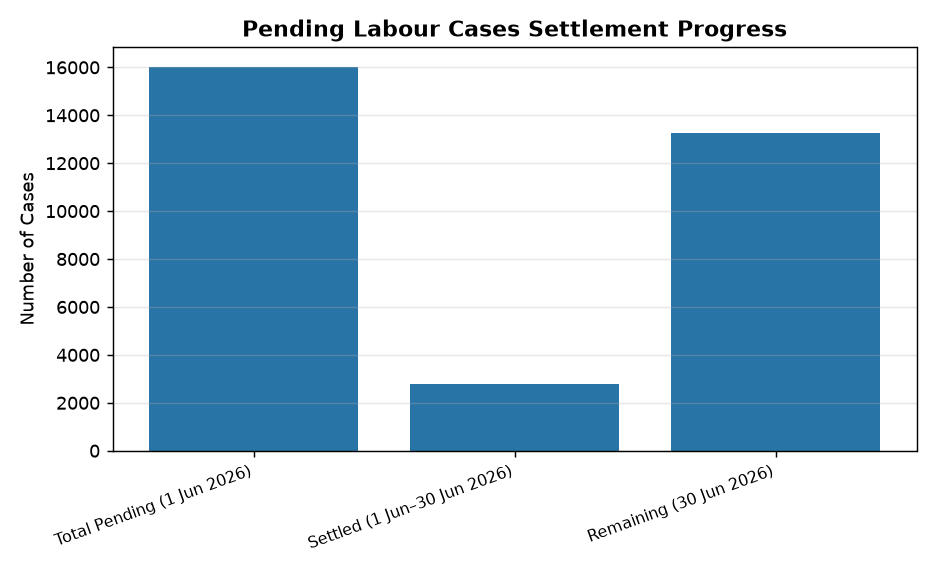
- The initiative incorporates digital tools and periodic reviews to track progress, with a reported disposal of 2,769 cases in the first month, demonstrating early momentum.
- The campaign underscores the government’s commitment to reducing pendency in labour adjudication, which is critical for ensuring timely justice to workers and maintaining industrial peace.
- It also aligns with the broader objectives of the Labour Codes (2020), which seek to simplify labour laws and enhance compliance while balancing the interests of employers and workers.
- The campaign’s success will depend on sustained institutional capacity, adequate staffing, and the adoption of best practices in dispute resolution, including alternative dispute resolution mechanisms.
Key Features
| Feature | Significance |
|---|---|
| Three-month Special Campaign (1 June–31 August 2026) | Accelerates disposal of pending labour disputes and statutory claims, reducing pendency in regional offices. |
| Focus on Industrial Disputes, Wages, Gratuity, Maternity Benefits | Targets high-impact areas where delays disproportionately affect workers’ livelihoods and legal entitlements. |
| Monthly Disposal Tracking (2,769 cases in first month) | Provides measurable progress metrics for administrative accountability and public transparency. |
| Centralised Coordination by Chief Labour Commissioner | Ensures uniformity in case handling and resource allocation across regional offices. |
| Written Parliamentary Reply by Minister of State | Demonstrates legislative oversight and government responsiveness to parliamentary queries on labour administration. |
Why it Matters
Economic
- Reduces transaction costs for businesses by shortening dispute resolution timelines, enhancing ease of doing business.
- Protects workers’ income security by expediting statutory dues such as wages, gratuity, and maternity benefits.
- Stimulates formal sector employment by resolving disputes that deter hiring or investment in labour-intensive industries.
Administrative
- Demonstrates proactive governance in addressing systemic delays in labour adjudication.
- Enhances efficiency of quasi-judicial bodies under the Ministry of Labour and Employment.
- Serves as a model for other sectors grappling with pendency in dispute resolution.
Legal
- Reinforces the principle of timely justice as a constitutional guarantee under Article 21 (Right to Life and Livelihood).
- Aligns with the Industrial Disputes Act, 1947, which mandates expeditious resolution of labour conflicts.
- Supports enforcement of statutory rights under the Maternity Benefit (Amendment) Act, 2017, and Payment of Gratuity Act, 1972.
Social
- Mitigates financial hardship for workers awaiting unpaid wages or statutory benefits, particularly in informal and unorganised sectors.
- Promotes gender equity by prioritising maternity benefit claims, addressing systemic delays faced by women workers.
- Enhances trust in labour institutions, reducing reliance on prolonged litigation.
Challenges
1. Structural Pendency in Labour Adjudication
- Chronic understaffing in labour courts and quasi-judicial bodies delays case resolution.
- Complexity of industrial disputes involving multiple stakeholders (employers, unions, government).
- Inadequate digital infrastructure for case management and tracking in regional offices.
UPSC Link: GS-II: Judiciary and Tribunals
2. Enforcement Gaps in Statutory Claims
- Low awareness among workers about legal entitlements (e.g., gratuity, maternity benefits).
- Weak monitoring mechanisms for compliance with court orders or settlements.
- Geographical disparities in access to labour offices, particularly in rural and remote areas.
UPSC Link: GS-II: Labour Welfare
3. Resource Constraints in Regional Offices
- Limited financial and human resources to handle surge in case disposal during campaigns.
- Training gaps among adjudicating officers on emerging labour laws and digital tools.
UPSC Link: GS-II: Government Policies and Interventions
4. Inter-State Coordination Challenges
- Divergent state-level policies on labour adjudication create inconsistencies in case handling.
- Lack of standardised protocols for inter-state labour disputes (e.g., migrant workers).
- Delays in sharing of records between state and central authorities.
UPSC Link: GS-II: Centre-State Relations
Challenges — UPSC Perspective
| Issue | Concern |
|---|---|
| Case Backlog | 16,033 pending cases as of 1 June 2026 indicate systemic inefficiency in dispute resolution. |
| Disparate Disposal Rates | Regional offices may exhibit uneven performance, leading to inequitable access to justice. |
| Worker Awareness | Limited outreach on statutory rights hampers utilisation of expedited disposal mechanisms. |
| Digital Divide | Regional offices in less developed states may lack robust case management systems. |
| Multi-Stakeholder Coordination | Delays arise from conflicting claims by employers, unions, and government agencies. |
| Post-Disposal Enforcement | Even after settlement, delays in implementation of orders undermine the campaign’s impact. |
Way Forward
- Strengthen digital case management systems in regional labour offices to enable real-time tracking of disposal rates.
- Conduct targeted awareness campaigns for workers and employers on statutory entitlements and dispute resolution mechanisms.
- Augment staffing in labour courts and quasi-judicial bodies through temporary deployments or contractual appointments.
- Establish standardised protocols for inter-state labour disputes to ensure uniformity in adjudication.
- Implement a grievance redressal mechanism for post-disposal implementation failures to ensure compliance with settlements.
- Integrate labour dispute resolution with the e-Shram portal to streamline case registration and tracking for unorganised sector workers.
- Publish quarterly progress reports on disposal rates and pendency reduction to enhance transparency and accountability.
- Explore mediation and arbitration as complementary mechanisms to reduce judicial burden in industrial disputes.
UPSC Value Addition
Keywords for Mains Answer-Writing
Industrial Disputes Act, 1947 · Labour adjudication mechanisms · Pending labour cases · Wage and gratuity disputes · Maternity Benefit Act, 1961 · Industrial Tribunals and Labour Courts · Labour welfare and enforcement · Judicial efficiency in labour matters · Statutory claims in labour disputes · Role of Chief Labour Commissioner
Constitutional & Policy Linkages
- {‘Article’: ‘Article 21 (Right to Life and Personal Liberty)’, ‘note’: ‘Includes right to livelihood and timely justice’}
- {‘Article’: ‘Article 39 (Directive Principles)’, ‘note’: ‘Promotes living wage and equitable treatment’}
- {‘Article’: ‘Article 43 (Directive Principles)’, ‘note’: ‘Secures living wages and decent conditions’}
Concept Flow
Chronic pendency in labour disputes → Economic uncertainty for workers and employers → Special campaign launched to expedite disposal → Targeted focus on wages, gratuity, maternity benefits → Disposal of 2,769 cases in first month → Reduction in backlog but structural issues persist → Need for systemic reforms in adjudication and enforcement → Long-term impact on ease of doing business and worker welfare
Prelims Practice Questions
Q1. Which of the following is NOT a statutory claim covered under the special campaign for settlement of long-pending labour cases launched by the Ministry of Labour and Employment?
- Wage disputes
- Gratuity claims
- Maternity benefits
- Provident Fund withdrawal claims
Answer: Provident Fund withdrawal claims — The special campaign specifically targets wage disputes, gratuity claims, maternity benefits, and other statutory claims as per the Industrial Disputes Act, 1947. Provident Fund withdrawal claims fall under the Employees’ Provident Funds and Miscellaneous Provisions Act, 1952, and are not included in this campaign.
Q2. Under which constitutional provision is the Chief Labour Commissioner (Central) empowered to adjudicate industrial disputes?
- Article 246 of the Constitution
- Article 323A of the Constitution
- Article 324 of the Constitution
- Article 299 of the Constitution
Answer: Article 323A of the Constitution — Article 323A of the Constitution empowers the Parliament to establish administrative tribunals, including Industrial Tribunals and Labour Courts, for the adjudication of industrial disputes. The Chief Labour Commissioner (Central) functions under this framework.
Q3. The special campaign for settlement of long-pending labour cases is being conducted by the Ministry of Labour and Employment under the aegis of which authority?
- Employees’ Provident Fund Organisation (EPFO)
- Chief Labour Commissioner (Central)
- Labour Bureau
- Directorate General of Factory Advice Service and Labour Institutes (DGFASLI)
Answer: Chief Labour Commissioner (Central) — The special campaign is being conducted by the Chief Labour Commissioner (Central) under the Ministry of Labour and Employment to expedite the settlement of pending labour cases.
Mains Practice Question
✍ Examine the significance of the special campaign launched by the Ministry of Labour and Employment for the settlement of long-pending labour cases. How does this initiative align with the objectives of the Industrial Disputes Act, 1947, and what challenges may hinder its effective implementation?
Approach: Begin by outlining the objectives of the Industrial Disputes Act, 1947, emphasizing its role in resolving industrial disputes and ensuring social justice for workers. Discuss the significance of the special campaign in expediting the settlement of pending cases, particularly wage disputes, gratuity claims, and maternity benefits. Highlight the challenges in implementation, such as inadequate infrastructure, judicial delays, and the need for capacity building among labour adjudication authorities. Conclude by suggesting measures to enhance the effectiveness of the campaign, such as digitization of records, training of adjudicating officers, and strengthening of Labour Courts.
Source: PIB (Press Information Bureau)
Generated by AanyaAi for educational purpose.

- महिला किसानों के एफपीओ ने खेत में बनाया 1 मेगावाट का सौर ऊर्जा संयंत्र - September 18, 2026
- Odisha Women’s FPO Launches Dual-Use Solar Farm on 13 Acres - September 18, 2026
- AI हथियारीकरण का खतरा: क्या सचमुच डराने-धमकाने की रणनीति? - September 18, 2026

No Comments