


27 Jul UPSC Alert: Centre Strengthens SC/ST Atrocities Act with ₹63.67 Crore Funds
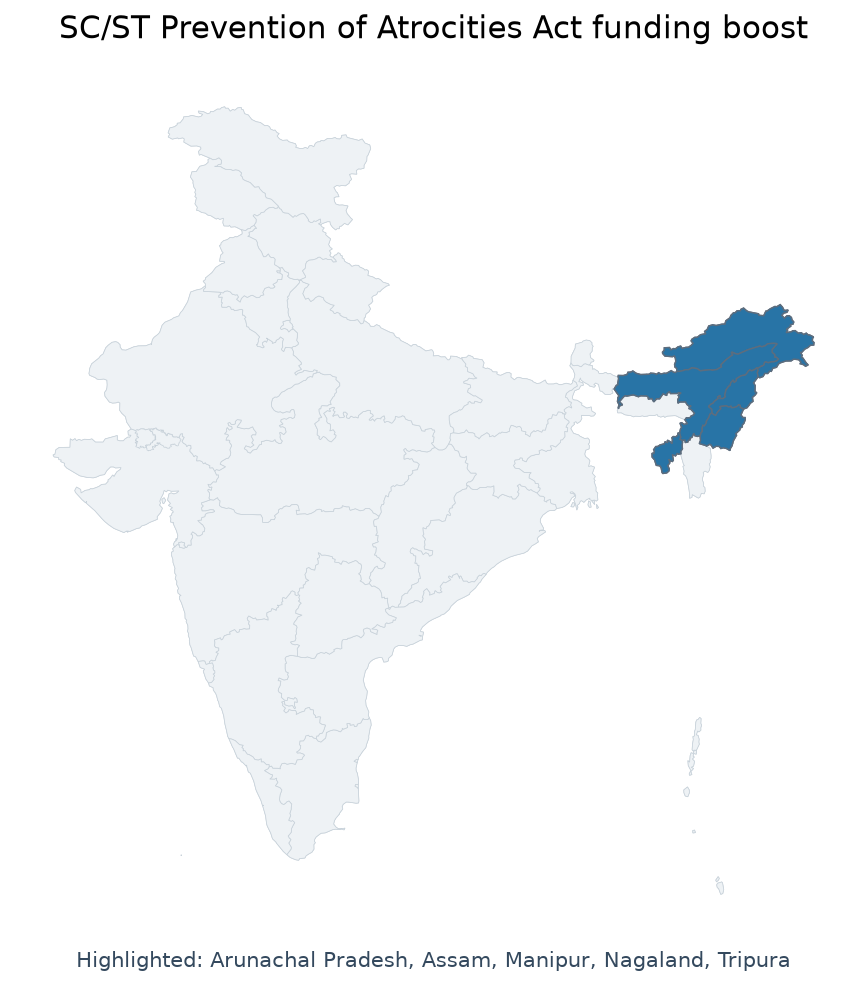
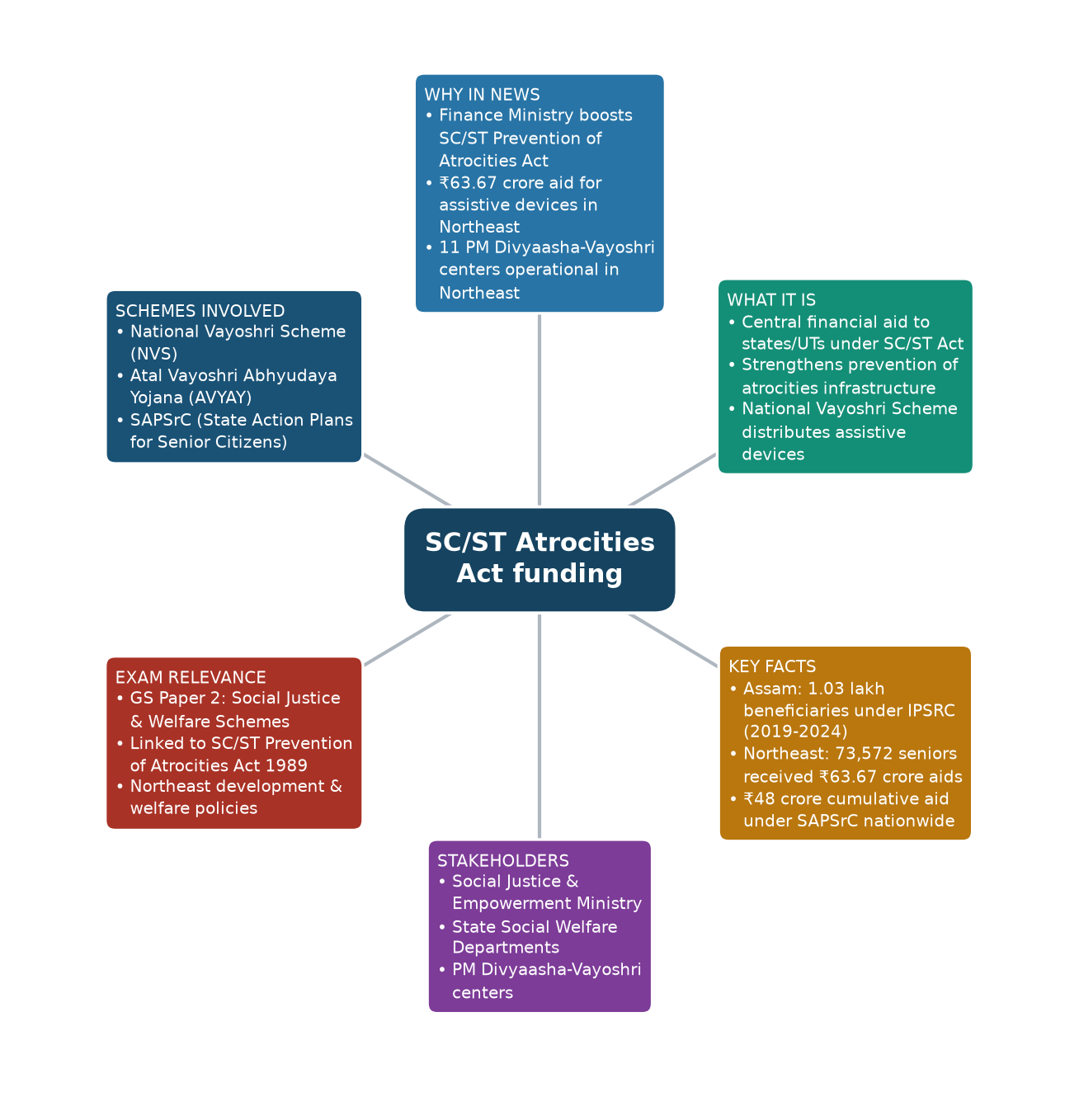
Map & concept mind-map: SC/ST Prevention of Atrocities Act funding boost
Subject Relevance — Where This Topic Fits
- GS Paper II — Governance, Constitution, Polity, Social Justice and International Relations | GS Paper III — Welfare Schemes for Vulnerable Sections of the population by the Centre and States and the Performance of these Schemes
- Prelims: SC/ST (Prevention of Atrocities) Act, 1989, Scheduled Castes and Scheduled Tribes (Prevention of Atrocities) Amendment Act, 2018, National Action Plan for Social Justice (NAPSJ), Assistive Devices for Senior Citizens and Persons with Disabilities, PM-Divyashakti Kendra, Atal Vayo Abhyudaya Yojana (AVYAY), Integrated Programme for Senior Citizens (IPSRC), National Vayoshri Yojana (NVY), Assistance to Disabled Persons for Purchase/Fitting of Aids and Appliances (ADIP), Deendayal Disabled Rehabilitation Scheme (DDRS), Unique Disability ID (UDID), Cross Disability Early Intervention Centres (CRCs), Scheme for Implementation of Persons with Disabilities Act (SIPDA)
- Essay: Social Justice and Inclusive Development: The Role of Constitutional Safeguards and State Intervention, Technology and Welfare: Bridging Gaps for Marginalised Communities
Quick Revision: The SC/ST (Prevention of Atrocities) Act, 1989, read with the 2018 Amendment, is a critical legislative tool for combating caste-based discrimination and violence, mandating stringent punishments, special courts, and victim rehabilitation measures.
Why is this in the news?
The Union Ministry of Social Justice and Empowerment has recently announced financial assistance to States and Union Territories to strengthen the implementation of the Scheduled Castes and Scheduled Tribes (Prevention of Atrocities) Act, 1989. This initiative is part of a broader strategy to enhance social justice mechanisms, particularly for marginalised communities, while simultaneously addressing the welfare needs of senior citizens and persons with disabilities in the northeastern region through targeted schemes such as the National Vayoshri Yojana and the ADIP scheme. The announcement underscores the government’s commitment to a multi-dimensional approach to social justice, combining legislative enforcement with inclusive welfare measures.
Background
- The Scheduled Castes and Scheduled Tribes (Prevention of Atrocities) Act, 1989, was enacted to prevent the commission of offences against members of Scheduled Castes (SCs) and Scheduled Tribes (STs) and to provide for special courts for the trial of such offences and the relief and rehabilitation of victims.
- The Act was amended in 2018 to include new types of atrocities and enhance the powers of the courts, reflecting the evolving nature of social discrimination and violence.
- The northeastern region of India, comprising eight states, faces unique socio-economic and geographical challenges, necessitating targeted welfare interventions.
- The Ministry of Social Justice and Empowerment has been implementing several flagship schemes for senior citizens and persons with disabilities, including the National Vayoshri Yojana, Atal Vayo Abhyudaya Yojana, and the Assistance to Disabled Persons for Purchase/Fitting of Aids and Appliances (ADIP) scheme.
- The northeastern states have received cumulative financial assistance exceeding ₹48 crore under the State Action Plan for Senior Citizens (SAPSrC) over the past five years.
What is the Scheduled Castes and Scheduled Tribes (Prevention of Atrocities) Act, 1989, and its recent strengthening measures?
- The SC/ST (Prevention of Atrocities) Act, 1989, is a legislative measure aimed at deterring and punishing crimes against members of Scheduled Castes and Scheduled Tribes, who are historically marginalised and vulnerable to discrimination and violence.
- The Act defines specific offences such as forced labour, denial of economic rights, and social boycott, and prescribes stringent punishments, including imprisonment and fines.
- The 2018 Amendment expanded the scope of the Act by adding new offences such as garlanding with footwear, disrobing, and forcing to drink or eat any inedible or obnoxious substance, thereby addressing evolving forms of atrocities.
- The Act mandates the establishment of Special Courts for the speedy trial of offences, with provisions for the appointment of Special Public Prosecutors and exclusive Special Courts in high-atrocity areas.
- The Act also provides for relief and rehabilitation measures, including compensation to victims, rehabilitation of the victims’ families, and measures for the prevention of atrocities, such as the setting up of vigilance and monitoring committees at the district and state levels.
- The recent financial assistance to States and Union Territories is intended to strengthen the implementation of the Act by enhancing the capacity of state machinery, including the establishment of exclusive Special Courts, training of police personnel, and provision of victim support services.
- The Act is complemented by other constitutional and statutory safeguards, such as the Protection of Civil Rights Act, 1955, and the provisions of the Indian Penal Code (IPC) relating to caste-based discrimination and violence.
- The enforcement of the Act is monitored by the National Commission for Scheduled Castes (NCSC) and the National Commission for Scheduled Tribes (NCST), which are constitutional bodies tasked with overseeing the implementation of safeguards for SCs and STs.
Key Features
| Feature | Significance |
|---|---|
| Financial Assistance to States/UTs under SC/ST (PoA) Act | Strengthens implementation of the Act by enhancing state-level capacity for prevention of atrocities and victim support. |
| National Vayoshri Yojana (NVY) | Provides free assistive devices to elderly below poverty line with age-related disabilities, improving their functional independence and quality of life. |
| Atal Vayo Abhyudaya Yojana (AVYAY) – Integrated Programme for Senior Citizens (IPSRC) | Offers integrated support including housing, nutrition, healthcare, and recreation for indigent senior citizens across states. |
| Assistance to Disabled Persons for Purchase/Fitting of Aids and Appliances (ADIP) | Enables disabled individuals to access assistive devices, reducing dependency and promoting social inclusion. |
| State Action Plans for Senior Citizens (SAPSrC) | Facilitates state-led initiatives for awareness, cataract surgeries, and welfare activities through financial grants. |
| Scheme for Implementation of Persons with Disabilities Act (SIPDA) – Awareness Generation Programme (AGP) | Raises awareness on rights of persons with disabilities and promotes early intervention services in the Northeast. |
| Cross Disability Early Intervention Centres (CRC Guwahati & Imphal) | Provides early screening, therapeutic, and rehabilitation services for children with disabilities in the Northeast. |
Why it Matters
Social Justice & Inclusive Development
- Enhances constitutional mandate under Article 46 to protect marginalised groups from social injustice and exploitation.
- Promotes equitable access to welfare measures for Scheduled Castes (SCs), Scheduled Tribes (STs), and Persons with Disabilities (PwDs).
- Reduces inter-generational poverty by providing assistive devices and healthcare support to elderly and disabled populations.
Administrative & Institutional Strengthening
- Centralised financial support to states/UTs ensures uniform implementation of welfare schemes across regions.
- State Action Plans and Early Intervention Centres institutionalise localised, need-based service delivery.
- Strengthens the role of District Social Welfare Officers and local bodies in monitoring and grievance redressal.
Healthcare & Rehabilitation
- Provision of assistive devices under NVY and ADIP improves functional ability and reduces caregiver burden.
- Early intervention services for children with disabilities prevent secondary disabilities and promote inclusion.
- Cataract surgeries and healthcare support under SAPSrC enhance longevity and quality of life for senior citizens.
Regional Equity & Northeast Focus
- Concentrated financial allocation to Northeast states addresses regional disparities in welfare service delivery.
- Strengthens infrastructure for disability and elderly care in remote and underserved areas.
- Promotes cultural sensitivity in service delivery through state-specific initiatives.
Challenges
1. Implementation Gaps in SC/ST (PoA) Act
- Low conviction rates under the Act due to weak investigation and prosecution mechanisms.
- Inadequate victim compensation and rehabilitation support in many states.
- Delayed registration of FIRs and underreporting of atrocities due to social stigma.
UPSC Link: GS-II: Social Justice
2. Accessibility Barriers for Elderly and Disabled
- Limited availability of assistive devices in rural and tribal areas of the Northeast.
- High out-of-pocket expenditure on healthcare despite subsidies, leading to financial distress.
- Lack of trained professionals for early intervention and rehabilitation services.
UPSC Link: GS-II: Welfare Schemes
3. State-Level Coordination Deficits
- Fragmented implementation of welfare schemes due to poor inter-departmental coordination.
- Inadequate monitoring and evaluation mechanisms to track utilisation of funds.
- Delays in fund disbursement and utilisation due to bureaucratic bottlenecks.
UPSC Link: GS-II: Centre-State Relations
4. Awareness and Stigma
- Low awareness among SC/ST communities about legal rights and welfare schemes under the Act.
- Cultural stigma associated with disabilities and old age discourages beneficiaries from availing services.
- Misinformation about eligibility criteria for schemes leads to exclusion of genuine beneficiaries.
UPSC Link: GS-II: Social Justice
5. Resource Constraints in Northeast
- Limited healthcare infrastructure in remote districts of the Northeast.
- Shortage of trained personnel for disability assessment and rehabilitation.
- Geographical barriers hinder last-mile delivery of assistive devices and services.
UPSC Link: GS-II: Regional Development
Challenges — UPSC Perspective
| Issue | Concern |
|---|---|
| Low Conviction Rates under SC/ST (PoA) Act | Weak prosecution and judicial delays undermine deterrence against atrocities. |
| Inadequate Assistive Device Coverage | Rural and tribal areas lack access to assistive devices despite scheme provisions. |
| Delayed Fund Utilisation | Bureaucratic delays in disbursement of grants reduce scheme effectiveness. |
| Stigma and Social Exclusion | Cultural barriers prevent beneficiaries from accessing welfare services. |
| Limited Early Intervention Services | Shortage of trained professionals in Northeast delays critical support for children with disabilities. |
| Poor Inter-Departmental Coordination | Fragmented implementation of schemes leads to duplication and gaps in service delivery. |
Government Initiatives — Must-Memorise for Prelims
- Scheduled Castes and Scheduled Tribes (Prevention of Atrocities) Act, 1989
- National Vayoshri Yojana (NVY)
- Atal Vayo Abhyudaya Yojana (AVYAY) – Integrated Programme for Senior Citizens (IPSRC)
- Assistance to Disabled Persons for Purchase/Fitting of Aids and Appliances (ADIP)
- State Action Plans for Senior Citizens (SAPSrC)
- Scheme for Implementation of Persons with Disabilities Act (SIPDA)
Way Forward
- Strengthen state-level implementation units under SC/ST (PoA) Act with dedicated staff for monitoring and grievance redressal.
- Expand early intervention services in Northeast by establishing more Cross Disability Centres and training local professionals.
- Leverage digital platforms for real-time tracking of fund utilisation and beneficiary outreach in remote areas.
- Conduct awareness campaigns in tribal and rural areas to reduce stigma and improve scheme uptake among SC/ST and PwD communities.
- Enhance inter-departmental coordination through joint review meetings and integrated district-level plans.
- Increase budgetary allocation for assistive devices in Northeast to bridge urban-rural divides in accessibility.
- Promote public-private partnerships for last-mile delivery of assistive devices and rehabilitation services.
- Introduce performance-based incentives for states to improve conviction rates under the SC/ST (PoA) Act.
UPSC Value Addition
Keywords for Mains Answer-Writing
Scheduled Castes and Scheduled Tribes (Prevention of Atrocities) Act, 1989 · Financial Assistance to States and UTs · Social Justice and Empowerment Ministry · Assistive Devices for Senior Citizens · Divyangjan Empowerment Schemes · National Vayosri Yojana · ADIP Scheme · Early Intervention Centres for Disabled Children · Inclusive Education for Divyangjan · Northeast Region Development · Constitutional Provisions for SC/ST Welfare · Judicial Safeguards for Marginalised Groups
Constitutional & Policy Linkages
- Article 15(4) – Special provisions for advancement of socially and educationally backward classes
- Article 16(4) – Reservation in favour of backward classes
- Article 41 – Right to public assistance in cases of unemployment, old age, sickness, and disability
- Article 46 – Promotion of educational and economic interests of SCs, STs, and weaker sections
- Seventh Schedule – State List (Item 20: Social security and social insurance)
Concept Flow
Enactment of SC/ST (PoA) Act → State receives financial assistance → Strengthened implementation → Reduced atrocities → Enhanced social justice → NVY and ADIP schemes → Provision of assistive devices → Improved functional independence → Enhanced quality of life → Reduced poverty → State Action Plans for Senior Citizens → Awareness programmes → Cataract surgeries and healthcare → Increased longevity → Reduced caregiver burden → SIPDA (AGP component) → Awareness generation → Early intervention services → Prevention of secondary disabilities → Inclusive education → Cross Disability Early Intervention Centres → Screening and rehabilitation → Functional improvement → Social inclusion → Economic empowerment
Prelims Practice Questions
Q1. Which of the following schemes is NOT directly associated with the empowerment of Divyangjan (persons with disabilities)?
- ADIP Scheme
- National Vayosri Yojana
- Deen Dayal Divyangjan Rehabilitation Scheme
- Pradhan Mantri Awas Yojana
Answer: Pradhan Mantri Awas Yojana — Pradhan Mantri Awas Yojana (PMAY) is a housing scheme for all citizens, not specifically for Divyangjan. ADIP, National Vayosri Yojana, and Deen Dayal Divyangjan Rehabilitation Scheme are directly linked to the empowerment of persons with disabilities.
Q2. Under which constitutional provision is the Scheduled Castes and Scheduled Tribes (Prevention of Atrocities) Act, 1989 primarily framed?
- Article 15(4)
- Article 17
- Article 46
- Article 342
Answer: Article 17 — Article 17 of the Constitution abolishes untouchability and provides a legal framework for the prevention of atrocities against SCs and STs, which is the basis for the Atrocities Act, 1989.
Q3. The National Vayosri Yojana primarily aims to provide:
- Free healthcare services to senior citizens
- Financial assistance for housing to senior citizens
- Free assistive devices to senior citizens with age-related disabilities
- Pension schemes for senior citizens
Answer: Free assistive devices to senior citizens with age-related disabilities — The National Vayosri Yojana provides free assistive devices such as hearing aids, wheelchairs, and walking sticks to senior citizens belonging to Below Poverty Line (BPL) households or those with age-related disabilities.
Mains Practice Question
✍ Analyse the significance of the financial assistance provided by the Government of India to states and Union Territories for the effective implementation of the Scheduled Castes and Scheduled Tribes (Prevention of Atrocities) Act, 1989. How does this measure align with the constitutional mandate for social justice and the protection of marginalised communities?
Approach: Begin by outlining the constitutional provisions (Articles 15, 17, 46) that mandate social justice and protection for SCs and STs. Discuss the role of the Atrocities Act, 1989, in addressing systemic discrimination and violence. Examine the financial assistance mechanism as a tool to strengthen the Act’s implementation, including capacity-building, awareness programmes, and institutional support. Highlight the socio-economic context of marginalised communities, particularly in the Northeast, and how targeted financial aid can mitigate structural barriers. Conclude by linking this measure to broader goals of inclusive development and constitutional morality.
Source: PIB (Press Information Bureau)
Generated by AanyaAi for educational purpose.

- केरल में एंटीमाइक्रोबियल रेजिस्टेंस: सरकारी रिपोर्ट में चौंकाने वाले आँकड़े सामने - September 23, 2026
- Kerala’s AMR Crisis: Rising Drug Resistance Threatens Public Health in 2025 - September 23, 2026
- सुप्रीम कोर्ट ने दवाओं की ऊंची कीमतों को ‘लूट’ बताया, सरकार से पूछा- क्या है कानून? - September 23, 2026

No Comments