


24 Sep UPSC Alert: Delhi-Dehradun Expressway to Get 3 New Foot Over Bridges with Lifts
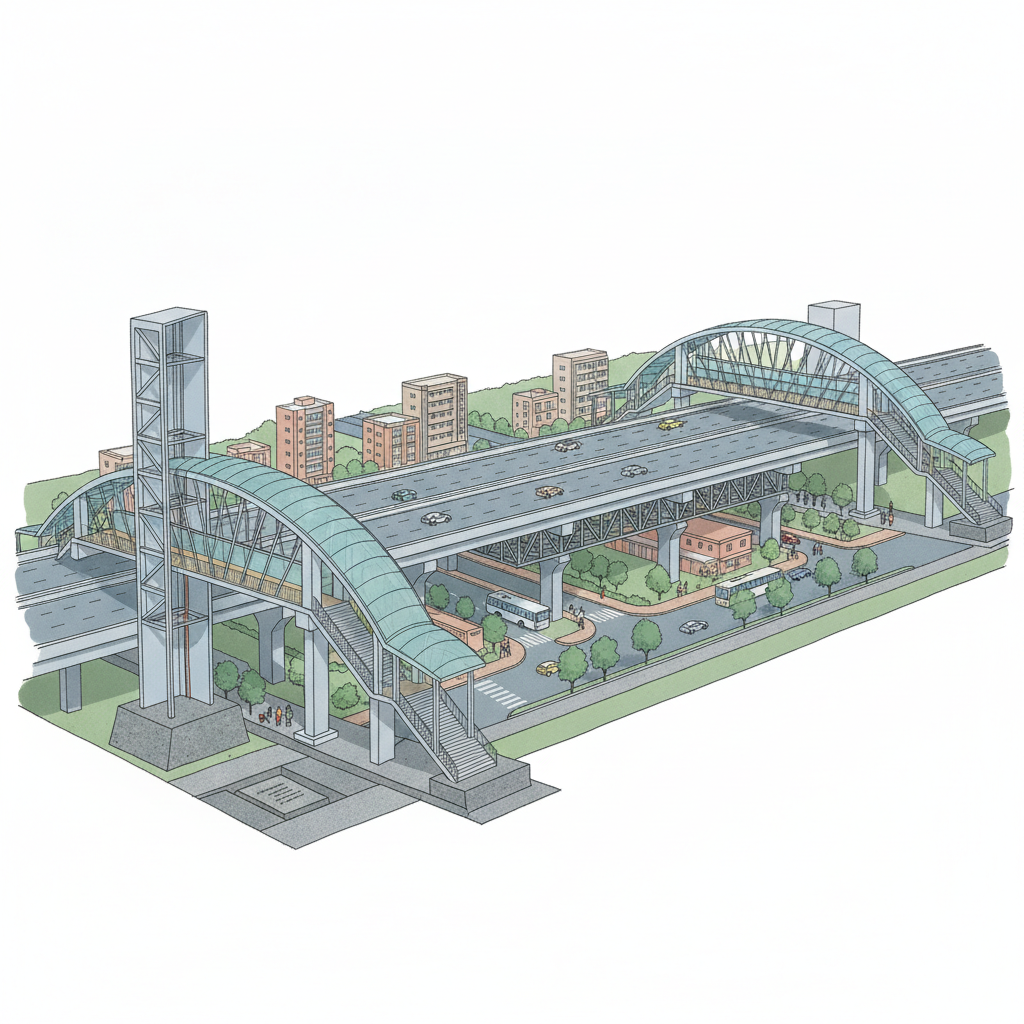
✎ Foot-over bridges (FOBs) are elevated pedestrian crossings that enhance safety by separating foot traffic from vehicular movement, particularly critical in urban expressways intersecting dense localities.
Subject Relevance — Where This Topic Fits
- GS Paper II — Governance, Transparency and Accountability (Infrastructure Governance) | GS Paper III — Infrastructure: Roads and Highways
- Prelims: National Highways Authority of India (NHAI), Foot-over Bridges (FOBs), Elevated Corridors, Public Transport Infrastructure, Urban Mobility, Net Zero Emissions by 2070
- Essay: Urban Infrastructure and Sustainable Development, Balancing Development and Environmental Sustainability
Quick Revision: Foot-over bridges (FOBs) are elevated pedestrian crossings that enhance safety by separating foot traffic from vehicular movement, particularly critical in urban expressways intersecting dense localities.
Why is this in the news?
The laying of foundation stones for two foot-over bridges (FOBs) on the Delhi-Saharanpur-Dehradun Expressway (NH-709B) in East Delhi underscores the government’s focus on enhancing pedestrian safety and urban mobility through dedicated infrastructure. These initiatives align with broader national objectives of sustainable urban development and decarbonisation of transport networks.
Background
- The Delhi-Saharanpur-Dehradun Expressway (NH-709B) is part of India’s National Highway network, designed to improve connectivity between Delhi, Saharanpur, and Dehradun while decongesting urban areas.
- Urban expressways in densely populated regions often intersect with residential, commercial, and local transit corridors, necessitating dedicated pedestrian infrastructure to mitigate accident risks.
- India’s commitment to achieving Net Zero Emissions by 2070, as articulated in the Panchamrit goals, includes decarbonising transport sectors through renewable energy integration and sustainable infrastructure.
- The Prime Minister’s vision for ‘Viksit Bharat@2047’ emphasises citizen-centric infrastructure development, including safe, accessible, and sustainable urban mobility solutions.
What are Foot-Over Bridges (FOBs)?
- Foot-Over Bridges (FOBs) are elevated pedestrian crossings designed to provide safe, grade-separated pathways for pedestrians across busy roads or highways, eliminating conflicts with vehicular traffic.
- FOBs are equipped with staircases, ramps, and in this case, lifts to ensure accessibility for all users, including senior citizens, persons with disabilities, and schoolchildren.
- The inclusion of lifts in FOBs enhances inclusivity, aligning with the Rights of Persons with Disabilities Act, 2016, and the Accessible India Campaign (Sugamya Bharat Abhiyan).
- FOBs reduce pedestrian-vehicle accidents by separating walking paths from high-speed traffic corridors, thereby improving road safety statistics.
- The Delhi-Saharanpur-Dehradun Expressway incorporates FOBs as part of its urban segment, where the highway intersects densely populated areas like Geeta Colony, Gandhi Nagar, and Laxmi Nagar.
- These structures are typically constructed using reinforced concrete or steel, with modular designs to facilitate rapid deployment and minimal disruption to traffic.
- The cost of FOB construction is borne by the National Highways Authority of India (NHAI) under the Ministry of Road Transport and Highways (MoRTH), with funding sourced from the Central Road Fund (CRF) and other budgetary allocations.
Key Features
| Feature | Significance |
|---|---|
| Foot-Over Bridges (FOB) with Lifts | Provides safe, dedicated pedestrian crossings over NH-709B, reducing accidents and improving mobility for all users, including senior citizens, persons with disabilities, students, and daily commuters. |
| Elevated Corridor Integration | Enhances land-use efficiency beneath the expressway by enabling parking, public facilities (EV charging, toilets), and aesthetic landscaping, reducing congestion and improving corridor aesthetics. |
| Solar Panel Installation | Promotes renewable energy use for highway operations, aligns with India’s net-zero target by 2070, and reduces dependence on conventional power sources. |
| Comprehensive Beautification Plan | Improves urban environment along the corridor, enhances property values, and fosters community engagement in infrastructure development. |
| Multi-Modal Connectivity | Links residential, commercial, and local transit hubs, ensuring seamless integration with Delhi’s urban mobility network. |
Why it Matters
Urban Mobility & Safety
- Reduces pedestrian-vehicle conflicts by providing dedicated, barrier-free crossings over high-traffic expressways.
- Enhances last-mile connectivity for residents in dense urban areas like Gandhi Nagar and Laxmi Nagar.
- Improves road safety metrics by minimizing accidents and enhancing visibility for both pedestrians and drivers.
Sustainable Infrastructure
- Integrates renewable energy (solar panels) into highway operations, contributing to India’s climate commitments.
- Optimizes underutilized land beneath elevated corridors for public amenities, reducing urban sprawl pressures.
- Supports electric vehicle (EV) adoption by providing charging infrastructure along major transit routes.
Economic & Urban Development
- Boosts local economies by improving accessibility to commercial and residential zones.
- Enhances property values and attractiveness of adjacent areas through aesthetic and functional upgrades.
- Facilitates smoother freight and passenger movement, reducing logistics costs and time delays.
Governance & Policy Alignment
- Reflects the central government’s focus on citizen-centric infrastructure under the ‘Viksit Bharat @2047’ vision.
- Demonstrates inter-agency coordination between NHAI, Delhi Development Authority, and local municipal bodies.
- Aligns with global best practices in sustainable urban mobility and climate-resilient infrastructure.
Challenges
1. Land Acquisition & Right-of-Way
- Acquiring land for FOBs and elevated corridors in densely populated urban areas can face delays due to legal and compensation disputes.
- Ensuring minimal disruption to existing utilities and infrastructure during construction.
UPSC Link: Land Reforms (GS-II)
2. Pedestrian Safety Compliance
- Ensuring universal accessibility, including for persons with disabilities, requires adherence to standards like the Harmonised Guidelines and Space Standards for Barrier-Free Built Environment.
- Monitoring and maintenance of FOBs post-construction to prevent vandalism or neglect.
UPSC Link: Rights of Persons with Disabilities Act, 2016 (GS-II)
3. Environmental & Social Impact
- Balancing infrastructure development with environmental conservation, particularly in greenfield or peri-urban areas.
- Addressing community concerns regarding noise, air pollution, and visual intrusion from elevated corridors.
UPSC Link: Environmental Impact Assessment (EIA) Notification, 2006 (GS-III)
4. Funding & Resource Allocation
- Securing adequate budgetary allocations for multi-modal infrastructure projects amidst competing priorities.
- Ensuring cost-effectiveness in solar panel integration and other sustainability measures.
UPSC Link: Public-Private Partnerships (PPP) (GS-III)
5. Inter-Agency Coordination
- Aligning efforts between NHAI, state governments, municipal corporations, and local bodies for seamless project execution.
- Streamlining approvals and clearances for construction, utilities, and public amenities.
UPSC Link: Administrative Reforms (GS-II)
Challenges — UPSC Perspective
| Issue | Concern |
|---|---|
| Urban Density Constraints | Limited space for FOBs and elevated corridors in high-traffic areas like East Delhi. |
| Accessibility Standards | Ensuring FOBs meet universal design norms for persons with disabilities and elderly users. |
| Cost Overruns | Potential delays or budget escalations due to unforeseen ground conditions or material shortages. |
| Utility Relocation | Disruptions caused by shifting underground cables, pipelines, or drainage systems during construction. |
| Public Resistance | Opposition from local communities due to perceived noise, pollution, or loss of green spaces. |
| Maintenance Gaps | Risk of FOB underutilization or neglect post-construction without proper upkeep mechanisms. |
Government Initiatives — Must-Memorise for Prelims
- National Highways Development Project (NHDP)
- Bharatmala Pariyojana
- Smart Cities Mission (for integrated urban mobility solutions)
Way Forward
- Accelerate land acquisition and right-of-way clearances through streamlined legal and administrative processes.
- Ensure strict compliance with accessibility standards (e.g., Harmonised Guidelines) in FOB design and construction.
- Integrate solar panel installations with grid connectivity to maximize renewable energy utilisation.
- Establish a dedicated maintenance fund for FOBs and elevated corridor amenities to ensure longevity.
- Conduct periodic safety audits and user feedback surveys to identify and address operational gaps.
- Promote multi-modal connectivity by linking FOBs with metro stations, bus stops, and cycle lanes.
- Leverage PPP models to attract private investment for sustainability and aesthetic enhancements.
- Develop a city-wide pedestrian policy to guide future FOB and crosswalk infrastructure projects.
UPSC Value Addition
Keywords for Mains Answer-Writing
Urban infrastructure development · Pedestrian safety measures · Expressway connectivity · Public utility infrastructure · Sustainable transport solutions · Renewable energy integration · Multi-modal urban transport · Urban planning and governance · National Highways Authority of India (NHAI) · Elevated highway corridors · Accessibility for vulnerable groups · Smart city infrastructure · Carbon-neutral transport corridors · Urban mobility challenges
Concept Flow
Urbanisation and vehicular growth → Increased pedestrian-vehicle conflicts → Need for safe pedestrian infrastructure → Government’s ‘Viksit Bharat @2047’ vision → Focus on sustainable, citizen-centric infrastructure → Planning and approval of FOBs and elevated corridors → Land acquisition and design finalisation → Construction of FOBs with lifts and solar panels → Integration with urban mobility networks → Operationalisation and maintenance → Long-term safety, accessibility, and sustainability outcomes
Prelims Practice Questions
Q1. Consider the following statements regarding the Delhi-Saharanpur-Dehradun Expressway (NH-709B):
1. It is an elevated corridor passing through densely populated areas of East Delhi.
2. The expressway includes provisions for electric vehicle charging stations and public toilets under its elevated section.
3. The entire project is being implemented by the Delhi Development Authority (DDA) without NHAI involvement.
How many of the above statements are correct?
- Only one
- Only two
- All
- None
Answer: Only two — Statement 1 is correct as the expressway passes through densely populated areas like Geeta Colony and Laxmi Nagar. Statement 2 is correct as the press release mentions EV charging, toilets, and parking under the elevated corridor. Statement 3 is incorrect as the project is being implemented by NHAI, not DDA.
Q2. Assertion (A): The construction of foot-over bridges (FOBs) with lift facilities on expressways is primarily aimed at enhancing vehicular traffic flow.
Reason (R): Lifts in FOBs are provided to improve accessibility for senior citizens, persons with disabilities, and students, thereby promoting inclusive urban mobility.
Options:
A. Both A and R are true, and R is the correct explanation of A.
B. Both A and R are true, but R is NOT the correct explanation of A.
C. A is true, but R is false.
D. A is false, but R is true.
Answer: ? — Assertion (A) is true as FOBs reduce pedestrian-vehicle conflicts, indirectly aiding traffic flow. However, Reason (R) is also true and independent—it highlights the social inclusivity aspect of lifts in FOBs, which is not the primary reason for traffic flow enhancement.
Q3. Match the following pairs related to infrastructure projects in India:
Column I (Project) | Column II (Implementing Agency)
————————————————|————————————
1. Delhi-Saharanpur-Dehradun Expressway (NH-709B)| a. Ministry of Road Transport and Highways
2. Delhi Metro Phase IV | b. National Highways Authority of India (NHAI)
3. Smart Cities Mission | c. Delhi Metro Rail Corporation (DMRC)
4. Atal Mission for Rejuvenation and Urban Transformation (AMRUT) | d. Ministry of Housing and Urban Affairs
Options:
A. 1-b, 2-c, 3-d, 4-a
B. 1-a, 2-c, 3-d, 4-b
C. 1-b, 2-c, 3-a, 4-d
D. 1-a, 2-b, 3-d, 4-c
- A
- B
- C
- D
Answer: A — 1-b: NH-709B is implemented by NHAI under MoRTH. 2-c: Delhi Metro Phase IV is executed by DMRC. 3-d: Smart Cities Mission is under MoHUA. 4-a: AMRUT is a scheme of MoHUA, but the implementing agency is state governments, not MoRTH. Hence, the closest correct match is A.
Mains Practice Question
✍ The integration of pedestrian infrastructure with elevated expressway corridors represents a paradigm shift in urban mobility planning in India. Critically examine this assertion with reference to the Delhi-Saharanpur-Dehradun Expressway (NH-709B) project. Also, analyse the role of such initiatives in achieving the Sustainable Development Goals (SDGs) 11 and 13. (15 Marks)
Approach: MODEL-ANSWER SKELETON:
1. **Context and Project Overview (2 Marks)**
– Briefly describe the NH-709B project, its alignment through East Delhi, and the rationale for elevated corridors.
– Mention the specific pedestrian infrastructure components: FOBs with lifts at Geeta Colony (km 5+100) and Laxmi Nagar (km 2+800), and the approved FOB at Bhajanpura (km 10+800).
2. **Pedestrian Safety and Inclusive Mobility (4 Marks)**
– **Safety**: Explain how FOBs reduce pedestrian-vehicle conflicts and accidents (cite MoRTH guidelines or NHAI standards).
– **Inclusivity**: Discuss the provision of lifts for senior citizens, persons with disabilities, students, and workers (reference UN Convention on the Rights of Persons with Disabilities and India’s Rights of Persons with Disabilities Act, 2016).
– **Urban Equity**: Link to SDG 11 (Sustainable Cities and Communities) targets 11.2 (access to safe, affordable, accessible, and sustainable transport systems) and 11.7 (provide universal access to safe, inclusive, and accessible green and public spaces).
3. **Sustainable and Smart Infrastructure (4 Marks)**
– **Renewable Energy Integration**: Explain the installation of solar panels on the elevated corridor (reference India’s National Solar Mission and SDG 13 target 13.2 on integrating climate change measures into national policies).
– **Multi-functional Spaces**: Discuss the use of space under the elevated corridor for parking, EV charging, public toilets, and beautification (link to smart city principles and SDG 11 target 11.6 on reducing environmental impact of cities).
– **Carbon Footprint**: Highlight the reduction in emissions and energy efficiency (reference India’s NDCs under the Paris Agreement).
4. **Challenges and Critique (3 Marks)**
– **Implementation Gaps**: Discuss potential challenges such as land acquisition, cost overruns, or delays in approvals for FOBs.
– **Urban Governance**: Critique the role of multiple agencies (NHAI, MoRTH, Delhi government, local bodies) in ensuring seamless integration.
– **Equity Concerns**: Address whether such projects disproportionately benefit certain socio-economic groups or areas.
5. **Conclusion and Way Forward (2 Marks)**
– Summarise the transformative potential of such projects in redefining urban mobility.
– Suggest measures for scaling up: integrated planning with public transport (metro/bus), community participation, and leveraging technology (AI for traffic management, IoT for infrastructure monitoring).
– Emphasise the need for a balanced approach that prioritises both environmental sustainability and social inclusivity.
Source: PIB (Press Information Bureau)
Uttarakhand PCS (UKPSC) — State PCS Practice
Prelims: Which of the following statements is correct regarding the inauguration of the two foot-over bridges on the Delhi-Saharanpur-Dehradun Expressway by Union Minister Harsh Malhotra?
- A. The foot-over bridges were inaugurated in the Dehradun district of Uttarakhand.
- B. The expressway is part of the National Highway-73 and connects Delhi to Saharanpur via Dehradun.
- C. The inauguration was part of the ‘Gati Shakti’ initiative aimed at improving multi-modal connectivity in Uttarakhand.
- D. The foot-over bridges were constructed under the ‘Bharatmala Pariyojana’ to enhance road safety for pedestrians in Eastern Delhi.
Answer: D. The foot-over bridges were constructed under the ‘Bharatmala Pariyojana’ to enhance road safety for pedestrians in Eastern Delhi. — The foot-over bridges were inaugurated in Eastern Delhi, not Uttarakhand, but the expressway connects Delhi to Saharanpur via Dehradun, and the project aligns with the ‘Gati Shakti’ initiative for multi-modal connectivity.
Mains: Critically analyse the significance of the Delhi-Saharanpur-Dehradun Expressway for Uttarakhand’s socio-economic development, with special reference to connectivity, tourism, and regional integration. Also discuss the role of the ‘Gati Shakti’ initiative in accelerating such infrastructure projects in the state.
Generated by AanyaAi for educational purpose.
Related guides on our sites
- Current affairs for upsc 2026
- Best PSIR optional coaching in delhi for UPSC
- How to prepare for GS paper 1 for UPSC CSE mains exam
- Best UPSC coaching for IFOS exam

- महाराष्ट्र में त्योहार जुलूसों पर बॉम्बे हाईकोर्ट का बड़ा फैसला: पटाखे, लेजर और संगीत पर रोक - September 24, 2026
- Bombay HC Bans Firecrackers, Music in Maharashtra Processions: Key UPSC Analysis - September 24, 2026
- तमिलनाडु में महिला कर्मचारियों के लिए सवैतनिक माहवारी अवकाश नीति पर HC का आदेश - September 24, 2026

No Comments