


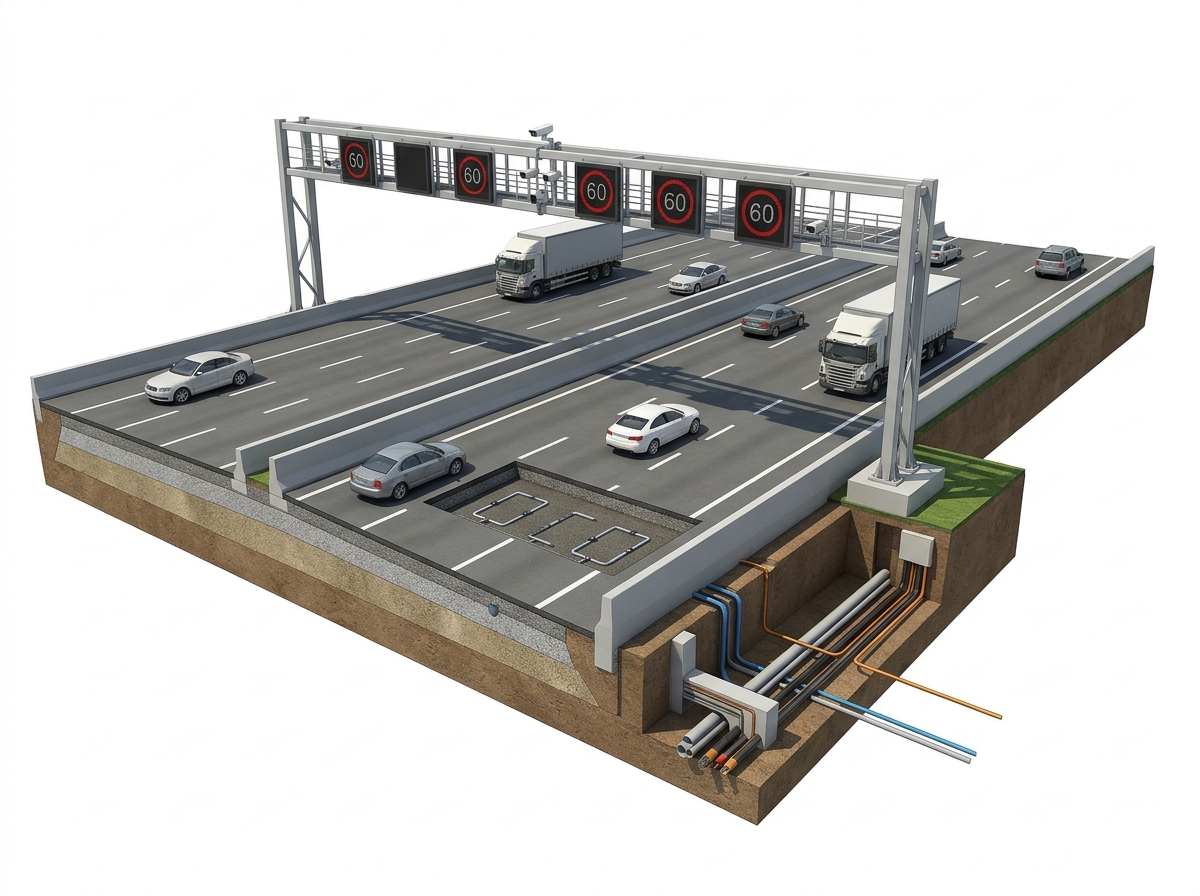
08 Aug UPSC Alert: Delhi-Meerut Expressway to Get Dynamic Speed Limits Soon!
Variable Speed Limit systemSensor networksAI-driven signage✎ Variable Speed Limits (VSL) dynamically adjust speed restrictions using real-time traffic data to reduce congestion and accidents, departing from India’s traditional static speed enforcement systems.
Subject Relevance — Where This Topic Fits
- GS Paper III — Infrastructure: Energy, Ports, Roads, Airports, Railways, etc.
- Prelims: Variable Speed Limits (VSL), Intelligent Transport Systems (ITS), MoRTH, CSIR-CRRI, IIT Roorkee, Delhi-Meerut Expressway, Traffic Congestion, Real-time Traffic Monitoring
- Essay: Technology as a Catalyst for Sustainable Urban Mobility, Balancing Infrastructure Development with Smart Solutions
Quick Revision: Variable Speed Limits (VSL) dynamically adjust speed restrictions using real-time traffic data to reduce congestion and accidents, departing from India’s traditional static speed enforcement systems.
Why is this in the news?
The Ministry of Road Transport and Highways (MoRTH) is piloting a Variable Speed Limit (VSL) system on the Delhi-Meerut Expressway to dynamically adjust speed restrictions based on real-time traffic conditions, aiming to mitigate congestion and enhance road safety. This initiative, slated for launch around 15 August 2026, represents a shift from traditional static speed limits to adaptive traffic management, leveraging sensor networks and AI-driven signage.
Background
- The Delhi-Meerut Expressway, a 96 km-long controlled-access highway, is a critical freight and passenger corridor connecting Delhi to Uttar Pradesh, experiencing severe congestion during peak hours.
- Traditional traffic management relies on fixed speed limits (70 km/h for cars, 50 km/h for heavy vehicles), which fail to account for dynamic conditions such as accidents, weather disruptions, or sudden traffic surges.
- Global precedents exist: VSL systems in the UK (M25), Germany (A8), and the US (I-95) have demonstrated reductions in congestion-related delays and accident rates by 15–25%.
- India’s National Smart Cities Mission (2015) and the National Highways Authority of India (NHAI) have prioritised Intelligent Transport Systems (ITS) to improve urban mobility.
- The pilot study is co-led by CSIR-Central Road Research Institute (CRRI) and IIT Roorkee, institutions with expertise in traffic engineering and highway safety.
- The project aligns with MoRTH’s broader strategy to integrate AI and IoT in road infrastructure, as outlined in the ‘Digital Highway Vision 2025’.
What is Variable Speed Limit (VSL) Technology?
- A dynamic traffic management system that adjusts speed limits in real-time based on live traffic data, weather conditions, and road incidents.
- Utilises a network of sensors, cameras, and AI algorithms to monitor vehicle density, speed variations, and environmental factors.
- Electronic Variable Message Signs (VMS) display updated speed limits, which are automatically recalibrated to prevent abrupt halts and reduce stop-and-go traffic.
- Aims to optimise traffic flow, lower fuel consumption, and minimise accident risks by reducing speed differentials between vehicles.
- Distinct from static limits: VSL adapts to conditions rather than enforcing uniform restrictions, thereby improving efficiency during peak and off-peak hours.
- The Delhi-Meerut Expressway pilot will cover an 8.7 km stretch between Sarai Kale Khan and the UP border, serving as a testbed for scalability.
- Success metrics include reduction in average travel time, collision frequency, and emissions, with data to be analysed by CSIR-CRRI and IIT Roorkee.
- VSL is a component of broader Intelligent Transport Systems (ITS), which also encompass adaptive traffic signals, dynamic lane management, and incident detection systems.
Key Features
| Feature | Significance |
|---|---|
| Dynamic Speed Limit Adjustment | Real-time adaptation to traffic density and weather conditions to optimise vehicular flow and reduce congestion |
| Electronic Variable Message Signs (VMS) | Display speed limits dynamically, ensuring driver compliance through automated updates |
| Integration with Traffic Sensors | Provides live data on vehicle density, speed, and environmental factors for informed decision-making |
| Pilot Study Framework | Scientific validation of VSL efficacy under controlled conditions before nationwide scaling |
| Multi-Institutional Collaboration | Leverages expertise from IIT Roorkee and CSIR-CRRI for robust technical and empirical assessment |
Why it Matters
Traffic Management and Safety
- Reduces abrupt braking and stop-and-go traffic, lowering rear-end collision risks on high-density corridors like Delhi-Meerut Expressway
- Minimises fuel wastage and emissions by maintaining steady traffic flow, aligning with India’s net-zero commitments
- Enhances predictability of travel time, improving user experience and modal shift towards expressways
Urban Mobility and Regional Connectivity
- Alleviates pressure on parallel routes (e.g., NH-58, NH-9) by optimising expressway utilisation during peak hours
- Supports economic integration between Delhi-NCR and western Uttar Pradesh, facilitating logistics and commuter mobility
- Demonstrates scalable solutions for other congested corridors (e.g., Mumbai-Pune, Bengaluru-Chennai)
Technological and Policy Innovation
- Pioneers AI-driven traffic systems in India, bridging the gap between traditional static limits and smart mobility frameworks
- Provides empirical evidence for MoRTH to refine National Highways Authority of India (NHAI) operational guidelines
- Sets a precedent for public-private partnerships in intelligent transport systems (ITS) deployment
Challenges
1. Driver Compliance and Behavioural Adaptation
- Risk of non-compliance due to habitual adherence to static speed limits, necessitating public awareness campaigns
- Potential for sudden speed reductions to cause rear-end collisions if not calibrated with traffic density
- Need for real-time feedback mechanisms to educate drivers on the rationale behind dynamic limits
UPSC Link: GS3: Transport Infrastructure
2. Technical and Infrastructure Constraints
- High capital expenditure for sensor networks, VMS, and data processing infrastructure across national highways
- Dependence on uninterrupted power supply and robust telecommunication networks for seamless operation
- Cybersecurity vulnerabilities in connected traffic systems requiring stringent safeguards
UPSC Link: GS3: Science & Technology
3. Environmental and Socio-Economic Trade-offs
- Possible increase in noise pollution near residential areas due to sustained higher speeds during off-peak hours
- Disproportionate impact on low-income commuters who may lack access to real-time traffic updates
- Need for equitable design to prevent marginalisation of non-motorised transport users
UPSC Link: GS3: Environmental Pollution
4. Regulatory and Governance Challenges
- Lack of standardised protocols for dynamic speed limits under the Motor Vehicles Act, 1988
- Coordination gaps between MoRTH, state transport departments, and local authorities for enforcement
- Liability issues in case of accidents attributed to dynamic speed adjustments
UPSC Link: GS2: Government Policies
Challenges — UPSC Perspective
| Issue | Concern |
|---|---|
| Public Acceptance | Skepticism towards perceived ‘arbitrary’ speed changes without clear communication |
| Data Privacy | Potential misuse of traffic data collected from sensors and cameras |
| Maintenance Costs | High operational expenditure for continuous monitoring and system updates |
| Interstate Coordination | Need for synchronised policies across state borders for seamless traffic flow |
| Weather Extremes | Limited efficacy of VSL during monsoon flooding or fog conditions |
Way Forward
- Conduct pre-launch awareness drives via radio, social media, and on-ground campaigns to familiarise drivers with VSL rationale
- Deploy pilot study findings to refine algorithms for speed adjustment, ensuring minimal disruption during peak hours
- Establish a multi-stakeholder task force (MoRTH, NHAI, IITs, state police) for real-time monitoring and grievance redressal
- Integrate VSL with existing traffic management systems (e.g., FASTag, GPS-based navigation apps) for unified user experience
- Develop a national framework for dynamic speed limits, incorporating lessons from the Delhi-Meerut Expressway pilot
- Pilot similar systems on other congested corridors (e.g., Delhi-Gurgaon, Mumbai-Pune) for comparative analysis
- Invest in R&D for low-cost sensor networks and AI models to reduce deployment costs across tier-2 cities
UPSC Value Addition
Keywords for Mains Answer-Writing
Variable Speed Limits (VSL) · Intelligent Transport Systems (ITS) · Real-time traffic management · Dynamic speed regulation · Traffic flow optimization · Road safety measures · MoRTH pilot projects · IIT Roorkee research · CSIR-CRRI studies · Urban transport infrastructure · Sustainable mobility solutions · Smart city technologies
Concept Flow
High traffic density on Delhi-Meerut Expressway → Congestion and stop-and-go traffic → Increased emissions and fuel consumption → Static speed limits fail to adapt to real-time conditions → Need for dynamic regulation → Introduction of VSL technology → Traffic sensors and AI analyse density/weather → Electronic signboards adjust speed limits → Traffic flow normalises → Reduced abrupt braking → Lower collision risks and smoother commutes → Improved regional economic connectivity → Empirical validation through pilot study → Policy refinement for nationwide scaling → Integration with national smart mobility goals
Prelims Practice Questions
Q1. Consider the following statements regarding the Variable Speed Limit (VSL) pilot project on the Delhi-Meerut Expressway:
1. The project is funded by the Ministry of Road Transport and Highways (MoRTH).
2. The study is being conducted by IIT Delhi and CSIR-NEERI.
3. The pilot covers a stretch of 8.7 km between Sarai Kale Khan and UP Border.
4. The system uses real-time traffic sensors and electronic signboards to adjust speed limits dynamically.
How many of the above statements are correct?
- Only one
- Only two
- Only three
- All four
Answer: Only three — Statements 1 and 4 are correct. Statement 2 is incorrect as the study is led by IIT Roorkee and CSIR-CRRI, not IIT Delhi or CSIR-NEERI. Statement 3 is correct regarding the pilot stretch.
Q2. Assertion (A): Variable Speed Limits (VSL) systems are designed to reduce traffic congestion by dynamically adjusting speed limits based on real-time conditions.
Reason (R): VSL systems rely solely on manual intervention by traffic police to alter speed limits during peak hours.
In the context of the above two statements, which one of the following is correct?
- Both A and R are true and R is the correct explanation of A.
- Both A and R are true but R is NOT the correct explanation of A.
- A is true but R is false.
- A is false but R is true.
Answer: A is true but R is false. — Assertion (A) is true as VSL systems use real-time data to adjust speed limits. Reason (R) is false because VSL systems operate automatically via sensors and electronic signboards, not manual intervention.
Mains Practice Question
✍ The introduction of Variable Speed Limits (VSL) on the Delhi-Meerut Expressway represents a shift from traditional static speed regulation to dynamic, data-driven traffic management. Critically analyse the potential benefits and challenges of implementing VSL systems in India’s urban transport infrastructure. Substantiate your answer with reference to the pilot project and global best practices. (15 Marks)
Approach: MODEL-ANSWER SKELETON:
1. **Definition and Mechanism of VSL**:
– Explain VSL as a component of Intelligent Transport Systems (ITS).
– Describe how real-time traffic data (sensors, cameras) feeds into dynamic speed adjustments.
– Reference the Delhi-Meerut Expressway pilot project (MoRTH-funded, IIT Roorkee and CSIR-CRRI collaboration, 8.7 km stretch).
2. **Potential Benefits**:
– **Traffic Flow Optimization**: Reduce sudden braking, congestion, and stop-and-go traffic.
– **Road Safety**: Lower accident risks by preventing speed differentials between lanes.
– **Environmental Impact**: Reduced idling and smoother traffic reduce emissions.
– **Cost Efficiency**: Avoids costly infrastructure expansion (e.g., widening roads).
– **Global Precedents**: Cite successful VSL implementations in the USA, UK, and Germany.
3. **Challenges and Limitations**:
– **Technological Dependence**: Reliance on sensors, AI, and IoT infrastructure; vulnerability to technical failures.
– **Public Acceptance**: Driver skepticism or non-compliance with dynamic limits.
– **Regulatory and Legal Frameworks**: Need for clear guidelines on liability in case of accidents under VSL.
– **Data Privacy**: Concerns over real-time tracking of vehicles.
– **Scalability**: Challenges in replicating the model across India’s diverse urban-rural transport networks.
4. **Comparative Analysis with Static Speed Limits**:
– Contrast VSL with traditional fixed speed limits (e.g., 70 km/h for cars, 50 km/h for heavy vehicles on DME).
– Highlight how VSL adapts to real-time conditions (e.g., weather, accidents, peak hours).
5. **Way Forward**:
– Recommend phased rollout with public awareness campaigns.
– Suggest integration with other ITS components (e.g., adaptive traffic signals, incident detection).
– Emphasize the need for multi-stakeholder collaboration (government, academia, private sector).
6. **Conclusion**:
– Summarize that VSL is a promising but complex solution requiring robust infrastructure and policy support.
Source: amarujala.com
Generated by AanyaAi for educational purpose.

- युवा संगम: सिक्किम-राजस्थान सांस्कृतिक आदान-प्रदान से सीखें विरासत - October 3, 2026
- Karnataka Launches Praja Seva Legal Aid Centre for Court Case Resolution - October 3, 2026
- महाराष्ट्र में मानसून की असामयिक वापसी: 21 जिलों में बारिश की कमी - October 3, 2026

No Comments