


31 Aug UPSC Alert: Depalpur’s Zero Legacy Waste Mission Success Model
✎ Swachh Bharat Mission-Urban 2.0 mandates 100% scientific processing of urban solid waste, including legacy waste remediation, through structured initiatives like ‘Swachh City Pair’ and the 4-bin segregation system…
Subject Relevance — Where This Topic Fits
- GS Paper II — Governance, Constitution, Polity, Social Justice and International relations (Urban governance and mission-mode programmes) | GS Paper III — Environment, Ecology, Bio-diversity and Climate Change (Solid waste management, circular economy, waste-to-energy)
- Prelims: Swachh Bharat Mission-Urban 2.0, Solid Waste Management Rules, 2016, Waste-to-Energy (WtE) plants, Scientific landfill remediation, Plastic Waste Management Rules, 2022, Circular economy, Refuse-Derived Fuel (RDF), Urban Local Bodies (ULBs), 4-bin waste segregation system, Mission Zero Waste
- Essay: Sustainable urban development: Balancing growth with environmental stewardship, From waste to resource: The circular economy as a paradigm for India’s urban future
Quick Revision: Swachh Bharat Mission-Urban 2.0 mandates 100% scientific processing of urban solid waste, including legacy waste remediation, through structured initiatives like ‘Swachh City Pair’ and the 4-bin segregation system, operationalising circular economy principles in ULBs.
Why is this in the news?
The Press Information Bureau (PIB) reported on 31 August 2026 the successful scientific remediation of 1,250 metric tonnes of legacy waste in Depalpur, Madhya Pradesh, under the ‘Swachh City Pair’ initiative of the Ministry of Housing and Urban Affairs (MoHUA). The transformation, achieved through a four-bin waste segregation system, integrated waste recovery, and public participation, exemplifies the operationalisation of Swachh Bharat Mission-Urban 2.0’s zero-legacy waste goal. This initiative is significant as it demonstrates scalable urban solid waste management (SWM) practices in tier-II cities, aligning with the constitutional mandate for clean and sustainable urban environments under Article 48A and Directive Principles of State Policy.
Background
- The Solid Waste Management Rules, 2016, mandate segregation of waste at source into four categories: biodegradable, non-biodegradable, domestic hazardous, and plastic waste, with scientific processing and disposal.
- The ‘Swachh City Pair’ initiative, a 100-day structured guidance programme under SBM-U 2.0, pairs mentor cities (e.g., Indore) with mentee cities (e.g., Depalpur) to facilitate knowledge transfer, capacity building, and best-practice replication in urban waste management.
- Urban India generates approximately 62 million tonnes of solid waste annually, with legacy waste accumulation posing significant environmental and public health challenges in many cities.
- The 4-bin segregation system is a critical intervention under SBM-U 2.0, designed to enhance resource recovery and reduce landfill dependency, in line with the circular economy framework.
- Legacy waste refers to accumulated solid waste in dumpsites over years, often containing recyclables, inert material, and hazardous components, requiring scientific remediation to prevent groundwater contamination and methane emissions.
What is the ‘Swachh City Pair’ initiative and how does it operationalise scientific solid waste management?
- The initiative is based on the ‘Each One Teach One’ model, where mentor cities (e.g., Indore) share technical expertise, operational protocols, and governance frameworks with mentee cities (e.g., Depalpur) through Memorandums of Understanding (MoUs).
- Focus areas include source segregation, door-to-door waste collection, scientific processing (composting, recycling, waste-to-energy), and legacy waste remediation, with a target of 100% coverage in mentee cities.
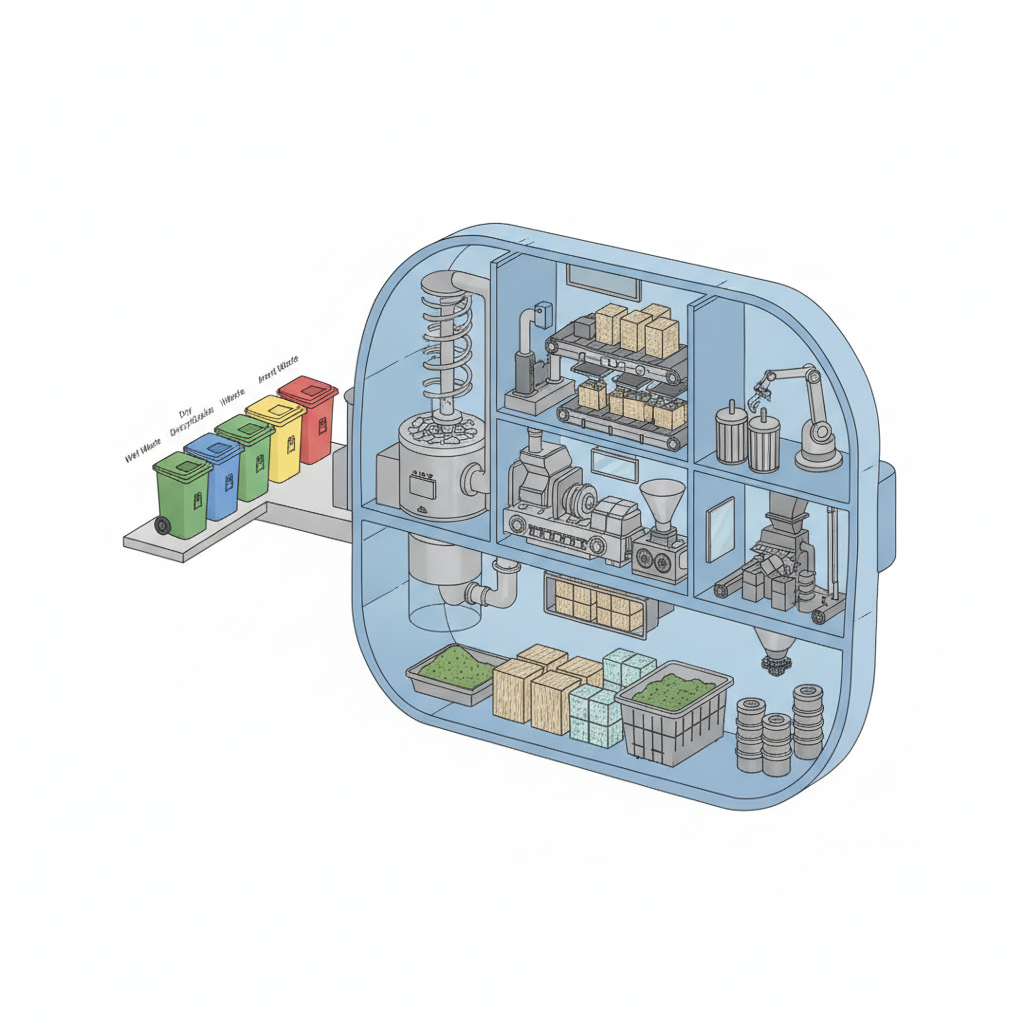
- [‘The 4-bin waste segregation system classifies waste into: (1) biodegradable (wet waste), (2) non-biodegradable (dry recyclables), (3) domestic hazardous waste, and (4) plastic waste. This system enhances resource recovery and reduces landfill burden, aligning with the Solid Waste Management Rules, 2016.’]
- Legacy waste remediation involves scientific processing of accumulated dumpsite waste, including mechanical segregation, recovery of recyclables (e.g., plastics, metals, glass), and conversion of non-recyclable waste into Refuse-Derived Fuel (RDF) for co-processing in cement plants.
- Public participation is integral, with campaigns like ‘Poha Party’ in Depalpur fostering community ownership and behavioural change in waste management practices.
- The initiative integrates digital tools for monitoring and compliance, including GIS mapping of dumpsites, real-time tracking of waste flows, and performance dashboards for ULBs.
- Outcomes include reduced landfill dependency, improved public health, enhanced resource recovery, and the creation of green public spaces from remediated dumpsites.
Key Features
| Feature | Significance |
|---|---|
| Four-bin waste segregation system | Ensures source-level separation of waste into recyclable, biodegradable, domestic hazardous, and residual categories, reducing contamination and enhancing processing efficiency. |
| Scientific processing of legacy waste (1,250 metric tonnes) | Involves mechanical segregation, recovery of recyclables (4.5 tonnes), and conversion of non-recyclable waste into Refuse-Derived Fuel (RDF) for co-processing in cement plants, ensuring environmentally safe disposal. |
| Knowledge transfer through ‘Swachh City Pair’ initiative | Facilitates structured mentorship between 72 mentor cities and 200 apprentice cities, promoting best practices in urban waste management under SBM-U 2.0. |
| Community engagement and ownership | Public participation through door-to-door collection, awareness campaigns, and celebration of milestones (e.g., ‘Poha Party’) fosters behavioural change and sustained compliance. |
| Post-cleanup land reclamation | Conversion of erstwhile dump sites into green public spaces with tree plantation drives and civic amenities, symbolizing urban regeneration and ecological restoration. |
Why it Matters
Urban Governance & Service Delivery
- Demonstrates scalable models for integrated solid waste management (SWM) in small and medium urban local bodies (ULBs), addressing legacy waste challenges through scientific and participatory approaches.
- Validates the efficacy of ‘Swachh City Pair’ initiative under SBM-U 2.0, proving that structured mentorship can accelerate capacity-building in urban waste management across diverse municipal contexts.
- Highlights the role of ULB leadership (e.g., Mayor and IAS Commissioner) in driving mission-mode projects with measurable outcomes, reinforcing the importance of administrative will in public service delivery.
Environmental Sustainability
- Advances circular economy principles by maximizing resource recovery (4.5 tonnes recyclables) and converting non-recyclable waste into RDF, reducing landfill dependency and greenhouse gas emissions.
- Showcases a replicable framework for legacy waste remediation, aligning with India’s commitments under the Solid Waste Management Rules, 2016 and the National Clean Air Programme (NCAP).
- Promotes urban greening through post-cleanup afforestation, contributing to carbon sequestration and microclimate regulation in urban areas.
Social & Economic Dimensions
- Creates livelihood opportunities for informal waste workers through formal integration into municipal waste collection systems, enhancing their dignity and economic security.
- Generates public spaces for recreational and social activities, improving quality of life and fostering community cohesion in previously neglected areas.
- Serves as a case study for cost-effective urban renewal, where investment in waste management infrastructure yields long-term environmental and civic dividends.
Challenges
1. Legacy Waste Management
- Accumulated waste over decades poses technical challenges due to mixed composition, requiring specialized machinery and scientific processing to separate and treat components.
- High capital and operational costs for legacy waste remediation, necessitating public-private partnerships (PPP) and central/state funding mechanisms (e.g., SBM-U 2.0 grants).
- Risk of secondary pollution during processing, demanding strict compliance with environmental norms (e.g., CPCB guidelines for RDF plants).
UPSC Link: Solid Waste Management Rules 2016
2. Behavioural Change & Compliance
- Public resistance to source segregation due to entrenched habits, necessitating sustained awareness campaigns and community engagement strategies.
- Need for continuous monitoring and feedback loops to ensure compliance, as lapses in segregation can undermine the entire waste management chain.
- Limited awareness among marginalized communities (e.g., slum dwellers) about waste segregation benefits, requiring targeted interventions.
UPSC Link: Swachh Bharat Mission-Urban 2.0
3. Institutional Capacity & Resource Constraints
- Small ULBs often lack technical expertise and financial resources to implement advanced waste management systems, highlighting the need for inter-municipal collaboration.
- Dependence on informal waste pickers for collection and segregation, which, while cost-effective, requires formalization to ensure worker safety and fair wages.
- Coordination gaps between municipal bodies, state agencies, and private operators can delay project implementation and reduce efficiency.
UPSC Link: 74th Constitutional Amendment Act
Challenges — UPSC Perspective
| Issue | Concern |
|---|---|
| High operational costs of legacy waste processing | Financial sustainability of ULBs without adequate central/state funding or revenue generation from waste-to-wealth initiatives. |
| Low public participation in source segregation | Cultural and behavioural barriers that hinder the effectiveness of waste management systems, requiring long-term behavioural change campaigns. |
| Limited technical expertise in small ULBs | Need for capacity-building programs and knowledge-sharing platforms to empower municipal officials in waste management technologies. |
| Environmental risks in waste processing | Potential for air, water, and soil pollution during segregation, composting, or RDF production, necessitating strict regulatory oversight. |
| Informal sector integration challenges | Formalizing informal waste workers into municipal systems while ensuring their social security and occupational safety. |
Government Initiatives — Must-Memorise for Prelims
- Swachh Bharat Mission-Urban 2.0
- Swachh City Pair Initiative
- Solid Waste Management Rules, 2016
Way Forward
- Scale up the ‘Swachh City Pair’ model to include more mentor-apprentice city pairs, with standardized metrics for knowledge transfer and outcome evaluation.
- Expand financial instruments (e.g., viability gap funding, green bonds) to support legacy waste remediation projects in smaller ULBs.
- Institutionalize community monitoring mechanisms (e.g., citizen feedback apps, ward-level waste management committees) to sustain behavioural change.
- Develop a national framework for integrating informal waste workers into formal municipal systems, including skill training and social security coverage.
- Promote PPP models for waste-to-energy and RDF plants, ensuring transparent bidding processes and environmental safeguards.
- Enhance inter-municipal cooperation through regional waste management clusters to optimize resource utilization and reduce costs.
- Strengthen data-driven governance by mandating real-time tracking of waste collection, segregation, and processing metrics across ULBs.
- Integrate urban waste management with climate action plans (e.g., NCAP, SDG 11) to align local efforts with national environmental goals.
UPSC Value Addition
Keywords for Mains Answer-Writing
Solid Waste Management · Swachh Bharat Mission-Urban 2.0 · Urban Waste Segregation · Scientific Waste Processing · Legacy Waste Management · Swachh Shakti 2025 · Swachh City Pair Initiative · Circular Economy · Waste-to-Energy · Sustainable Urban Governance · Public-Private Partnership in Waste Management · Urban Local Bodies (ULBs) · Plastic Waste Management Rules 2022 · Waste Segregation at Source · Recycling and Co-processing · Community Participation in Waste Management
Constitutional & Policy Linkages
- Article 243W: Functions of municipalities, including urban planning, public health, and waste management.
Concept Flow
Urbanization → Increased solid waste generation → Legacy waste accumulation → Environmental degradation (land, air, water pollution) → Policy response: SBM-U 2.0 and SWM Rules 2016 → Mandate source segregation, scientific processing, and circular economy principles → Institutional mechanism: Swachh City Pair initiative → Mentor-apprentice model for capacity-building and knowledge transfer → Implementation: Four-bin segregation system + mechanical processing of legacy waste → Recovery of recyclables and RDF production → Outcome: Legacy waste remediation → Land reclamation and urban greening → Enhanced public spaces and community engagement → Long-term impact: Sustainable urban waste management → Improved public health, environmental quality, and civic pride
Prelims Practice Questions
Q1. Consider the following statements regarding the Swachh Bharat Mission-Urban 2.0:
1. It is a continuation of the Swachh Bharat Mission-Urban launched in 2014.
2. It focuses on complete faecal sludge management and wastewater treatment.
3. It aims to achieve 100% waste segregation at source in all Urban Local Bodies by 2026.
4. It includes a component for scientific processing of legacy waste.
How many of the above statements are correct?
- Only one
- Only two
- Only three
- All
Answer: All — Statements 1, 2, and 4 are correct. Statement 3 is incorrect as the target for 100% waste segregation at source is set for 2025-26, not 2026. The mission emphasizes faecal sludge management, wastewater treatment, and legacy waste processing.
Q2. Assertion (A): The ‘Swachh City Pair’ initiative under Swachh Bharat Mission-Urban 2.0 facilitates knowledge transfer between cities.
Reason (R): It mandates that all Urban Local Bodies must replicate the waste management practices of the capital city without any local adaptations.
Options:
A. Both A and R are true, and R is the correct explanation of A.
B. Both A and R are true, but R is NOT the correct explanation of A.
C. A is true, but R is false.
D. A is false, but R is true.
Answer: ? — Assertion (A) is true as the ‘Swachh City Pair’ initiative is designed to promote knowledge transfer and capacity building between cities. Reason (R) is false because the initiative encourages adaptation of best practices to local contexts rather than rigid replication.
Q3. Match the following initiatives with their respective objectives under Swachh Bharat Mission-Urban 2.0:
Initiative:
1. Swachh Shakti 2025
2. Swachh City Pair
3. Legacy Waste Management
4. Waste-to-Energy
Objective:
A. To promote women-led cleanliness and sanitation efforts
B. To facilitate knowledge sharing between cities
C. To scientifically process accumulated waste from past decades
D. To convert non-recyclable waste into energy
Select the correct match:
- 1-A, 2-B, 3-C, 4-D
- 1-B, 2-A, 3-D, 4-C
- 1-C, 2-D, 3-A, 4-B
- 1-D, 2-C, 3-B, 4-A
Answer: 1-A, 2-B, 3-C, 4-D — 1-A: Swachh Shakti 2025 focuses on women-led cleanliness efforts. 2-B: Swachh City Pair promotes knowledge sharing. 3-C: Legacy Waste Management aims at scientifically processing accumulated waste. 4-D: Waste-to-Energy converts non-recyclable waste into energy.
Mains Practice Question
✍ The successful scientific processing of legacy waste in Depalpur under the Swachh Bharat Mission-Urban 2.0 exemplifies a model for sustainable urban waste management in India. Critically examine the challenges and policy imperatives for scaling such initiatives nationwide. (15 Marks)
Approach: MODEL-ANSWER SKELETON:
1. **Context and Significance**:
– Define legacy waste and its environmental and public health impacts.
– Highlight Depalpur’s achievement: 1,250 metric tonnes of legacy waste processed, 4.5 tonnes of recyclables recovered, and 50-60 tonnes of RDF sent for co-processing.
– Emphasise the role of the Swachh Bharat Mission-Urban 2.0 and the Swachh City Pair initiative in enabling this transformation.
2. **Challenges in Scaling Legacy Waste Management**:
– **Technical Challenges**: Lack of standardised scientific processing methods, inadequate infrastructure, and high costs of remediation.
– **Financial Constraints**: Limited budgetary allocations for ULBs, dependency on central funds, and need for public-private partnerships (PPPs).
– **Institutional and Governance Gaps**: Fragmented responsibilities among ULBs, lack of skilled workforce, and weak enforcement of Solid Waste Management Rules, 2016.
– **Social and Behavioural Barriers**: Low public awareness, resistance to segregation at source, and lack of community participation.
– **Policy and Regulatory Hurdles**: Inconsistent implementation of Plastic Waste Management Rules, 2022, and gaps in Extended Producer Responsibility (EPR) compliance.
3. **Policy Imperatives for Scaling Up**:
– **Strengthening Institutional Frameworks**: Empower ULBs with technical and financial autonomy, and establish dedicated legacy waste management cells.
– **Financial Innovations**: Leverage green bonds, carbon credits, and viability gap funding to attract private investment.
– **Technological Interventions**: Promote decentralised waste processing units, bio-methanation plants, and waste-to-energy facilities tailored to local needs.
– **Awareness and Capacity Building**: Launch nationwide campaigns like Swachh Shakti 2025 to educate citizens and train municipal staff.
– **Legal and Regulatory Reforms**: Strengthen enforcement of SWM Rules, 2016, and mandate third-party audits for legacy waste sites.
– **Community Engagement**: Institutionalise participatory models such as Swachhagrahis and citizen feedback mechanisms.
4. **Comparative Perspective**:
– Cite successful international models (e.g., Sweden’s waste-to-energy programmes, Germany’s dual system for packaging waste) to draw lessons for India.
5. **Conclusion**:
– Stress the need for a multi-dimensional approach combining technology, finance, governance, and community participation.
– Highlight that Depalpur’s model can be replicated with contextual adaptations, but requires political will, sustained funding, and stakeholder collaboration.
Source: PIB (Press Information Bureau)
Generated by AanyaAi for educational purpose.
Related guides on our sites
- Best PSIR optional coaching for upsc
- Best PSIR optional teacher for upsc
- Best teacher of PSIR optional for upsc
- Best PSIR optional coaching in delhi for UPSC

- लखनऊ में ‘ऑपरेशन जागृति’: युवाओं को नशे से बचाने का अभियान - October 2, 2026
- Buxa Tiger Reserve Welcomes First Tigress Under Tiger Reintroduction Program - October 2, 2026
- नीति आयोग ने कोलकाता में SDG बजट पर राष्ट्रीय कार्यशाला आयोजित की, जानिए मुख्य बिंदु - October 2, 2026

No Comments