


27 Jul UPSC Alert: ESIC Extends ABVKY Scheme till June 2027 – Key Details
Subject Relevance — Where This Topic Fits
- GS Paper II — Governance, Welfare Schemes for Vulnerable Sections | GS Paper III — Labour Reforms, Social Security, Employment
- Prelims: Atal Bimit Vyakti Kalyan Yojana (ABVKY), Employees’ State Insurance Corporation (ESIC), Direct Benefit Transfer (DBT), Unemployment Insurance, Social Security, Permanent Account Number (PAN), Aadhaar-enabled Payment System (AePS), Labour Codes
- Essay: Role of social security in inclusive growth, Challenges in formalising the informal workforce
Quick Revision: ABVKY provides cash compensation to insured workers facing involuntary unemployment, subject to eligibility and contribution criteria, with benefits disbursed via Direct Benefit Transfer (DBT).
Why is this in the news?
The Employees’ State Insurance Corporation (ESIC) has extended the Atal Bimit Vyakti Kalyan Yojana (ABVKY) for a further period from 01 July 2026 to 30 June 2027. This extension is significant as it underscores the government’s commitment to providing financial relief to insured persons facing involuntary unemployment, particularly in the context of evolving labour market dynamics and the need for robust social security mechanisms.
Background
- The Employees’ State Insurance Corporation (ESIC) operates under the Employees’ State Insurance Act, 1948, providing social security to workers in India.
- ABVKY was launched as a welfare measure to offer cash compensation to insured persons who become unemployed involuntarily.
- The scheme is designed to mitigate the financial hardship of unemployment by providing periodic cash benefits for a limited duration.
- The extension aligns with the broader framework of labour reforms aimed at enhancing the coverage and effectiveness of social security systems.
- The scheme’s implementation is monitored by the Ministry of Labour and Employment, with ESIC as the nodal agency.
What is the Atal Bimit Vyakti Kalyan Yojana (ABVKY)?
- ABVKY is a welfare scheme administered by the Employees’ State Insurance Corporation (ESIC) under the Employees’ State Insurance Act, 1948.
- The scheme provides cash compensation to insured persons who become involuntarily unemployed, subject to specific eligibility criteria.
- Eligibility requires the insured person to have been in insurable employment for at least 12 continuous months immediately preceding unemployment.
- Additionally, the insured person must have contributed for at least 78 days in any one full contribution period preceding unemployment.
- The scheme excludes unemployment arising from misconduct, lockout, superannuation (retirement), or being found guilty of making a false statement under the provisions of the Employees’ State Insurance Act, 1948.
- The scheme incorporates Direct Benefit Transfer (DBT) to ensure timely and transparent disbursement of benefits to beneficiaries’ bank accounts.
- Claims under ABVKY are processed online, with regular monitoring to expedite settlement and reduce delays.
Key Features
| Feature | Significance |
|---|---|
| Eligibility Criteria | Ensures targeted delivery by requiring 12 months of continuous insurable employment and a minimum contribution of 78 days in any one contribution period prior to unemployment, excluding cases of misconduct, lockout, or fraudulent declarations. |
| Benefit Period Extension | The scheme’s validity has been extended from 01.07.2026 to 30.06.2027, providing continued social security coverage for insured persons during unemployment. |
| Digital Claim Processing | Introduction of online submission and processing of claims, along with Direct Benefit Transfer (DBT) to beneficiaries’ bank accounts, enhances transparency and reduces delays in benefit disbursement. |
| Monitoring Mechanism | Regular monitoring of claim settlements ensures timely payment of benefits, addressing administrative bottlenecks and improving accountability within the ESIC framework. |
Why it Matters
Social Security Framework
- ABVKY is a critical component of India’s social security architecture under the Employees’ State Insurance Act, 1948, providing unemployment benefits to insured persons during periods of involuntary job loss.
- The scheme aligns with the Directive Principles of State Policy (Article 41) by ensuring public assistance in cases of unemployment, contributing to social justice and inclusive growth.
- By extending coverage to insured persons, ABVKY mitigates the economic vulnerability of workers in the organised sector, particularly during cyclical downturns or structural employment shifts.
Fiscal and Administrative Efficiency
- The shift to online claim processing and DBT reduces leakages and administrative costs, improving the scheme’s cost-effectiveness and scalability.
- Regular monitoring and digitalisation of claims enhance the predictability of fiscal outlays, enabling better budgetary planning for the ESIC and the Ministry of Labour and Employment.
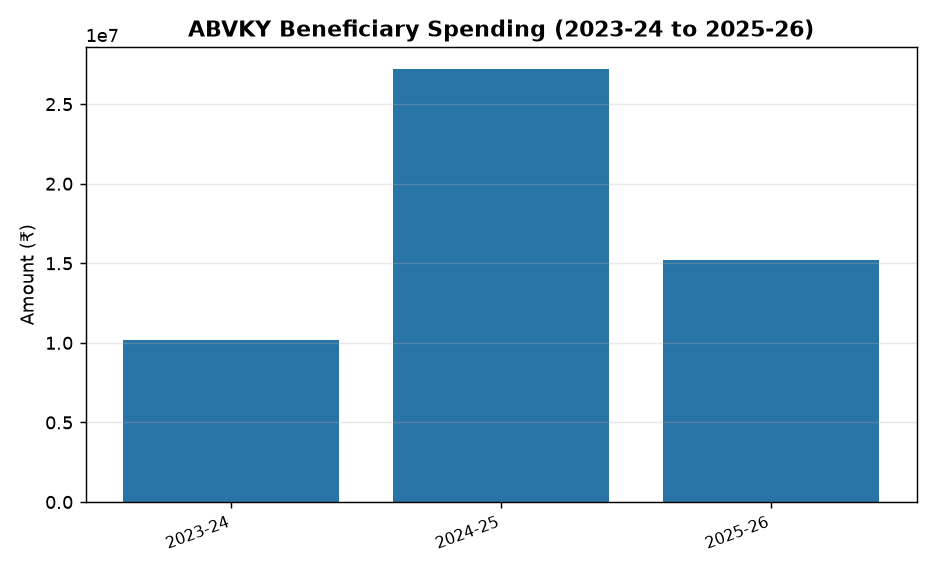
- The increasing expenditure trend (₹1.02 crore in 2023-24 to ₹2.72 crore in 2024-25) reflects growing utilisation, necessitating robust fiscal safeguards to prevent over-expenditure.
Labour Market Resilience
- ABVKY acts as an automatic stabiliser for the labour market by providing temporary income support to laid-off workers, reducing the multiplier effect of unemployment on aggregate demand.
- The scheme incentivises formal employment by linking benefits to prior contributions, thereby discouraging informalisation and promoting compliance with the ESI Act, 1948.
- By excluding cases of misconduct or fraud, the scheme maintains its integrity while ensuring that genuine beneficiaries receive timely support.
Challenges
1. Coverage Gaps in the Unorganised Sector
- ABVKY primarily benefits insured persons under the ESI Act, leaving the vast majority of India’s workforce in the unorganised sector without unemployment insurance coverage.
- The eligibility requirement of 12 months of continuous insurable employment excludes temporary and informal workers, who are most vulnerable to job insecurity.
UPSC Link: GS-II: Labour reforms and social security
2. Implementation Delays and Administrative Bottlenecks
- Despite digitalisation, delays in claim processing and disbursement persist due to bureaucratic inertia, lack of awareness among beneficiaries, and technical glitches in the online portal.
- The requirement for beneficiaries to submit claims within a stipulated period (post-unemployment) may exclude those unaware of the scheme or lacking access to digital infrastructure.
UPSC Link: GS-II: Governance and e-governance
3. Fiscal Sustainability
- The rising expenditure trend (e.g., ₹2.72 crore in 2024-25) raises concerns about the long-term fiscal viability of ABVKY, particularly if unemployment rates escalate due to economic slowdowns or technological disruptions.
- The scheme’s reliance on contributions from employers and employees may become unsustainable if the ratio of contributors to beneficiaries declines due to structural employment changes.
UPSC Link: GS-III: Fiscal policy and resource mobilisation
4. Awareness and Outreach Deficits
- Many eligible insured persons remain unaware of ABVKY’s provisions, leading to underutilisation of the scheme and exclusion of deserving beneficiaries.
- Limited outreach in regional languages and through grassroots institutions (e.g., labour departments, trade unions) hampers effective dissemination of scheme details.
UPSC Link: GS-II: Social sector schemes and their outreach
Challenges — UPSC Perspective
| Issue | Concern |
|---|---|
| Exclusion of Unorganised Sector Workers | The scheme’s design excludes the majority of India’s workforce, who lack access to formal employment and ESI coverage. |
| Digital Divide and Accessibility | Beneficiaries in rural or economically weaker sections may face challenges in accessing online claim submission due to limited internet connectivity or digital literacy. |
| Fraud and Misrepresentation Risks | The potential for false claims or misrepresentation of employment status exists, necessitating robust verification mechanisms. |
| Inter-State Variations in Implementation | Disparities in administrative capacity across states may lead to uneven implementation, affecting the scheme’s reach and effectiveness. |
| Inflationary Pressures on Benefit Amounts | Fixed benefit amounts may lose purchasing power over time, reducing the real value of unemployment support. |
Way Forward
- Enhance awareness campaigns through multi-lingual outreach, leveraging digital platforms, labour departments, and trade unions to educate insured persons about ABVKY’s provisions.
- Expand the scheme’s coverage to include workers in the unorganised sector through convergence with other social security schemes (e.g., PM-SYM, Aam Aadmi Bima Yojana) and pilot projects in high-unemployment regions.
- Strengthen the digital infrastructure for claim processing by integrating AI-driven fraud detection, real-time tracking of claim status, and grievance redressal mechanisms.
- Introduce dynamic benefit structures indexed to inflation or local wage levels to ensure the real value of unemployment support is maintained over time.
- Conduct periodic third-party audits of the ESIC’s claim settlement processes to identify bottlenecks and recommend administrative reforms.
- Collaborate with state governments to standardise implementation protocols and address inter-state disparities in scheme delivery.
- Explore public-private partnerships to augment the ESIC’s capacity for outreach, verification, and benefit disbursement, particularly in underserved regions.
UPSC Value Addition
Keywords for Mains Answer-Writing
Atal Bimit Vyakti Kalyan Yojana (ABVKY) · Employees’ State Insurance Corporation (ESIC) · Unemployment insurance · Social security for workers · Direct Benefit Transfer (DBT) · Contribution period in ESI · Eligibility criteria for ABVKY · ESIC Act 1948 · Labour welfare schemes · Unemployment benefit · Formal sector workers · Wage loss compensation · Social security architecture · ESIC contribution conditions · Unemployment due to misconduct exclusion
Constitutional & Policy Linkages
- Article 41 – Right to public assistance in cases of unemployment
Concept Flow
Unemployment in the formal sector → Loss of income → Eligibility under ABVKY (12 months of insurable employment + 78 days’ contribution) → Claim submission (online/offline) → Verification by ESIC → Approval → Direct Benefit Transfer (DBT) → Financial relief to beneficiary → Mitigation of economic vulnerability → Contribution to social stability.
Prelims Practice Questions
Q1. Which of the following is NOT a valid reason for ineligibility under the Atal Bimit Vyakti Kalyan Yojana (ABVKY)?
- A. Unemployment due to misconduct by the insured person
- B. Unemployment arising from retirement (superannuation)
- C. Unemployment caused by a factory lockout
- D. Unemployment following continuous ESI contribution for 12 months
Answer: D. Unemployment following continuous ESI contribution for 12 months — ABVKY explicitly excludes unemployment due to misconduct, lockout, superannuation, or fraud under the ESI Act, 1948. Continuous ESI contribution for 12 months is a prerequisite for eligibility, not a disqualification.
Q2. The Atal Bimit Vyakti Kalyan Yojana (ABVKY) provides unemployment benefits to insured persons under which of the following conditions?
- A. Minimum 78 days of contribution in any one contribution period within the preceding 12 months
- B. Minimum 78 days of contribution in each of the preceding 12 months
- C. Minimum 78 days of contribution in the last 6 months only
- D. Minimum 78 days of contribution in the last 24 months
Answer: A. Minimum 78 days of contribution in any one contribution period within the preceding 12 months — ABVKY mandates that the insured person must have contributed for at least 78 days in any one full contribution period within the 12 months preceding unemployment, not in every month or a longer period.
Q3. Which of the following statements about the Atal Bimit Vyakti Kalyan Yojana (ABVKY) is correct?
- A. The scheme is administered by the Employees’ Provident Fund Organisation (EPFO)
- B. Benefits under ABVKY are disbursed through Direct Benefit Transfer (DBT) to beneficiaries’ bank accounts
- C. ABVKY covers all workers in the unorganised sector
- D. The scheme was launched in 2020 under the Atal Pension Yojana framework
Answer: B. Benefits under ABVKY are disbursed through Direct Benefit Transfer (DBT) to beneficiaries’ bank accounts — ABVKY is administered by the Employees’ State Insurance Corporation (ESIC), not EPFO. It targets insured persons in the formal sector and is distinct from Atal Pension Yojana. Benefits are disbursed via DBT to ensure timely and transparent payments.
Mains Practice Question
✍ Critically examine the role of the Atal Bimit Vyakti Kalyan Yojana (ABVKY) in addressing unemployment challenges for formal sector workers in India. Assess its eligibility criteria, benefit structure, and implementation challenges, and suggest measures to enhance its effectiveness in the context of evolving labour market dynamics.
Approach: Begin by contextualising ABVKY within India’s social security architecture, highlighting its objective to provide wage loss compensation to insured persons facing involuntary unemployment. Analyse the eligibility criteria—continuous 12-month ESI coverage and minimum 78 days’ contribution in any one period—to assess inclusivity and coverage gaps. Evaluate the benefit disbursement mechanism (DBT) and claim settlement reforms (online submission, monitoring) for efficiency. Critique the scheme’s limitations, such as exclusion of unorganised workers, narrow eligibility window, and dependency on ESI contribution history. Conclude with recommendations: expanding coverage to gig/platform workers, relaxing contribution thresholds for vulnerable groups, integrating with other skilling/employment schemes (e.g., PMKVY), and leveraging technology for real-time monitoring of labour market trends to tailor benefits dynamically.
Source: PIB (Press Information Bureau)
Generated by AanyaAi for educational purpose.

- PM Vishwakarma Yojana Completes 3 Years: 30 Lakh Artisans Registered - September 16, 2026
- डीएफपीडी विशेष अभियान 6: 2 से 31 अक्टूबर 2026 तक स्वच्छता एवं दक्षता अभियान - September 16, 2026
- DFPD’s Special Campaign 6: Key Focus Areas for UPSC & State PCS - September 16, 2026

No Comments