


06 Aug UPSC Alert: Government Expands Indigenous AI Infrastructure via India-AI Mission & Semiconductor Initiatives
✎ The India-AI Mission and Semiconductor Initiatives are strategic interventions to reduce India’s technological dependency by developing indigenous AI foundation models, enhancing compute infrastructure, and fostering a…
Subject Relevance — Where This Topic Fits
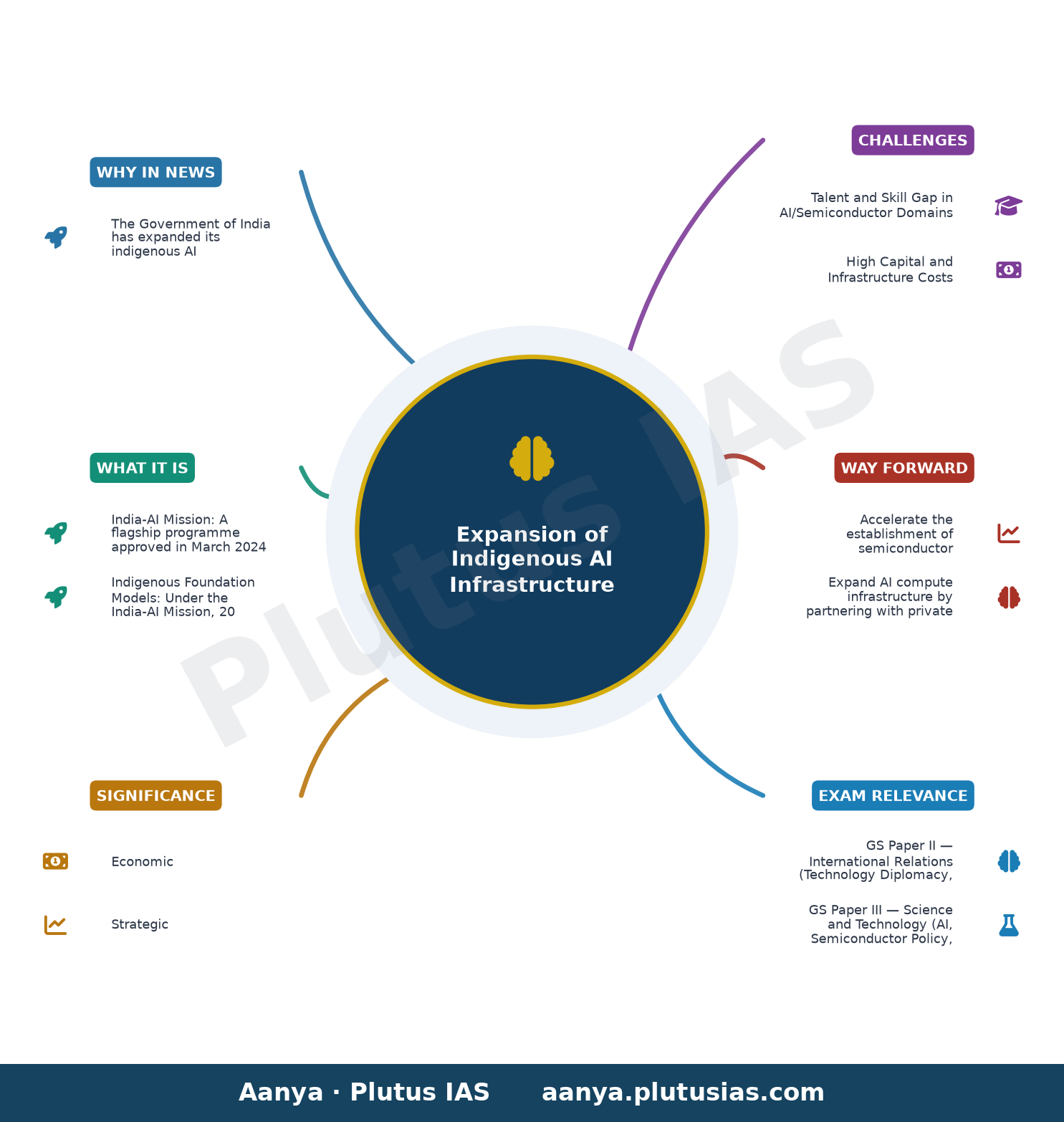
- GS Paper II — International Relations (Technology Diplomacy, Digital Public Infrastructure) | GS Paper III — Science and Technology (AI, Semiconductor Policy, Digital Economy, R&D Ecosystems) | GS Paper III — Economy (Manufacturing Sector, Startup Ecosystem, PLI Schemes) | GS Paper III — Environment (Energy-Efficient Computing, E-Waste Management)
- Prelims: Artificial Intelligence (AI), Foundation Models, Large Language Models (LLMs), Semiconductor Manufacturing, PLI Scheme, National Mission on Interdisciplinary Cyber-Physical Systems (NM-ICPS), Digital India, Atmanirbhar Bharat, National AI Portal, Compute-as-a-Service, GPU Hours, Intellectual Property Rights (IPR), Deep-Tech Startups, ETL (Electronics and IT) Ministry
- Essay: Technological Sovereignty in the Digital Age: Balancing Innovation and Self-Reliance, The Role of Public Policy in Shaping India’s AI and Semiconductor Future
Quick Revision: The India-AI Mission and Semiconductor Initiatives are strategic interventions to reduce India’s technological dependency by developing indigenous AI foundation models, enhancing compute infrastructure, and fostering a self-reliant semiconductor ecosystem, aligning with the goals of ‘Atmanirbhar Bharat’ and global leadership in AI and electronics manufacturing.
Why is this in the news?
The Government of India has expanded its indigenous AI infrastructure through the India-AI Mission and semiconductor initiatives, aiming to reduce dependency on foreign technology while fostering self-reliance in AI and semiconductor value chains. This strategic move aligns with the broader vision of ‘Atmanirbhar Bharat’ and positions India as a global hub for AI-driven innovation and electronics manufacturing. The expansion includes indigenous foundation models and enhanced AI compute capacity, reflecting a multi-dimensional approach to address domestic technological gaps and economic opportunities.
Background
- The India-AI Mission, approved on 7 March 2024 with a budget of ₹10,371.92 crore over five years, aims to create a robust and inclusive AI ecosystem by developing indigenous technologies and reducing reliance on foreign AI models.
- The National Mission on Interdisciplinary Cyber-Physical Systems (NM-ICPS), with a budget of ₹3,660 crore, focuses on fostering innovation in AI, robotics, IoT, and quantum technologies, aligning with the broader goal of developing cyber-physical systems for national development.
- India’s domestic AI and semiconductor capabilities remain underdeveloped compared to global leaders, necessitating structured policy interventions to mitigate risks associated with over-reliance on imported technologies.
- The expansion of AI infrastructure includes the development of indigenous foundation models, high-performance computing systems, and AI application prototypes, with a focus on public sector deployment and startup incubation.
What are the India-AI Mission and Semiconductor Initiatives?
- India-AI Mission: A flagship programme approved in March 2024 with a ₹10,371.92 crore budget, aimed at developing a self-reliant AI ecosystem through indigenous foundation models, compute infrastructure, and AI application development. The mission focuses on reducing dependency on foreign AI technologies while fostering innovation in public and private sectors.
- Indigenous Foundation Models: Under the India-AI Mission, 20 indigenous foundation models have been identified for support, including 12 Large Multimodal Models (LMMs) and 8 Small Language Models (SLMs). These models are developed with IPR retained by Indian applicants, ensuring technological sovereignty and reducing reliance on foreign AI solutions.
- AI Compute Infrastructure: The mission includes the establishment of high-performance AI compute systems, such as the 1.1 EFLOPS system at NIC Data Centre, Delhi, and the provision of GPU hours to 237 projects. This enhances India’s AI research and development capabilities by providing accessible compute resources to academia and industry.
- AI Application Development: The mission has facilitated the development of 62 AI prototypes and the deployment of 20 AI solutions in public sector institutions. Additionally, 11 national-level hackathons and innovation challenges have been launched to encourage grassroots innovation in AI.
- AI Excellence Centres: The government has approved 58 AI excellence centres across states and union territories, with 22 centres already operational in 13 states. These centres focus on capacity building, research, and innovation in AI, fostering regional technological development.
- Safe and Trustworthy AI: The mission includes projects addressing bias mitigation, machine unlearning, privacy-preserving AI, algorithm auditing, and explainability. This ensures that AI systems developed in India are ethical, transparent, and aligned with global standards.
- NM-ICPS Mission: The National Mission on Interdisciplinary Cyber-Physical Systems, with a ₹3,660 crore budget, supports the establishment of 25 Technology Innovation Hubs (TIHs) across academic institutions. These hubs focus on AI, robotics, IoT, quantum technologies, and cybersecurity, fostering innovation and entrepreneurship in deep-tech sectors.
Key Features
| Feature | Significance |
|---|---|
| Indigenous Foundation Models (LMMs & SLMs) | Reduces dependency on foreign AI models, ensures data sovereignty, and strengthens India’s position in the global AI value chain through 20 indigenous models (12 LMMs and 8 SLMs) with retained IP rights. |
| AI Compute Infrastructure (GPU Hours & HPC Systems) | Expands domestic compute capacity to 93.18 lakh GPU hours and deploys 1.1 EFLOPS HPC systems (e.g., NIC Data Centre, Delhi), enabling large-scale AI training and inference for public and private sectors. |
| AI Excellence Centres (State-wise Deployment) | 58 centres approved across 13 states/UTs to foster local AI innovation, skill development, and sectoral applications, aligning with the goal of inclusive and regionally distributed AI growth. |
| Secure & Trustworthy AI Initiatives | 13 projects selected to address bias mitigation, privacy-preserving AI, algorithmic auditing, and explainability, ensuring ethical and reliable AI deployment in governance and critical sectors. |
| Semiconductor Manufacturing Ecosystem (Semicon 2.0) | Targets self-reliance in semiconductor fabrication by integrating upstream (design) and downstream (packaging) capacities, reducing import dependence and enhancing supply chain resilience for electronics manufacturing. |
Why it Matters
Economic
- Catalyses high-value job creation in AI, semiconductor design, and allied sectors, aligning with the vision of a $1 trillion digital economy by 2030.
- Reduces import burden on AI and semiconductor technologies, estimated at over $10 billion annually, thereby improving the trade balance.
- Enhances competitiveness of Indian startups and MSMEs by providing subsidised compute resources and innovation grants.
Strategic
- Strengthens national security by reducing vulnerabilities in critical AI-driven systems (e.g., defence, finance, and infrastructure) through indigenous alternatives.
- Positions India as a global leader in ethical AI and semiconductor innovation, countering geopolitical dependencies in technology supply chains.
- Supports the ‘Atmanirbhar Bharat’ initiative by fostering a self-sustaining ecosystem for high-tech manufacturing and R&D.
Technological
- Accelerates India’s transition from a consumer to a producer of AI and semiconductor technologies, bridging the gap in foundational model development.
- Enables cross-sectoral integration (e.g., healthcare, agriculture, and smart cities) through domain-specific AI solutions and cyber-physical systems.
- Promotes interdisciplinary research via programmes like NM-ICPS, fostering collaboration between academia, industry, and government.
Social
- Promotes inclusive AI adoption by ensuring accessibility through public sector deployments (e.g., 20 AI solutions in government institutions) and regional excellence centres.
- Supports multilingual and culturally relevant AI models (e.g., BharatGen), preserving linguistic diversity and enhancing digital inclusion.
Challenges
1. Talent and Skill Gap in AI/Semiconductor Domains
- Limited availability of skilled professionals in niche areas like semiconductor design, AI ethics, and high-performance computing.
- Need for accelerated upskilling programmes to meet the demand of 1 million AI/ML professionals by 2026, as projected by industry bodies.
UPSC Link: GS3: Science-Tech, GS2: Skill Development
2. High Capital and Infrastructure Costs
- Substantial investment required for semiconductor fabrication plants (fabs) and AI compute infrastructure, with high risks of obsolescence in fast-evolving tech.
- Dependence on global supply chains for critical components (e.g., advanced lithography machines) poses bottlenecks.
UPSC Link: GS3: Industrial Policy, GS3: Infrastructure
3. Ethical and Regulatory Concerns
- Risk of algorithmic bias, misinformation, and privacy violations in AI systems, necessitating robust governance frameworks.
- Lack of standardised auditing mechanisms for AI models deployed in public sector applications.
UPSC Link: GS2: Governance, GS4: Ethics
4. Global Competition and Geopolitical Pressures
- Intense competition from countries like the US, China, and South Korea in semiconductor and AI innovation, requiring sustained policy support.
- Potential trade restrictions or technology denial regimes (e.g., semiconductor export controls) that could disrupt supply chains.
UPSC Link: GS2: International Relations
5. Data Localisation and Privacy Challenges
- Balancing the need for large-scale data access for AI training with stringent data localisation laws (e.g., DPDP Act 2023) to protect citizen privacy.
- Ensuring interoperability of AI systems across diverse linguistic and cultural datasets.
UPSC Link: GS2: Fundamental Rights, GS3: Cyber Security
Challenges — UPSC Perspective
| Issue | Concern |
|---|---|
| Capital Intensity | High upfront costs for semiconductor fabs and AI compute infrastructure deter private investment despite long-term benefits. |
| Talent Shortage | Insufficient domestic expertise in AI/ML, semiconductor design, and cyber-physical systems limits innovation and scalability. |
| Regulatory Fragmentation | Overlapping or inconsistent policies across states/UTs may hinder the establishment and operation of AI excellence centres. |
| Supply Chain Vulnerabilities | Dependence on imported raw materials (e.g., silicon wafers) and equipment (e.g., EUV lithography machines) poses risks to self-reliance. |
| Ethical Risks in AI Deployment | Lack of standardised auditing and bias-mitigation frameworks for AI models deployed in governance and critical sectors. |
Government Initiatives — Must-Memorise for Prelims
- IndiaAI Mission
- National Mission on Interdisciplinary Cyber-Physical Systems (NM-ICPS)
Way Forward
- Accelerate the establishment of semiconductor fabrication plants (fabs) under the Semicon India Programme by streamlining regulatory approvals and offering fiscal incentives.
- Expand AI compute infrastructure by partnering with private sector players to set up additional high-performance computing (HPC) centres in tier-2/3 cities.
- Launch nationwide upskilling programmes in collaboration with IITs, IIITs, and industry consortia to address the talent gap in AI, semiconductor design, and cyber-physical systems.
- Develop a unified national framework for AI ethics, including mandatory algorithmic audits and bias-mitigation guidelines for public sector deployments.
- Enhance data governance by finalising the Digital Personal Data Protection Act 2023 rules to balance innovation with citizen privacy.
- Foster public-private partnerships (PPPs) to co-develop domain-specific AI models (e.g., agriculture, healthcare) and semiconductor IP blocks.
- Strengthen international collaborations (e.g., semiconductor supply chain alliances) to mitigate geopolitical risks and access critical technologies.
- Monitor and evaluate the impact of AI excellence centres through periodic audits to ensure equitable regional development and measurable outcomes.
UPSC Value Addition
Keywords for Mains Answer-Writing
Artificial Intelligence Mission (India-AI) · Semiconductor Mission · Indigenous AI infrastructure · National Mission on Interdisciplinary Cyber-Physical Systems (NM-ICPS) · AI compute capacity · Foundation models · Semiconductor 2.0 · Technology self-reliance · AI excellence centres · Deep-tech startups · AI governance · Cyber-Physical Systems (CPS) · AI for public good · National AI Strategy · Ethical AI · High-Performance Computing (HPC) · Technology transfer in AI
Concept Flow
Government identifies gaps in domestic AI and semiconductor capabilities → Launches IndiaAI Mission and Semicon India Programme → Allocates budget and approves indigenous foundation models (LMMs/SLMs) → Expands AI compute infrastructure (GPU hours, HPC systems) → Establishes AI excellence centres across states → Addresses ethical and security concerns via secure AI initiatives → Strengthens semiconductor manufacturing ecosystem (Semicon 2.0) → Drives technological self-reliance and economic growth.
Prelims Practice Questions
Q1. Consider the following statements regarding the ‘India-AI Mission’:
1. The mission was approved by the Union Cabinet on 7 March 2024 with a budget outlay of ₹10,371.92 crore over five years.
2. The mission aims to develop indigenous foundation models, including Large Multimodal Models (LMMs) and Small Language Models (SLMs).
3. The mission does not provide support for AI compute capacity or High-Performance Computing (HPC) systems.
4. The mission includes the establishment of AI excellence centres across all states and Union Territories.
How many of the above statements are correct?
- Only one
- Only two
- Only three
- All
Answer: Only three — Statements 1 and 2 are correct. Statement 3 is incorrect as the mission does provide support for AI compute capacity and HPC systems. Statement 4 is incorrect as the mission has approved 58 AI excellence centres, but not all states/UTs have centres established yet.
Q2. Assertion (A): The ‘Semiconductor Mission’ is a part of the broader ‘Semicon 2.0’ initiative to strengthen domestic semiconductor manufacturing.
Reason (R): Semiconductors are classified as a ‘basic industry’ essential for achieving technology self-reliance under the ‘Atmanirbhar Bharat’ vision.
Options:
A. Both A and R are true, and R is the correct explanation of A.
B. Both A and R are true, but R is NOT the correct explanation of A.
C. A is true, but R is false.
D. A is false, but R is true.
Answer: ? — Both the Assertion (A) and Reason (R) are true, and the Reason (R) correctly explains the Assertion (A). The ‘Semiconductor Mission’ is indeed a component of ‘Semicon 2.0’, and semiconductors are recognised as a ‘basic industry’ under the ‘Atmanirbhar Bharat’ initiative.
Q3. Match the following initiatives with their respective objectives:
Column I (Initiative) | Column II (Objective)
— | —
A. India-AI Mission | 1. Strengthen domestic semiconductor manufacturing
B. Semiconductor Mission | 2. Develop indigenous AI foundation models and compute capacity
C. National Mission on Interdisciplinary Cyber-Physical Systems (NM-ICPS) | 3. Foster innovation in AI, robotics, IoT, and cybersecurity through Technology Innovation Hubs
D. Semicon 2.0 | 4. Enhance AI governance and ethical AI development
Choose the correct match:
- A-2, B-1, C-3, D-4
- A-1, B-2, C-3, D-4
- A-4, B-1, C-2, D-3
- A-2, B-4, C-1, D-3
Answer: A-2, B-1, C-3, D-4 — Correct matches are: A-2 (India-AI Mission aims to develop indigenous AI foundation models and compute capacity), B-1 (Semiconductor Mission aims to strengthen domestic semiconductor manufacturing), C-3 (NM-ICPS fosters innovation in AI, robotics, IoT, and cybersecurity through Technology Innovation Hubs), D-4 (Semicon 2.0 focuses on enhancing AI governance and ethical AI development).
Mains Practice Question
✍ The Government of India’s twin initiatives—’India-AI Mission’ and ‘Semiconductor Mission’—are positioned as cornerstones of the country’s technological self-reliance strategy. Critically examine the rationale behind these initiatives, their key components, and the challenges they are likely to encounter in achieving their stated objectives. Also, analyse how these missions align with the broader vision of ‘Atmanirbhar Bharat’ and the National AI Strategy. (15 Marks)
Approach: MODEL-ANSWER SKELETON:
1. **Rationale and Objectives**:
– Explain the strategic necessity of reducing dependence on foreign AI infrastructure and semiconductor supply chains, citing vulnerabilities exposed during geopolitical tensions (e.g., semiconductor shortages post-COVID-19 and US-China trade restrictions).
– Highlight the alignment with PM’s vision of making technology accessible to all (e.g., ‘Sabka Saath, Sabka Vikas’) and fostering economic opportunities.
– Reference the National AI Strategy’s goals: inclusivity, job creation, and addressing India-specific challenges (e.g., multilingualism, healthcare, agriculture).
2. **Key Components of the Initiatives**:
– **India-AI Mission**:
– Indigenous foundation models (e.g., ‘BharatGen’, ‘Sarvam’, ‘AvaartAI’) and their significance in reducing reliance on proprietary models.
– AI compute capacity (e.g., 1.1 EFlops HPC system at NIC Data Centre, Delhi) and subsidised GPU hours for startups.
– AI excellence centres (58 approved, 22 operational) for skill development and innovation.
– Ethical AI frameworks (e.g., bias mitigation, algorithm auditing, privacy-preserving AI).
– **Semiconductor Mission**:
– Focus on end-to-end value chain development (design, fabrication, packaging, testing).
– ‘Semicon 2.0’ initiative to enhance domestic manufacturing capabilities.
– Integration with ‘Make in India’ and ‘Digital India’ to position India as a global electronics manufacturing hub.
3. **Challenges and Limitations**:
– **Technological Gaps**: Limited domestic expertise in advanced semiconductor fabrication (e.g., <5% global share in semiconductor manufacturing).
– **Human Capital**: Shortage of skilled workforce in AI, semiconductor design, and CPS domains despite initiatives like NM-ICPS.
– **Infrastructure Bottlenecks**: High capital expenditure and long gestation periods for semiconductor fabs; reliance on imported raw materials (e.g., silicon wafers).
– **Regulatory and Ethical Issues**: Ensuring data privacy, preventing algorithmic bias, and balancing innovation with ethical governance.
– **Competition**: Global players (e.g., TSMC, NVIDIA) dominate the AI and semiconductor markets, posing market access challenges.
4. **Alignment with ‘Atmanirbhar Bharat’ and National AI Strategy**:
– **Atmanirbhar Bharat**: Emphasise self-sufficiency in critical technologies, reducing import dependence (e.g., semiconductors worth ~$15 billion imported annually), and creating jobs in high-tech sectors.
– **National AI Strategy**: Highlight inclusivity (e.g., AI for rural development, healthcare), multilingual AI models, and public-private partnerships to democratise AI access.
5. **Way Forward**:
– Strengthen academia-industry collaboration (e.g., IITs, IIITs, and private sector R&D labs).
– Leverage global partnerships (e.g., semiconductor fabrication collaborations with Japan, US, or EU) while ensuring technology transfer.
– Expand funding for deep-tech startups and incubators (e.g., via SIDBI, MeitY’s ‘AI for All’ initiatives).
– Develop a robust IPR framework to protect indigenous innovations and incentivise R&D.
**Balanced View**: Acknowledge the potential of these initiatives to transform India’s tech landscape while recognising the time-bound nature of their success and the need for continuous policy support.
Source: PIB (Press Information Bureau)
Generated by AanyaAi for educational purpose.

- तमिलनाडु के लिए क्या है ‘एल नीनो’ और उत्तर-पूर्वी मानसून का खतरा? - September 23, 2026
- El Nino & Northeast Monsoon: Impact on Tamil Nadu for UPSC 2026 - September 23, 2026
- हिमाचल में डिजिटल भुगतान क्रांति: बिलासपुर अव्वल, महिलाओं की भागीदारी 93% तक पहुंची - September 23, 2026

No Comments