


06 Aug UPSC Alert: Government Expands Indigenous AI Infrastructure via India-AI Mission
✎ India’s IndiaAI Mission and Semiconductor Initiatives are strategic pillars aimed at reducing technological dependence by developing indigenous foundational AI models, enhancing high-performance computing capacity, and…
Subject Relevance — Where This Topic Fits
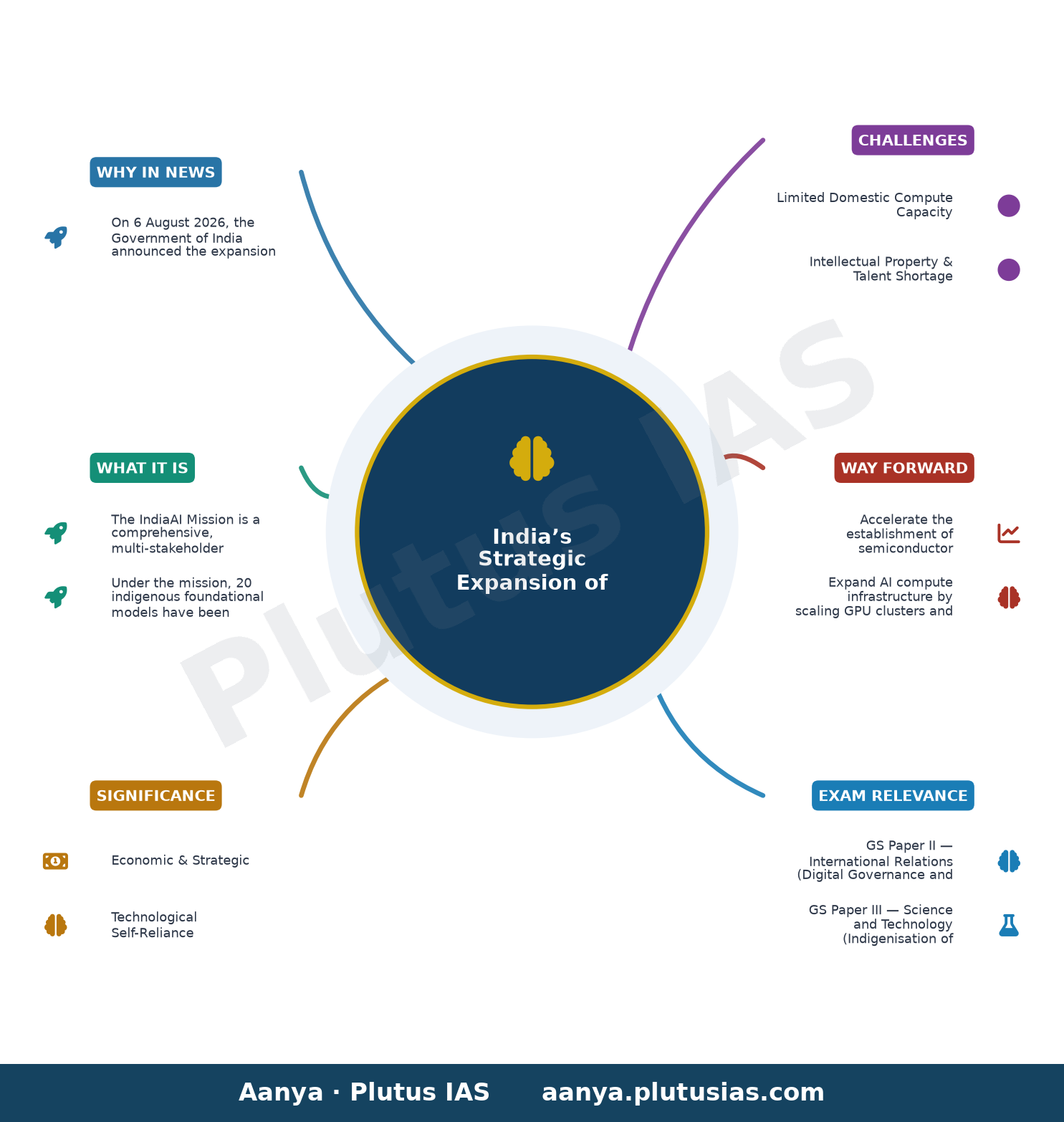
- GS Paper II — International Relations (Digital Governance and Global AI Governance Frameworks) | GS Paper III — Science and Technology (Indigenisation of Technology, Semiconductor Manufacturing, AI Ecosystem Development)
- Prelims: Artificial Intelligence (AI), Foundation Models, Semiconductor Manufacturing, Parametric Models, GPU Hours, National Mission on Interdisciplinary Cyber-Physical Systems (NM-ICPS), PLI Scheme, Digital Public Infrastructure (DPI), BharatNet, Atmanirbhar Bharat, IndiaAI Mission, Semicon India Programme, Compute as a Service (CaaS), Multimodal Models (LMM), Small Language Models (SLM), Indigenous IPR, High-Performance Computing (HPC), National Supercomputing Mission (NSM)
- Essay: The Imperative of Technological Self-Reliance in the 21st Century: Lessons from India’s AI and Semiconductor Initiatives, Digital Sovereignty and National Security: Balancing Innovation with Strategic Autonomy
Quick Revision: India’s IndiaAI Mission and Semiconductor Initiatives are strategic pillars aimed at reducing technological dependence by developing indigenous foundational AI models, enhancing high-performance computing capacity, and strengthening domestic semiconductor manufacturing under the ‘Semicon 2.0’ framework.
Why is this in the news?
On 6 August 2026, the Government of India announced the expansion of indigenous AI infrastructure through the IndiaAI Mission and semiconductor initiatives, signalling a strategic pivot towards reducing dependence on foreign technology in critical domains. This development is anchored in the broader vision of Atmanirbhar Bharat (Self-Reliant India) and aligns with the Prime Minister’s emphasis on leveraging technology for inclusive economic growth. The announcement underscores the government’s commitment to fostering a robust domestic AI ecosystem, including foundational models, high-performance computing, and semiconductor manufacturing, while mitigating risks associated with limited domestic capabilities in these sectors.
Background
- The Union Cabinet approved the IndiaAI Mission on 7 March 2024 with a budgetary outlay of ₹10,371.92 crore over five years, aiming to create a resilient and inclusive AI ecosystem aligned with India’s developmental goals.
- India’s AI strategy is rooted in the Prime Minister’s vision of making technology accessible to all, addressing India-centric challenges, and generating economic and employment opportunities for citizens.
- The government recognises vulnerabilities in the AI value chain, particularly in semiconductor manufacturing, computing infrastructure, foundational models, and advanced research ecosystems, necessitating indigenous technological development.
- The National Mission on Interdisciplinary Cyber-Physical Systems (NM-ICPS), approved by the Union Cabinet with a budget of ₹3,660 crore, serves as a foundational pillar for integrating AI, robotics, IoT, and quantum technologies into India’s industrial and governance frameworks.
- Public sector initiatives such as the National Supercomputing Mission (NSM) and Digital India programmes have laid the groundwork for high-performance computing (HPC) and digital public infrastructure (DPI), which are now being leveraged for AI development.
What are the IndiaAI Mission and Semiconductor Initiatives?
- The IndiaAI Mission is a comprehensive, multi-stakeholder programme designed to democratise access to AI technologies, develop indigenous foundational models, and enhance India’s compute infrastructure, thereby reducing reliance on foreign AI systems.
- Under the mission, 20 indigenous foundational models have been identified for support, including 12 Large Multimodal Models (LMMs) and 8 Small Language Models (SLMs), with intellectual property rights retained by Indian developers. Notable examples include ‘Sarvam AI’ (30B and 105B parameter models), ‘Indus’ models, ‘BharatGen’ (multilingual models like Param 2-17B, Patram-7B, and Shrutam-2), and ‘Avataar AI’ (video generation models).
- The mission has approved 237 projects under a subsidised Compute-as-a-Service (CaaS) model, allocating 93.18 lakh GPU hours to developers. Additionally, a high-performance AI compute system with a capacity of approximately 1.1 EFLOPS has been commissioned at the NIC Data Centre in Shastri Park, Delhi.
- To foster innovation, 11 national-level hackathons and innovation challenges have been launched, resulting in 62 AI prototypes and the deployment of 20 AI solutions in public sector institutions. Further, 58 AI Excellence Centres have been approved across states and union territories, with 22 already operational in 13 regions.
- The mission also prioritises ethical AI development through projects focused on bias mitigation, explainable AI, privacy-preserving techniques, algorithmic auditing, and machine unlearning, ensuring that AI systems are secure, transparent, and trustworthy.
- Complementary to the IndiaAI Mission, the NM-ICPS under the Department of Science and Technology (DST) integrates AI with cyber-physical systems, IoT, robotics, and quantum technologies, establishing 25 Technology Innovation Hubs (TIHs) across academic institutions to drive experimental research and prototyping.
Key Features
| Feature | Significance |
|---|---|
| Indigenous Foundation Models (LMM & SLM) | Reduces dependency on foreign AI models, ensures data sovereignty, and strengthens India’s position in the global AI value chain through homegrown intellectual property rights. |
| AI Compute Infrastructure (GPU Hours & HPC) | Enhances domestic AI research capabilities by providing subsidized compute access, enabling large-scale model training and deployment within India. |
| AI Excellence Centres (58 Approved, 22 Operational) | Fosters regional innovation hubs, promotes grassroots AI adoption, and bridges the digital divide by decentralizing AI expertise across states and UTs. |
| Safe & Trustworthy AI Initiatives (13 Projects) | Addresses algorithmic bias, privacy concerns, and explainability in AI systems, aligning with global ethical AI frameworks and regulatory compliance. |
| Semiconductor Manufacturing Ecosystem | Strengthens India’s strategic autonomy in critical electronics supply chains, reduces import dependence, and supports the ‘Make in India’ vision for high-tech manufacturing. |
Why it Matters
Economic & Strategic
- Reduces foreign exchange outflows by substituting imports of AI infrastructure and semiconductors with domestic alternatives.
- Enhances India’s competitiveness in the global AI and semiconductor markets, positioning the country as a hub for high-value technology exports.
- Supports the vision of a $1 trillion digital economy by 2030 through indigenous innovation in AI and semiconductor manufacturing.
Technological Self-Reliance
- Mitigates risks associated with over-reliance on foreign AI models and semiconductor supply chains, particularly in geopolitically sensitive sectors.
- Accelerates the development of domain-specific AI applications (e.g., healthcare, agriculture, governance) tailored to India’s unique challenges.
- Promotes vertical integration in the AI value chain, from hardware (semiconductors) to software (foundation models) and applications.
Social & Governance
- Ensures equitable access to AI technologies across regions, sectors, and socio-economic groups through decentralized excellence centers and subsidized compute support.
- Supports public sector digitization by deploying AI solutions in government institutions, improving service delivery and administrative efficiency.
- Fosters a culture of innovation and entrepreneurship in deep-tech sectors, aligning with the ‘Atmanirbhar Bharat’ initiative.
Geopolitical
- Strengthens India’s strategic autonomy in critical technologies, reducing vulnerabilities in supply chains disrupted by global conflicts or trade restrictions.
- Enhances India’s role in global AI governance by developing indigenous ethical frameworks and standards for AI deployment.
Challenges
1. Limited Domestic Compute Capacity
- India’s current AI compute infrastructure lags behind global leaders, necessitating continued investment in high-performance computing (HPC) and GPU clusters.
- High costs of compute resources may deter startups and researchers from accessing advanced AI tools without sustained subsidies.
UPSC Link: GS3: Science & Tech – AI & Computing
2. Intellectual Property & Talent Shortage
- Developing high-quality foundation models requires specialized talent in machine learning, data science, and semiconductor design, which is currently in short supply.
- Ensuring that indigenous AI models remain competitive with global counterparts demands ongoing R&D and collaboration with academia and industry.
UPSC Link: GS3: Skill Development & Human Resources
3. Supply Chain Vulnerabilities in Semiconductors
- Semiconductor manufacturing is capital-intensive and technologically complex, requiring long-term investment and global partnerships to achieve scale.
- Geopolitical dependencies (e.g., reliance on foreign semiconductor equipment) pose risks to India’s self-reliance goals.
UPSC Link: GS3: Industrial Policy & Manufacturing
4. Ethical & Regulatory Risks
- Ensuring AI systems are free from bias, respect privacy, and are explainable requires robust governance frameworks and continuous auditing.
- Lack of standardized AI ethics guidelines may lead to inconsistencies in compliance across sectors and regions.
UPSC Link: GS4: Ethics in Governance
5. Regional Disparities in AI Adoption
- Uneven distribution of AI excellence centers and compute resources may exacerbate digital divides between urban and rural areas.
- Limited awareness and infrastructure in tier-2/3 cities could hinder the inclusive growth of India’s AI ecosystem.
UPSC Link: GS2: Governance & Social Justice
Challenges — UPSC Perspective
| Issue | Concern |
|---|---|
| High Cost of AI Compute | Subsidies may not be sustainable long-term; requires private sector investment to scale infrastructure. |
| Talent Migration | Risk of skilled professionals moving abroad due to better opportunities, impacting domestic R&D. |
| Semiconductor Fabrication Lag | India lacks advanced fabrication plants (fabs); reliance on imports for critical components remains high. |
| Data Privacy & Security | Handling sensitive data for AI training raises concerns about compliance with laws like the DPDP Act, 2023. |
| Ethical AI Deployment | Ensuring fairness, transparency, and accountability in AI systems across diverse applications. |
Government Initiatives — Must-Memorise for Prelims
- IndiaAI Mission (2024)
- India Semiconductor Mission (ISM)
- Interdisciplinary Cyber-Physical Systems (ICPS) Mission
Way Forward
- Accelerate the establishment of semiconductor fabrication units (fabs) in India through public-private partnerships and global collaborations.
- Expand AI compute infrastructure by scaling GPU clusters and HPC facilities, with a focus on Tier-2/3 cities to reduce regional disparities.
- Strengthen academia-industry collaboration to address talent shortages, including upskilling programs and PhD fellowships in AI and semiconductor technologies.
- Develop a national AI ethics framework with standardized guidelines for bias mitigation, privacy protection, and algorithmic transparency.
- Enhance funding and incubation support for deep-tech startups in AI and semiconductor design to foster innovation and entrepreneurship.
- Promote international partnerships to access advanced semiconductor manufacturing technologies and AI research collaborations.
- Implement robust data governance policies to ensure compliance with the Digital Personal Data Protection (DPDP) Act, 2023, while enabling ethical AI training.
- Monitor and evaluate the impact of AI excellence centers and compute subsidies to ensure equitable access and measurable outcomes.
UPSC Value Addition
Keywords for Mains Answer-Writing
Artificial Intelligence Mission (India-AI Mission) · National Mission on Interdisciplinary Cyber-Physical Systems (NM-ICPS) · Semiconductor Manufacturing Policy · Indigenous AI Infrastructure · Foundation Models in AI · AI Compute Capacity · AI Excellence Centres · Technology Self-Reliance (Atmanirbhar Bharat) · AI Ethics and Bias Mitigation · Public Sector AI Deployment
Concept Flow
Government launches IndiaAI Mission and Semiconductor Initiatives → → Allocation of budget (₹10,371.92 crore) and approval of 58 AI Excellence Centres → → Development of indigenous foundation models (LMM, SLM) and AI compute infrastructure → → Deployment of AI solutions in public sector institutions and startups → → Establishment of semiconductor manufacturing ecosystem → → Achievement of technological self-reliance and reduced import dependence → → Enhanced global competitiveness and strategic autonomy in AI and semiconductor sectors.
Prelims Practice Questions
Q1. Consider the following statements regarding the India-AI Mission:
1. The Mission was approved by the Union Cabinet on 7 March 2024.
2. The total budget allocated for the Mission over five years is ₹10,371.92 crore.
3. The Mission focuses exclusively on the development of Large Language Models (LLMs).
4. The Mission aims to establish 58 AI Excellence Centres across states and Union Territories.
How many of the above statements are correct?
- Only one
- Only two
- Only three
- All
Answer: Only three — Statements 1, 2, and 4 are correct. Statement 3 is incorrect as the Mission supports both Large Language Models (LLMs) and Large Multimodal Models (LMMs), alongside Small Language Models (SLMs).
Q2. Assertion (A): The National Mission on Interdisciplinary Cyber-Physical Systems (NM-ICPS) is implemented by the Department of Science and Technology with a budget of ₹3,660 crore.
Reason (R): The Mission aims to establish 25 Technology Innovation Hubs (TIHs) across academic institutions to foster research in AI, robotics, IoT, and quantum technologies.
Options:
A. Both A and R are true, and R is the correct explanation of A.
B. Both A and R are true, but R is not the correct explanation of A.
C. A is true, but R is false.
D. A is false, but R is true.
Answer: ? — Both Assertion (A) and Reason (R) are true, and Reason (R) correctly explains Assertion (A). The NM-ICPS is indeed implemented by the DST with a ₹3,660 crore budget, and its objective includes establishing TIHs for interdisciplinary research.
Q3. Match the following initiatives with their respective objectives:
Column I (Initiative) | Column II (Objective)
1. India-AI Mission | A. Strengthening semiconductor manufacturing and electronics production
2. Semicon India Programme | B. Developing indigenous foundation models and AI compute capacity
3. NM-ICPS | C. Establishing AI Excellence Centres and fostering innovation
4. AIRAWAT | D. Building high-performance AI compute infrastructure
Options:
A. 1-B, 2-A, 3-C, 4-D
B. 1-C, 2-A, 3-B, 4-D
C. 1-B, 2-A, 3-D, 4-C
D. 1-A, 2-B, 3-C, 4-D
Answer: ? — Correct matching: 1-B (India-AI Mission focuses on indigenous AI infrastructure), 2-A (Semicon India Programme targets semiconductor manufacturing), 3-C (NM-ICPS establishes AI Excellence Centres), 4-D (AIRAWAT is a high-performance AI compute system).
Mains Practice Question
✍ Critically examine the role of the India-AI Mission and the Semiconductor India Programme in advancing India’s technological self-reliance. How far have these initiatives succeeded in addressing the challenges of indigenous AI infrastructure development? Also, analyse the potential implications for India’s global competitiveness in the semiconductor and AI sectors. (15 Marks)
Approach: MODEL-ANSWER SKELETON:
1. **Introduction (2 Marks)**
– Define technological self-reliance (Atmanirbhar Bharat) in the context of AI and semiconductors.
– State the objectives of the India-AI Mission (approved 7 March 2024, ₹10,371.92 crore budget) and Semiconductor India Programme.
– Highlight the dual focus: indigenous foundation models (e.g., ‘BharatGen’, ‘Avataar AI’) and semiconductor manufacturing.
2. **India-AI Mission: Key Components and Progress (4 Marks)**
– Indigenous Foundation Models: Support for 20 models (12 LMMs, 8 SLMs) with IP rights retained by applicants (e.g., ‘Sarvam AI’, ‘Indus’, ‘Genini.AI’).
– AI Compute Capacity: Subsidized GPU hours (93.18 lakh GPU hours approved) and high-performance systems (e.g., NIC Data Centre, Delhi: 1.1 EFlops).
– AI Excellence Centres: 58 centres approved, 22 operational across 13 states/UTs.
– Application Development: 62 AI prototypes and 20 public-sector deployments.
– Ethical AI: 13 projects on bias mitigation, privacy-preserving AI, and algorithm auditing.
3. **Semiconductor India Programme: Strategic Framework (4 Marks)**
– Policy Initiatives: Structured and targeted policies to develop the semiconductor value chain (e.g., Production-Linked Incentive (PLI) schemes, Semicon 2.0).
– Objectives: Reduce import dependence, position India as a global electronics manufacturing hub.
– Challenges: Limited domestic manufacturing capacity, high capital intensity, and global competition.
4. **Critical Analysis: Successes and Gaps (3 Marks)**
– Successes: Progress in indigenous model development, compute infrastructure, and institutional frameworks (e.g., NM-ICPS, TIHs).
– Gaps: Dependency on global supply chains for advanced semiconductor nodes, limited commercialization of indigenous models, and skill gaps in AI/ML workforce.
5. **Global Competitiveness Implications (2 Marks)**
– Potential to disrupt global AI value chains by leveraging India’s demographic dividend and IT prowess.
– Semiconductor manufacturing as a strategic lever for geopolitical influence (e.g., alliances with like-minded nations).
– Risks: Over-reliance on subsidies, regulatory hurdles, and competition from established players (e.g., TSMC, NVIDIA).
6. **Conclusion (2 Marks)**
– Summarize the dual-track approach (AI + semiconductors) as a long-term strategy for technological sovereignty.
– Emphasize the need for sustained investment, public-private partnerships, and global collaborations to bridge gaps.
Source: PIB (Press Information Bureau)
Generated by AanyaAi for educational purpose.

- तमिलनाडु के लिए क्या है ‘एल नीनो’ और उत्तर-पूर्वी मानसून का खतरा? - September 23, 2026
- El Nino & Northeast Monsoon: Impact on Tamil Nadu for UPSC 2026 - September 23, 2026
- हिमाचल में डिजिटल भुगतान क्रांति: बिलासपुर अव्वल, महिलाओं की भागीदारी 93% तक पहुंची - September 23, 2026

No Comments