


28 Jul UPSC Alert: Govt Approves ₹25,938 Cr PLI Scheme for Auto Industry
Subject Relevance — Where This Topic Fits
- GS Paper III — Indian Economy: Issues relating to Planning, Mobilization of Resources, Growth, Development and Employment | GS Paper III — Effects of Liberalization on the Economy, Changes in Industrial Policy and their Effects on Industrial Growth
- Prelims: PLI Scheme, AAT, Rare Earth Permanent Magnets, PM E-DRIVE, Automotive Testing Agencies, FDI in Auto Sector, Make in India, Atmanirbhar Bharat
- Essay: India’s Manufacturing Renaissance: The Role of PLI Schemes in Achieving Self-Reliance and Global Competitiveness, The Intersection of Industrial Policy and Sustainable Mobility: Lessons from PLI-Auto and PM E-DRIVE
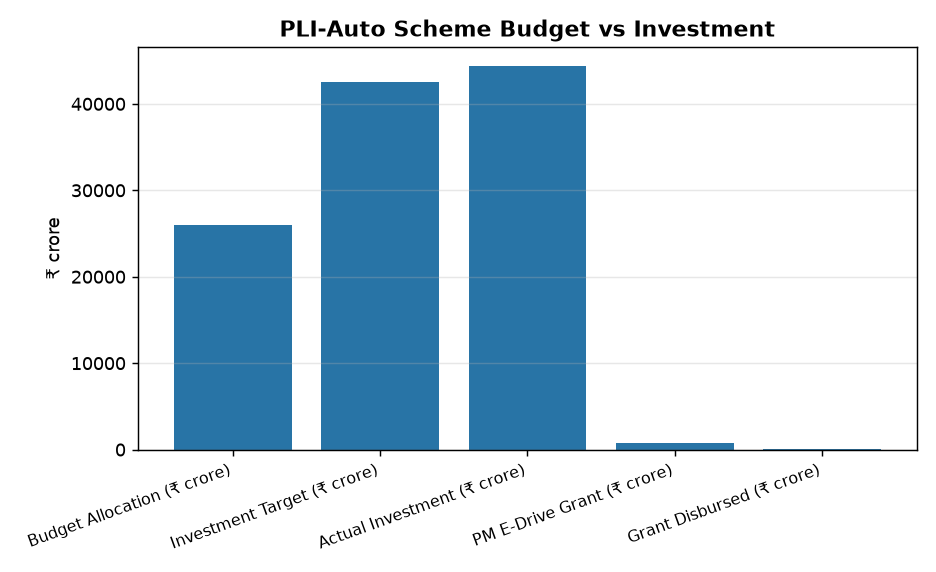
Quick Revision: The PLI-Auto scheme is a performance-linked incentive mechanism with a ₹25,938 crore outlay to boost domestic manufacturing of advanced automotive technologies, with ₹44,326 crore already invested by approved applicants as of March 2026.
Why is this in the news?
The Union Cabinet’s approval of the Production-Linked Incentive (PLI) Scheme for Automobiles and Auto Components (PLI-Auto) with a budgetary outlay of ₹25,938 crore, along with the operational progress reported on 28 July 2026, underscores India’s strategic thrust towards enhancing indigenous manufacturing capabilities in advanced automotive technologies. This development is critical as it aligns with the broader objectives of the ‘Atmanirbhar Bharat’ initiative and the ‘Make in India’ campaign, while also addressing the global shift towards electric mobility and sustainable supply chains.
Background
- The PLI Scheme was introduced in 2021 as part of the Government of India’s broader industrial policy framework to incentivize domestic manufacturing across key sectors, including automobiles, electronics, and pharmaceuticals.
- The PLI-Auto scheme specifically targets the production of Advanced Automotive Technology (AAT) products, such as electric vehicles (EVs), hydrogen fuel cell vehicles, and components like batteries, motors, and power electronics.
- India’s automotive industry is the fourth-largest in the world, contributing approximately 7.1% to the country’s GDP and employing over 37 million people directly and indirectly.
- The global automotive industry is undergoing a paradigm shift towards electrification, digitalization, and sustainability, necessitating substantial investments in R&D and manufacturing infrastructure.
- The scheme is designed to reduce import dependence in critical automotive components, particularly rare earth permanent magnets, which are essential for electric motors and other advanced applications.
- The PM E-DRIVE scheme, a sub-component of the broader PLI framework, focuses on upgrading automotive testing infrastructure to support the development and certification of electric and hybrid vehicles.
What is the PLI Scheme for Automobiles and Auto Components (PLI-Auto)?
- The PLI-Auto scheme is a central sector scheme launched on 23 September 2021 with a total budgetary outlay of ₹25,938 crore to incentivize the production of Advanced Automotive Technology (AAT) products in India.
- The scheme aims to enhance India’s manufacturing capabilities by attracting investments, fostering innovation, and promoting the indigenous production of high-value automotive components and vehicles.
- Eligible applicants under the scheme include domestic and global automotive manufacturers, component suppliers, and technology providers engaged in the production of AAT products such as electric vehicles, hydrogen fuel cell vehicles, and related components.
- The scheme operates on a performance-linked incentive model, where incentives are disbursed based on incremental sales of eligible products over a five-year period, with a minimum investment threshold and domestic value addition criteria.
- As of 31 March 2026, approved applicants have reported investments of ₹44,326 crore against a target of ₹42,500 crore, indicating strong industry participation and confidence in the scheme.
- The scheme also includes provisions for the development of rare earth permanent magnets, critical for electric vehicle motors, with a Request for Proposal (RFP) issued on 20 March 2026 to promote domestic manufacturing of these components.
- The PM E-DRIVE scheme, a complementary initiative under the PLI framework, provides ₹780 crore for the upgradation of automotive testing agencies, with ₹16.63 crore already disbursed as of 20 July 2026 to support the certification and testing of electric and hybrid vehicles.
Key Features
| Feature | Significance |
|---|---|
| Budgetary Outlay of ₹25,938 crore | Provides fiscal support for scaling advanced automotive manufacturing in India, aligning with the ‘Atmanirbhar Bharat’ vision. |
| Investment Target of ₹42,500 crore | Demonstrates industry confidence, with ₹44,326 crore already committed, exceeding initial projections. |
| Focus on Advanced Automotive Products (AAT) | Encourages R&D and production of high-value components, including electric and hybrid technologies. |
| Sintered Rare Earth Permanent Magnets (REPM) Scheme | Supports indigenous production of critical materials for electric vehicles (EVs) and green mobility solutions. |
| PM E-DRIVE Scheme | Allocates ₹780 crore for upgrading automotive testing infrastructure, ensuring compliance with global safety and emissions standards. |
Why it Matters
Economic Impact
- Boosts domestic manufacturing competitiveness, reducing import dependence for high-tech auto components.
- Enhances export potential by positioning India as a hub for advanced automotive products.
- Stimulates ancillary industries, including raw material suppliers and testing agencies, creating employment.
- Aligns with global trends in electric mobility, ensuring India’s relevance in the automotive supply chain.
Strategic Autonomy
- Reduces reliance on imports for critical components like rare earth magnets, essential for EVs and defense applications.
- Strengthens India’s position in the global automotive industry, competing with established manufacturing hubs like China and Germany.
- Supports the ‘Make in India’ initiative by fostering indigenous innovation and reducing trade deficits in the automotive sector.
Environmental and Technological Advancement
- Promotes the development of cleaner, energy-efficient vehicles, contributing to India’s climate commitments under the Paris Agreement.
- Encourages adoption of electric and hybrid technologies, reducing vehicular emissions and dependence on fossil fuels.
- Facilitates the transition to green mobility by accelerating the production of advanced automotive components.
Challenges
1. Supply Chain Disruptions
- Dependence on imported raw materials, such as rare earth elements, poses risks to uninterrupted production.
- Global geopolitical tensions and trade restrictions may disrupt supply chains, affecting timelines and costs.
UPSC Link: GS3: Supply chain resilience
2. Technological Gaps
- India lacks indigenous capabilities in certain advanced automotive technologies, necessitating continued reliance on foreign expertise.
- R&D investments in high-value components, such as batteries and control systems, remain insufficient compared to global leaders.
UPSC Link: GS3: Technology transfer and innovation
3. Regulatory and Compliance Hurdles
- Stringent global safety and emissions standards require continuous upgrades to testing infrastructure and manufacturing processes.
- Complex regulatory frameworks across states may delay project implementation and increase compliance costs.
UPSC Link: GS2: Regulatory frameworks and ease of doing business
4. Skilled Labour Shortage
- The automotive sector faces a shortage of skilled workers, particularly in advanced manufacturing and R&D roles.
- Vocational training programs need scaling to meet industry demands, especially in electric vehicle technology.
UPSC Link: GS3: Skill development and employment
Challenges — UPSC Perspective
| Issue | Concern |
|---|---|
| Raw Material Dependence | Risk of supply chain disruptions due to reliance on imported rare earth elements and other critical inputs. |
| R&D Investment Gaps | Insufficient domestic innovation in high-value automotive components, lagging behind global leaders. |
| Infrastructure Bottlenecks | Limited testing and manufacturing infrastructure may hinder the scaling of advanced automotive products. |
| Regulatory Complexity | Multiple compliance requirements across states may delay project execution and increase costs. |
| Skilled Labour Deficit | Shortage of trained personnel in advanced manufacturing and EV technology poses a long-term challenge. |
Government Initiatives — Must-Memorise for Prelims
- Production-Linked Incentive (PLI) Scheme for Automobile and Auto Components
- Scheme for Promotion of Manufacturing of Sintered Rare Earth Permanent Magnets
- PM E-DRIVE Scheme for Automotive Testing Infrastructure Upgradation
Way Forward
- Enhance domestic R&D capabilities in advanced automotive technologies, including batteries, motors, and control systems.
- Strengthen supply chain resilience by diversifying sources of critical raw materials and promoting local extraction.
- Expand vocational training programs in collaboration with industry to address the skilled labour shortage.
- Streamline regulatory processes and establish a single-window clearance system for automotive manufacturing projects.
- Accelerate the adoption of electric and hybrid technologies by incentivizing local production of key components.
- Invest in upgrading testing infrastructure to meet global safety and emissions standards, ensuring compliance.
- Promote public-private partnerships to foster innovation and technology transfer in the automotive sector.
UPSC Value Addition
Keywords for Mains Answer-Writing
Production-Linked Incentive (PLI) Scheme · Automobile and Auto Components Industry · Advanced Automotive Technology (AAT) · Manufacturing Capacity Enhancement · Rare Earth Permanent Magnets · PM E-DRIVE Scheme · Automotive Testing Agencies · Capital Expenditure Subsidy · Atmanirbhar Bharat · Self-Reliance in Critical Technologies · Fiscal Incentives for Green Mobility · Global Supply Chain Diversification
Concept Flow
Government approval of PLI-Auto scheme with ₹25,938 crore outlay → Industry response: ₹44,326 crore investment exceeding ₹42,500 crore target → Focus on advanced automotive products (AAT) and rare earth magnets to reduce import dependence → PM E-DRIVE scheme allocates ₹780 crore for testing infrastructure upgrades → Strengthening of domestic manufacturing and supply chains for global competitiveness → Transition towards electric mobility and green automotive technologies → Long-term impact: Reduced trade deficit, enhanced export potential, and strategic autonomy
Prelims Practice Questions
Q1. Consider the following statements regarding the PLI Scheme for the Automobile and Auto Components Industry in India: 1. The scheme was approved on 23 September 2021 with a budgetary outlay of ₹25,938 crore. 2. The scheme aims to enhance India’s manufacturing capabilities in advanced automotive products. 3. The scheme includes provisions for subsidies to upgrade automotive testing agencies under the PM E-DRIVE initiative. Which of the statements given above is/are correct?
- 1 and 2 only
- 2 and 3 only
- 1 and 3 only
- 1, 2 and 3
Answer: 1, 2 and 3 — All three statements are factually accurate as per the official PIB release. The PLI scheme for automobiles was indeed approved on 23 September 2021 with a ₹25,938 crore outlay, aims to boost advanced automotive manufacturing, and includes provisions for upgrading testing agencies under PM E-DRIVE.
Q2. Which of the following initiatives is associated with the promotion of sintered rare earth permanent magnets in India?
- National Mission on Quantum Technologies and Applications
- Production-Linked Incentive (PLI) Scheme for Automobile and Auto Components
- Production-Linked Incentive (PLI) Scheme for Specialty Steel
- National Hydrogen Mission
Answer: Production-Linked Incentive (PLI) Scheme for Automobile and Auto Components — The promotion of sintered rare earth permanent magnets is explicitly mentioned in the context of the PLI scheme for the Automobile and Auto Components Industry, as indicated in the PIB release.
Mains Practice Question
✍ Critically evaluate the role of the Production-Linked Incentive (PLI) Scheme in enhancing India’s self-reliance in the automobile and auto components sector. Discuss its potential to integrate India into global supply chains while addressing challenges such as technological upgradation and fiscal sustainability.
Approach: Begin by outlining the objectives and budgetary allocation of the PLI scheme for automobiles. Analyse its impact on manufacturing capacity, investment inflows, and technological advancement, citing the ₹44,326 crore investment reported against a ₹42,500 crore target. Discuss the scheme’s alignment with the ‘Atmanirbhar Bharat’ initiative and its role in reducing import dependence. Address challenges such as fiscal sustainability given the ₹25,938 crore outlay, the need for continuous innovation to meet global standards, and the role of ancillary industries like rare earth permanent magnets. Conclude with a balanced assessment of its long-term viability and potential to position India as a global manufacturing hub.
Source: PIB (Press Information Bureau)
Generated by AanyaAi for educational purpose.

- आंध्र प्रदेश पुलिस ने शुरू किया AI आधारित ड्रोन निगरानी और SafeStay एप, जानिए कैसे करेगा मदद - September 22, 2026
- AI-Drone Monitoring & SafeStay AP: UPSC’s Tech-Driven Policing Initiative Explained - September 22, 2026
- भारत-यूरोपीय संघ सहयोग: कुमारस्वामी ने आईटीआरई प्रतिनिधिमंडल से बातचीत में जोर दिया EV, बैटरी और डीकार्बोनाइजेशन पर - September 22, 2026

No Comments