


22 Jul UPSC Alert: Govt Boosts Senior Citizen Jobs via NCSPortal 2026
Subject Relevance — Where This Topic Fits
- GS Paper I — Indian Society: Demographic Dividend and Ageing Population | GS Paper II — Welfare Schemes for Vulnerable Sections | GS Paper III — Employment and Skill Development
- Prelims: National Career Service (NCS) Portal, UNFPA India Ageing Report 2023, Model Career Centres (MCC), Active Ageing, Senior Citizens Employment, Skill Development for Elderly
- Essay: The Challenges and Opportunities of an Ageing Population in India, Role of Technology in Bridging Employment Gaps for Marginalised Groups
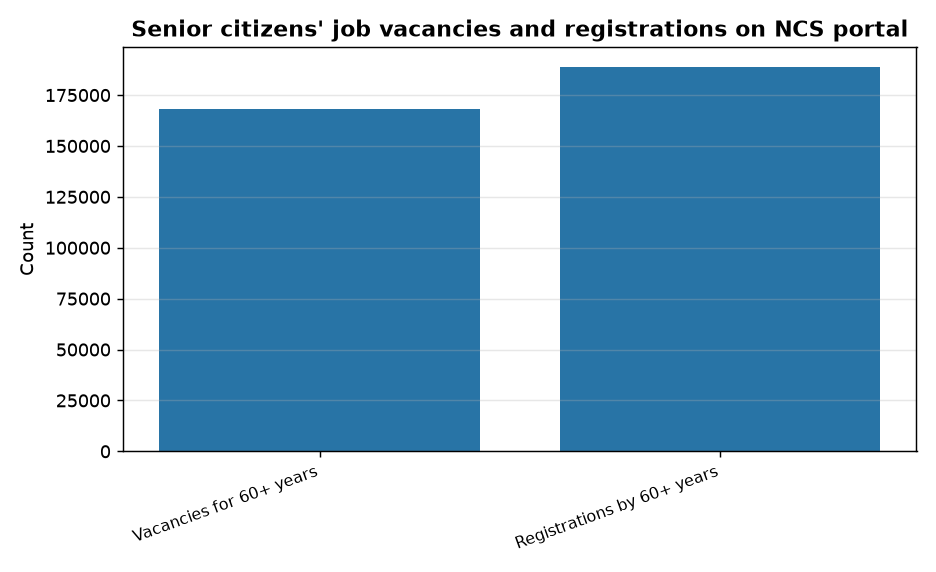
Quick Revision: The NCS portal is a critical digital platform for senior citizens’ re-employment, currently hosting 1.68 lakh vacancies and 1.89 lakh registered senior job seekers, addressing India’s demographic shift towards an ageing population.
Why is this in the news?
The Union Minister for Social Justice and Empowerment, Dr. Virendra Kumar, highlighted in the Rajya Sabha the government’s initiative to promote re-employment opportunities for senior citizens through the National Career Service (NCS) portal. This initiative aligns with the demographic projections from the UNFPA India Ageing Report 2023, which underscores the urgent need for policies to ensure livelihood security for the elderly, particularly in the unorganised sector. The NCS portal currently hosts 1.68 lakh job vacancies suitable for individuals aged 60 and above, with 1.89 lakh registered senior job seekers, reflecting a concerted effort to integrate experienced professionals into the workforce.
Background
- The United Nations Population Fund (UNFPA) India Ageing Report 2023 projects that the population of individuals aged 60 years and above will rise from 10.4% in 2022 to 20.8% by 2050 and further to 36% by 2100, indicating a significant demographic shift towards an ageing society.
- India’s elderly population faces challenges such as limited access to formal employment, lack of skill upgradation opportunities, and inadequate social security measures, particularly in the unorganised sector.
- The government has approved 407 Model Career Centres (MCCs) across states and institutions to facilitate employment fairs, career counselling, and training for both youth and senior citizens.
- The NCS portal has registered over 6.46 crore job seekers and 58.76 lakh employers since its inception, with 1.89 lakh senior citizens among the job seekers and 1.68 lakh vacancies suitable for them currently available.
What is the National Career Service (NCS) Portal and its Role in Senior Citizens’ Employment?
- The NCS portal is a digital platform launched in 2015 to provide a comprehensive employment ecosystem, including job matching, career counselling, and skill development services.
- It operates under the National Employment Service (NES) and is designed to cater to diverse segments of the workforce, including senior citizens, through dedicated initiatives.
- The portal facilitates registration for job seekers, employers, and career counsellors, enabling seamless interaction and employment opportunities.
- For senior citizens, the NCS portal offers tailored services such as re-employment opportunities, skill upgradation programmes, and access to age-appropriate job vacancies across sectors like administration, consultancy, and part-time roles.
- The portal leverages AI-driven tools to match job seekers with suitable vacancies, ensuring efficiency and inclusivity in the employment process.
- Model Career Centres (MCCs) established under the NCS initiative serve as physical hubs for employment fairs, career guidance, and training programmes, extending the portal’s reach to rural and semi-urban areas.
- The NCS portal’s data indicates a growing participation of senior citizens, with 1.89 lakh registered job seekers and 1.68 lakh vacancies, reflecting the platform’s evolving role in addressing demographic challenges.
- The initiative aligns with the concept of ‘Active Ageing,’ which emphasises the inclusion of older adults in economic activities to enhance their social and economic well-being.
Key Features
| Feature | Significance |
|---|---|
| National Career Service (NCS) Portal | A digital platform under the Ministry of Labour & Employment that aggregates job seekers and employers, including senior citizens, to facilitate employment linkages through AI-driven matching and career counselling. |
| Model Career Centres (MCCs) | 407 centres established across states to provide employment fairs, career counselling, and skill training to job seekers, including those above 60 years, ensuring last-mile delivery of employment services. |
| Senior Citizen Re-employment Initiative | A dedicated sub-portal on NCS for individuals aged 60+ to register, access age-appropriate job vacancies, and receive career guidance, addressing structural unemployment in the elderly demographic. |
| UNFPA India Ageing Report 2023 Integration | Policy alignment with demographic projections (60+ population rising to 20.8% by 2050 and 36% by 2100) to design targeted employment policies for the elderly, ensuring income security and social inclusion. |
| AI-Enabled Job Matching | Automated matching of senior citizens’ skills and experience with employer requirements, reducing transaction costs and improving efficiency in re-employment for experienced professionals. |
Why it Matters
Demographic Transition
- India is experiencing a rapid demographic shift with the elderly population (60+) projected to rise from 10.4% in 2022 to 20.8% by 2050 and 36% by 2100, necessitating proactive employment policies to harness their experience.
- This transition requires structural interventions to prevent economic marginalisation of senior citizens, particularly in the unorganised sector where formal employment opportunities are scarce.
Economic Productivity
- Re-employing senior citizens leverages their decades of experience, reducing skill gaps in critical sectors such as education, healthcare, and advisory roles, thereby enhancing overall labour productivity.
- The NCS portal’s 1.68 lakh vacancies for seniors and 1.89 lakh registered elderly job seekers indicate untapped economic potential that can be mobilised to address labour shortages in niche domains.
Social Inclusion & Welfare
- Active ageing policies, such as those promoted by the NCS portal, align with the United Nations Sustainable Development Goal 8 (Decent Work and Economic Growth) and Goal 10 (Reduced Inequalities) by ensuring income security for the elderly.
- Inclusion of senior citizens in the formal workforce mitigates the risk of poverty in old age, reducing dependency on social security schemes and improving intergenerational equity.
Policy Framework & Governance
- The integration of the UNFPA Ageing Report 2023 into policy design reflects a data-driven approach to addressing demographic challenges, ensuring evidence-based interventions rather than ad-hoc measures.
- The establishment of 407 Model Career Centres (MCCs) demonstrates a decentralised governance model, enhancing accessibility of employment services for elderly job seekers in rural and semi-urban areas.
Challenges
1. Skill Mismatch and Age Bias
- Despite experience, senior citizens often face skill obsolescence in rapidly evolving sectors, requiring upskilling and reskilling initiatives to remain employable.
- Employer bias against hiring older workers persists, particularly in sectors prioritising youth and digital literacy, necessitating awareness campaigns and incentives for inclusive hiring.
UPSC Link: GS Paper 1: Indian Society – Ageing Population
2. Accessibility and Digital Divide
- A significant portion of the elderly population, especially in rural areas, lacks digital literacy, limiting their ability to utilise the NCS portal effectively.
- Physical accessibility to Model Career Centres (MCCs) remains a challenge in remote regions, requiring mobile career counselling units and community outreach programmes.
UPSC Link: GS Paper 2: Governance – Digital Divide
3. Formalisation of Employment
- The unorganised sector, where a majority of elderly workers are employed, lacks formal employment contracts, social security, and pension benefits, increasing vulnerability.
- Transitioning elderly workers from informal to formal employment requires policy incentives such as tax benefits for employers and social security coverage.
UPSC Link: GS Paper 3: Indian Economy – Informal Sector
4. Economic Viability of Re-employment
- Wage disparities between senior citizens and younger workers may discourage employers from hiring them, despite their experience, unless incentivised.
- The cost of training and accommodating elderly workers in modern work environments may deter small and medium enterprises (SMEs) from participating.
UPSC Link: GS Paper 3: Indian Economy – Labour Market
5. Policy Coordination and Implementation Gaps
- Fragmentation between central and state-level employment schemes may lead to duplication of efforts or gaps in service delivery for elderly job seekers.
- Monitoring and evaluation mechanisms for re-employment initiatives remain weak, requiring robust data systems to track outcomes and adjust policies dynamically.
UPSC Link: GS Paper 2: Governance – Policy Implementation
Challenges — UPSC Perspective
| Issue | Concern |
|---|---|
| Digital Literacy Deficit | Limited internet access and digital skills among elderly job seekers hinder effective utilisation of the NCS portal. |
| Employer Resistance | Ageism in hiring practices persists, particularly in sectors prioritising youth and digital proficiency. |
| Informal Sector Dominance | Lack of formal employment contracts and social security for elderly workers in unorganised sectors increases economic vulnerability. |
| Skill Obsolescence | Rapid technological advancements render traditional skills of senior citizens obsolete, necessitating continuous upskilling. |
| Geographical Disparities | Uneven distribution of Model Career Centres (MCCs) limits access for elderly job seekers in remote and rural areas. |
| Wage Disparities | Lower wage expectations of elderly workers may not align with employer cost structures, discouraging formal employment. |
Government Initiatives — Must-Memorise for Prelims
- Model Career Centres (MCCs)
- UNFPA India Ageing Report 2023 (as a policy reference)
Way Forward
- Strengthen digital literacy programmes for elderly job seekers through partnerships with NGOs, SHGs, and local governments to enhance NCS portal utilisation.
- Introduce tax incentives and subsidies for employers hiring senior citizens above 60 years, particularly in sectors facing labour shortages.
- Expand the network of Model Career Centres (MCCs) to underserved regions, including rural and tribal areas, with mobile career counselling units.
- Develop sector-specific upskilling programmes for elderly workers, focusing on digital literacy, soft skills, and emerging industries such as healthcare and IT-enabled services.
- Enhance monitoring and evaluation of re-employment initiatives through real-time data analytics on the NCS portal to identify gaps and measure outcomes.
- Launch awareness campaigns to combat ageism in hiring practices, targeting both employers and job seekers, in collaboration with industry associations.
- Integrate social security benefits with re-employment schemes to ensure income security for elderly workers transitioning to formal employment.
- Establish a national helpline and grievance redressal mechanism for elderly job seekers to address issues related to job matching and employer-employee disputes.
UPSC Value Addition
Keywords for Mains Answer-Writing
National Career Service (NCS) portal · Senior Citizens Employment · Active Ageing Policy · Demographic Dividend · Skilled Workforce · Model Career Centres (MCC) · UNFPA India Ageing Report 2023 · Inclusive Economic Growth · Employment Generation · Labour Force Participation · Re-employment Initiatives · Demographic Transition
Constitutional & Policy Linkages
- Directive Principles of State Policy (Article 38, 39, 41) – Ensuring livelihood security and public assistance in cases of unemployment.
Concept Flow
Demographic ageing (60+ population rising to 36% by 2100) → Increased economic dependency risk → Policy response: NCS portal and MCCs for senior re-employment → Structural unemployment in elderly demographic → Skill obsolescence and age bias → Need for upskilling and inclusive hiring practices → Formalisation of elderly workforce → Income security and social inclusion → Alignment with SDGs 8 and 10 → Digital divide among elderly → Limited access to NCS portal → Requires digital literacy and mobile career counselling units → Employer reluctance to hire seniors → Wage disparities and productivity concerns → Incentives and policy interventions needed → Policy fragmentation → Gaps in service delivery → Need for robust monitoring and inter-state coordination → Successful re-employment → Enhanced labour productivity and economic growth → Contribution to India’s demographic dividend
Prelims Practice Questions
Q1. Consider the following statements regarding the National Career Service (NCS) portal: 1. It is an initiative under the Ministry of Labour and Employment. 2. The NCS portal provides career counselling and training for job seekers. 3. The portal has registered over 58 lakh employers since its inception. Which of the statements given above is/are correct?
- 1 and 2 only
- 2 and 3 only
- 1 and 3 only
- 1, 2 and 3
Answer: 2 and 3 only — Statement 1 is incorrect as the NCS portal is managed by the Ministry of Labour and Employment, not the Ministry of Social Justice and Empowerment. Statements 2 and 3 are correct as the portal offers career counselling, training, and has registered over 58 lakh employers.
Q2. Which of the following reports highlights the demographic transition in India, particularly the ageing population?
- World Population Prospects 2022
- UNFPA India Ageing Report 2023
- Global Ageing Report 2021
- Census of India 2021
Answer: UNFPA India Ageing Report 2023 — The UNFPA India Ageing Report 2023 specifically addresses the demographic transition in India, including the ageing population trends and associated socio-economic implications.
Q3. The National Career Service (NCS) portal aims to achieve which of the following objectives? 1. To provide a platform for job seekers and employers. 2. To promote active ageing and re-employment for senior citizens. 3. To facilitate skill development for the youth. Select the correct answer using the code below:
- 1 only
- 1 and 2 only
- 2 and 3 only
- 1, 2 and 3
Answer: 1, 2 and 3 — The NCS portal aims to provide a platform for job seekers and employers (1), promote active ageing and re-employment for senior citizens (2), and facilitate skill development for the youth (3). All three objectives are correct.
Mains Practice Question
✍ Examine the significance of the National Career Service (NCS) portal in addressing the challenges posed by India’s demographic transition, particularly the ageing population. How can the NCS portal contribute to inclusive economic growth and employment generation? (250 words)
Approach: Begin by outlining the demographic transition in India, highlighting the projected increase in the elderly population by 2050 and 2100. Discuss the challenges posed by an ageing population, such as labour force participation and economic dependency. Explain the role of the NCS portal in promoting active ageing and re-employment for senior citizens, including its features like career counselling, training, and job matching. Highlight how the portal bridges the gap between employers and job seekers, thereby contributing to inclusive economic growth and employment generation. Conclude by emphasizing the need for such initiatives to harness the demographic dividend and ensure sustainable development.
Source: PIB (Press Information Bureau)
Generated by AanyaAi for educational purpose.

- केरल लोक सेवा आयोग ने उच्च न्यायालय में दायर किया मामला, सदस्यों के खिलाफ मामला रद्द करने की मांग - September 23, 2026
- KPSC Challenges Prosecution Sanction in Kerala High Court: Key UPSC Polity Insight - September 23, 2026
- केरल में एंटीमाइक्रोबियल रेजिस्टेंस: सरकारी रिपोर्ट में चौंकाने वाले आँकड़े सामने - September 23, 2026

No Comments