


11 Aug UPSC Alert: Govt Initiatives for Menstrual Health & Hygiene in India
✎ The Menstrual Hygiene Scheme (MHS) under the National Health Mission (NHM) is a centrally sponsored initiative that promotes menstrual health and hygiene among adolescent girls through awareness generation, provision of…
Subject Relevance — Where This Topic Fits
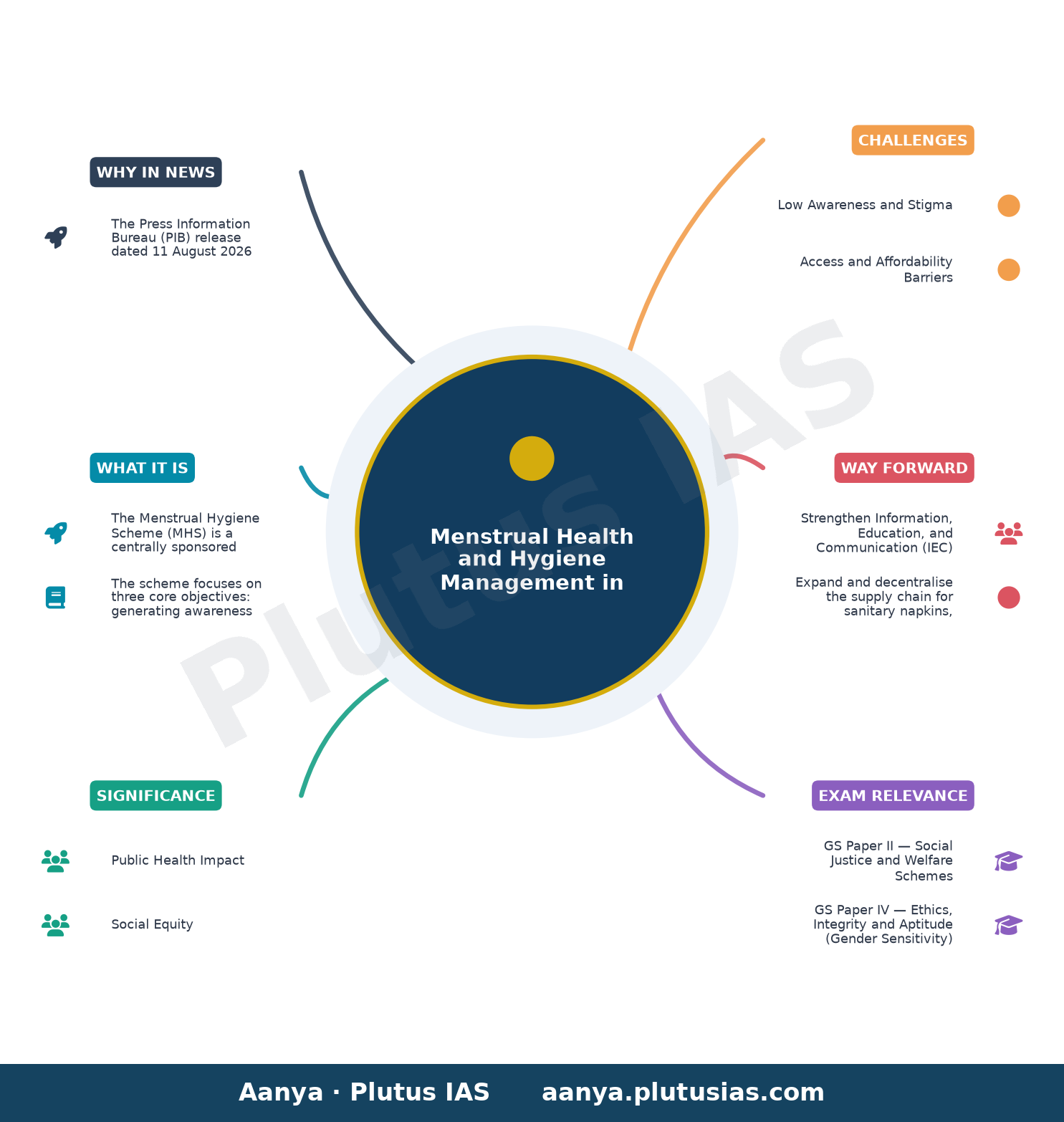
- GS Paper II — Social Justice and Welfare Schemes | GS Paper IV — Ethics, Integrity and Aptitude (Gender Sensitivity)
- Prelims: Menstrual Hygiene Scheme (MHS), National Health Mission (NHM), Rashtriya Kishor Swasthya Karyakram (RKSK), Swachh Bharat Mission (SBM), Sustainable Development Goal (SDG) 3.7, Sustainable Development Goal (SDG) 5.6
- Essay: Gender equality as a catalyst for public health transformation, Intersection of health, education and gender justice in policy implementation
Quick Revision: The Menstrual Hygiene Scheme (MHS) under the National Health Mission (NHM) is a centrally sponsored initiative that promotes menstrual health and hygiene among adolescent girls through awareness generation, provision of affordable sanitary napkins and safe disposal mechanisms, monitored via a multi-tiered governance framework.
Why is this in the news?
The Press Information Bureau (PIB) release dated 11 August 2026 highlights the institutional and programme-based initiatives undertaken by the Ministry of Health and Family Welfare to promote menstrual health and hygiene (MHM) among adolescent girls through the Menstrual Hygiene Scheme (MHS) under the National Health Mission (NHM). This initiative underscores the government’s commitment to addressing menstrual health as a critical public health and gender equity concern within India’s health governance framework.
Background
- Menstrual health and hygiene is recognised as a key determinant of adolescent girls’ physical, mental and social well-being, with implications for school attendance, dignity and gender equality.
- Monitoring of MHM interventions is conducted through a multi-tiered system involving state-level reviews, National Programme Coordination Committee (NPCC) meetings and annual Common Review Missions (CRM).
- The scheme aligns with India’s commitments under the Sustainable Development Goals (SDGs), particularly SDG 3.7 (universal access to sexual and reproductive health services) and SDG 5.6 (universal access to sexual and reproductive health and rights).
What is the Menstrual Hygiene Scheme (MHS)?
- The Menstrual Hygiene Scheme (MHS) is a centrally sponsored scheme implemented under the National Health Mission (NHM) to promote menstrual health and hygiene among adolescent girls in India.
- The scheme focuses on three core objectives: generating awareness about menstrual health, ensuring the availability of quality and affordable sanitary napkins, and promoting safe and environmentally sustainable disposal practices.
- Under the MHS, state governments and Union Territories submit proposals as part of their Annual Programme Implementation Plans (PIPs) to receive financial assistance for state-specific menstrual hygiene initiatives.
- The scheme leverages multiple delivery platforms, including health facilities, community forums, frontline health workers (ASHAs), digital dissemination tools and adolescent-focused platforms to conduct Information, Education and Communication (IEC) activities.
- MHS integrates counselling services to educate adolescent girls on safe menstrual practices, hygiene management and the importance of breaking menstrual taboos.
- The scheme promotes the use of eco-friendly menstrual hygiene products and supports the establishment of mechanisms for safe disposal.
- Monitoring and evaluation are conducted through a robust multi-tiered framework, including state-level reviews, NPCC meetings and annual Common Review Missions (CRM) to assess progress against approved targets.
Key Features
| Feature | Significance |
|---|---|
| National Health Mission (NHM) support to States/UTs | Provides financial and technical assistance for menstrual hygiene schemes under Annual Programme Implementation Plans (APIPs), ensuring state-level ownership and implementation. |
| Menstrual Hygiene Scheme (MHS) | Focuses on awareness generation, ensuring access to affordable and quality sanitary napkins, safe disposal mechanisms, and counselling on safe menstrual practices for adolescent girls. |
| Multi-tiered monitoring framework under NHM | Includes reviews of state-wise progress against approved targets during National Programme Coordination Committee (NPCC) meetings, ensuring accountability and course correction. |
| Annual Common Review Mission (CRM) | Conducts independent ground-level assessments of programme implementation, health system strengthening, and progress on key indicators, enhancing transparency. |
| Inter-ministerial coordination for school policies | Ensures coordinated action by relevant ministries and departments to promote access to safe, effective, and affordable menstrual hygiene measures in schools. |
Why it Matters
Public Health Impact
- Reduces reproductive tract infections (RTIs) and other health complications linked to poor menstrual hygiene practices among adolescent girls.
- Promotes gender-inclusive health policies by addressing a critical yet often overlooked aspect of adolescent health.
- Enhances school attendance and retention rates among adolescent girls by ensuring access to safe menstrual hygiene management (MHM) facilities.
Social Equity
- Bridges the urban-rural and socio-economic divide by ensuring affordable and quality sanitary products reach marginalised communities.
- Supports the empowerment of adolescent girls through education and awareness, fostering long-term socio-economic benefits.
Governance and Policy Coordination
- Demonstrates a model of multi-level governance involving central ministries, state governments, and local stakeholders for targeted health interventions.
- Highlights the role of monitoring frameworks (e.g., NPCC, CRM) in ensuring programme effectiveness and accountability.
Sustainability and Environmental Considerations
- Encourages the adoption of eco-friendly menstrual hygiene products and safe disposal mechanisms, aligning with broader environmental sustainability goals.
Challenges
1. Low Awareness and Stigma
- Persistent cultural taboos and lack of awareness about menstrual hygiene among adolescents, parents, and communities hinder effective implementation.
- Limited reach of Information, Education, and Communication (IEC) activities in remote and tribal areas.
UPSC Link: GS Paper 2, Governance
2. Access and Affordability Barriers
- Inadequate distribution networks for sanitary napkins in rural and underserved areas, leading to supply chain bottlenecks.
- Financial constraints faced by low-income households in purchasing menstrual hygiene products.
UPSC Link: GS Paper 2, Welfare Schemes
3. Infrastructure Gaps in Schools
- Insufficient WASH (Water, Sanitation, and Hygiene) facilities in schools, particularly in government-run institutions, affecting adolescent girls’ participation.
- Lack of separate and functional toilets for girls in many schools.
UPSC Link: GS Paper 2, Social Justice
4. Monitoring and Evaluation Challenges
- Inconsistent data collection and reporting mechanisms across states, complicating the assessment of programme outcomes.
- Limited capacity of local health systems to conduct real-time monitoring and feedback loops.
UPSC Link: GS Paper 2, Governance
5. Inter-Ministerial Coordination Gaps
- Fragmented implementation across ministries (e.g., Health, Women and Child Development, Education) due to overlapping mandates and lack of unified guidelines.
- Delays in policy formulation and implementation at the state level.
UPSC Link: GS Paper 2, Governance
Challenges — UPSC Perspective
| Issue | Concern |
|---|---|
| Cultural taboos and stigma | Hinder open discussions on menstrual hygiene, reducing effectiveness of awareness campaigns. |
| Supply chain inefficiencies | Lead to stockouts of sanitary napkins in rural areas, disrupting access. |
| Inadequate school infrastructure | Prevents safe and dignified menstrual hygiene management for adolescent girls. |
| Limited inter-ministerial synergy | Results in duplication of efforts or gaps in programme coverage. |
| Data gaps in monitoring | Obscure the true impact of schemes, complicating evidence-based policymaking. |
Government Initiatives — Must-Memorise for Prelims
- National Health Mission (NHM) – Menstrual Hygiene Component
Way Forward
- Strengthen Information, Education, and Communication (IEC) campaigns to address cultural taboos and stigma through community engagement and digital platforms.
- Expand and decentralise the supply chain for sanitary napkins, leveraging local self-help groups (SHGs) and ASHA workers for last-mile delivery.
- Mandate and enforce WASH infrastructure standards in all schools, including separate toilets for girls, with periodic audits by state education departments.
- Enhance inter-ministerial coordination by establishing a unified national framework for menstrual hygiene management (MHM) with clear roles for Health, Education, and Women and Child Development ministries.
- Improve data systems by integrating menstrual hygiene indicators into national health surveys (e.g., NFHS) and state-level health management information systems (HMIS).
- Promote the use of eco-friendly menstrual products through subsidies and awareness campaigns, aligning with the Swachh Bharat Mission’s sustainability goals.
- Conduct periodic reviews of state-level programmes under the NHM umbrella, with a focus on equity and inclusion for marginalised groups.
UPSC Value Addition
Keywords for Mains Answer-Writing
Menstrual Health and Hygiene Management (MHM) · National Health Mission (NHM) · Menstrual Hygiene Scheme (MHS) · Adolescent Health Programme · Information, Education and Communication (IEC) activities · Sustainable Development Goals (SDG) 3 and 5 · Multi-tier monitoring framework under NHM · School-based menstrual hygiene policies · Socio-cultural barriers to menstrual health · Public health governance and inter-ministerial coordination
Concept Flow
Cultural taboos and lack of awareness → Poor menstrual hygiene practices → Increased risk of infections and absenteeism → Targeted health interventions (e.g., MHS) → Awareness campaigns and IEC activities → Improved knowledge and behaviour change. → Limited access to affordable sanitary products → Supply chain inefficiencies → Programme implementation under NHM → Financial and technical support to states → Distribution networks and subsidies → Enhanced accessibility. → Inadequate school infrastructure → WASH gaps → National policies (e.g., SBM) → Mandate for separate toilets and hygiene facilities → School-level audits and upgrades → Improved school retention for girls. → Fragmented governance → Overlapping mandates → Inter-ministerial coordination → Unified national framework → Clear roles and responsibilities → Efficient programme delivery. → Poor monitoring and data gaps → Inconsistent reporting → Multi-tiered review mechanisms (NPCC, CRM) → State-wise progress tracking → Evidence-based policymaking. → Environmental concerns → Eco-friendly products → Subsidies and awareness → Sustainable menstrual hygiene management → Alignment with Swachh Bharat Mission goals.
Prelims Practice Questions
Q1. Consider the following statements regarding the Menstrual Hygiene Scheme (MHS) in India:
1. The MHS is implemented under the National Health Mission (NHM) to promote menstrual health and hygiene among adolescent girls.
2. The scheme ensures the availability of quality and affordable sanitary napkins through health facilities and frontline workers.
3. The scheme mandates the inclusion of menstrual hygiene education in school curricula across all states.
4. The monitoring of the scheme is conducted through a multi-tier framework involving the National Health Council (NHC).
How many of the above statements are correct?
- Only one
- Only two
- Only three
- All four
Answer: All four — Statements 1, 2, and 4 are correct as per the NHM framework and the Menstrual Hygiene Scheme. Statement 3 is incorrect because the scheme promotes menstrual hygiene awareness but does not mandate curriculum inclusion across all states.
Q2. Assertion (A): The National Health Mission (NHM) employs a multi-tier monitoring framework to assess the implementation of the Menstrual Hygiene Scheme (MHS).
Reason (R): The framework includes reviews during meetings of the National Health Council (NHC) to evaluate state-wise progress against approved targets.
Options:
A. Both A and R are true, and R is the correct explanation of A.
B. Both A and R are true, but R is not the correct explanation of A.
C. A is true, but R is false.
D. A is false, but R is true.
- A
- B
- C
- D
Answer: B — Both the assertion and reason are true, and the reason correctly explains the assertion. The NHM uses a multi-tier monitoring framework, including NHC meetings, to review state-wise progress under the MHS.
Mains Practice Question
✍ The promotion of menstrual health and hygiene among adolescent girls requires a multi-dimensional approach involving health systems, educational institutions, and community engagement. Critically examine the role of the National Health Mission (NHM) in addressing menstrual health and hygiene in India, with reference to the Menstrual Hygiene Scheme (MHS) and its monitoring mechanisms. (15 Marks)
Approach: MODEL-ANSWER SKELETON:
1. **Introduction (2 Marks)**: Define Menstrual Health and Hygiene Management (MHM) and its significance in achieving SDG 3 (Good Health and Well-being) and SDG 5 (Gender Equality). Highlight the socio-cultural and economic barriers to menstrual health in India.
2. **Role of NHM and MHS (5 Marks)**:
– Explain the NHM as a flagship health programme under the Ministry of Health and Family Welfare.
– Detail the objectives of the Menstrual Hygiene Scheme (MHS): awareness creation, provision of quality and affordable sanitary napkins, safe disposal, and counseling on safe menstrual practices.
– Discuss the implementation strategy: health facilities, frontline workers (ASHAs), community platforms, and digital dissemination.
3. **Monitoring Mechanisms (4 Marks)**:
– Describe the multi-tier monitoring framework under NHM: reviews during National Health Council (NHC) meetings, state-wise progress assessment against approved targets.
– Explain the role of Annual Common Review Missions (CRM) in providing independent ground assessments of implementation, health system strengthening, and progress on key indicators.
4. **Challenges and Gaps (3 Marks)**:
– Highlight challenges: socio-cultural taboos, lack of awareness, affordability, and access to sanitary products in rural and marginalized communities.
– Discuss gaps in inter-ministerial coordination and the need for sustained IEC activities.
5. **Conclusion (1 Mark)**: Summarize the importance of a holistic approach involving health systems, education, and community engagement to address menstrual health holistically.
Source: PIB (Press Information Bureau)
Generated by AanyaAi for educational purpose.

- पेंशन भुगतान में विभाजन से बुजुर्गों को मुश्किल, अधिकार समूहों की चिंता - September 26, 2026
- UPSC Alert: Pension Split Policy Raises Hardship Concerns for Elderly in AP - September 26, 2026
- पीएम स्मृति चिह्न ई-नीलामी 2026: ओडिशा की सांस्कृतिक विरासत का अनूठा प्रदर्शन - September 26, 2026

No Comments