


27 Jul UPSC Alert: Govt Launches 3-Month Drive to Clear Pending Labour Cases
Subject Relevance — Where This Topic Fits
- GS Paper II — Governance, Constitution and Polity (Labour Administration and Industrial Relations) | GS Paper III — Economy (Labour Reforms, Industrial Disputes and Social Security)
- Prelims: Industrial Disputes Act, 1947, Minimum Wages Act, 1948, Payment of Gratuity Act, 1972, Maternity Benefit Act, 1961, Chief Labour Commissioner (Central), Labour Courts, Conciliation Officers, Industrial Tribunals
- Essay: The Role of State in Ensuring Labour Justice: Balancing Efficiency and Equity, Judicial Delay and Administrative Reforms: A Case Study of Labour Dispute Resolution
Quick Revision: The Special Campaign for Expeditious Disposal of Pending Labour Cases (1 June 2026–31 August 2026) is a time-bound initiative by the Chief Labour Commissioner (Central) to resolve 16,033 pending labour disputes, including industrial disputes and statutory claims, through enhanced conciliation, digital monitoring, and prioritised adjudication.
Why is this in the news?
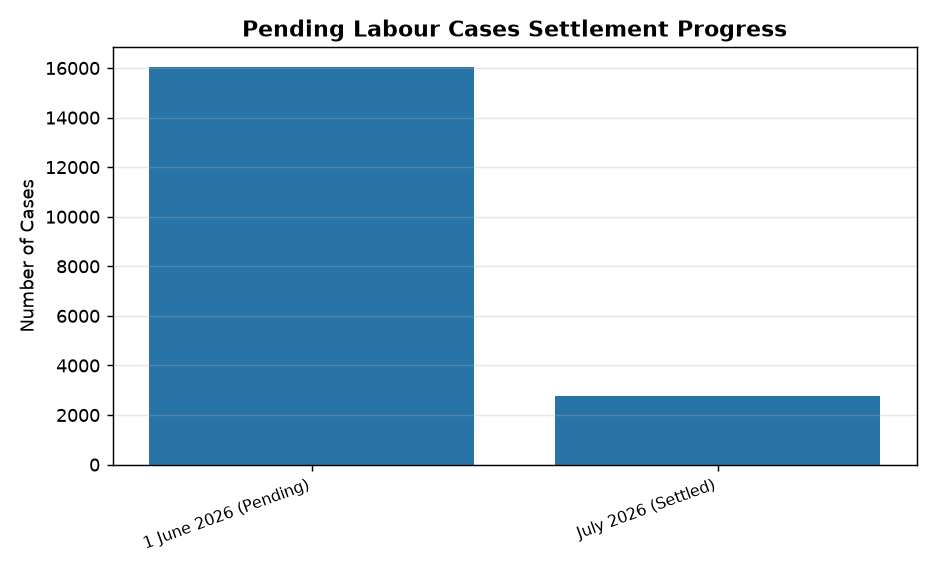
The Ministry of Labour and Employment has launched a three-month special campaign from 1 June 2026 to 31 August 2026 to expedite the disposal of 16,033 pending labour cases across regional offices, including disputes related to wages, gratuity, maternity benefits, and other statutory claims.
Background
- The Industrial Disputes Act, 1947, mandates mechanisms for resolution of labour disputes through conciliation, Labour Courts, and Industrial Tribunals to ensure timely justice.
- The Payment of Gratuity Act, 1972, and the Maternity Benefit Act, 1961, are critical labour legislations ensuring statutory entitlements to workers, often subject to disputes over non-payment or delayed disbursement.
- The Chief Labour Commissioner (Central) oversees the enforcement of labour laws and adjudication of disputes through regional offices, acting as a quasi-judicial authority.
- Pendency in labour adjudication has historically been attributed to procedural delays, lack of dedicated benches, and multiplicity of forums, exacerbating worker grievances.
- The COVID-19 pandemic and subsequent economic disruptions further exacerbated labour disputes, particularly in sectors like manufacturing, construction, and services.
- The Government of India has periodically introduced special drives, such as the ‘Special Campaign for Redressal of Pending Cases’, to address judicial and administrative backlogs.
What is the Special Campaign for Expeditious Disposal of Pending Labour Cases?
- The campaign is a time-bound initiative launched by the Chief Labour Commissioner (Central) to resolve pending labour disputes within three months (1 June 2026 to 31 August 2026), focusing on industrial disputes and statutory claims like wages, gratuity, and maternity benefits.
- The campaign targets 16,033 pending cases as of 1 June 2026, with a goal to significantly reduce pendency through dedicated benches, digital monitoring, and streamlined processes.
- Key mechanisms employed include enhanced conciliation efforts, prioritisation of cases based on urgency, and utilisation of Labour Courts and Industrial Tribunals for expeditious adjudication.
- The campaign aligns with the broader objective of the Ministry of Labour and Employment to strengthen labour administration and ensure timely justice for workers, particularly in the informal and unorganised sectors.
- Digital tools, such as e-filing and virtual hearings, are being leveraged to expedite proceedings and reduce physical delays in case disposal.
- The initiative is part of a larger framework of labour reforms aimed at improving ease of doing business while safeguarding workers’ rights and entitlements.
- The campaign also seeks to address systemic issues such as lack of dedicated judicial manpower, procedural bottlenecks, and inadequate infrastructure in labour adjudication bodies.
Key Features
| Feature | Significance |
|---|---|
| Three-month Special Campaign | Accelerates resolution of long-pending labour disputes and statutory claims, reducing pendency in regional offices. |
| Coverage of Disputes | Includes industrial disputes, wage claims, gratuity, maternity benefits, and other statutory dues under the purview of the Chief Labour Commissioner. |
| Quantitative Targeting | Aims to resolve 16,033 pending cases as of 1 June 2026, with 2,769 cases resolved in the first month. |
| Temporal Focus | Conducted from 1 June 2026 to 31 August 2026, ensuring concentrated administrative effort during the period. |
| Administrative Mechanism | Operates through regional offices of the Chief Labour Commissioner, leveraging existing institutional infrastructure. |
Why it Matters
Economic
- Enhances ease of doing business by reducing legal uncertainty for employers and employees.
- Promotes timely wage disbursement and statutory benefits, improving labour market efficiency.
- Reduces financial strain on workers awaiting pending dues, thereby supporting household consumption.
Legal-Administrative
- Strengthens enforcement of labour laws by expediting dispute resolution.
- Demonstrates administrative commitment to judicial and quasi-judicial processes under labour statutes.
- Sets a precedent for periodic review and clearance of backlog in labour adjudication.
Social
- Supports vulnerable workers, including women seeking maternity benefits, by ensuring timely redressal.
- Reduces exploitation risks in cases of unpaid wages or gratuity, fostering trust in labour relations.
- Aligns with constitutional directive principles of state policy under Articles 38 and 41.
Challenges
1. Institutional Capacity Constraints
- Limited manpower and infrastructure in regional labour offices may hinder effective implementation.
- Dependence on manual processes and paper-based records can slow down dispute resolution.
UPSC Link: Labour Administration and Inspection
2. Complexity of Labour Disputes
- Multiplicity of labour laws and overlapping jurisdictions complicate dispute adjudication.
- Interpretational ambiguities in statutes like the Industrial Disputes Act, 1947, and Payment of Gratuity Act, 1972.
UPSC Link: Industrial Relations
3. Data and Digital Divide
- Inconsistent digitalisation of labour records across states impedes tracking and resolution.
- Lack of unified case management systems hampers real-time monitoring of pending cases.
UPSC Link: E-Governance in Labour Administration
4. Stakeholder Coordination Gaps
- Poor coordination between labour departments, courts, and employers delays dispute settlement.
- Absence of standardised protocols for mediation and conciliation.
UPSC Link: Labour Welfare Schemes
5. Resource Mobilisation
- Insufficient budgetary allocation for special campaigns, including training and infrastructure upgrades.
- Dependence on ad-hoc funding mechanisms rather than structured financial planning.
UPSC Link: Public Expenditure Management
Challenges — UPSC Perspective
| Issue | Concern |
|---|---|
| Pending Cases Backlog | 16,033 cases as of 1 June 2026 indicate systemic delays in labour dispute resolution. |
| Regional Disparities | Uneven distribution of pending cases across states may reflect administrative inefficiencies. |
| Legal Ambiguities | Overlapping provisions in labour laws create interpretational challenges for adjudicating authorities. |
| Digitalisation Lag | Incomplete transition to e-governance in labour departments slows case processing. |
| Stakeholder Engagement | Low participation of employers and workers in conciliation proceedings reduces resolution rates. |
| Monitoring and Evaluation | Lack of robust MIS tools to track progress and outcomes of special campaigns. |
Way Forward
- Constitute dedicated task forces in each regional labour office to monitor case progress and resolve bottlenecks.
- Accelerate digitalisation of labour records through the e-Shram portal and case management systems.
- Conduct training programmes for labour officers on conciliation, mediation, and legal provisions to enhance efficiency.
- Strengthen coordination between labour departments, courts, and tripartite bodies for seamless dispute resolution.
- Introduce time-bound targets for case disposal with periodic reviews at the state and national levels.
- Ensure adequate budgetary allocation for special campaigns, including technology upgrades and human resource augmentation.
- Promote awareness campaigns among workers and employers about statutory rights and dispute resolution mechanisms.
- Establish a grievance redressal mechanism for real-time tracking of pending cases and stakeholder feedback.
UPSC Value Addition
Keywords for Mains Answer-Writing
Industrial Disputes Act, 1947 · Labour law reforms · Pending labour cases · Wage and Gratuity claims · Maternity Benefit Act, 1961 · Central Industrial Relations Machinery · Labour adjudication process · Ease of Doing Business · Statutory dues of workers · Labour welfare administration
Constitutional & Policy Linkages
- {‘Article 38(2):’: ‘Minimising inequalities in income and opportunities through timely labour justice.’}
- {‘Article 41:’: ‘Right to work and public assistance in cases of unemployment.’}
- {‘Article 42:’: ‘Provision for just and humane conditions of work and maternity relief.’}
- {‘Article 43:’: ‘Living wage and decent standard of life for workers.’}
Concept Flow
Pendency of labour disputes → Economic inefficiency and social distress → Launch of Special Campaign → Institutional review and capacity building → Digitalisation and process streamlining → Enhanced dispute resolution → Timely disbursement of wages and benefits → Improved labour market efficiency and worker welfare.
Prelims Practice Questions
Q1. Which of the following is NOT a statutory benefit covered under the special campaign launched by the Labour Ministry in June 2026?
- A. Gratuity
- B. Maternity Benefit
- C. Provident Fund Contributions
- D. Wage Arrears
Answer: C. Provident Fund Contributions — The special campaign targets settlement of wage arrears, gratuity, maternity benefits, and other statutory dues. Provident Fund contributions are administered separately under the Employees’ Provident Funds and Miscellaneous Provisions Act, 1952, and are not part of this initiative.
Q2. The special campaign for disposal of pending labour cases is being conducted by which of the following authorities?
- A. Employees’ Provident Fund Organisation (EPFO)
- B. Chief Labour Commissioner (Central)
- C. Ministry of Corporate Affairs
- D. State Labour Departments
Answer: B. Chief Labour Commissioner (Central) — The campaign is spearheaded by the Central Office of the Chief Labour Commissioner under the Ministry of Labour and Employment to expedite the disposal of pending labour cases across regional offices.
Mains Practice Question
✍ Examine the significance of the Labour Ministry’s three-month special campaign (June–August 2026) for the disposal of pending labour cases. How does this initiative align with the objectives of the Industrial Disputes Act, 1947, and what challenges may impede its effective implementation?
Approach: Begin by outlining the objectives of the special campaign, including its focus on wage arrears, gratuity, maternity benefits, and industrial disputes. Discuss the relevance of these objectives to the Industrial Disputes Act, 1947, which aims to promote industrial peace and adjudicate disputes. Highlight the campaign’s role in reducing pendency and ensuring timely justice for workers. Address potential challenges such as inadequate infrastructure, limited judicial capacity, and coordination issues between central and state authorities. Conclude by emphasizing the need for sustained reforms in labour adjudication mechanisms to ensure long-term efficacy.
Source: PIB (Press Information Bureau)
Generated by AanyaAi for educational purpose.

- महिला किसानों के एफपीओ ने खेत में बनाया 1 मेगावाट का सौर ऊर्जा संयंत्र - September 18, 2026
- Odisha Women’s FPO Launches Dual-Use Solar Farm on 13 Acres - September 18, 2026
- AI हथियारीकरण का खतरा: क्या सचमुच डराने-धमकाने की रणनीति? - September 18, 2026

No Comments