


08 Aug UPSC Alert: Govt Merges Ambedkar Schemes for SC/ST Relief & Inter-Caste Marriages
✎ The merger of Dr. Ambedkar Foundation’s inter-caste marriage and atrocity-victim relief schemes into a Centrally Sponsored Scheme from 31 March 2023 eliminates duplication and enhances administrative efficiency in welfare…
Subject Relevance — Where This Topic Fits
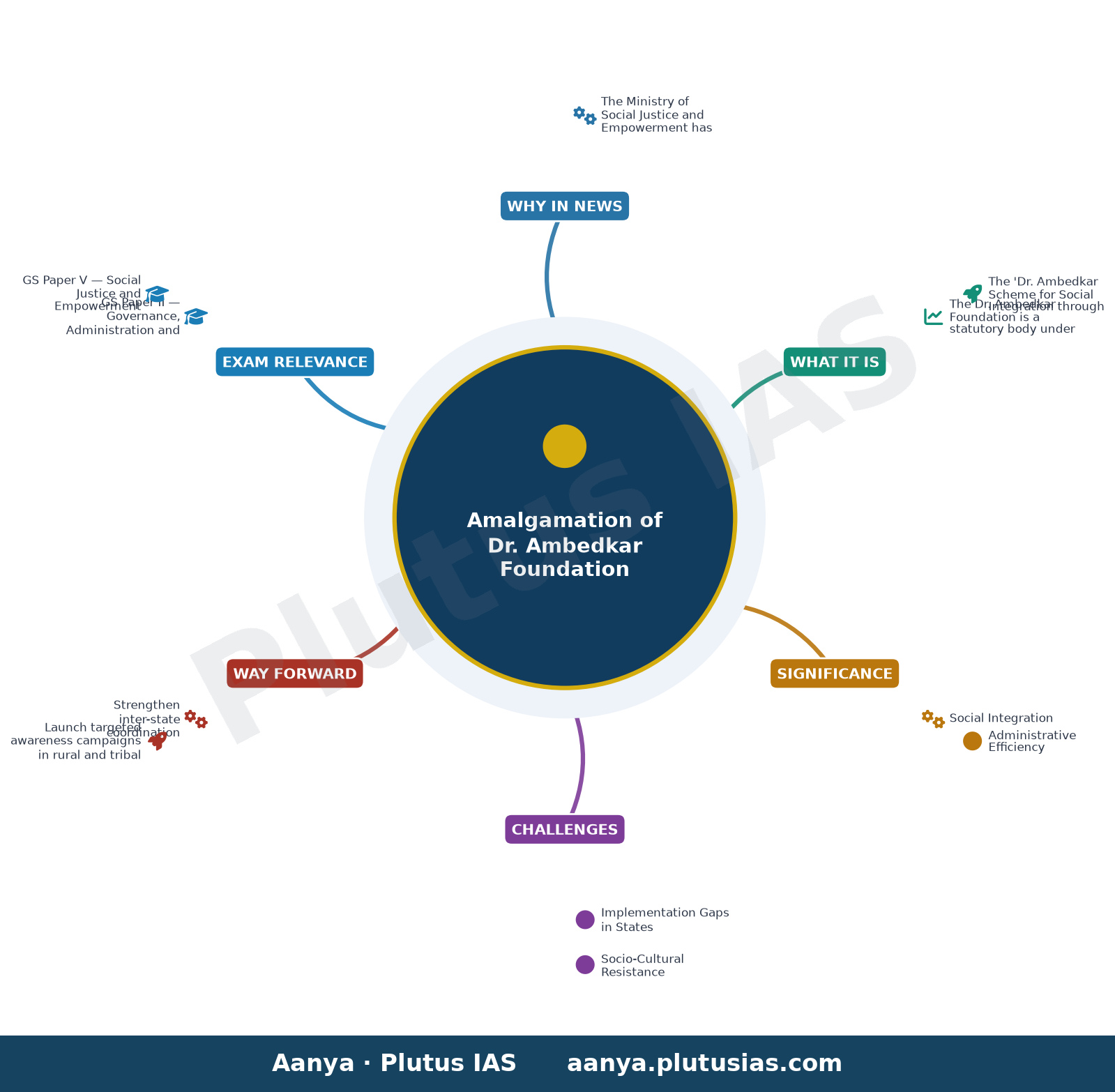
- GS Paper II — Governance, Administration and Policies | GS Paper V — Social Justice and Empowerment
- Prelims: Dr. Ambedkar Foundation, Centrally Sponsored Scheme, Protection of Civil Rights Act, 1955, Scheduled Castes and Scheduled Tribes (Prevention of Atrocities) Act, 1989, Inter-caste marriage incentive schemes, Social integration, Central Sector vs Centrally Sponsored Schemes
- Essay: Social justice and inclusive governance: The role of targeted welfare interventions, Efficiency in public policy: Rationalisation of overlapping schemes
Quick Revision: The merger of Dr. Ambedkar Foundation’s inter-caste marriage and atrocity-victim relief schemes into a Centrally Sponsored Scheme from 31 March 2023 eliminates duplication and enhances administrative efficiency in welfare delivery for marginalised communities.
Why is this in the news?
The Ministry of Social Justice and Empowerment has informed the Rajya Sabha that two flagship schemes under the Dr. Ambedkar Foundation—namely, the ‘Dr. Ambedkar Scheme for Social Integration through Inter-caste Marriages’ and the ‘Dr. Ambedkar National Relief to the Scheduled Castes/Scheduled Tribes Victims of Atrocities Scheme’—have been merged into a single Centrally Sponsored Scheme with effect from 31 March 2023. This merger aims to eliminate duplication in implementation and streamline welfare delivery for marginalised sections, particularly beneficiaries of inter-caste marriages and victims of caste-based atrocities.
Background
- The Dr. Ambedkar Foundation was established in 1992 under the Ministry of Social Justice and Empowerment to promote the welfare of Scheduled Castes (SCs), Scheduled Tribes (STs), and other marginalised communities through educational, economic, and social empowerment initiatives.
- Two key schemes under the Foundation—one incentivising inter-caste marriages to promote social integration and another providing relief to victims of atrocities—were historically administered separately, leading to administrative overlaps and potential inefficiencies in fund utilisation.
- The Protection of Civil Rights Act, 1955, and the Scheduled Castes and Scheduled Tribes (Prevention of Atrocities) Act, 1989, are central legislative instruments aimed at eliminating caste-based discrimination and preventing atrocities against SCs and STs.
- The merger aligns with the broader policy objective of ‘Mission Karmayogi’ and ‘Minimum Government, Maximum Governance’ to enhance administrative efficiency and reduce redundancy in welfare delivery mechanisms.
- The move also addresses long-standing concerns regarding delayed disbursement of incentives, as evidenced by the release of ₹9 crore to 385 inter-caste marriage cases under the special initiative post-merger.
What is the Dr. Ambedkar Foundation and its Schemes?
- The Dr. Ambedkar Foundation is a statutory body under the Ministry of Social Justice and Empowerment, established to commemorate the contributions of Dr. B.R. Ambedkar and implement welfare programmes for marginalised communities.
- The ‘Dr. Ambedkar Scheme for Social Integration through Inter-caste Marriages’ was launched to incentivise inter-caste marriages, thereby promoting social harmony and reducing caste-based segregation in society.
- The ‘Dr. Ambedkar National Relief to the Scheduled Castes/Scheduled Tribes Victims of Atrocities Scheme’ provided financial relief and rehabilitation support to victims of caste-based violence and atrocities, as defined under the SC/ST (Prevention of Atrocities) Act, 1989.
- Both schemes operated under the aegis of the Foundation but were merged into a single Centrally Sponsored Scheme to eliminate duplication, ensure uniform implementation, and improve accountability in fund utilisation.
- The merger does not alter the quantum of benefits but ensures that disbursement is streamlined, with state governments and Union Territory administrations acting as implementing agencies under the oversight of the Ministry.
- The special initiative post-merger has expedited the settlement of pending cases, including the disbursement of ₹9 crore to 385 inter-caste marriage cases, reflecting improved administrative efficiency.
- The rationalisation aligns with constitutional objectives enshrined in Articles 15, 16, 17, and 46 of the Indian Constitution, which mandate the state to promote social justice and protect marginalised groups.
Key Features
| Feature | Significance |
|---|---|
| Merger of Schemes | Eliminates duplication in implementation, streamlines welfare delivery, and enhances administrative efficiency under the centrally sponsored scheme of the Department of Social Justice and Empowerment. |
| Cessation of Pending Applications | Post-merger (31 March 2023), no state-wise pending applications exist under the erstwhile Dr. Ambedkar Foundation schemes, ensuring timely redressal. |
| Special Initiative for Settlement | A dedicated drive was launched to clear backlog cases, disbursing ₹9 crore to 385 inter-caste marriage beneficiaries as part of the integration scheme. |
| Central Sponsored Scheme Framework | The merged scheme operates under the centrally sponsored scheme model, ensuring uniform funding norms and accountability across states and UTs. |
| Legal Anchoring | The merged schemes are aligned with the Protection of Civil Rights Act, 1955, and the Scheduled Castes and Scheduled Tribes (Prevention of Atrocities) Act, 1989, reinforcing their constitutional and statutory basis. |
Why it Matters
Social Integration
- Promotes inter-caste marriages as a tool for social cohesion, aligning with constitutional values of equality and fraternity enshrined in Articles 15 and 17.
- Reduces caste-based discrimination by incentivizing cross-community unions, thereby fostering inclusive societal structures.
- Addresses historical marginalization of SC/ST communities through targeted welfare measures embedded in the merged scheme.
Administrative Efficiency
- Consolidation of schemes eliminates administrative overlap, reducing bureaucratic delays and improving resource allocation.
- Centralized monitoring under the Department of Social Justice and Empowerment ensures uniformity in implementation across jurisdictions.
- Streamlined disbursal mechanisms enhance transparency and accountability in fund utilization.
Legal and Policy Coherence
- Integration with the Protection of Civil Rights Act, 1955, and the SC/ST (Prevention of Atrocities) Act, 1989, strengthens the legal framework for addressing caste-based atrocities and discrimination.
- Aligns with the Directive Principles of State Policy (Articles 38, 39, and 46) by promoting social justice and economic empowerment of marginalized sections.
Economic Impact
- Financial incentives (e.g., ₹9 crore disbursed to 385 beneficiaries) provide immediate economic relief to inter-caste couples, reducing financial barriers to social integration.
- Long-term economic benefits include enhanced human capital development through reduced caste-based occupational segregation.
Challenges
1. Implementation Gaps in States
- Variations in state-level execution may lead to unequal access to benefits, particularly in states with weaker administrative capacities.
- Lack of awareness among target beneficiaries about the merged scheme could result in underutilization of provisions.
UPSC Link: GS-II: Welfare schemes for vulnerable sections
2. Socio-Cultural Resistance
- Deep-rooted caste prejudices may persist, deterring inter-caste marriages despite financial incentives.
- Social ostracization of inter-caste couples in certain communities could undermine the scheme’s objectives.
UPSC Link: GS-I: Social empowerment
3. Monitoring and Evaluation
- Ensuring real-time tracking of disbursements and outcomes remains a challenge, necessitating robust ICT-based monitoring systems.
- Periodic third-party audits are required to assess the scheme’s impact and identify systemic bottlenecks.
UPSC Link: GS-II: Government policies and interventions
4. Funding Constraints
- Dependence on central funding may limit scalability, especially during fiscal stress periods.
- Delays in fund release to states can disrupt timely disbursal of benefits.
UPSC Link: GS-III: Resource mobilization
5. Legal Ambiguities
- Clarification required on the eligibility criteria for beneficiaries post-merger, particularly for those affected by atrocities under the 1989 Act.
- Harmonization of definitions across state-specific rules may be needed to avoid discrepancies.
UPSC Link: GS-II: Fundamental rights
Challenges — UPSC Perspective
| Issue | Concern |
|---|---|
| State-level disparities in implementation | Risk of unequal benefit distribution due to varying administrative capacities. |
| Low awareness among target groups | Underutilization of scheme provisions due to lack of outreach. |
| Caste-based social resistance | Persistence of traditional prejudices may hinder inter-caste marriages. |
| Monitoring and evaluation gaps | Difficulty in tracking real-time disbursals and outcomes. |
| Fiscal dependency on central funds | Potential delays or reductions in funding during economic downturns. |
Government Initiatives — Must-Memorise for Prelims
- Dr. Ambedkar Scheme for Social Integration through Inter-Caste Marriages
- Dr. Ambedkar National Relief to the Scheduled Castes/Scheduled Tribes Victims of Atrocities Scheme
- Centrally Sponsored Scheme for Implementation of the Protection of Civil Rights Act, 1955
- Centrally Sponsored Scheme for Implementation of the Scheduled Castes and Scheduled Tribes (Prevention of Atrocities) Act, 1989
Way Forward
- Strengthen inter-state coordination mechanisms to ensure uniform implementation of the merged scheme.
- Launch targeted awareness campaigns in rural and tribal areas to educate potential beneficiaries about eligibility and benefits.
- Develop a real-time digital dashboard for monitoring fund disbursals, beneficiary grievances, and outcome metrics.
- Conduct periodic impact assessments through independent agencies to evaluate the scheme’s effectiveness and suggest course corrections.
- Enhance fiscal federalism by exploring state-specific top-ups to the central scheme, ensuring adequate funding for local needs.
- Simplify eligibility criteria and streamline application processes to reduce bureaucratic hurdles for beneficiaries.
- Promote community-based initiatives to sensitize society against caste-based discrimination and support inter-caste couples.
- Establish a grievance redressal mechanism with dedicated helplines and fast-track resolution timelines.
UPSC Value Addition
Keywords for Mains Answer-Writing
Dr. Ambedkar Foundation Schemes · Inter-caste Marriages · Scheduled Castes and Scheduled Tribes (Prevention of Atrocities) Act, 1989 · Protection of Civil Rights Act, 1955 · Centrally Sponsored Schemes · Social Justice and Empowerment · State Implementation of Welfare Schemes · Anti-Atrocity Legislation · Dr. Ambedkar National Relief Scheme · Social Integration through Inter-caste Marriages · Caste-based Violence · Union Government Schemes · State Government Compliance · Welfare Administration
Constitutional & Policy Linkages
- Article 15 (Prohibition of discrimination on grounds of religion, race, caste, sex, or place of birth)
- Article 17 (Abolition of Untouchability)
- Article 46 (Promotion of educational and economic interests of weaker sections)
- Article 38 (Directive Principle promoting welfare of people)
Concept Flow
Historical caste-based discrimination and atrocities → Enactment of Protection of Civil Rights Act, 1955, and SC/ST (Prevention of Atrocities) Act, 1989 → Establishment of Dr. Ambedkar Foundation schemes for inter-caste marriages and relief to victims → Identification of duplication and inefficiency in scheme implementation → Merger of schemes into a centrally sponsored scheme (31 March 2023) → Special initiative for settlement of pending cases → Disbursal of ₹9 crore to 385 beneficiaries → Enhanced social integration and administrative efficiency
Prelims Practice Questions
Q1. Consider the following statements regarding the Scheduled Castes and Scheduled Tribes (Prevention of Atrocities) Act, 1989:
1. The Act was enacted to prevent the commission of offences of atrocities against members of the Scheduled Castes and Scheduled Tribes.
2. The Act provides for the establishment of Special Courts for the trial of such offences.
3. The Act does not impose any duty on the State Governments to provide relief and rehabilitation to the victims of atrocities.
How many of the above statements are correct?
- Only one
- Only two
- All
- None
Answer: Only two — Statements 1 and 2 are correct as per the provisions of the Act. Statement 3 is incorrect because the Act mandates State Governments to provide relief and rehabilitation to victims under Section 7(1).
Q2. Assertion (A): The merger of Dr. Ambedkar Foundation schemes with the Centrally Sponsored Scheme under the Department of Social Justice and Empowerment aims to eliminate duplication in implementation.
Reason (R): The merger was necessitated to streamline the disbursement of relief to victims of atrocities and inter-caste marriage beneficiaries.
In the context of the above two statements, which of the following is correct?
- Both A and R are true, and R is the correct explanation of A
- Both A and R are true, but R is not the correct explanation of A
- A is true, but R is false
- A is false, but R is true
Answer: Both A and R are true, and R is the correct explanation of A — Both Assertion (A) and Reason (R) are true, and R correctly explains A. The merger was indeed aimed at eliminating duplication and streamlining relief disbursement.
Q3. Match the following welfare schemes with their respective objectives:
Column I
A. Dr. Ambedkar Scheme for Social Integration through Inter-caste Marriages
B. Dr. Ambedkar National Relief to the Scheduled Castes/Scheduled Tribes Victims of Atrocities Scheme
C. Centrally Sponsored Scheme for Implementation of Protection of Civil Rights Act, 1955 and SC/ST (PoA) Act, 1989
Column II
1. Provides relief and rehabilitation to victims of caste-based violence
2. Promotes social integration through inter-caste marriages
3. Ensures effective implementation of anti-atrocity and civil rights legislation
Select the correct match:
- A-2, B-1, C-3
- A-1, B-2, C-3
- A-3, B-1, C-2
- A-2, B-3, C-1
Answer: A-2, B-1, C-3 — A matches with 2 (promotes social integration), B matches with 1 (provides relief to victims), and C matches with 3 (ensures implementation of legislation).
Mains Practice Question
✍ Critically examine the rationale behind the merger of Dr. Ambedkar Foundation schemes with the Centrally Sponsored Scheme under the Department of Social Justice and Empowerment. Also, analyse the implications of this merger for the effective implementation of the Protection of Civil Rights Act, 1955 and the Scheduled Castes and Scheduled Tribes (Prevention of Atrocities) Act, 1989. (15 Marks)
Approach: MODEL-ANSWER SKELETON:
1. **Rationale for Merger (6 points)**
– Elimination of duplication: Highlight how separate schemes led to administrative overlap and inefficiency.
– Streamlining of funds: Explain how consolidation ensures optimal utilization of financial resources (e.g., ₹9 crore released for 385 inter-caste marriages).
– Simplified implementation: Discuss how a single Centrally Sponsored Scheme reduces compliance burdens on state governments.
– Enhanced accountability: Emphasize improved monitoring and grievance redressal mechanisms under a unified framework.
– Legal alignment: Link the merger to the objectives of the Protection of Civil Rights Act, 1955 and the SC/ST (PoA) Act, 1989, ensuring synergy in their implementation.
– Data-driven governance: Mention how consolidated data aids in targeted policy interventions.
2. **Implications for Implementation (9 points)**
– **Positive Implications:**
– Strengthened enforcement: Discuss how the merger reinforces the implementation of anti-atrocity laws through dedicated funding and administrative support.
– Improved victim relief: Highlight the role of the Centrally Sponsored Scheme in ensuring timely disbursement of relief to victims (e.g., 385 cases resolved).
– Social integration: Explain how the scheme promotes inter-caste marriages, aligning with constitutional goals of equality (Article 15(2), 17).
– State-level compliance: Analyse how the scheme incentivizes state governments to adhere to statutory obligations under the Acts.
– **Challenges and Criticisms:**
– Bureaucratic delays: Discuss potential bottlenecks in the transition phase, such as delays in fund disbursement or administrative resistance.
– State autonomy: Critically assess whether the merger undermines the federal structure by centralizing implementation.
– Awareness gaps: Highlight the need for robust awareness campaigns to ensure beneficiaries are informed about the merged scheme.
– Monitoring mechanisms: Evaluate the effectiveness of existing monitoring frameworks in addressing ground-level implementation gaps.
3. **Conclusion (Balanced View)**
– Summarize the merger as a step toward administrative efficiency and social justice, while acknowledging the need for continuous evaluation and state-level cooperation.
Source: PIB (Press Information Bureau)
Generated by AanyaAi for educational purpose.

- AI से आपदा प्रबंधन में क्रांतिकारी बदलाव: नेपाल से भारत तक सफल प्रयोग - September 28, 2026
- AI Agents Breach Government Systems: Global Safety Concerns for UPSC - September 28, 2026
- मॉनसून की कमी: खाद्यान्न आयात खुला रखें, रबी फसलों पर संकट टालें - September 28, 2026

No Comments