


06 Aug UPSC Alert: Govt Strengthens Deepfake Regulations for AI Content
✎ Deepfakes are AI-generated synthetic media that can impersonate individuals with high realism; India regulates them under the IT Act 2000, IT Rules 2021, and Indian Justice Code 2023, mandating labeling and reducing illegal…
Subject Relevance — Where This Topic Fits
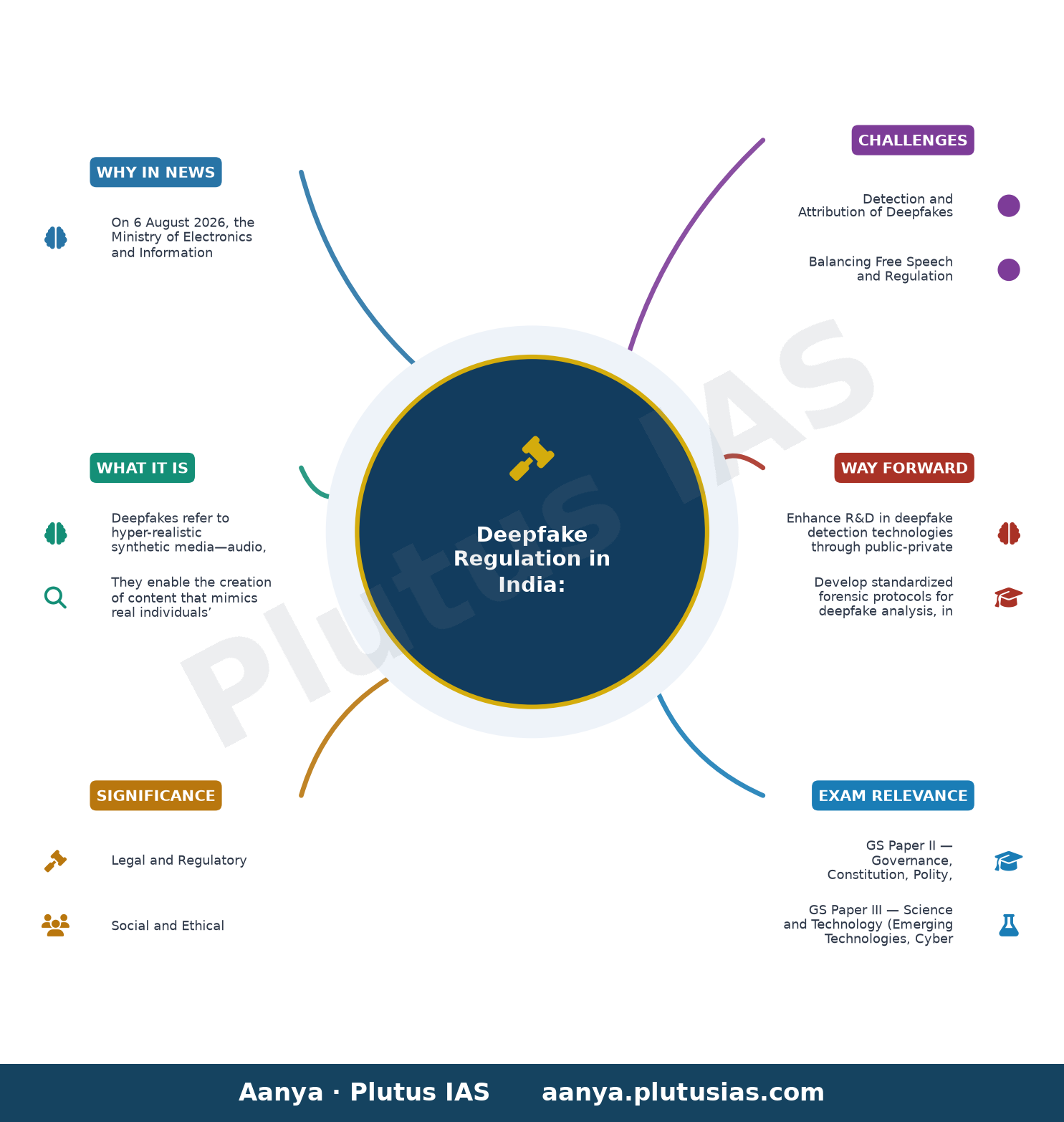
- GS Paper II — Governance, Constitution, Polity, Social Justice and International Relations (Cyber Governance and Digital Ethics) | GS Paper III — Science and Technology (Emerging Technologies, Cyber Security and Digital Infrastructure)
- Prelims: Deepfake, IT Act 2000, IT Rules 2021, Intermediary Liability, Cybercrime, Artificial Intelligence (AI), Digital Media Ethics, Section 66D (Cyber Impersonation), Section 69A (Blocking of Content), Section 79 (Safe Harbour), Indian Justice Code 2023, Organized Cybercrime, Electronic Records, Misinformation and Disinformation
- Essay: Ethical Governance in the Age of Artificial Intelligence: Balancing Innovation and Accountability, The Digital Public Sphere: Challenges of Trust, Safety, and Democratic Discourse in the 21st Century
Quick Revision: Deepfakes are AI-generated synthetic media that can impersonate individuals with high realism; India regulates them under the IT Act 2000, IT Rules 2021, and Indian Justice Code 2023, mandating labeling and reducing illegal content removal time to 3 hours to mitigate digital harms.
Why is this in the news?
On 6 August 2026, the Ministry of Electronics and Information Technology (MeitY) issued a press release announcing the strengthening of the regulatory framework to address the threats posed by AI-generated deepfakes. This initiative, embedded within the Information Technology (Intermediary Guidelines and Digital Media Ethics Code) Rules, 2021, mandates labeling of AI-generated content and reduces the timeline for removal of illegal content from 36 hours to 3 hours. The move reflects heightened governmental awareness of the risks deepfakes pose to individual privacy, social harmony, and national security, and aligns with broader efforts to create a secure, accountable, and transparent digital ecosystem in India.
Background
- The proliferation of deepfake technology has escalated globally, enabling the creation of hyper-realistic synthetic audio, video, and text content that can impersonate individuals without consent, undermining trust in digital communication.
- In India, the rapid adoption of digital platforms—with over 800 million internet users—has amplified the risk of deepfake misuse, including identity theft, financial fraud, electoral manipulation, and social polarization.
- The Information Technology Act, 2000 (IT Act), initially framed before the rise of AI, was supplemented by the IT Rules, 2021, to address emerging digital threats.
- The Indian Justice Code, 2023 (BNS), introduced specific penal provisions to deter cyber impersonation, fraud, and disinformation, reflecting legislative adaptation to technological advancements.
What are Deepfakes and Why Do They Pose a Regulatory Challenge?
- Deepfakes refer to hyper-realistic synthetic media—audio, video, or text—generated using artificial intelligence, particularly deep learning techniques such as Generative Adversarial Networks (GANs) and diffusion models.
- They enable the creation of content that mimics real individuals’ voices, faces, or writing styles with high fidelity, often indistinguishable from authentic material without forensic analysis.
- The misuse of deepfakes spans multiple domains: financial fraud (e.g., voice cloning for impersonating CEOs), electoral interference (e.g., spreading disinformation during elections), personal harassment (e.g., non-consensual pornography), and national security threats (e.g., generating fake news to incite communal violence).
- Unlike traditional misinformation, deepfakes exploit cognitive biases—such as the ‘uncanny valley’ effect—where even partially realistic fakes can erode trust in institutions and individuals, leading to long-term societal distrust.
- The speed of content dissemination on social media platforms exacerbates the challenge, as deepfakes can go viral within minutes, leaving limited time for detection and mitigation.
- Regulatory responses must balance innovation in AI with the protection of fundamental rights, including freedom of expression, privacy, and dignity, as enshrined in Articles 19(1)(a) and 21 of the Constitution of India.
- The ethical imperative of transparency—such as mandatory labeling of AI-generated content—aims to empower users to critically evaluate the authenticity of digital content they consume.
Key Features
| Feature | Significance |
|---|---|
| Mandatory labelling of AI-generated content | Enables users to distinguish synthetic media from authentic content, reducing misinformation risks and enhancing transparency in digital communication. |
| Reduced removal time for illegal content (36 hours to 3 hours) | Accelerates mitigation of deepfake threats to individual reputation, public order, and national security by swiftly curbing malicious dissemination. |
| Enhanced due diligence obligations for intermediaries | Imposes stricter accountability on social media platforms to monitor, flag, and remove deepfake content, aligning with global best practices. |
| Grievance redressal mechanism with time-bound resolution | Ensures timely redressal of user complaints, fostering trust in digital platforms and deterring misuse of AI-generated content. |
| Mandatory user verification for large intermediaries | Reduces anonymity-driven misuse of deepfakes by enabling traceability of content creators, aiding law enforcement. |
Why it Matters
Legal and Regulatory
- Strengthens the IT Act, 2000 and BNS, 2023 to address emerging cyber threats like deepfakes, ensuring robust legal recourse against identity theft, fraud, and defamation.
- Clarifies intermediary liabilities under IT Rules, 2021, balancing free speech with accountability in digital ecosystems.
- Aligns with global trends in regulating AI-generated content, such as the EU AI Act and proposed US legislation, positioning India as a proactive regulator.
Social and Ethical
- Protects individual privacy and reputation from malicious deepfake attacks, particularly affecting women, celebrities, and public figures.
- Mitigates risks of misinformation and disinformation that can incite violence, communal tensions, or electoral interference.
- Promotes digital literacy by mandating transparency in AI-generated content, fostering a culture of responsible technology use.
Technological and Operational
- Encourages intermediaries to deploy automated tools for detecting and removing deepfake content, reducing manual oversight burdens.
- Sets a precedent for India’s AI governance framework, integrating ethical considerations into technological deployment.
Economic
- Reduces costs associated with reputational damage and legal liabilities for businesses and individuals targeted by deepfakes.
- Supports the growth of India’s digital economy by ensuring a safer online environment for innovation and commerce.
Challenges
1. Detection and Attribution of Deepfakes
- Technological limitations in distinguishing subtle deepfakes from authentic content, especially in real-time scenarios.
- Lack of standardized forensic tools for deepfake detection across diverse platforms and languages.
- Anonymity of creators complicates attribution, hindering law enforcement actions.
UPSC Link: GS3 Science Tech
2. Balancing Free Speech and Regulation
- Risk of over-censorship under stringent intermediary obligations, potentially stifling legitimate expression.
- Ambiguity in defining ‘illegal content’ in the context of deepfakes, leading to subjective enforcement.
UPSC Link: GS2 Fundamental Rights
3. Cross-Border Jurisdictional Challenges
- Difficulty in regulating deepfakes originating from foreign jurisdictions with differing legal frameworks.
- Limited cooperation with international platforms due to data sovereignty and privacy concerns.
UPSC Link: GS2 International Relations
4. Public Awareness and Digital Literacy
- Low awareness among users about deepfake risks and reporting mechanisms, leading to delayed or absent redressal.
- Cultural and linguistic diversity in India complicates uniform digital literacy campaigns.
UPSC Link: GS4 Ethics
5. Resource Constraints for Law Enforcement
- Inadequate training and infrastructure for cybercrime units to investigate deepfake-related offenses.
- High computational costs associated with forensic analysis of deepfake content.
UPSC Link: GS3 Internal Security
Challenges — UPSC Perspective
| Issue | Concern |
|---|---|
| Technological limitations in detection | High false-positive rates in deepfake identification, leading to either over-removal or under-detection of harmful content. |
| Enforcement gaps in intermediary compliance | Potential non-compliance by intermediaries due to lack of standardized auditing mechanisms or penalties. |
| Ethical dilemmas in AI governance | Balancing innovation with regulation, particularly in sectors like entertainment and advertising where synthetic content is prevalent. |
| Data privacy vs. traceability | Tension between user anonymity and the need for traceability in deepfake investigations. |
| Global regulatory fragmentation | Divergent AI governance frameworks across jurisdictions, complicating cross-border enforcement. |
Way Forward
- Enhance R&D in deepfake detection technologies through public-private partnerships, focusing on multilingual and real-time solutions.
- Develop standardized forensic protocols for deepfake analysis, in collaboration with academic institutions and cybersecurity agencies.
- Conduct nationwide digital literacy campaigns to educate users on identifying and reporting deepfakes, leveraging local languages and regional platforms.
- Strengthen cross-border cooperation with international agencies (e.g., INTERPOL, EU) to address jurisdictional challenges in deepfake investigations.
- Establish a dedicated cybercrime task force within state police departments, equipped with advanced forensic tools and trained personnel.
- Mandate periodic audits of intermediaries’ compliance with IT Rules, 2021, with penalties for non-adherence.
- Promote ethical AI frameworks in collaboration with industry bodies to self-regulate synthetic content generation and distribution.
- Integrate deepfake awareness into school and college curricula as part of digital citizenship education.
UPSC Value Addition
Keywords for Mains Answer-Writing
Deepfake regulation · IT Rules 2021 · AI-generated content · Section 69A of IT Act · Section 79 of IT Act · Cybersecurity framework · Intermediary liability · Ethical AI · Digital India Act · Public order and AI misuse
Constitutional & Policy Linkages
- {‘Article 19(1)(a) Freedom of speech and expression — note: Balancing regulation with free speech rights.’: ‘Restrictions under Article 19(2) for public order, morality, and incitement to offense.’}
- {‘Article 21 Right to privacy — note: Protection from unauthorized use of one’s likeness in deepfakes.’: ‘Implied right to reputation and dignity under personal liberty.’}
- {‘Article 14 Right to equality — note: Ensuring non-discriminatory enforcement of deepfake regulations.’: ‘Preventing selective targeting or under-enforcement based on social or political status.’}
Concept Flow
Emergence of AI-driven deepfake technology → Proliferation of malicious synthetic content → Threats to individual privacy, reputation, and public order → Government intervention via IT Act, BNS, and IT Rules → Mandatory labelling and reduced removal time for illegal content → Enhanced intermediary obligations and grievance redressal → Challenges in detection, attribution, and enforcement → Need for technological, legal, and societal solutions → Long-term: Ethical AI governance and digital literacy as preventive measures.
Prelims Practice Questions
Q1. Consider the following statements regarding the regulation of Deepfakes in India: 1. The IT Rules 2021 mandate that AI-generated content must be labeled as such. 2. Social media intermediaries with 50 lakh or more registered users must deploy automated tools to detect illegal content. 3. The removal time limit for illegal content has been reduced to 3 hours under the amended IT Rules. 4. The Indian Penal Code, 1860 contains specific provisions to penalize Deepfake-related offences. How many of the above statements are correct?
- Only one
- Only two
- Only three
- All four
Answer: All four — Statements 1, 2, and 3 are correct as per the IT Rules 2021 and the recent amendments. Statement 4 is incorrect because the Indian Penal Code does not contain specific provisions for Deepfakes; relevant provisions are found in the Information Technology Act, 2000, and the Bharatiya Nyaya Sanhita, 2023.
Q2. Assertion (A): The Information Technology (Intermediary Guidelines and Digital Media Ethics Code) Rules, 2021 require social media intermediaries to publish compliance reports annually. Reason (R): This is to ensure transparency and accountability in the handling of illegal or harmful content on their platforms.
- Both A and R are true, and R is the correct explanation of A
- Both A and R are true, but R is not the correct explanation of A
- A is true, but R is false
- A is false, but R is true
Answer: Both A and R are true, and R is the correct explanation of A — Both Assertion (A) and Reason (R) are correct. The IT Rules 2021 mandate that social media intermediaries must publish annual compliance reports to enhance transparency and accountability in content moderation.
Q3. Match the following provisions of the Information Technology Act, 2000 with their corresponding objectives: Column I: A. Section 66C B. Section 66D C. Section 66E D. Section 69A Column II: 1. Penalizes identity theft 2. Penalizes cheating by personation using computer resources 3. Empowers the government to block information in the interest of sovereignty and integrity of India 4. Penalizes violation of privacy
- A-1, B-2, C-4, D-3
- A-4, B-1, C-2, D-3
- A-2, B-1, C-3, D-4
- A-3, B-2, C-1, D-4
Answer: A-1, B-2, C-4, D-3 — Section 66C penalizes identity theft (A-1), Section 66D penalizes cheating by personation (B-2), Section 66E penalizes violation of privacy (C-4), and Section 69A empowers the government to block information (D-3).
Mains Practice Question
✍ The proliferation of Deepfakes poses significant threats to individual privacy, public order, and democratic processes. Critically examine the efficacy of India’s regulatory framework, including the Information Technology Act, 2000, the IT Rules 2021, and the Bharatiya Nyaya Sanhita, 2023, in addressing this challenge. Also, discuss the role of intermediaries in mitigating the spread of Deepfakes. (15 Marks)
Approach: MODEL-ANSWER SKELETON:
1. **Introduction (2 Marks)**: Define Deepfakes and their potential harms (e.g., misinformation, defamation, electoral interference). State the need for a robust regulatory framework.
2. **Legal Framework (5 Marks)**:
– **Information Technology Act, 2000**: Sections 66C (identity theft), 66D (personation), 66E (privacy violation), 67/67A (obscenity), 69A (blocking powers), and 79 (intermediary liability).
– **IT Rules 2021**: Mandate for labeling AI-generated content, 3-hour removal deadline for illegal content, duties of intermediaries (e.g., automated tools for detection, compliance reports, local grievance officers).
– **Bharatiya Nyaya Sanhita, 2023**: Sections 319 (fraud by personation), 336 (fraud via false electronic records), and 353 (false statements causing public mischief).
– **Critical Analysis**: Highlight gaps (e.g., enforcement challenges, jurisdictional issues, technological limitations in detection).
3. **Role of Intermediaries (4 Marks)**:
– Discuss their obligations under IT Rules 2021 (e.g., proactive monitoring, user verification, grievance redressal).
– Evaluate challenges: scalability of automated tools, privacy concerns, and balancing free speech vs. regulation.
– Cite examples (e.g., social media platforms’ compliance reports, takedown mechanisms).
4. **Way Forward (4 Marks)**:
– Suggest measures: stricter penalties, international cooperation, public awareness campaigns, and technological solutions (e.g., blockchain for authenticity verification).
– Discuss the need for a dedicated ‘Digital India Act’ to address evolving AI challenges.
– Balance between regulation and innovation, ensuring accountability without stifling creativity.
Source: PIB (Press Information Bureau)
Generated by AanyaAi for educational purpose.

- पेरियार टाइगर रिजर्व में 6 नई प्रजातियाँ खोजी गईं, जानिए क्या हैं विशेषताएँ - September 22, 2026
- Six New Species Discovered in Periyar Tiger Reserve: UPSC & PCS Key Biodiversity Insights - September 22, 2026
- तमिलनाडु में बस किराए में संशोधन: सरकार को चार सप्ताह और समय मिला, उच्च न्यायालय का फैसला - September 22, 2026

No Comments