


11 Aug UPSC Alert: Green India Mission Restores 1.84 Lakh Hectares Degraded Land
✎ The Green India Mission (GIM) is a flagship scheme under the NAPCC that restores degraded forest lands through community participation, technological monitoring, and CAMPA-funded interventions to enhance carbon sequestration…
Subject Relevance — Where This Topic Fits
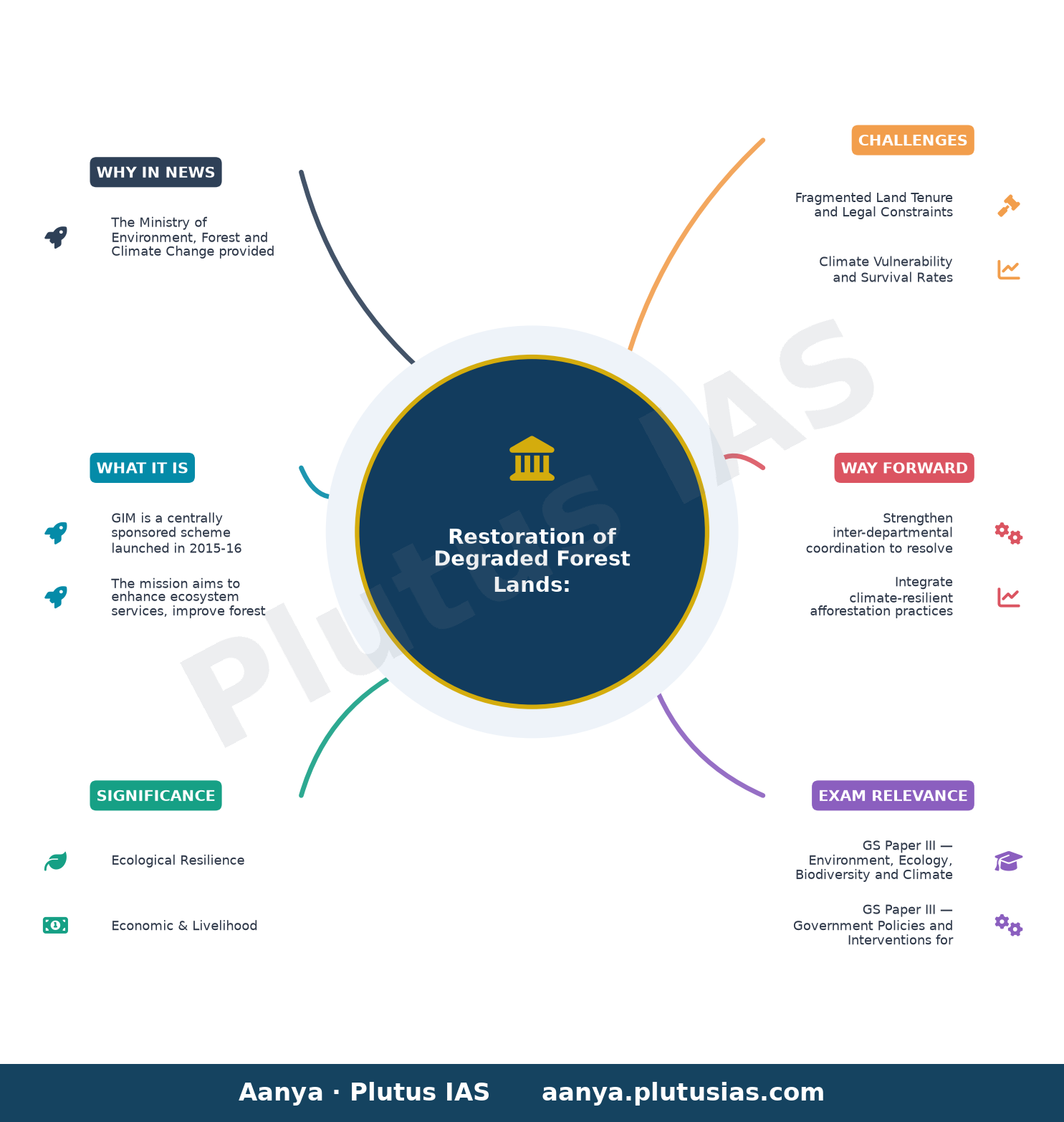
- GS Paper III — Environment, Ecology, Biodiversity and Climate Change | GS Paper III — Government Policies and Interventions for Development in various sectors
- Prelims: Green India Mission (GIM), National Action Plan on Climate Change (NAPCC), Compensatory Afforestation Fund Management and Planning Authority (CAMPA), Joint Forest Management Committees (JFMC), India State of Forest Report (ISFR), Geo-tagging of plantations, Integrated Landscape Approach, Urban Forest Scheme (Nagar Van Yojana)
- Essay: Sustainable forest management as a climate change mitigation strategy, Community participation in environmental governance: lessons from forest restoration programmes
Quick Revision: The Green India Mission (GIM) is a flagship scheme under the NAPCC that restores degraded forest lands through community participation, technological monitoring, and CAMPA-funded interventions to enhance carbon sequestration, biodiversity, and livelihoods.
Why is this in the news?
The Ministry of Environment, Forest and Climate Change provided detailed data on the progress of the Green India Mission (GIM) in restoring degraded forest lands across 17 states and one Union Territory. The response highlighted the ecological restoration of 1,84,467 hectares of degraded lands and outlined institutional mechanisms, including community-based monitoring and technological interventions such as geo-tagging and GIS mapping, to ensure the sustainability of restoration efforts.
Background
- The Green India Mission (GIM) is one of nine missions under the National Action Plan on Climate Change (NAPCC) launched in 2008 to address climate change through a multi-sectoral approach.
- Degraded forest lands are areas where forest cover has been reduced due to anthropogenic pressures such as deforestation, overgrazing, shifting cultivation, and climate-induced stresses like drought and forest fires.
- The NAPCC recognises forest ecosystems as critical carbon sinks and emphasises their restoration to enhance carbon sequestration and biodiversity conservation.
- India’s forest cover assessment, conducted biennially by the Forest Survey of India (FSI), serves as a baseline for monitoring changes and guiding restoration priorities.
- The Compensatory Afforestation Fund Act, 2016, and the CAMPA mechanism provide financial resources for afforestation and restoration activities, including those under GIM.
- Urban greening initiatives like the Nagar Van Yojana complement GIM by enhancing green cover in urban areas to improve air quality and micro-climates.
What is the Green India Mission (GIM)?
- GIM is a centrally sponsored scheme launched in 2015-16 under the NAPCC to restore degraded forest lands and non-forest lands through an integrated landscape approach.
- The mission aims to enhance ecosystem services, improve forest cover, and increase carbon sequestration while supporting biodiversity conservation and livelihoods of local communities.
- GIM operates through a decentralised model, involving state forest departments, local institutions such as Joint Forest Management Committees (JFMC), Village Forest Committees (VFC), and community-based organisations.
- The mission adopts a multi-layered monitoring framework, including ground-level inspections, third-party evaluations, and technological tools like geo-tagging, GIS mapping, and drone-based surveillance to track progress and ensure accountability.
- GIM’s activities include afforestation, nursery development, post-plantation care, and livelihood-linked interventions such as nursery management and eco-tourism to ensure long-term sustainability.
- The mission aligns with India’s international commitments under the United Nations Framework Convention on Climate Change (UNFCCC) and the Paris Agreement to enhance forest cover and reduce emissions from deforestation.
- GIM’s restoration efforts contribute to India’s Nationally Determined Contributions (NDCs), particularly the target of creating an additional carbon sink of 2.5 to 3 billion tonnes of CO2 equivalent by 2030.
Key Features
| Feature | Significance |
|---|---|
| Integrated Landscape Approach under GIM | Adopts a holistic, cross-sectoral strategy for restoring degraded forests and non-forest lands, integrating ecological, social, and economic dimensions to enhance resilience. |
| State-wise Targeted Restoration (1,84,467 ha) | Demonstrates decentralised implementation with measurable targets across 17 states and 1 UTs, reflecting adaptive governance and regional ecological priorities. |
| Community-Based Implementation (JFMCs, VFGs, SHGs) | Leverages local institutions for participatory planning, execution, and maintenance, ensuring ownership and sustainability of restoration activities. |
| Multi-Level Monitoring System | Combines ground-level inspections, third-party audits, drone surveillance, and geospatial tools (GIS, geo-tagging) for real-time tracking of survival rates and adaptive corrections. |
| Urban Forestry Initiative (Nagar Van Yojana) | Expands restoration beyond rural landscapes to urban areas, aiming to improve micro-climate and air quality through 600 Nagar Vans and 400 Nagar Vatika by 2026-27. |
Why it Matters
Ecological Resilience
- Restores degraded ecosystems, enhancing biodiversity corridors and soil health, thereby mitigating desertification and land degradation.
- Contributes to India’s Nationally Determined Contributions (NDCs) under the Paris Agreement by increasing carbon sinks and sequestration potential.
- Supports the National Action Plan on Climate Change (NAPCC) by aligning with the Green India Mission’s goal of increasing forest cover by 5 million hectares.
Economic & Livelihood
- Generates rural employment through afforestation, nursery development, and allied activities, particularly in tribal and forest-dependent communities.
- Promotes non-timber forest products (NTFPs) and agroforestry, diversifying income sources for local stakeholders.
- Reduces pressure on existing forests by improving degraded lands, thereby easing the burden on protected areas.
Institutional Strengthening
- Enhances the capacity of Joint Forest Management Committees (JFMCs) and Village Forest Committees (VFCs) in participatory governance and sustainable land-use planning.
- Fosters inter-departmental coordination between forestry, agriculture, and urban development sectors for integrated landscape management.
- Demonstrates the efficacy of decentralised planning in environmental governance, aligning with the 73rd and 74th Constitutional Amendments.
Technological Integration
- Pioneers the use of geospatial tools (GIS, remote sensing, drone surveillance) for precision monitoring, ensuring transparency and accountability in fund utilisation.
- Facilitates data-driven decision-making for adaptive management, including gap-filling in afforestation sites based on survival rate assessments.
- Supports the Indian Forest Survey’s biennial assessments (ISFR), providing empirical evidence for policy adjustments.
Challenges
1. Fragmented Land Tenure and Legal Constraints
- Degraded lands often fall under disputed ownership or encroachment, complicating restoration efforts and delaying project approvals.
- Overlapping jurisdictions between forest departments, revenue authorities, and local bodies create administrative bottlenecks.
UPSC Link: Land Reforms (Article 39(b), Directive Principles)
2. Climate Vulnerability and Survival Rates
- Extreme weather events (droughts, floods) and pest infestations threaten sapling survival, particularly in arid and semi-arid regions.
- Low soil moisture and nutrient depletion in degraded lands reduce the success rate of afforestation without intensive pre-treatment.
UPSC Link: Climate Change Adaptation (SDG 13)
3. Funding Gaps and Delayed Disbursements
- Inconsistent state-level budgetary allocations and procedural delays in fund release under CAMPA hinder timely implementation.
- Reliance on annual operational plans limits long-term planning and scalability of restoration projects.
UPSC Link: Finance Commission (Article 280)
4. Community Participation and Awareness
- Low awareness among local stakeholders about the benefits of restoration and their roles in maintenance leads to passive participation.
- Competing livelihood priorities (e.g., agriculture, mining) often overshadow conservation efforts, especially in tribal regions.
UPSC Link: Participatory Forest Management (FRA 2006)
5. Monitoring and Accountability Mechanisms
- Third-party audits, while robust, may face delays due to logistical constraints, affecting real-time corrective actions.
- Geospatial data, though advanced, requires skilled personnel for interpretation, posing capacity-building challenges at the grassroots level.
UPSC Link: Environmental Impact Assessment (EIA 2006)
Challenges — UPSC Perspective
| Issue | Concern |
|---|---|
| Land Tenure Disputes | Legal ambiguities delay project initiation and complicate land-use planning. |
| Low Sapling Survival Rates | Climate extremes and poor soil conditions undermine restoration outcomes. |
| Delayed Fund Disbursement | Procedural bottlenecks reduce the efficacy of annual operational plans. |
| Limited Community Engagement | Passive participation hampers long-term sustainability of restored sites. |
| Monitoring Lag | Delays in third-party audits and geospatial data processing affect adaptive management. |
Government Initiatives — Must-Memorise for Prelims
- National Mission for a Green India (GIM) under NAPCC
- Nagar Van Yojana (NVY)
- Compensatory Afforestation Fund Management and Planning Authority (CAMPA)
Way Forward
- Strengthen inter-departmental coordination to resolve land tenure disputes and streamline approvals for degraded land restoration.
- Integrate climate-resilient afforestation practices (e.g., drought-tolerant species, soil moisture conservation) into project designs to enhance survival rates.
- Establish a dedicated corpus under CAMPA for long-term funding, reducing reliance on annual budgetary allocations.
- Expand community awareness campaigns and capacity-building programs for JFMCs, VFCs, and SHGs to foster ownership.
- Leverage drone technology for real-time monitoring in inaccessible or high-risk terrains to improve data accuracy.
- Align GIM with state-level climate action plans (e.g., State Action Plans on Climate Change) for synergistic outcomes.
- Promote agroforestry and NTFP-based livelihoods to incentivize local participation in restoration activities.
- Enhance collaboration with the Indian Forest Survey (FSI) to integrate ISFR data into adaptive management frameworks.
UPSC Value Addition
Keywords for Mains Answer-Writing
Green India Mission · National Action Plan on Climate Change · degraded forest land restoration · Integrated Landscape Approach · Joint Forest Management Committees · Nagar Van Yojana · ecological restoration · climate change mitigation · Community-based forest management · Forest Survey of India · India State of Forest Report · Geo-tagging of afforestation sites · climate finance · forest cover assessment · micro-climate improvement
Constitutional & Policy Linkages
- Directive Principles of State Policy (Article 48A) – Protection and improvement of environment and forests
- 73rd and 74th Constitutional Amendments – Decentralised governance and participatory forest management
Concept Flow
Degradation of forest and non-forest lands due to anthropogenic pressures and climate change → Formulation of National Action Plan on Climate Change (NAPCC) and launch of Green India Mission (GIM) in 2015-16 → Adoption of Integrated Landscape Approach for targeted restoration across 17 states and 1 UT → Implementation via community-based institutions (JFMCs, VFCs) and multi-level monitoring systems → Technological integration (GIS, geospatial tools, drone surveillance) for precision tracking and adaptive corrections → Expansion to urban areas through Nagar Van Yojana to improve micro-climate and air quality → Outcome: Enhanced ecological resilience, carbon sequestration, and livelihood opportunities
Prelims Practice Questions
Q1. Consider the following statements regarding the Green India Mission (GIM):
1. GIM is one of the nine missions under the National Action Plan on Climate Change (NAPCC).
2. The mission aims to restore degraded forest land and non-forest areas through an integrated landscape approach.
3. Under GIM, the Ministry of Environment, Forest and Climate Change has allocated funds to all 28 states and 8 Union Territories.
4. The mission promotes the use of drone-based monitoring for ecological restoration activities.
How many of the above statements are correct?
- Only one
- Only two
- Only three
- All four
Answer: All four — Statements 1, 2, and 4 are correct. Statement 3 is incorrect as the funds have been allocated only to 7 states under GIM for the financial year 2026-27.
Q2. Assertion (A): The Green India Mission (GIM) employs Geo-tagging and GIS-based mapping for monitoring afforestation activities.
Reason (R): These technological tools enhance transparency and accountability in the implementation of ecological restoration projects.
In the context of the above two statements, which one of the following is correct?
- Both A and R are true, and R is the correct explanation of A.
- Both A and R are true, but R is not the correct explanation of A.
- A is true, but R is false.
- A is false, but R is true.
Answer: Both A and R are true, but R is not the correct explanation of A. — Both the Assertion (A) and Reason (R) are true, and the Reason (R) correctly explains the Assertion (A) as Geo-tagging and GIS-based mapping are used to monitor afforestation sites, ensuring transparency and accountability.
Q3. Match the following initiatives with their respective objectives:
Column I (Initiative) | Column II (Objective)
—————————————————|—————————————————
A. Green India Mission (GIM) | 1. Development of urban forests and urban gardens
B. Nagar Van Yojana (NVY) | 2. Restoration of degraded forest land
C. Joint Forest Management Committees (JFMC) | 3. Community-based forest management
D. Forest Survey of India (FSI) | 4. Assessment of forest cover using remote sensing
Choose the correct match:
- A-2, B-1, C-3, D-4
- A-1, B-2, C-3, D-4
- A-4, B-1, C-2, D-3
- A-2, B-3, C-1, D-4
Answer: A-2, B-1, C-3, D-4 — The correct matches are: A-2 (GIM aims to restore degraded forest land), B-1 (NVY aims to develop urban forests and gardens), C-3 (JFMC is a community-based forest management initiative), and D-4 (FSI assesses forest cover using remote sensing).
Mains Practice Question
✍ Critically examine the role of the Green India Mission (GIM) in addressing climate change and ecological restoration in India. How far has the mission succeeded in achieving its objectives through an integrated landscape approach? Substantiate your answer with reference to technological interventions and community participation. (15 Marks)
Approach: MODEL-ANSWER SKELETON:
1. **Introduction (2 Marks)**
– Brief background of the Green India Mission (GIM) as part of the National Action Plan on Climate Change (NAPCC) and its launch in 2015-16.
– Objectives: Restoration of degraded forest land and non-forest areas through an integrated landscape approach.
2. **Role in Climate Change Mitigation and Ecological Restoration (4 Marks)**
– **Climate Change Mitigation**: GIM contributes to India’s Nationally Determined Contributions (NDCs) under the Paris Agreement by enhancing forest cover and carbon sequestration.
– **Ecological Restoration**: Focus on restoring degraded lands to improve biodiversity, soil health, and ecosystem services.
– **Integrated Landscape Approach**: Combines afforestation, agroforestry, and sustainable land-use practices to address ecological and livelihood challenges.
3. **Technological Interventions (3 Marks)**
– **Geo-tagging and GIS-based Mapping**: Used for real-time monitoring of afforestation sites, ensuring transparency and accountability.
– **Remote Sensing and Drone-based Monitoring**: Facilitates large-scale assessment of forest cover and ecological restoration progress.
– **Forest Survey of India (FSI) Reports**: Biennial assessments (India State of Forest Report) provide data-driven insights for policy formulation.
4. **Community Participation (3 Marks)**
– **Joint Forest Management Committees (JFMC) and Village Forest Committees (VFC)**: Involve local communities in decision-making and implementation.
– **Livelihood Linkages**: Integration of afforestation with livelihood activities (e.g., nurseries, eco-tourism) to ensure sustainability.
– **Capacity Building**: Training and awareness programs for local stakeholders to enhance participation and ownership.
5. **Challenges and Limitations (2 Marks)**
– **Funding Constraints**: Limited financial resources for large-scale restoration projects.
– **Land Tenure Issues**: Conflicts over land ownership and usage rights.
– **Monitoring Gaps**: Ensuring long-term survival of planted saplings and addressing gaps in third-party evaluations.
6. **Conclusion (1 Mark)**
– GIM has made significant strides in ecological restoration and climate change mitigation but requires sustained funding, technological innovation, and community engagement to achieve its long-term goals.
Source: PIB (Press Information Bureau)
Generated by AanyaAi for educational purpose.

- Exercise Tarang Shakti 2026: India’s Mega Multi-Nation Air Power Showcase - September 27, 2026
- रबी अभियान 2026: राष्ट्रीय सम्मेलन में केंद्र-राज्य तालमेल पर होगा जोर - September 27, 2026
- Himachal CM Sukhu: All Doctor Vacancies to be Filled by March - September 27, 2026

No Comments