


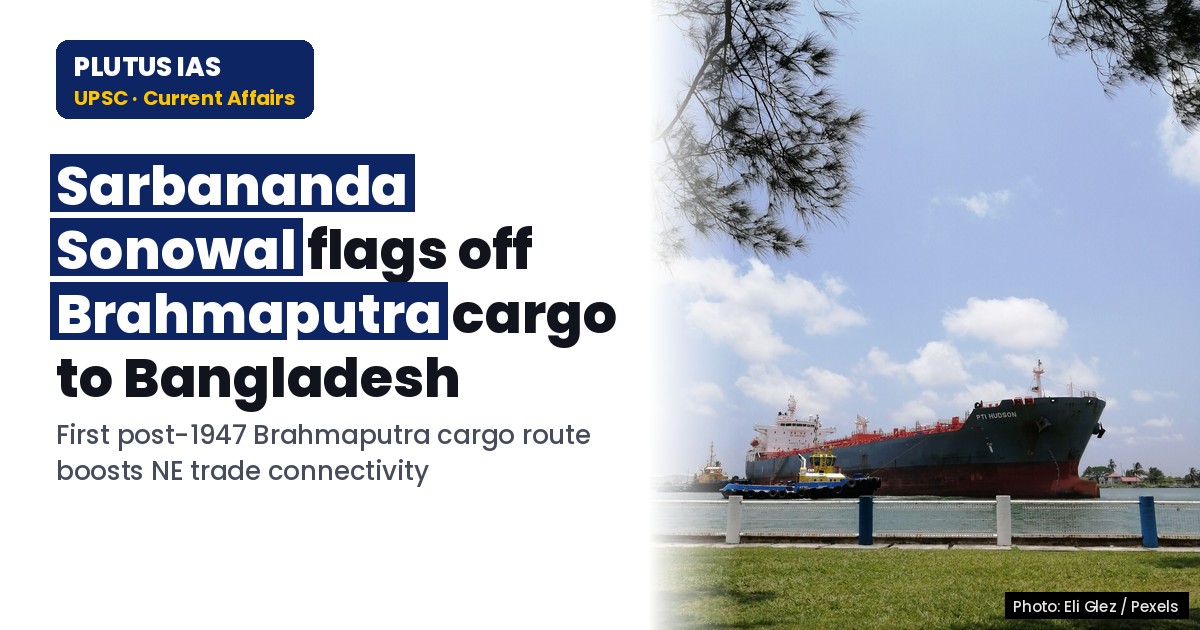
05 Oct UPSC Alert: Historic Brahmaputra cargo route to Bangladesh launched from Dibrugarh
✎ The Indo-Bangladesh Protocol on Inland Water Transit and Trade (PIWT&T) enables cross-border cargo movement via designated river routes, including the Brahmaputra (NW-2), reducing logistics costs and integrating northeastern…
Subject Relevance — Where This Topic Fits
- GS Paper II — India and its Neighbourhood: Regional Connectivity and Trade | GS Paper III — Infrastructure: Roads, Railways, Waterways and their Interlinking
- Prelims: National Waterway-2 (Brahmaputra), Indo-Bangladesh Protocol on Inland Water Transit and Trade (PIWT&T), Bogibeel Terminal, Methanol, Assam Petrochemicals Limited (APCL), India-Bangladesh Land Customs Stations (LCS), Protocol Routes, Cargo Handling, Inland Water Transport (IWT)
- Essay: Regional Integration and Sustainable Development: The Role of Inland Waterways in South Asia, Infrastructure as a Catalyst for Economic Transformation: Lessons from the Brahmaputra
Quick Revision: The Indo-Bangladesh Protocol on Inland Water Transit and Trade (PIWT&T) enables cross-border cargo movement via designated river routes, including the Brahmaputra (NW-2), reducing logistics costs and integrating northeastern India with regional markets.
Why is this in the news?
On 5 October 2026, the Union Minister for Ports, Shipping and Waterways flagged off the first post-independence international freight consignment from the Bogibeel Terminal in Dibrugarh, Assam, to Dhaka, Bangladesh. The shipment of 540 metric tonnes of methanol, produced by Assam Petrochemicals Limited (APCL) at Namrup, was transported via the Brahmaputra River (National Waterway-2) and the Indo-Bangladesh Protocol Route, marking a historic resumption of riverine trade connectivity after nearly seven decades. This initiative underscores the strategic importance of inland waterways in enhancing regional trade, reducing logistics costs, and integrating the northeastern region with global markets.
Background
- The Brahmaputra River, one of the world’s largest transboundary rivers, flows through India, China, and Bangladesh, with a significant stretch (891 km) in India designated as National Waterway-2 (NW-2) under the Inland Waterways Authority of India (IWAI).
- Historically, Dibrugarh was a major river port in eastern India, connected to Kolkata via steamers until the 1950s, facilitating the transport of tea, timber, and passengers.
- Partition in 1947 disrupted traditional trade routes, forcing Assam’s exports to transit through erstwhile East Pakistan (now Bangladesh), while the 1950 Assam earthquake altered riverbed topography, leading to the closure of the Dibrugarh Steamer Ghat in 1956.
- The Indo-Pakistan War of 1965 and subsequent geopolitical tensions further constrained cross-border river trade, though the India-Bangladesh Protocol on Inland Water Transit and Trade (PIWT&T), signed in 1972, provided a legal framework for resumed cooperation.
- The declaration of NW-2 in 1988 and the operationalisation of the PIWT&T in 1977 (with periodic updates) laid the groundwork for modern inland waterway trade, though commercial utilisation remained limited until recent infrastructure upgrades.
What is the Indo-Bangladesh Protocol on Inland Water Transit and Trade (PIWT&T)?
- A bilateral agreement between India and Bangladesh, first signed in 1972 and periodically updated, facilitating the movement of goods and passengers between the two countries via designated inland water routes.
- It designates specific stretches of rivers (including the Brahmaputra) as ‘Protocol Routes’ for transit, allowing vessels of both countries to ply between agreed ports without customs formalities at intermediate points.
- The Protocol currently covers 10 routes, including the Brahmaputra (NW-2) and the Ganga (NW-1), enabling seamless cross-border cargo and passenger movement.
- It exempts vessels from heavy customs inspections at intermediate points, reducing transit time and logistics costs, and promotes regional economic integration.
- The Protocol is complemented by Land Customs Stations (LCS) at key locations (e.g., Dhubri, Pandu) to facilitate cargo handling, customs clearance, and immigration checks for international consignments.
- Recent infrastructure developments, such as the establishment of LCS at Bogibeel and Dhubri, have revitalised the Protocol’s operational viability, enabling commercial shipments like the methanol consignment.
- The Protocol aligns with broader initiatives under the BBIN (Bangladesh-Bhutan-India-Nepal) Motor Vehicles Agreement and the South Asian Association for Regional Cooperation (SAARC) framework for trade facilitation.
Key Features
| Feature | Significance |
|---|---|
| National Waterway-2 (NW-2) | Designated in 1988, NW-2 spans 891 km from Pandu to Dhubri on the Brahmaputra River, enabling inland water transport (IWT) for goods and passengers. |
| Bogibeel Terminal | A modern riverine terminal at Dibrugarh, operationalised post-2018, serving as a gateway for NE India’s trade connectivity with Bangladesh and beyond. |
| Protocol Route (IBPR) | India-Bangladesh Protocol on Inland Water Transit and Trade (PIWT&T) permits cross-border movement of vessels between designated ports, including Dhubri-Pangaoan route. |
| Customs & Immigration Facilities | Recent establishment of border customs and immigration complexes at Bogibeel and Dhubri enables seamless cross-border cargo movement. |
| Methanol Consignment | 540 metric tonnes of methanol produced by Assam Petrochemicals Limited (APCL), Namrup, marks the first post-independence export via inland waterways from Upper Assam. |
Why it Matters
Economic Integration
- Revives historical trade routes between Dibrugarh and Dhaka, reducing dependence on road/rail for NE India’s exports to Bangladesh.
- Lowers logistics costs by leveraging Brahmaputra’s natural waterway, enhancing competitiveness of Assam’s petrochemical and agro-based industries.
- Promotes regional economic corridors under Act East Policy, linking NE India to ASEAN markets via Bangladesh.
Strategic Connectivity
- Demonstrates viability of IWT as a sustainable alternative to congested land routes for cross-border trade.
- Strengthens India’s inland water transport infrastructure, aligning with Sagarmala Programme’s objectives for multimodal logistics.
- Facilitates people-to-people ties and cultural exchange through revived riverine connectivity.
Infrastructure Development
- Highlights modernisation of riverine terminals (e.g., Bogibeel) to handle international cargo, aligning with PM Gati Shakti’s multi-modal integration.
- Showcases role of central and state agencies (MoPSW, Assam Govt.) in operationalising trade corridors.
- Sets precedent for future exports (e.g., tea, plywood, petroleum products) via NW-2.
Historical Continuity
- Reconnects Dibrugarh’s legacy as a major river port (pre-1956), restoring its role in NE India’s trade ecosystem.
- Underscores resilience of Brahmaputra’s navigability despite geological and geopolitical disruptions (e.g., 1950 earthquake, 1965 war).
Challenges
1. Seasonal Navigability
- Brahmaputra’s water levels fluctuate seasonally, limiting year-round operations; dredging and channel maintenance are critical.
- Siltation and sandbars pose risks to vessel movement, requiring continuous hydrographic surveys.
UPSC Link: Geography of Brahmaputra Basin
2. Cross-Border Regulatory Hurdles
- Compliance with India-Bangladesh Protocol on Inland Water Transit and Trade (PIWT&T) requires harmonised customs, immigration, and port procedures.
- Differences in regulatory frameworks (e.g., cargo documentation, security protocols) may delay clearances.
UPSC Link: India-Bangladesh Bilateral Agreements
3. Infrastructure Gaps
- Limited depth at certain stretches of NW-2 necessitates investment in jetties, terminals, and navigational aids.
- Lack of integrated multimodal hubs at key locations (e.g., Dhubri) restricts seamless cargo transfer.
UPSC Link: Sagarmala Programme
4. Market and Supply Chain Risks
- Dependence on a single commodity (methanol) for initial trials exposes trade to price volatility and demand fluctuations.
- Competition from cheaper alternatives (e.g., road/rail transport) may deter long-term adoption.
UPSC Link: Logistics Costs in India
5. Geopolitical Constraints
- Historical sensitivities around cross-border trade (e.g., 1965 war) necessitate diplomatic assurances for sustained operations.
- Bangladesh’s domestic policies (e.g., port congestion, tariffs) may impact transit efficiency.
UPSC Link: India-Bangladesh Relations
Challenges — UPSC Perspective
| Issue | Concern |
|---|---|
| Seasonal water levels | Restricts year-round operations; requires dredging and maintenance. |
| Customs delays at borders | Differences in clearance procedures may slow cargo movement. |
| Infrastructure bottlenecks | Limited terminal depth and lack of multimodal hubs. |
| Geopolitical risks | Historical tensions may affect long-term trade agreements. |
| Market volatility | Dependence on single commodity exposes trade to price fluctuations. |
Government Initiatives — Must-Memorise for Prelims
- Sagarmala Programme
- National Waterways Act, 2016
- India-Bangladesh Protocol on Inland Water Transit and Trade (PIWT&T)
Way Forward
- Expand pilot trials to include diverse commodities (e.g., tea, plywood, petroleum products) to assess year-round viability.
- Invest in dredging and channel maintenance to ensure navigability during low-water seasons.
- Establish integrated customs, immigration, and port facilities at Dhubri and other key terminals.
- Develop multimodal logistics hubs linking NW-2 to rail and road networks under PM Gati Shakti.
- Strengthen bilateral cooperation with Bangladesh to harmonise trade procedures and reduce regulatory delays.
- Promote public-private partnerships (PPPs) for terminal modernisation and vessel procurement.
- Conduct feasibility studies for extending NW-2 connectivity to Myanmar and ASEAN markets.
- Enhance digital integration (e.g., e-documentation, real-time tracking) to streamline cross-border trade.
UPSC Value Addition
Keywords for Mains Answer-Writing
Bogibeel Terminal · National Waterway-2 (NW-2) · India-Bangladesh Protocol on Inland Water Transit and Trade (IBPITT) · Assam Petro-Chemicals Limited (APCL) · Methanol export logistics · Inland water transport (IWT) corridors · Brahmaputra River · Port-led development in Northeast India · Customs and immigration facilitation · Historical revival of river trade routes · Regional connectivity infrastructure · Sustainable freight logistics
Concept Flow
Historical trade routes (pre-1956) → Partition (1947) and 1950 earthquake disrupt connectivity → Designation of NW-2 (1988) → Establishment of Bogibeel Terminal → Operationalisation of customs/immigration facilities → First methanol consignment dispatch (2026) → Potential expansion to ASEAN markets.
Prelims Practice Questions
Q1. Consider the following statements regarding the India-Bangladesh Protocol on Inland Water Transit and Trade (IBPITT):
1. The Protocol was signed in 1972 between India and Bangladesh.
2. The Protocol allows for the movement of goods between the two countries via designated river routes.
3. The Brahmaputra River (National Waterway-2) is not covered under this Protocol.
How many of the above statements are correct?
- Only one
- Only two
- All
- None
Answer: Only two — Statement 1 is correct (signed in 1972). Statement 2 is correct (allows goods movement via designated routes). Statement 3 is incorrect (Brahmaputra/NW-2 is covered under the Protocol). Only two statements are correct.
Q2. Assertion (A): The Brahmaputra River has been declared as National Waterway-2 (NW-2) under the National Waterways Act, 2016.
Reason (R): The NW-2 route connects Dhubri in Assam to Sadiya, facilitating inland water transport.
Options:
A. Both A and R are true, and R is the correct explanation of A.
B. Both A and R are true, but R is not the correct explanation of A.
C. A is true, but R is false.
D. A is false, but R is true.
Answer: ? — Assertion (A) is true: NW-2 is declared under the National Waterways Act, 2016. Reason (R) is also true and correctly explains A, as NW-2 connects Dhubri to Sadiya.
Q3. Match the following pairs related to river transport corridors in India:
Column I (River/Corridor) Column II (National Waterway Number)
1. Brahmaputra River A. National Waterway-1
2. Ganga-Bhagirathi-Hooghly River B. National Waterway-2
3. Godavari River C. National Waterway-4
4. Krishna River D. National Waterway-3
Options:
A. 1-B, 2-A, 3-C, 4-D
B. 1-A, 2-B, 3-C, 4-D
C. 1-B, 2-A, 3-D, 4-C
D. 1-A, 2-C, 3-B, 4-D
- A
- B
- C
- D
Answer: A — Correct matching: 1-B (Brahmaputra = NW-2), 2-A (Ganga-Bhagirathi-Hooghly = NW-1), 3-D (Godavari = NW-4), 4-C (Krishna = NW-3).
Mains Practice Question
✍ The revival of inland water transport (IWT) corridors, exemplified by the recent methanol shipment from Bogibeel Terminal to Bangladesh via the Brahmaputra River (National Waterway-2), represents a strategic shift in regional connectivity infrastructure. Critically examine the potential of IWT corridors in enhancing trade, logistics efficiency, and socio-economic integration in Northeast India. Also, assess the challenges in operationalising such corridors in the context of geopolitical, infrastructural, and regulatory constraints. (15 Marks)
Approach: [‘Define inland water transport (IWT) and its significance as a sustainable, cost-effective freight mode.’, ‘Contextualise the Bogibeel-Bangladesh methanol shipment as a case study of IWT revival in Northeast India.’] [{‘trade_and_logistics_benefits’: [‘Efficiency: Lower per-unit transport costs compared to road/rail; reduced carbon footprint (citing IWT as 3-4 times more fuel-efficient than road transport).’, ‘Connectivity: Links landlocked Northeast to regional markets (Bangladesh, Bhutan) and global trade via Chittagong/Chalna ports.’, ‘Supply chain resilience: Diversification from congested rail/road networks; example: Brahmaputra’s 891 km stretch (Dhubri to Sadiya) as NW-2.’, ‘Data: Reference to India’s 111 notified national waterways and the 2016 National Waterways Act to underscore policy intent.’]}, {‘socio_economic_integration’: [‘Employment generation: Direct/indirect jobs in port operations, logistics, and ancillary services in Assam/Arunachal Pradesh.’, ‘Industrialisation: Facilitates movement of raw materials (e.g., methanol from APCL) and finished goods, aiding MSMEs in Northeast.’, ‘Cross-border cooperation: Strengthens India-Bangladesh Protocol on Inland Water Transit and Trade (IBPITT, 1972); potential for trans-shipment hubs.’, ‘Cultural continuity: Revival of historical trade routes (e.g., pre-1947 steamer services from Calcutta to Dibrugarh).’]}, {‘challenges’: [‘Geopolitical: Dependence on Bangladesh’s cooperation for protocol route access; historical disruptions (e.g., 1965 war).’, ‘Infrastructural: Need for modern terminals (e.g., Bogibeel, Dhubri), dredging, and navigational aids; shallow drafts in dry seasons.’, ‘Regulatory: Streamlining customs/immigration at border checkpoints; compliance with IMO safety standards for vessels.’, ‘Economic viability: High initial capital expenditure; competition from road/rail freight; need for subsidies or viability gap funding.’, ‘Environmental: Sedimentation in Brahmaputra; climate change impacts on river flow and flood risks.’]}, {‘comparative_perspective’: [‘Contrast with China’s Yangtze River model (world’s busiest IWT corridor) or Europe’s Rhine-Danube network to highlight India’s lag.’, ‘Reference to Sagarmala Programme’s IWT sub-mission and PM Gati Shakti’s multi-modal integration for policy alignment.’]}] [‘Balanced assessment: IWT corridors offer long-term strategic advantages but require sustained investment, inter-state coordination, and regional diplomacy.’, ‘Policy recommendations: Strengthen IBPITT implementation; develop hinterland connectivity (e.g., Dhubri-Phulbari bridge); leverage digital platforms for cargo tracking.’]
Source: PIB (Press Information Bureau)
Assam PCS (APSC) — State PCS Practice
Prelims: Which of the following statements is correct regarding the recent international cargo movement from Assam’s Bogibeel Bridge to Bangladesh?
- It marks the first-ever post-independence international cargo movement via Bogibeel Bridge to Bangladesh.
- The cargo movement was facilitated under the India-Bangladesh Protocol on Inland Water Transit and Trade (PIWTT).
- The consignment included essential goods like foodgrains and construction materials.
- All of the above.
Answer: All of the above. — The recent cargo movement from Assam’s Bogibeel Bridge to Bangladesh is historic as it is the first post-independence international cargo transit via this route, facilitated under the PIWTT, and included essential goods.
Mains: Discuss the significance of the recent international cargo movement from Assam’s Bogibeel Bridge to Bangladesh in the context of India-Bangladesh trade relations and Assam’s role in enhancing regional connectivity. (250 words)
Generated by AanyaAi for educational purpose.
Related guides on our sites
- How to prepare for GS paper 1 for UPSC CSE mains exam
- Best UPSC coaching for IFOS exam
- Best mentorship programme for upsc
- UPSC+BA degree

- UPSC Alert: Historic Brahmaputra cargo route to Bangladesh launched from Dibrugarh - October 5, 2026
- चिंतन शिविर 2026: राजमार्ग अवसंरचना विकास के लिए नया एजेंडा - October 5, 2026
- Gandhi Jayanti 2026: Textile Ministry Launches Swachhata Abhiyan 6.0 - October 5, 2026

No Comments