


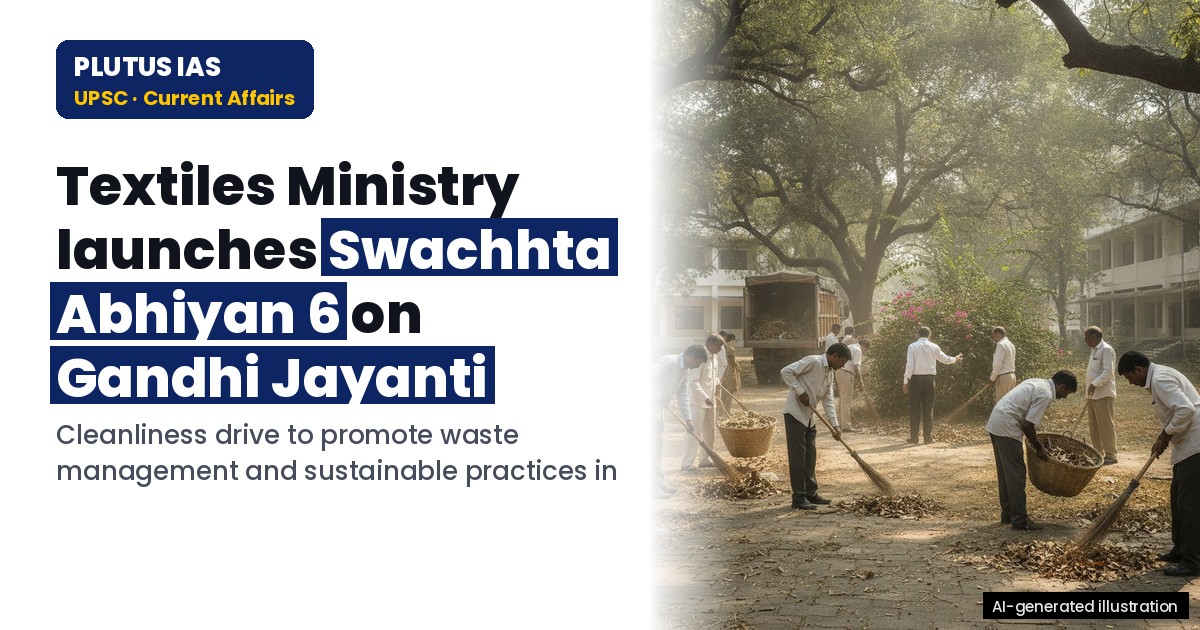
05 Oct Gandhi Jayanti 2026: Textile Ministry Launches Swachhata Abhiyan 6.0
✎ Special Campaign 6.0 is a government-wide cleanliness and efficiency drive that leverages Gandhi Jayanti to promote sustainable waste management, institutional cleanliness, and participatory governance, with a focus on textile…
Subject Relevance — Where This Topic Fits
- GS Paper II — Governance, Transparency and Accountability | GS Paper III — Environment and Sustainable Development
- Prelims: Swachh Bharat Mission, Special Campaign 2.0/3.0/6.0, textile waste management, NIFT Delhi, Jute Board Kolkata
- Essay: Sustainable Development Goals: India’s Progress and Challenges, Role of Institutions in Promoting Cleanliness and Public Health
Quick Revision: Special Campaign 6.0 is a government-wide cleanliness and efficiency drive that leverages Gandhi Jayanti to promote sustainable waste management, institutional cleanliness, and participatory governance, with a focus on textile waste recycling and circular economy principles.
Why is this in the news?
The Ministry of Textiles organised a series of cleanliness and sanitation activities under Special Campaign 6.0 on Gandhi Jayanti (2 October 2026) to institutionalise cleanliness, responsible waste management, and sustainable workplace practices across its attached and subordinate offices, including NIFT Delhi and the National Jute Board, Kolkata. The initiative included waste collection drives, oath-taking ceremonies, and campus-wide cleanliness drives, aligning with the broader objectives of the Swachh Bharat Mission and India’s commitment to sustainable development.
Background
- The Special Campaign initiative was launched by the Government of India to promote cleanliness, efficiency, and reduction of pendency in government offices, with a focus on sustainable practices and waste management.
- Gandhi Jayanti is observed annually on 2 October to commemorate Mahatma Gandhi’s birth anniversary and is associated with the principles of cleanliness (Swachhata) and non-violence, making it an opportune occasion for such drives.
- Textile waste, including post-consumer garments and jute-based materials, poses significant environmental challenges, necessitating structured waste collection and recycling mechanisms.
- Institutions like NIFT Delhi and the National Jute Board play a pivotal role in promoting sustainable practices within the textile and fashion ecosystem.
- The campaign reflects the government’s emphasis on participatory governance, where citizens and institutional stakeholders are encouraged to contribute actively to cleanliness and sustainability.
What is Special Campaign 6.0 and its relevance to cleanliness and sustainability?
- Special Campaign 6.0 is a government-wide initiative launched to promote cleanliness, efficiency, and reduction of pendency in government offices, with a focus on sustainable practices and waste management.
- The campaign is structured around thematic drives, including cleanliness drives, waste segregation, e-waste management, and the disposal of obsolete items, to foster a culture of responsibility and accountability in workplaces.
- Gandhi Jayanti is leveraged as a symbolic occasion to reinforce the principles of cleanliness and non-violence, aligning administrative efforts with national values.
- The Textile Ministry’s participation in Special Campaign 6.0 includes activities such as oath-taking ceremonies, campus cleanliness drives, and textile waste collection drives, demonstrating institutional commitment to sustainability.
- Textile waste management is a critical component of the campaign, with a focus on responsible collection, segregation, recycling, and upcycling of post-consumer garments and jute-based materials.
- The campaign emphasises the role of institutions like NIFT Delhi and the National Jute Board in promoting sustainable practices within the textile and fashion sectors, including waste reduction and circular economy principles.
- The campaign underscores the importance of collective action, where government employees, faculty, and students are encouraged to adopt sustainable practices and contribute to a cleaner, healthier environment.
Key Features
| Feature | Significance |
|---|---|
| Gandhi Jayanti observance under Swachhata Hi Seva Abhiyaan 6.0 | Leverages national symbolism to institutionalise cleanliness culture in government offices, aligning with Gandhian principles of hygiene and public service. |
| Textile waste collection initiative | Introduces structured segregation and recycling of consumer textile waste, promoting circular economy principles within governmental premises. |
| Swachhata Shaptav (Cleanliness Oath) | Formalises individual and institutional commitment to hygiene, reinforcing behavioural change through collective pledge. |
| Campus-wide sanitation drives in NIFT Delhi and regional offices | Demonstrates operational implementation of cleanliness protocols, including waste management and clutter reduction in educational and administrative settings. |
| Focus on e-waste and obsolete item disposal | Extends cleanliness agenda to electronic waste, addressing hazardous material management in line with E-Waste (Management) Rules, 2022. |
Why it Matters
Institutional Governance
- Reaffirms the Ministry of Textiles’ commitment to the ‘Swachh Bharat Mission’ framework, integrating cleanliness as a core operational value.
- Demonstrates inter-departmental collaboration between textile governance bodies (NIFT, National Jute Board) and central administrative offices.
- Establishes a precedent for sector-specific ministries to adopt and adapt national cleanliness campaigns within their functional domains.
Sustainability & Circular Economy
- Introduces a textile waste management system, aligning with Sustainable Development Goal 12 (Responsible Consumption and Production).
- Promotes upcycling and recycling of textile waste, reducing landfill burden and resource depletion in the textile industry.
- Encourages adoption of Extended Producer Responsibility (EPR) principles, albeit in a consumer waste context.
Behavioural & Cultural Impact
- Uses symbolic events (Gandhi Jayanti) to embed cleanliness as a cultural norm within government institutions.
- Leverages oath-taking ceremonies to institutionalise behavioural change, a technique validated in public health and governance models.
- Targets employees as change agents, creating a ripple effect in community practices through workplace influence.
Operational Efficiency
- Integrates cleanliness drives with waste management, reducing clutter and improving workspace hygiene in high-traffic areas.
- Incorporates e-waste disposal protocols, addressing a critical gap in office waste management systems.
- Establishes a model for continuous improvement in sanitation standards through periodic audits and feedback loops.
Challenges
1. Behavioural Resistance to Change
- Low initial engagement from employees accustomed to traditional waste disposal practices.
- Need for sustained motivational campaigns to prevent relapse into pre-intervention habits.
UPSC Link: Ethics: Attitude and Foundational Values
2. Infrastructure Gaps in Waste Segregation
- Limited availability of designated textile waste bins in non-office areas, leading to contamination.
- Inadequate training for staff on segregation protocols, risking misclassification of waste.
UPSC Link: Environmental Pollution: Solid Waste Management
3. Logistical Challenges in E-Waste Disposal
- Lack of certified e-waste recycling facilities in proximity to government campuses.
- Regulatory ambiguity in disposal pathways for obsolete office equipment.
UPSC Link: Environmental Governance: Legal Framework
4. Resource Constraints for Monitoring
- Insufficient personnel dedicated to overseeing cleanliness drives and waste collection.
- Need for digital tracking systems to monitor participation and waste diversion rates.
UPSC Link: Public Administration: Challenges in Implementation
5. Cultural Normalisation of Waste Burning
- Prevalence of informal textile waste burning in urban peripheries, requiring community-level interventions.
- Lack of awareness among citizens on safe textile waste disposal methods.
UPSC Link: Environmental Pollution: Air Quality Management
Challenges — UPSC Perspective
| Issue | Concern |
|---|---|
| Low participation in waste segregation | Risk of cross-contamination reducing recycling efficacy. |
| Inadequate storage for collected textile waste | Potential for pest infestation and odour nuisance in offices. |
| Absence of standardised disposal guidelines | Legal liability risks for improper waste handling. |
| Limited inter-ministerial coordination | Fragmented approach to national cleanliness goals. |
| High cost of e-waste recycling | Financial burden on government budgets for sustainable disposal. |
| Public apathy towards textile waste | Low demand for recycled textile products, discouraging circular economy adoption. |
Government Initiatives — Must-Memorise for Prelims
- Swachh Bharat Mission (SBM) 2.0
Way Forward
- Conduct periodic training sessions for staff on waste segregation, recycling, and e-waste disposal protocols.
- Expand textile waste collection infrastructure with clearly marked, colour-coded bins in all ministry premises.
- Partner with certified recyclers and NGOs to establish end-to-end textile waste management chains.
- Introduce incentive mechanisms (e.g., recognition awards) for departments achieving highest waste diversion rates.
- Develop a digital dashboard to track real-time waste collection, segregation, and recycling metrics.
- Collaborate with local urban bodies to integrate textile waste collection into municipal solid waste systems.
- Launch awareness campaigns in residential colonies near ministry offices to extend cleanliness culture beyond workplaces.
- Incorporate cleanliness and sustainability clauses in vendor contracts for office maintenance and supply chains.
UPSC Value Addition
Keywords for Mains Answer-Writing
Swachh Bharat Mission · Special Campaign 6.0 · Ministry of Textiles · Sustainable Waste Management · Circular Economy · Institutional Cleanliness · Gandhi Jayanti · Textile Waste Recycling · National Institute of Fashion Technology (NIFT) · Responsible Workplace Practices · Waste Segregation · Plastic Waste Management · Clean India Mission · Sustainable Development Goals (SDGs) · Government of India Initiatives
Concept Flow
Gandhi Jayanti observance → Symbolic commitment to cleanliness → Institutionalisation via Swachhata Hi Seva Abhiyaan 6.0. → Cleanliness drive → Waste segregation protocols → Textile waste collection initiative. → Waste collection → Recycling and upcycling → Circular economy promotion. → Circular economy adoption → Reduced landfill burden → Environmental sustainability. → Institutional cleanliness → Improved employee well-being → Enhanced operational efficiency. → Operational efficiency → Model replication → Sector-wide adoption of cleanliness norms.
Prelims Practice Questions
Q1. Consider the following statements regarding Special Campaign 6.0 launched by the Ministry of Textiles:
1. It was inaugurated on Gandhi Jayanti (2 October 2026).
2. The campaign includes textile waste collection drives and segregation of consumer-used textiles.
3. The campaign is limited to the National Institute of Fashion Technology (NIFT), Delhi campus.
How many of the above statements are correct?
- Only one
- Only two
- All three
- None
Answer: Only two — Statement 1 is correct as the campaign was launched on Gandhi Jayanti (2 October 2026). Statement 2 is correct as the campaign includes textile waste collection and recycling initiatives. Statement 3 is incorrect as the campaign extends beyond NIFT Delhi to include multiple offices and regional establishments under the Ministry of Textiles.
Q2. Assertion (A): The Ministry of Textiles’ Special Campaign 6.0 emphasizes sustainable waste management practices, including textile waste recycling.
Reason (R): The campaign aligns with the principles of the Swachh Bharat Mission and the Sustainable Development Goals (SDGs).
- Both A and R are true, and R is the correct explanation of A.
- Both A and R are true, but R is not the correct explanation of A.
- A is true, but R is false.
- A is false, but R is true.
Answer: Both A and R are true, and R is the correct explanation of A. — Assertion (A) is correct as the campaign prioritizes textile waste recycling and sustainable waste management. Reason (R) is also correct as these principles align with the Swachh Bharat Mission and SDGs. However, R does not directly explain A, as A focuses on campaign-specific actions while R provides broader policy alignment.
Q3. Match the following initiatives with their respective objectives under the Ministry of Textiles’ Special Campaign 6.0:
Initiative:
A. Textile Waste Collection Drives
B. Swachhata Shaptas (Cleanliness Oaths)
C. Institutional Cleanliness Campaigns
D. E-waste Management
Objective:
1. Promoting responsible workplace practices and clean environments
2. Collection and segregation of consumer-used textiles for recycling
3. Conducting cleanliness drives in government offices and campuses
4. Managing electronic waste in compliance with e-waste rules
- A-2, B-1, C-3, D-4; A-1, B-2, C-3, D-4; A-3, B-1, C-2, D-4; A-4, B-2, C-3, D-1
- answer_list_indexes_to_match_columns_1_to_1: [0, 1, 2, 3],
- answer_pairings_as_list_of_tuples_to_match_columns_1_to_1: [[0, 0], [1, 1], [2, 2], [3, 3]],
- answer_pairings_as_list_of_tuples_to_match_columns_1_to_1: [[0, 1], [1, 0], [2, 2], [3, 3]],
- answer_pairings_as_list_of_tuples_to_match_columns_1_to_1: [[0, 3], [1, 2], [2, 1], [3, 0]]
- answer_pairings_as_list_of_tuples_to_match_columns_1_to_1: [[0, 2], [1, 3], [2, 1], [3, 0]]
Answer: A-2, B-1, C-3, D-4; A-1, B-2, C-3, D-4; A-3, B-1, C-2, D-4; A-4, B-2, C-3, D-1 — The correct matching is: A-2 (Textile Waste Collection Drives aim to collect and segregate textiles for recycling), B-1 (Swachhata Shaptas promote responsible workplace practices and clean environments), C-3 (Institutional Cleanliness Campaigns involve cleanliness drives in offices and campuses), D-4 (E-waste Management focuses on compliance with e-waste rules).
Mains Practice Question
✍ The Ministry of Textiles’ Special Campaign 6.0, launched on Gandhi Jayanti, embodies the principles of institutional cleanliness and sustainable waste management. Critically examine the significance of such campaigns in achieving the objectives of the Swachh Bharat Mission and the Sustainable Development Goals (SDGs). Also, discuss the role of government institutions in fostering a culture of responsible waste management. (15 Marks)
Approach: MODEL-ANSWER SKELETON:
1. **Introduction (2 Marks)**
– Define Special Campaign 6.0 and its objectives (institutional cleanliness, textile waste recycling, e-waste management).
– Link the campaign to the Swachh Bharat Mission (SBM) and SDGs (SDG 6: Clean Water and Sanitation, SDG 11: Sustainable Cities and Communities, SDG 12: Responsible Consumption and Production).
2. **Significance of Campaigns like Special Campaign 6.0 (5 Marks)**
– **Institutional Cleanliness**: Role in creating model workplaces (e.g., NIFT Delhi, Patna Jute Board campus) that can be replicated across sectors. Cite examples of cleanliness drives in government offices.
– **Sustainable Waste Management**: How textile waste collection and recycling contribute to circular economy principles (reduce, reuse, recycle). Highlight the importance of segregating consumer-used textiles.
– **Behavioral Change**: Use of Swachhata Shaptas (cleanliness oaths) to inculcate a culture of cleanliness and responsibility among employees and stakeholders.
– **Policy Alignment**: Alignment with SBM 2.0 (2020-2025) and SDGs, particularly SDG 12.5 (substantially reduce waste generation through prevention, reduction, recycling, and reuse).
3. **Role of Government Institutions (5 Marks)**
– **Leadership and Example**: How government institutions (e.g., NIFT, National Jute Board) set benchmarks for cleanliness and waste management that can influence private and public sectors.
– **Multi-stakeholder Collaboration**: Role of ministries, educational institutions, and local bodies in ensuring the success of such campaigns. Cite examples from the campaign (e.g., participation of senior officials, faculty, and staff).
– **Regulatory Framework**: Reference to the Solid Waste Management Rules, 2016, and E-waste (Management) Rules, 2022, which mandate responsible waste management practices.
– **Challenges**: Discuss potential challenges such as lack of awareness, inadequate infrastructure for recycling, and resistance to behavioral change.
4. **Conclusion (3 Marks)**
– Summarize the importance of institutionalizing cleanliness and waste management practices.
– Emphasize the need for sustained efforts, policy support, and public participation to achieve long-term goals.
– Highlight the role of such campaigns in building a Swachh and Sashakt Bharat (Clean and Empowered India).
Source: PIB (Press Information Bureau)
Generated by AanyaAi for educational purpose.
Related guides on our sites
- Best PSIR optional coaching in delhi
- Best PSIR optional coaching in delhi for UPSC
- Anthropology VS PSIR
- Best PSIR optional coaching online

- Gandhi Jayanti 2026: Textile Ministry Launches Swachhata Abhiyan 6.0 - October 5, 2026
- आंध्र प्रदेश में चार नए पुलिस आयुक्तालयों की स्थापना: राज्य सेवा परीक्षा दृष्टिकोण - October 5, 2026
- Karnataka Halts Farm Land Survey Fee Hike Amid Drought Concerns - October 5, 2026

No Comments