


20 Jul UPSC Alert: How India’s Index Framework Drives Evidence-Based Policies
Subject Relevance — Where This Topic Fits
- GS Paper II — Governance, Transparency and Accountability | GS Paper III — Indian Economy and Issues Relating to Planning, Mobilization of Resources, Growth, Development and Employment | GS Paper III — Environment and Sustainable Development
- Prelims: National Statistical Commission, National Indicator Framework (NIF), Sustainable Development Goals (SDGs), Index of Industrial Production (IIP), Consumer Price Index (CPI), Gross Domestic Product (GDP), Periodic Labour Force Survey (PLFS), National Sample Survey (NSS), Administrative Data Systems
- Essay: The role of data in shaping public policy: Evidence versus ideology, Sustainable development as a framework for national governance
Quick Revision: MoSPI is the nodal ministry for India’s National Indicator Framework (NIF) under the SDGs, integrating administrative data and household surveys to enable evidence-based policy and monitor progress in human development and environmental sustainability.
Why is this in the news?
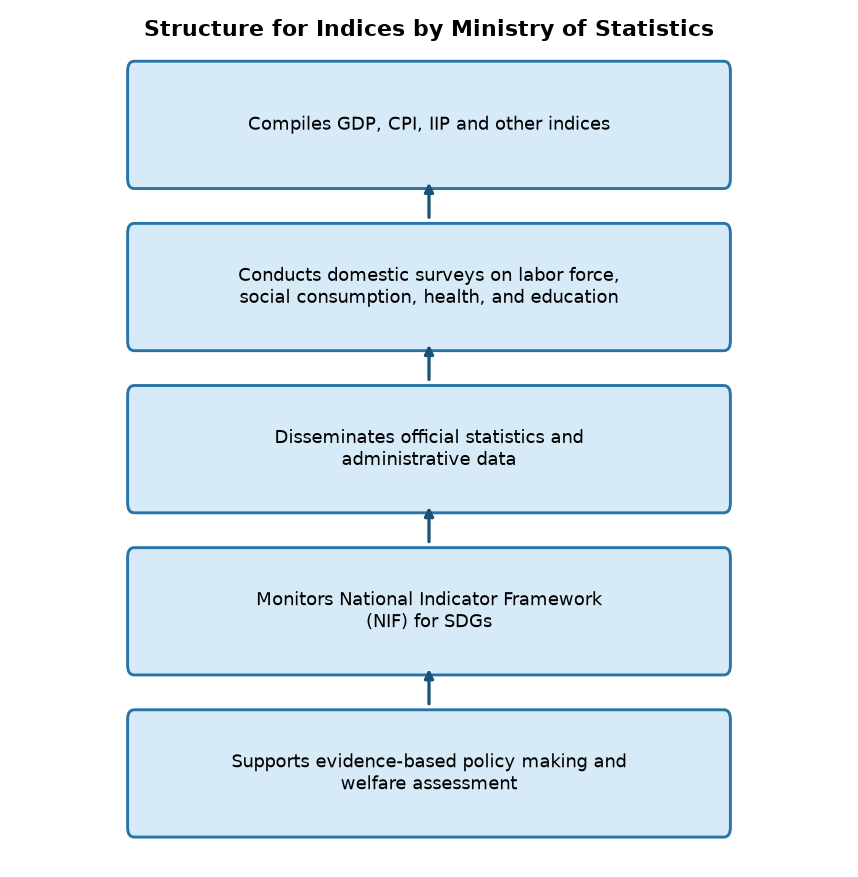
The Press Information Bureau (PIB) release dated 20 July 2026 highlights the Ministry of Statistics and Programme Implementation (MoSPI) as the nodal authority for the National Indicator Framework (NIF) under the Sustainable Development Goals (SDGs). It underscores MoSPI’s role in compiling key economic indices such as GDP, CPI, and IIP, alongside conducting household surveys on labour force, social consumption, health, and education. This institutional arrangement is critical for evidence-based policymaking and monitoring progress toward national and global development targets.
Background
- The Ministry of Statistics and Programme Implementation (MoSPI) is the apex body responsible for the coordination of statistical activities in India, as mandated by the National Statistical Commission (NSC) established in 2005.
- India’s commitment to the 2030 Agenda for Sustainable Development, adopted by the United Nations in 2015, necessitated the development of a National Indicator Framework (NIF) to align domestic monitoring with global SDG targets.
- The NIF was notified by MoSPI in 2018 and comprises 306 indicators across 17 SDGs, designed to track progress in poverty, health, education, gender equality, environmental sustainability, and other dimensions of human development.
- MoSPI compiles and disseminates official statistics through administrative data systems and large-scale household surveys, including the Periodic Labour Force Survey (PLFS), National Sample Survey (NSS), and Annual Health Survey (AHS).
- The release of GDP estimates, CPI, and IIP by MoSPI serves as foundational inputs for monetary policy, fiscal planning, and macroeconomic assessments by the Reserve Bank of India (RBI) and the Ministry of Finance.
- The National Statistical Commission (NSC) acts as an autonomous body to oversee the statistical system, ensuring credibility, independence, and methodological rigour in data generation.
What is the National Indicator Framework (NIF) and how does MoSPI contribute to it?
- The National Indicator Framework (NIF) is a structured set of 306 indicators aligned with the 17 Sustainable Development Goals (SDGs) and their 169 targets, adopted by India to monitor progress toward the 2030 Agenda for Sustainable Development.
- MoSPI serves as the nodal ministry for the NIF, coordinating with line ministries, state governments, and international agencies to ensure data availability, comparability, and timely reporting.
- The NIF is designed to be outcome-oriented, focusing on measurable changes in citizens’ well-being rather than mere output indicators, thereby enabling evidence-based policymaking and resource allocation.
- MoSPI compiles data from multiple sources, including administrative records (e.g., school enrolment, health facility utilisation) and household surveys (e.g., PLFS, NSS, NFHS), to populate the NIF indicators.
- The framework is periodically reviewed and updated to reflect new policy priorities, emerging data gaps, and methodological advancements, ensuring its relevance and utility for decision-makers.
- Indicators under the NIF are categorised into three tiers: Tier 1 (globally comparable), Tier 2 (national but comparable with sub-national data), and Tier 3 (unique to India or sub-national contexts), ensuring flexibility in monitoring.
- MoSPI’s role extends to capacity-building initiatives for state governments and statistical agencies to improve data quality, standardise methodologies, and enhance the utilisation of official statistics in governance.
- The NIF also supports India’s reporting obligations to the United Nations Statistical Division (UNSD) and other international bodies, facilitating global peer learning and benchmarking.
Key Features
| Feature | Significance |
|---|---|
| National Indicator Framework (NIF) for SDGs | Provides a structured set of 306 indicators across 17 SDGs to monitor progress, enabling evidence-based policy formulation and outcome assessment. |
| Gross Domestic Product (GDP) estimation | Serves as a primary macroeconomic indicator to measure the economic performance and growth trajectory of the nation. |
| Consumer Price Index (CPI) | Tracks inflation trends and cost of living, influencing monetary policy, wage adjustments, and social welfare schemes. |
| Index of Industrial Production (IIP) | Quantifies industrial activity, reflecting sectoral growth, employment trends, and economic diversification. |
| Household Surveys (e.g., Labour Force Survey, Social Consumption) | Generates granular data on employment, consumption patterns, health, and education, addressing data gaps in socio-economic dimensions. |
Why it Matters
Policy Formulation & Governance
- Enables the Union and State governments to design targeted interventions by aligning policies with empirical evidence derived from NIF indicators.
- Facilitates periodic assessment of developmental outcomes, ensuring accountability in public expenditure and programme implementation.
- Supports the formulation of the Annual Financial Statement (Budget) by providing reliable macroeconomic data for fiscal planning.
Socio-Economic Development
- Provides disaggregated data (e.g., gender, region, caste) to identify disparities and design inclusive policies for marginalised communities.
- Monitors progress towards SDG targets such as poverty reduction (SDG 1), quality education (SDG 4), and gender equality (SDG 5).
- Informs social welfare schemes (e.g., PM-KISAN, Ayushman Bharat) by identifying beneficiaries and evaluating impact.
Global Reporting & Diplomatic Engagement
- Submits India’s Voluntary National Review (VNR) to the United Nations High-Level Political Forum (HLPF) on SDG progress.
- Strengthens India’s position in international forums by showcasing data-driven commitments to sustainable development.
Data-Driven Decision Making
- Reduces reliance on anecdotal evidence by providing objective, verifiable data for policy evaluation.
- Enhances transparency and public trust through the dissemination of official statistics via platforms like the National Data Portal.
Challenges
1. Data Gaps & Survey Limitations
- Under-representation of remote, tribal, and conflict-affected regions in household surveys, leading to skewed policy responses.
- Lag in data dissemination due to the time-intensive nature of large-scale surveys (e.g., Periodic Labour Force Survey).
- Inconsistencies between administrative data (e.g., birth/death registrations) and survey-based estimates, complicating validation.
UPSC Link: Statistics Act, 2008
2. Technical & Methodological Constraints
- Difficulty in harmonising indicators across states due to varying definitions (e.g., poverty lines, employment metrics).
- Challenges in real-time data integration from diverse sources (e.g., GSTN, UIDAI) for dynamic policy adjustments.
- Limited capacity of state statistical systems to adopt advanced data analytics and geospatial mapping tools.
UPSC Link: National Statistical Commission
3. Political & Institutional Challenges
- Risk of data manipulation or suppression to align with political narratives, undermining credibility (e.g., GDP back-casting controversies).
- Fragmentation of statistical functions across ministries (e.g., NITI Aayog, MoSPI) leading to duplication or gaps.
- Inadequate funding for the National Statistical System (NSS), impacting survey frequency and quality.
UPSC Link: Constitutional Provisions
4. Sustainability & SDG Monitoring
- Selective prioritisation of SDG indicators based on political expediency, neglecting critical but less visible goals (e.g., SDG 12 on responsible consumption).
- Lack of standardised metrics for cross-national comparisons, limiting India’s participation in global benchmarking exercises.
- Delayed alignment of NIF with evolving global frameworks (e.g., 2030 Agenda revisions).
UPSC Link: SDG India Index
Challenges — UPSC Perspective
| Issue | Concern |
|---|---|
| Survey coverage gaps | Exclusion of vulnerable populations distorts developmental assessments. |
| Data latency | Delayed release of official statistics hampers timely policy responses. |
| Inter-state disparities | Variations in statistical methodologies impede equitable resource allocation. |
| Data privacy vs. utility | Balancing granularity with confidentiality in microdata dissemination. |
| Capacity constraints | State statistical departments lack technical expertise for advanced data processing. |
| Political interference | Risk of bias in data collection or suppression to serve electoral interests. |
Way Forward
- Strengthen the National Statistical System (NSS) by augmenting funding and modernising survey methodologies (e.g., digital data collection).
- Establish a multi-stakeholder task force to harmonise SDG indicators with state-specific priorities and global standards.
- Expand the coverage of household surveys to include marginalised groups through targeted sampling and community engagement.
- Develop a real-time data dashboard integrating administrative and survey data for dynamic policy monitoring (e.g., linked to GSTN and UIDAI).
- Enhance transparency by publishing raw survey data (anonymised) and methodological notes for public scrutiny.
- Invest in capacity-building for state statistical departments through training programmes in data analytics and geospatial tools.
- Institutionalise an independent audit mechanism for official statistics to ensure credibility and reduce political interference.
UPSC Value Addition
Keywords for Mains Answer-Writing
National Indicator Framework (NIF) · Sustainable Development Goals (SDGs) · National Statistical Office (NSO) · Official Statistics · Evidence-based policymaking · Gross Domestic Product (GDP) · Consumer Price Index (CPI) · Index of Industrial Production (IIP) · Household Surveys · Social and Economic Indicators · Administrative Data · Quality of Life Assessment
Constitutional & Policy Linkages
- Article 280: Finance Commission’s role in evaluating state finances using statistical data.
- Article 340: Backward Classes Commission’s reliance on socio-economic indicators for policy recommendations.
Concept Flow
Official statistics generation → Data dissemination via NSS and administrative records → Indicator framework development (NIF for SDGs) → Policy formulation and implementation → Outcome assessment and feedback loop for iterative improvements.
Prelims Practice Questions
Q1. Which of the following is NOT a function of the National Statistical Office (NSO) under the Ministry of Statistics and Programme Implementation?
- A. Compilation of Gross Domestic Product (GDP) estimates
- B. Conducting household surveys on labour force and social consumption
- C. Formulation of economic policies for the Union Government
- D. Dissemination of official statistics including CPI and IIP
Answer: C. Formulation of economic policies for the Union Government — The NSO compiles GDP estimates, conducts household surveys, and disseminates official statistics (CPI, IIP, etc.). However, formulation of economic policies is not its mandate; it is the domain of the Ministry of Finance and NITI Aayog.
Q2. The National Indicator Framework (NIF) for Sustainable Development Goals (SDGs) is primarily designed to:
- A. Track progress on social, economic, and environmental dimensions of development
- B. Replace the GDP as the sole measure of national progress
- C. Serve as a legal framework for environmental regulations
- D. Provide real-time data on stock market performance
Answer: A. Track progress on social, economic, and environmental dimensions of development — The NIF is a structured framework to monitor progress on SDGs across health, education, gender equality, environmental sustainability, and other dimensions, enabling evidence-based policymaking.
Q3. Which of the following indices is NOT compiled by the National Statistical Office (NSO)?
- A. Consumer Price Index (CPI)
- B. Index of Industrial Production (IIP)
- C. Human Development Index (HDI)
- D. Wholesale Price Index (WPI)
Answer: C. Human Development Index (HDI) — The NSO compiles CPI, IIP, and WPI. The Human Development Index (HDI) is published by the United Nations Development Programme (UNDP), not the NSO.
Mains Practice Question
✍ Examine the role of the National Statistical Office (NSO) in facilitating evidence-based policymaking in India. How does the National Indicator Framework (NIF) for Sustainable Development Goals (SDGs) contribute to this process? Substantiate your answer with relevant examples.
Approach: Begin by defining the NSO and its core functions, including the compilation of key economic indices (GDP, CPI, IIP) and the conduct of household surveys. Highlight its role in generating official statistics and administrative data. Then, discuss the NIF as a structured framework for monitoring SDG progress across multiple dimensions (health, education, gender equality, environmental sustainability). Emphasise how the integration of NSO data with NIF indicators enables policymakers to assess development outcomes, identify gaps, and design targeted interventions. Conclude by underscoring the importance of robust statistical systems in achieving inclusive and sustainable development.
Source: PIB (Press Information Bureau)
Generated by AanyaAi for educational purpose.


No Comments