


06 Aug UPSC Alert: India-AI Mission & Semiconductor Push for Self-Reliance
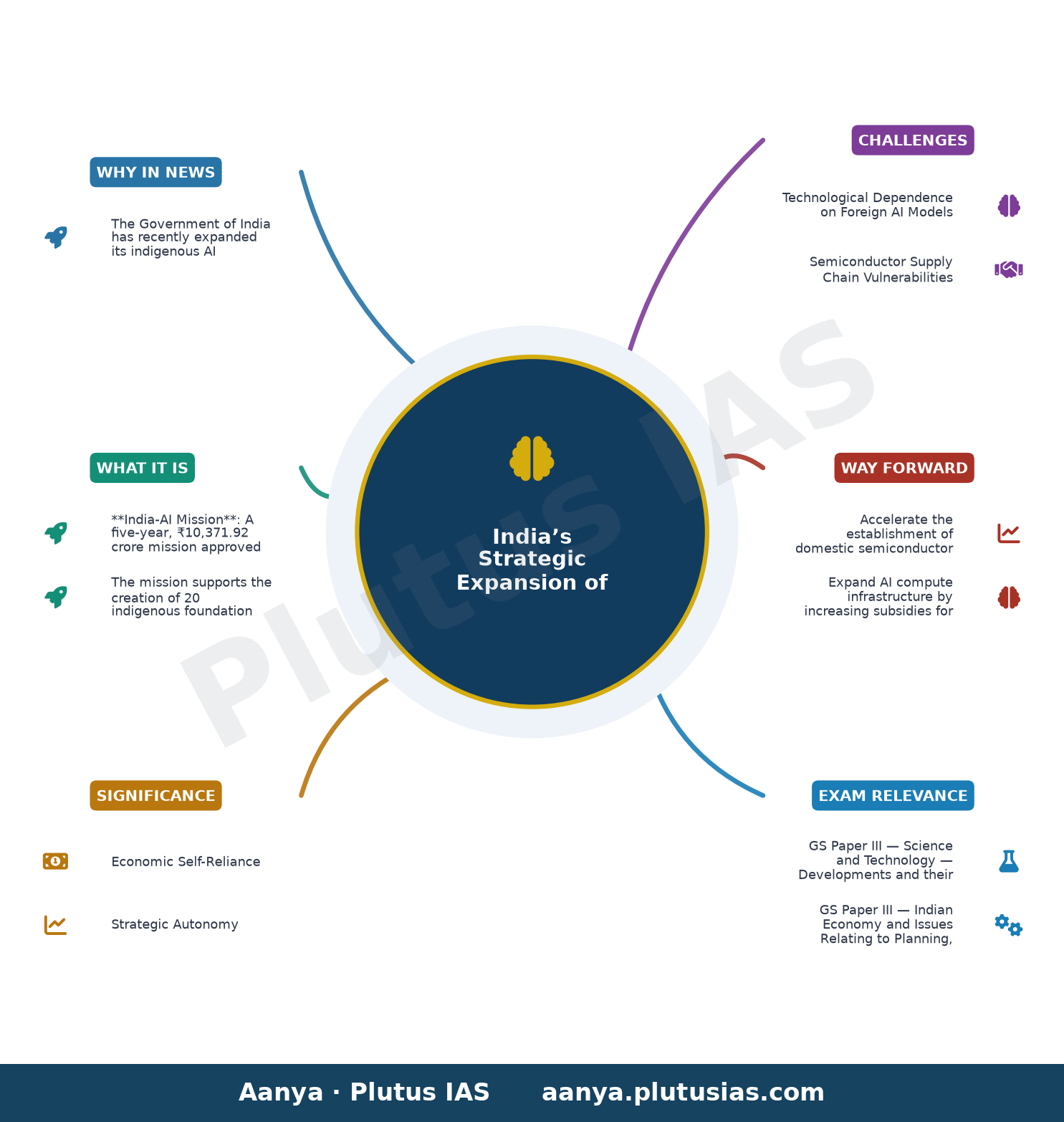
✎ The Government of India has recently expanded its indigenous AI infrastructure through the India-AI Mission and semiconductor initiatives, as announced by the Ministry of Electronics and Information Technology.
Subject Relevance — Where This Topic Fits
- GS Paper III — Science and Technology — Developments and their Applications and Effects in Everyday Life | GS Paper III — Indian Economy and Issues Relating to Planning, Mobilisation of Resources, Growth, Development and Employment | GS Paper III — Infrastructure: Energy, Ports, Roads, Airports, Railways etc.
- Prelims: Artificial Intelligence (AI), Foundation Models, Large Multimodal Models (LMM), Small Language Models (SLM), Semiconductor Manufacturing, Compute Infrastructure, GPU Hours, National Mission on Interdisciplinary Cyber-Physical Systems (NM-ICPS), Technology Innovation Hubs (TIH), Semicon 2.0, BharatGen, Sarvam AI, Aatmanirbhar Bharat, PLI Scheme, Production-Linked Incentive Scheme, Digital Public Infrastructure (DPI)
- Essay: Technological Self-Reliance and the Future of Global Innovation: India’s AI and Semiconductor Strategy, Balancing Global Integration with Domestic Innovation: Lessons from India’s AI and Semiconductor Ecosystem
Why is this in the news?
The Government of India has recently expanded its indigenous AI infrastructure through the India-AI Mission and semiconductor initiatives, as announced by the Ministry of Electronics and Information Technology. This strategic move aims to reduce reliance on foreign AI models and semiconductor supply chains while fostering domestic innovation, economic opportunities, and technological sovereignty. The expansion includes the development of indigenous foundation models, enhanced AI compute capacity, and the rollout of the Semicon 2.0 framework, positioning India as a global leader in AI-driven technological self-reliance.
Background
- The Union Cabinet approved the India-AI Mission on 7 March 2024 with a budget outlay of ₹10,371.92 crore over five years, aligning with India’s broader developmental goals and the vision of ‘Aatmanirbhar Bharat’ (Self-Reliant India).
- India’s AI strategy is rooted in the Prime Minister’s vision of making technology accessible to all citizens while addressing India-specific challenges such as linguistic diversity, digital divide, and economic disparities.
- The semiconductor industry is identified as a foundational sector critical for national security, economic growth, and technological independence, given its role in powering AI, electronics, and digital infrastructure.
- The government has acknowledged risks associated with limited domestic capabilities in AI compute infrastructure, foundational models, and semiconductor manufacturing, necessitating a multi-dimensional approach to mitigate supply chain vulnerabilities.
- The India Semiconductor Mission (ISM) and the Production-Linked Incentive (PLI) Scheme for semiconductors are key policy instruments designed to attract investment and build a robust domestic semiconductor ecosystem.
What are the India-AI Mission and Semiconductor Initiatives?
- **India-AI Mission**: A five-year, ₹10,371.92 crore mission approved by the Union Cabinet to develop a robust and inclusive AI ecosystem in India. It focuses on indigenous AI model development, AI compute infrastructure, application development, and capacity building.
- The mission supports the creation of 20 indigenous foundation models, including 12 Large Multimodal Models (LMMs) and 8 Small Language Models (SLMs), with intellectual property rights retained by Indian applicants. Notable initiatives include Sarvam AI’s 30 billion and 105 billion parameter models, BharatGen’s multilingual foundation models (Param 2-17B, Patram-7B, Shrutam-2), and Avatar AI’s video generation models.
- The mission has approved 237 projects for subsidised AI compute support, totalling 93.18 lakh GPU hours, and has initiated the procurement of a 1.1 EFLOPS high-performance AI compute system at the NIC Data Centre in Delhi.
- To foster innovation, 11 national-level hackathons and innovation challenges have been launched, resulting in 62 AI prototypes and the deployment of 20 AI solutions in public sector institutions.
- The mission also prioritises the development of 58 AI Excellence Centres across states and Union Territories, with 22 centres already operational in 13 regions, aimed at decentralising AI expertise and fostering regional innovation hubs.
- The mission includes 13 projects focused on bias mitigation, machine unlearning, privacy-preserving AI, algorithm auditing, and explainability to ensure ethical and trustworthy AI deployment.
- The mission aligns with the broader goal of positioning India as a global leader in AI by leveraging its demographic dividend, linguistic diversity, and growing digital infrastructure.
Key Features
| Feature | Significance |
|---|---|
| Indigenous AI Foundation Models | Development of 20 home-grown models (12 Large Multimodal Models and 8 Small Language Models) under ‘IndiaAI Mission’ to reduce dependency on foreign AI technologies and enhance technological sovereignty. |
| AI Compute Infrastructure | Expansion of high-performance AI compute systems, including a 1.1 EFLOPS system at NIC Data Centre, Delhi, and subsidy support for 237 projects with 93.18 lakh GPU hours to democratise access to computing resources. |
| Semiconductor Manufacturing Initiatives | Structured policy measures to strengthen domestic semiconductor manufacturing, aligning with the vision of making India a global hub for electronics manufacturing. |
| AI Excellence Centres | Establishment of 58 AI excellence centres across states and UTs, with 22 already operational, to foster regional innovation and skill development in AI. |
| Safe and Trustworthy AI | Focus on bias mitigation, privacy-preserving AI, algorithm auditing, and explainability through 13 selected projects to ensure ethical and reliable AI systems. |
Why it Matters
Economic Self-Reliance
- Reduces import dependency on advanced AI and semiconductor technologies, aligning with ‘Atmanirbhar Bharat’ objectives.
- Enhances India’s position in the global AI and semiconductor value chains, attracting investment and fostering job creation.
- Promotes indigenous innovation, reducing long-term costs and improving accessibility of AI solutions for public and private sectors.
Strategic Autonomy
- Strengthens India’s technological sovereignty by reducing vulnerabilities in critical AI and semiconductor supply chains.
- Mitigates geopolitical risks associated with over-reliance on foreign technologies, particularly in defence and strategic sectors.
- Supports the development of indigenous AI models for language, governance, and public service delivery, reducing exposure to foreign surveillance risks.
Skill Development and Human Capital
- Creates a skilled workforce through fellowships, training programs, and incubation support for AI and semiconductor professionals.
- Fosters interdisciplinary research and innovation via 25 Technology Innovation Hubs under NM-ICPS, covering AI, robotics, IoT, and quantum technologies.
- Encourages entrepreneurship and deep-tech startups, aligning with the goal of making India a global leader in AI-driven industries.
Public Service Delivery
- Enables development of AI solutions tailored to India-specific challenges, such as healthcare, agriculture, and education.
- Supports deployment of AI solutions in public sector institutions, improving efficiency and accessibility of government services.
- Facilitates multilingual AI models to bridge linguistic divides and ensure inclusive digital governance.
Challenges
1. Technological Dependence on Foreign AI Models
- India currently relies heavily on foreign AI models for critical applications, raising concerns about data privacy and geopolitical leverage.
- Limited control over proprietary AI models may hinder customisation for India-specific needs, such as regional languages and local governance challenges.
UPSC Link: GS3: Science & Tech
2. Semiconductor Supply Chain Vulnerabilities
- Semiconductor manufacturing is capital-intensive and requires long-term investment in R&D, infrastructure, and skilled manpower.
- Global semiconductor supply chains are concentrated in a few countries, making India vulnerable to disruptions and price fluctuations.
- Domestic semiconductor fabrication facilities face competition from established global players, necessitating targeted policy support.
UPSC Link: GS3: Industrial Policy
3. High Computational Costs and Infrastructure Gaps
- AI compute infrastructure requires significant investment in hardware, data centres, and energy resources, posing financial challenges.
- Uneven distribution of compute resources across states may exacerbate regional disparities in AI adoption and innovation.
UPSC Link: GS3: Infrastructure
4. Ethical and Regulatory Challenges in AI
- Ensuring fairness, transparency, and accountability in AI systems remains a critical challenge, particularly in public sector applications.
- Lack of a comprehensive AI regulatory framework may lead to misuse of AI technologies or unintended societal consequences.
- Balancing innovation with ethical considerations, such as bias mitigation and data privacy, requires robust governance mechanisms.
UPSC Link: GS4: Ethics & Governance
5. Talent Shortage in AI and Semiconductor Sectors
- India faces a significant shortage of skilled professionals in AI, semiconductor design, and advanced manufacturing.
- Brain drain and limited industry-academia collaboration hinder the development of a robust talent pipeline.
UPSC Link: GS3: Human Resource Development
Challenges — UPSC Perspective
| Issue | Concern |
|---|---|
| Data Privacy and Sovereignty | Risk of unauthorised access to sensitive data by foreign AI models, necessitating robust data governance frameworks. |
| High Capital Expenditure | Significant upfront investment required for AI compute infrastructure and semiconductor fabrication, posing financial sustainability challenges. |
| Regulatory Fragmentation | Lack of a unified AI policy may lead to inconsistent implementation and gaps in oversight across sectors. |
| Global Competition | Established semiconductor and AI hubs in countries like the US, China, and South Korea pose stiff competition to India’s domestic initiatives. |
| Skill Mismatch | Gap between industry requirements and academic curricula in AI and semiconductor technologies delays workforce readiness. |
| Ethical Dilemmas | Potential misuse of AI in surveillance, deepfakes, or algorithmic bias requires proactive ethical safeguards. |
Government Initiatives — Must-Memorise for Prelims
- IndiaAI Mission
- India Semiconductor Mission
- National Mission on Interdisciplinary Cyber-Physical Systems (NM-ICPS)
- Production-Linked Incentive (PLI) Scheme for Semiconductors and Display Manufacturing
Way Forward
- Accelerate the establishment of domestic semiconductor fabrication facilities with targeted incentives and public-private partnerships.
- Expand AI compute infrastructure by increasing subsidies for GPU access and setting up regional data centres to reduce latency and costs.
- Develop a comprehensive AI regulatory framework to address ethical, legal, and societal implications of AI adoption.
- Strengthen industry-academia collaboration through joint R&D projects, internships, and faculty exchange programs in AI and semiconductor technologies.
- Enhance skill development initiatives, including upskilling programs for professionals and school-level STEM education to build a future-ready workforce.
- Promote open-source AI models and frameworks to foster innovation and reduce dependency on proprietary technologies.
- Establish a national AI data governance policy to ensure data privacy, security, and interoperability across sectors.
- Encourage startups and MSMEs in AI and semiconductor sectors through incubation support, funding, and mentorship programs.
UPSC Value Addition
Keywords for Mains Answer-Writing
Artificial Intelligence (AI) Mission · Semiconductor Mission · Indigenous AI infrastructure · National Mission on Interdisciplinary Cyber-Physical Systems (NM-ICPS) · Foundation Models · AI Compute Capacity · Semiconductor 2.0 · Technology Self-Reliance · AI Excellence Centres · Public Sector AI Deployment
Concept Flow
Vision of Technological Sovereignty (Atmanirbhar Bharat) → Policy Initiatives (IndiaAI Mission, India Semiconductor Mission) → Indigenous AI and Semiconductor Development → Expansion of AI Compute Infrastructure → Skill Development and Innovation Ecosystem → Enhanced Public Service Delivery and Economic Growth → Reduced Import Dependency and Strategic Autonomy
Prelims Practice Questions
Q1. Consider the following statements regarding the ‘India-AI Mission’:
1. It was approved by the Union Cabinet on 7 March 2024.
2. The mission aims to develop indigenous foundation models, including Large Multimodal Models (LMMs) and Small Language Models (SLMs).
3. The mission does not provide subsidies for AI compute support to projects.
4. The mission has approved 237 projects under its compute support scheme.
How many of the above statements are correct?
- Only one
- Only two
- Only three
- All
Answer: All — Statements 1, 2, and 4 are correct. Statement 3 is incorrect as the mission does provide subsidies for AI compute support, with 237 projects approved and 93.18 lakh GPU hours sanctioned.
Q2. Assertion (A): The National Mission on Interdisciplinary Cyber-Physical Systems (NM-ICPS) aims to establish 25 Technology Innovation Hubs (TIHs) across India.
Reason (R): These TIHs focus on areas such as AI, machine learning, robotics, and quantum technologies to foster innovation and entrepreneurship.
In the context of the above two statements, which of the following is correct?
- Both A and R are true, and R is the correct explanation of A.
- Both A and R are true, but R is not the correct explanation of A.
- A is true, but R is false.
- A is false, but R is true.
Answer: Both A and R are true, but R is not the correct explanation of A. — Both the assertion and reason are true. The NM-ICPS indeed aims to establish 25 TIHs (A), and these hubs focus on AI, machine learning, robotics, and quantum technologies (R), making R the correct explanation of A.
Q3. Which of the following is NOT a component of the ‘India-AI Mission’ as outlined in the recent government initiatives?
- Development of indigenous foundation models like ‘Sarvam’ and ‘BharatGen’
- Establishment of AI Excellence Centres across states and Union Territories
- Subsidies for AI compute support to approved projects
- Direct manufacturing of semiconductor chips in India without any foreign collaboration
Answer: Direct manufacturing of semiconductor chips in India without any foreign collaboration — The ‘India-AI Mission’ includes the development of indigenous foundation models, establishment of AI Excellence Centres, and subsidies for AI compute support. However, it does not directly involve the manufacturing of semiconductor chips, which is covered under the ‘Semiconductor Mission’.
Mains Practice Question
✍ Critically analyse the significance of the ‘India-AI Mission’ and the ‘Semiconductor Mission’ in achieving technology self-reliance in India. How do these initiatives address the challenges in the AI value chain and semiconductor manufacturing? Also, examine the role of the National Mission on Interdisciplinary Cyber-Physical Systems (NM-ICPS) in fostering innovation and skill development in emerging technologies. (15 Marks)
Approach: MODEL-ANSWER SKELETON:
1. **Introduction**: Define technology self-reliance and its importance for India’s strategic autonomy and economic growth.
2. **India-AI Mission**:
– Purpose and budget (₹10,371.92 crore over 5 years).
– Key components: Indigenous foundation models (e.g., ‘Sarvam’, ‘BharatGen’), AI compute capacity, and subsidies for projects.
– Addressing challenges: Limited domestic capabilities in AI infrastructure, bias mitigation, and explainable AI.
3. **Semiconductor Mission**:
– Objective: Strengthening domestic semiconductor manufacturing and reducing reliance on imports.
– Role in AI value chain: Semiconductors are critical for AI hardware and infrastructure.
4. **NM-ICPS**:
– Purpose: Interdisciplinary research in cyber-physical systems, AI, robotics, and quantum technologies.
– Components: 25 Technology Innovation Hubs (TIHs), skill development, and entrepreneurship support.
5. **Challenges and Limitations**:
– High capital investment required for semiconductor manufacturing.
– Competition from global players like the US, China, and Taiwan.
– Need for sustained funding and R&D collaboration.
6. **Conclusion**: Summarise the strategic importance of these initiatives and their potential to position India as a global leader in AI and semiconductor technologies.
Source: PIB (Press Information Bureau)
Generated by AanyaAi for educational purpose.

- सर्वोच्च न्यायालय ने सीईसी और ईसी की नियुक्ति संबंधी कानून को पांच न्यायाधीशों की संविधान पीठ को भेजा - September 23, 2026
- Supreme Court to Hear Plea on CEC, ECs Appointment Law 2023 - September 23, 2026
- बेंगलुरु की रक्षा फर्म ने 100 घंटे की उड़ान परीक्षण पूरी की: देश का पहला AI-संचालित लड़ाकू विमान - September 23, 2026

No Comments