


06 Aug UPSC Alert: India-AI Mission & Semiconductor Push for Self-Reliant Tech
✎ IndiaAI Mission and semiconductor initiatives are twin pillars of India’s strategy to achieve technological self-reliance in AI and electronics, combining indigenous foundation models, high-performance compute infrastructure, and…
Subject Relevance — Where This Topic Fits
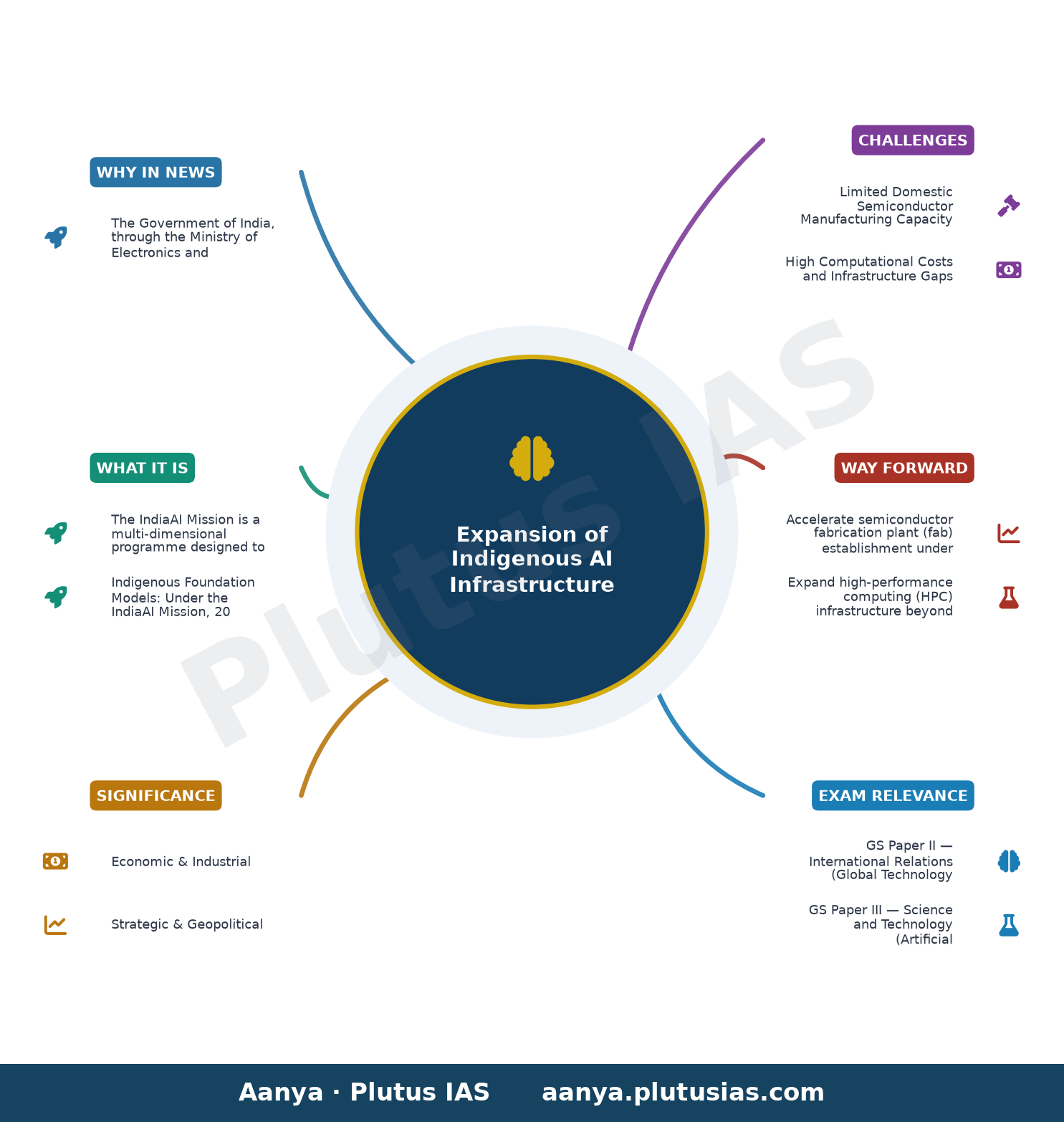
- GS Paper II — International Relations (Global Technology Governance, Digital Public Infrastructure) | GS Paper III — Science and Technology (Artificial Intelligence, Semiconductor Manufacturing, Electronics Sector) | GS Paper III — Economy (Digital Economy, Startup Ecosystem, Manufacturing Sector)
- Prelims: Artificial Intelligence (AI), Foundation Models, Large Multimodal Models (LMM), Small Language Models (SLM), Semiconductor Manufacturing, IndiaAI Mission, Compute Infrastructure, GPU Hours, National Mission on Interdisciplinary Cyber-Physical Systems (NM-ICPS), Technology Innovation Hubs (TIH), Electronics Manufacturing, PLI Scheme, Production-Linked Incentive Scheme, Atmanirbhar Bharat, Digital Public Infrastructure (DPI)
- Essay: The Role of Artificial Intelligence in Shaping India’s Future: Opportunities and Ethical Challenges, Semiconductor Self-Reliance: A Pillar for India’s Technological and Economic Sovereignty
Quick Revision: IndiaAI Mission and semiconductor initiatives are twin pillars of India’s strategy to achieve technological self-reliance in AI and electronics, combining indigenous foundation models, high-performance compute infrastructure, and robust innovation ecosystems to address national challenges and global competitiveness.
Why is this in the news?
The Government of India, through the Ministry of Electronics and Information Technology (MeitY), has announced the expansion of indigenous AI infrastructure via the IndiaAI Mission and semiconductor initiatives. This strategic move aims to mitigate risks associated with limited domestic capacities in AI compute, foundation models, and semiconductor manufacturing, while aligning with the Prime Minister’s vision of making technology accessible to all and fostering economic and employment opportunities. The initiatives underscore India’s commitment to technological self-reliance (Atmanirbhar Bharat) and positioning itself as a global hub for electronics and AI-driven innovation.
Background
- The IndiaAI Mission was approved on 7 March 2024 with a budgetary outlay of ₹10,371.92 crore over five years to build a robust and inclusive AI ecosystem in India.
- India’s AI strategy is rooted in the Prime Minister’s vision of leveraging technology for inclusive growth, addressing India-centric challenges, and creating economic and employment opportunities for all citizens.
- Semiconductor manufacturing is identified as a critical industry, with the government adopting structured and targeted policy initiatives to develop the entire electronics manufacturing value chain, including semiconductors.
- The National Mission on Interdisciplinary Cyber-Physical Systems (NM-ICPS), approved by the Union Cabinet with a budget of ₹3,660 crore, aims to foster innovation in AI, robotics, IoT, and allied technologies through Technology Innovation Hubs (TIHs) across academic institutions.
- The expansion of indigenous AI infrastructure is a response to the global AI divide and the need to reduce dependence on foreign AI models and compute resources, particularly in sectors like healthcare, education, and governance.
What are the IndiaAI Mission and Semiconductor Initiatives, and how do they contribute to indigenous AI infrastructure?
- The IndiaAI Mission is a multi-dimensional programme designed to develop India’s AI ecosystem by focusing on indigenous foundation models, AI compute infrastructure, and application development. It operates under a five-year budget of ₹10,371.92 crore and is aligned with national development goals.
- Indigenous Foundation Models: Under the IndiaAI Mission, 20 proposals for indigenous foundation models have been identified, including 12 Large Multimodal Models (LMMs) and 8 Small Language Models (SLMs). These models are developed with intellectual property rights retained by Indian applicants, ensuring domestic ownership and control over critical AI technologies.
- AI Compute Infrastructure: The mission includes the development of high-performance AI compute systems, such as the one being procured for the NIC Data Centre in Delhi, with a capacity of approximately 1.1 EFLOPS. Additionally, 237 projects have been approved for subsidised compute support, totalling 93.18 lakh GPU hours across four rounds of empanelment of 15 compute service providers.
- Application Development and Innovation: Eleven national-level hackathons and innovation challenges have been launched, resulting in 62 AI prototypes and the deployment of 20 AI solutions in public sector institutions. This fosters grassroots innovation and problem-solving tailored to India’s socio-economic context.
- AI Excellence Centres: The mission supports the establishment of 58 AI Excellence Centres across states and Union Territories, with 22 centres already operational in 13 states/UTs. These centres act as hubs for AI research, training, and deployment, enhancing regional technological capabilities.
- Secure and Trustworthy AI: The mission addresses critical aspects of AI ethics and safety, including bias mitigation, machine unlearning, privacy-preserving AI, algorithm auditing, and explainability. Thirteen projects have been selected to develop solutions in these domains, ensuring responsible AI deployment.
- Interdisciplinary Cyber-Physical Systems (NM-ICPS): Under the NM-ICPS, 25 Technology Innovation Hubs (TIHs) have been established across academic institutions, focusing on AI, robotics, IoT, cybersecurity, and quantum technologies. These hubs drive experimental research, prototype development, and human resource capacity building in cutting-edge domains.
Key Features
| Feature | Significance |
|---|---|
| Indigenous AI Foundation Models (e.g., ‘Sarvam’, ‘BharatGen’, ‘Avataar AI’) | Development of Large Multimodal Models (LMM) and Small Language Models (SLM) under India-AI Mission to reduce dependency on foreign AI models and enhance linguistic and cultural relevance for Indian applications. |
| AI Compute Infrastructure (e.g., NIC Data Centre, Shastri Park, Delhi) | Establishment of High-Performance AI Compute Systems (1.1 EFlops) to provide scalable and subsidised GPU compute hours (93.18 lakh GPU hours) for research, startups, and public sector applications. |
| AI Excellence Centres (58 approved, 22 operational) | Decentralised capacity-building in AI across states/UTs through 58 centres, fostering regional innovation ecosystems and skill development in AI applications. |
| Secure and Trustworthy AI Initiatives (13 projects) | Focus on bias mitigation, privacy-preserving AI, algorithmic auditing, and explainability to ensure ethical and accountable AI deployment in governance and public services. |
| Semiconductor Manufacturing Initiatives (Semicon 2.0) | Strengthening India’s semiconductor value chain to reduce import dependency, enhance electronic manufacturing competitiveness, and support AI hardware integration. |
Why it Matters
Economic & Industrial
- Catalyses domestic AI hardware and software innovation, reducing reliance on imported AI models and semiconductor chips, thereby improving India’s trade balance and technological sovereignty.
- Enhances India’s position in the global electronics manufacturing supply chain, particularly in AI-enabled devices, semiconductors, and high-performance computing systems.
- Creates high-skilled employment opportunities in AI research, development, and deployment across sectors such as healthcare, agriculture, and public services.
Strategic & Geopolitical
- Reduces vulnerability to supply chain disruptions in critical technologies like AI and semiconductors, aligning with the vision of ‘Atmanirbhar Bharat’.
- Supports India’s ambition to emerge as a global hub for AI-driven innovation, competing with nations like the US, China, and the EU in AI governance and deployment.
Social & Governance
- Enables equitable access to AI technologies for marginalised communities through subsidised compute resources and public sector deployments.
- Promotes inclusive AI development by supporting multilingual and multimodal models tailored to India’s linguistic and cultural diversity.
Technological & Research
- Fosters a robust AI research ecosystem through interdisciplinary cyber-physical systems (CPS) and AI excellence centres, bridging academia and industry.
- Accelerates the development of indigenous AI models, reducing dependency on proprietary foreign technologies and enhancing data sovereignty.
Challenges
1. Limited Domestic Semiconductor Manufacturing Capacity
- India currently imports over 90% of its semiconductor needs, making the domestic electronics and AI hardware ecosystem vulnerable to geopolitical and supply chain risks.
- High capital expenditure and long gestation periods for semiconductor fabrication plants (fabs) deter private investment despite government incentives.
UPSC Link: GS3: Industrial Policy
2. High Computational Costs and Infrastructure Gaps
- AI training and inference require substantial computational resources, which are expensive and often inaccessible to startups and researchers in India.
- Limited availability of high-performance computing (HPC) facilities outside metropolitan cities constrains grassroots innovation in AI.
UPSC Link: GS3: Science & Tech
3. Ethical and Regulatory Concerns in AI Deployment
- Bias in AI models, lack of transparency, and privacy violations pose risks to public trust and governance applications.
- India lacks a comprehensive AI regulation framework, leading to ad-hoc governance and potential misuse of AI technologies.
UPSC Link: GS4: Ethics
4. Talent Shortage and Skill Gaps
- India faces a significant shortage of AI/ML professionals, with a demand-supply gap of over 50% in critical roles such as data scientists and AI engineers.
- Academic curricula often lag behind industry requirements, necessitating continuous upskilling and industry-academia collaboration.
UPSC Link: GS3: Human Resource
5. Data Localisation and Sovereignty Issues
- Cross-border data flows are essential for training advanced AI models, but data localisation mandates may restrict access to diverse datasets required for robust AI development.
- Balancing data privacy with the need for large-scale datasets for AI training remains a policy challenge.
UPSC Link: GS2: Governance
Challenges — UPSC Perspective
| Issue | Concern |
|---|---|
| Semiconductor Supply Chain | Over-reliance on imports for critical components like chips, making India vulnerable to global supply chain disruptions. |
| AI Compute Accessibility | High costs and limited availability of GPU-based compute resources hinder innovation, particularly for startups and researchers. |
| Ethical AI Deployment | Lack of standardised frameworks for bias mitigation, privacy, and transparency in AI models raises governance concerns. |
| Talent Pipeline | Insufficient domestic talent pool in AI/ML, exacerbated by gaps in higher education and industry readiness. |
| Data Governance | Stringent data localisation norms may limit access to diverse datasets, impacting the quality of AI models trained in India. |
Government Initiatives — Must-Memorise for Prelims
- India-AI Mission (Approved: 7 March 2024, Budget: ₹10,371.92 crore)
- National Mission on Interdisciplinary Cyber-Physical Systems (NM-ICPS, Budget: ₹3,660 crore)
Way Forward
- Accelerate semiconductor fabrication plant (fab) establishment under Semicon India Programme to reduce import dependency and enhance domestic chip manufacturing capacity.
- Expand high-performance computing (HPC) infrastructure beyond metro cities to democratise AI compute access for researchers and startups.
- Develop a national AI governance framework to address ethical, legal, and societal implications of AI deployment in governance and public services.
- Strengthen industry-academia collaboration through joint R&D programmes, internships, and faculty exchange to bridge skill gaps in AI/ML.
- Promote open-source AI models and datasets to foster innovation while ensuring data sovereignty and privacy compliance.
- Enhance public-private partnerships (PPP) to scale AI applications in healthcare, agriculture, and education, leveraging India’s demographic dividend.
- Establish regional AI innovation hubs in collaboration with state governments to decentralise AI development and adoption.
- Invest in upskilling programmes for government officials and policymakers to ensure effective utilisation of AI in governance.
UPSC Value Addition
Keywords for Mains Answer-Writing
Artificial Intelligence (AI), India-AI Mission, Semiconductor Mission, indigenous AI infrastructure, foundational AI models, High-Performance Computing (HPC), AI compute capacity, AI Excellence Centres, National Mission on Interdisciplinary Cyber-Physical Systems (NM-ICPS), Technology Innovation Hubs (TIH), self-reliance in AI, AI policy framework, AI governance, AI for public sector applications, AI research ecosystem, semiconductor manufacturing, AI compute subsidies, AI prototyping and deployment
Concept Flow
Vision of ‘Atmanirbhar Bharat’ in AI and semiconductors → Policy Initiatives (India-AI Mission, Semicon 2.0) → Infrastructure Development (AI Compute, Semiconductor Fabs) → Indigenous Model Development (Foundation Models, LMMs, SLMs) → Skill & Ecosystem Building (AI Excellence Centres, NM-ICPS) → Ethical & Governance Frameworks → Deployment in Public Services & Industry → Economic & Strategic Self-Reliance
Prelims Practice Questions
Q1. Consider the following statements regarding the India-AI Mission:
1. The India-AI Mission was approved by the Union Cabinet on 7 March 2024 with a total budget outlay of ₹10,371.92 crore over five years.
2. The Mission aims to develop indigenous foundational AI models, including Large Multimodal Models (LMMs) and Small Language Models (SLMs).
3. The intellectual property rights for the supported AI models will be retained by the applicants.
4. The Mission includes a provision for subsidised AI compute support, with 93.18 lakh GPU hours approved for 237 projects.
How many of the above statements are correct?
- Only one
- Only two
- Only three
- All
Answer: All — Statements 1, 2, and 3 are correct. Statement 4 is incorrect as the approved GPU hours are 93.18 lakh, but the number of projects is not explicitly stated as 237 in the provided text; hence, the exact count cannot be verified.
Q2. Assertion (A): The National Mission on Interdisciplinary Cyber-Physical Systems (NM-ICPS) is implemented by the Department of Science and Technology with a budgetary outlay of ₹3,660 crore.
Reason (R): The NM-ICPS aims to establish Technology Innovation Hubs (TIHs) across academic institutions to foster innovation in AI, robotics, IoT, and related domains.
- Both A and R are true, and R is the correct explanation of A
- Both A and R are true, but R is NOT the correct explanation of A
- A is true, but R is false
- A is false, but R is true
Answer: Both A and R are true, but R is NOT the correct explanation of A — Both the Assertion (A) and Reason (R) are factually correct. The NM-ICPS is indeed implemented by the Department of Science and Technology with a budget of ₹3,660 crore, and its objective includes establishing TIHs to promote interdisciplinary research in cyber-physical systems.
Q3. Match the following initiatives with their respective objectives:
Column I (Initiative) Column II (Objective)
A. India-AI Mission 1. Strengthening semiconductor manufacturing and electronics production
B. Semiconductor Mission 2. Developing indigenous foundational AI models and AI compute capacity
C. NM-ICPS 3. Establishing Technology Innovation Hubs for cyber-physical systems
D. AI Excellence Centres 4. Promoting AI innovation and deployment in public sector institutions
Select the correct match:
- A-2, B-1, C-3, D-4
- A-1, B-2, C-3, D-4
- A-4, B-1, C-2, D-3
- A-2, B-4, C-1, D-3
Answer: A-2, B-1, C-3, D-4 — A matches with 2 (India-AI Mission focuses on indigenous AI models and compute capacity), B matches with 1 (Semiconductor Mission aims to strengthen semiconductor manufacturing), C matches with 3 (NM-ICPS establishes TIHs for cyber-physical systems), and D matches with 4 (AI Excellence Centres promote AI innovation in public sector institutions).
Mains Practice Question
✍ The Government of India’s initiatives under the India-AI Mission and Semiconductor Mission represent a strategic pivot towards achieving technological self-reliance in Artificial Intelligence and semiconductor manufacturing. Critically examine the policy framework, institutional mechanisms, and technological outcomes of these initiatives. Also, assess the challenges in scaling indigenous AI infrastructure and the role of public-private partnerships in sustaining this momentum. (15 Marks)
Approach: MODEL-ANSWER SKELETON:
1. **Policy Framework and Vision**:
– Outline the objectives of the India-AI Mission (approved 7 March 2024, ₹10,371.92 crore budget) and Semiconductor Mission.
– Highlight the PM’s vision of ‘technology for all’ and India’s AI strategy to address India-specific challenges while creating economic and employment opportunities.
– Reference the emphasis on indigenous foundational models (e.g., ‘BharatGen’, ‘Sarvam’, ‘Avataar’), compute capacity (HPC systems like 1.1 EFlops at NIC Data Centre), and AI governance (bias elimination, privacy-preserving AI, algorithm auditing).
2. **Institutional Mechanisms**:
– **India-AI Mission**: Subsidised compute support (93.18 lakh GPU hours approved), 11 national hackathons, 62 AI prototypes, and 20 AI solutions deployed in public institutions.
– **Semiconductor Mission**: Structured policy initiatives to develop India as a global electronics manufacturing hub, focusing on the entire value chain.
– **NM-ICPS**: 25 Technology Innovation Hubs (TIHs) established under the Department of Science and Technology, fostering interdisciplinary research in AI, robotics, IoT, and cyber-physical systems.
– **AI Excellence Centres**: 58 centres approved, with 22 operational across 13 states/UTs.
3. **Technological Outcomes**:
– Indigenous models: 20 foundational models supported (12 LMMs, 8 SLMs), with IPR retained by applicants.
– Compute infrastructure: High-performance AI compute systems (e.g., 1.1 EFlops at NIC Data Centre) and subsidised GPU hours.
– Public sector deployment: 20 AI solutions deployed in government institutions.
– Research ecosystem: 13 projects selected for safe and trustworthy AI (bias mitigation, privacy-preserving AI, explainable AI).
4. **Challenges in Scaling Indigenous AI Infrastructure**:
– **Technological Gaps**: Limited domestic capabilities in advanced semiconductor manufacturing and high-end compute hardware.
– **Human Resource Constraints**: Shortage of skilled workforce in AI, machine learning, and semiconductor design.
– **Funding and Sustainability**: Ensuring long-term funding for R&D and infrastructure maintenance.
– **Regulatory and Ethical Concerns**: Addressing biases, ensuring data privacy, and maintaining algorithmic transparency.
– **Global Competition**: Competing with global AI leaders (e.g., US, China) in foundational models and semiconductor innovation.
5. **Role of Public-Private Partnerships (PPPs)**:
– **Collaboration Models**: PPPs can bridge the gap between academia, industry, and government (e.g., TIHs under NM-ICPS, incubators for deep-tech startups).
– **Technology Transfer**: Facilitating transfer of indigenous technologies to industry for commercialisation.
– **Skill Development**: Joint initiatives for upskilling and reskilling the workforce (e.g., fellowship programmes, faculty development).
– **Innovation Ecosystem**: Leveraging private sector investment for scaling AI infrastructure and semiconductor manufacturing.
6. **Critical Assessment and Way Forward**:
– Evaluate the effectiveness of the initiatives in achieving self-reliance (e.g., reduction in import dependence, indigenous model adoption).
– Discuss the need for a balanced approach between indigenous development and global collaboration.
– Suggest measures for sustaining momentum: increased R&D funding, strengthening IPR frameworks, fostering startups, and aligning with global standards (e.g., AI ethics guidelines).
Source: PIB (Press Information Bureau)
Generated by AanyaAi for educational purpose.

- आपातकाल में ‘गायब’ शाह आयोग रिपोर्ट का रहस्यमयी पुनर्प्राप्ति - September 23, 2026
- What happened to the Shah Commission report on Emergency? UPSC analysis - September 23, 2026
- तमिलनाडु के लिए क्या है ‘एल नीनो’ और उत्तर-पूर्वी मानसून का खतरा? - September 23, 2026

No Comments