


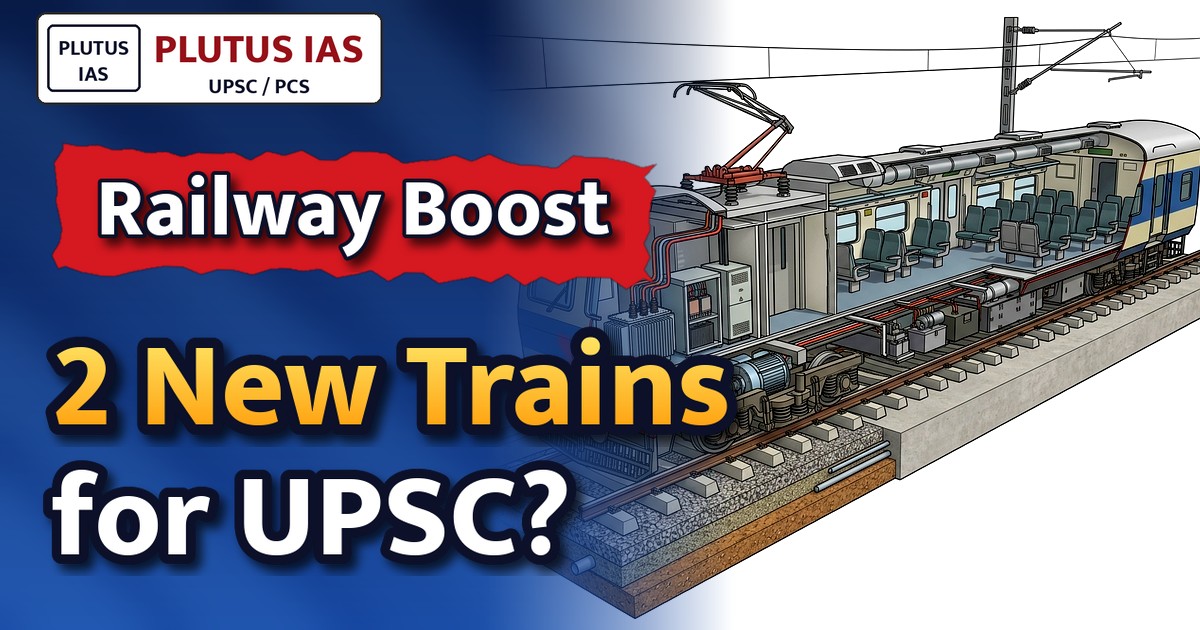
30 Sep UPSC Alert: Indian Railways Launches 2 New MEMU Trains for Regional Connectivity
✎ MEMU (Mainline Electric Multiple Unit) services are electric-powered commuter trains designed for regional connectivity, offering frequent stops and sustainable transport solutions.
Subject Relevance — Where This Topic Fits
- GS Paper III — Infrastructure: Transport and Communication
- Prelims: MEMU (Mainline Electric Multiple Unit), Regional Rail Connectivity, Railway Budget, Public Transport Infrastructure, Uttar Pradesh Railway Network
Quick Revision: MEMU (Mainline Electric Multiple Unit) services are electric-powered commuter trains designed for regional connectivity, offering frequent stops and sustainable transport solutions.
Why is this in the news?
The Ministry of Railways, through a press release dated 29 September 2026, approved the introduction of two new Mainline Electric Multiple Unit (MEMU) services connecting Meerut City with Khurja and Saharanpur in Uttar Pradesh. These services aim to strengthen regional rail connectivity by providing commuter-friendly travel options with multiple commercial stops, thereby enhancing last-mile connectivity and regional integration.
Background
- The Indian Railways operates MEMU services primarily for short to medium-distance commuter travel, characterized by frequent stops and electric traction.
- Uttar Pradesh, with its dense population and expanding urban centres, requires robust regional connectivity to support economic activities and reduce road congestion.
- MEMU trains are electrically operated, offering a sustainable and efficient mode of transport compared to diesel-based services.
- The decision reflects the Railways’ focus on decongesting major cities by providing alternative transport options to passengers traveling within the state.
- This initiative is part of the ongoing efforts to integrate smaller towns and cities with regional hubs, fostering economic and social cohesion.
What are MEMU (Mainline Electric Multiple Unit) Services?
- MEMU refers to Mainline Electric Multiple Unit trains, which are electric-powered trains designed for short to medium-distance commuter travel.
- These trains operate on electrified railway lines and consist of multiple coaches, allowing for higher passenger capacity compared to conventional trains.
- MEMU services are characterized by frequent stops at intermediate stations, making them ideal for regional connectivity and last-mile solutions.
- They are equipped with modern amenities such as comfortable seating, digital displays, and accessibility features for passengers with disabilities.
- The introduction of MEMU services is a strategic move to reduce dependence on road transport, thereby lowering carbon emissions and traffic congestion.
- These services are typically operated by the Indian Railways under the jurisdiction of zonal railways, with schedules designed to cater to peak and off-peak travel demands.
- MEMU trains are cost-effective to operate due to their electric propulsion, which reduces fuel costs and maintenance overheads.
- The decision to introduce new MEMU services is taken based on demand assessments, traffic surveys, and feasibility studies conducted by the Railways.
Key Features
| Feature | Significance |
|---|---|
| Introduction of two MEMU services | Enhances regional rail connectivity in western Uttar Pradesh by linking Meerut with Khurja and Saharanpur |
| All-station commercial halts | Ensures equitable access to rail transport for smaller towns and villages along the route |
| Operational timings (Khurja–Meerut) | Outbound: 13:15–17:20 (4h 5m); Inbound: 11:25–16:00 (4h 35m) |
| Operational timings (Saharanpur–Meerut) | Outbound: 05:50–08:10 (2h 20m); Inbound: 17:45–20:40 (2h 55m) |
| Train numbers | Khurja–Meerut: 64573/64574; Saharanpur–Meerut: 64580/64579 |
Why it Matters
Economic Integration
- Facilitates labour mobility between industrial hubs (Meerut, Saharanpur) and agricultural hinterlands (Khurja), supporting supply chains
- Reduces dependency on road transport, lowering logistics costs for MSMEs and agri-produce markets
- Stimulates local economies by increasing footfall in tier-2/3 cities through improved accessibility
Social Equity
- Bridges the last-mile connectivity gap for commuters in peri-urban areas, particularly women and students
- Promotes inclusive growth by providing affordable, time-bound transport options to marginalised communities
- Encourages rural-urban linkages, fostering social cohesion and cultural exchange
Infrastructure Utilisation
- Optimises underutilised rail corridors in western Uttar Pradesh, enhancing asset productivity
- Supports the ‘Make in India’ initiative by improving industrial logistics in the NCR periphery
- Aligns with the National Rail Plan 2030’s objective of increasing share of passenger rail in regional transport
Policy Alignment
- Implements provisions of the National Transport Policy 2022, prioritising multi-modal integration
- Advances the Sagarmala Programme’s hinterland connectivity goals through rail-based solutions
- Complements the PM Gati Shakti National Master Plan by strengthening regional rail networks
Challenges
1. Operational Bottlenecks
- Congestion on shared tracks with freight trains may lead to delays, particularly during peak hours
- Limited rolling stock availability could constrain frequency and reliability of MEMU services
- Need for real-time traffic management systems to mitigate delays in mixed-traffic corridors
UPSC Link: Railway Operations
2. Financial Sustainability
- Subsidised fares for MEMU services may strain railway finances without compensatory mechanisms
- High maintenance costs for short-haul routes require efficient cost-recovery models
- Dependence on cross-subsidisation from long-distance passenger or freight segments
UPSC Link: Railway Finances
3. Last-Mile Connectivity
- Inadequate feeder services (auto-rickshaws, e-rickshaws) at intermediate stations may limit accessibility
- Poor road-rail interface at junctions hampers seamless passenger movement
- Need for integrated multi-modal hubs to optimise end-to-end journeys
UPSC Link: Urban Transport
4. Land Acquisition & ROW
- Delays in land acquisition for track doubling or station expansion could stall project timelines
- Encroachments on railway land in peri-urban areas pose safety and operational risks
- Legal complexities in resolving Right of Way disputes with local authorities
UPSC Link: Land Acquisition
Challenges — UPSC Perspective
| Issue | Concern |
|---|---|
| Track congestion | Mixed-traffic operations may reduce punctuality and reliability |
| Rolling stock shortage | Limited MEMU rakes could constrain service expansion |
| Fare affordability | Subsidised pricing may require cross-subsidisation from other segments |
| Station infrastructure | Inadequate platforms and amenities at intermediate stations |
| Feeder connectivity | Poor last-mile transport options at rural/suburban stations |
Way Forward
- Conduct a corridor-wise traffic survey to assess demand patterns and optimise MEMU frequency
- Develop integrated multi-modal hubs at key junctions (e.g., Meerut, Khurja) to enhance feeder connectivity
- Invest in real-time traffic management systems for mixed-traffic corridors to improve punctuality
- Explore public-private partnerships for rolling stock procurement and maintenance of MEMU services
- Expand station infrastructure (platforms, footbridges, digital signage) to accommodate increased footfall
- Implement dynamic pricing models to balance affordability with financial sustainability
- Strengthen coordination with state transport departments to integrate MEMU services with bus networks
- Undertake periodic safety audits to mitigate risks from encroachments and track-side hazards
UPSC Value Addition
Keywords for Mains Answer-Writing
Memu services · regional rail connectivity · multi-modal connectivity · public transport infrastructure · railway network expansion · regional economic integration · semi-urban rail services · railway operational efficiency · transport policy · regional development · suburban rail systems · railway passenger amenities · railway corridor development · regional mobility · railway governance
Concept Flow
Regional economic disparities in western Uttar Pradesh → Demand for equitable transport access → Policy prioritisation of regional rail connectivity under National Rail Plan 2030 → Approval of MEMU services → Operationalisation of Khurja–Meerut and Saharanpur–Meerut MEMU routes → Enhanced rail connectivity → Increased passenger movement → Stimulation of local economies and labour mobility → Rising ridership → Need for infrastructure upgrades and feeder services → Policy feedback loop → Adjustments in fare structures and service frequency
Prelims Practice Questions
Q1. Consider the following statements regarding MEMU (Mainline Electric Multiple Unit) services in India:
1. MEMU services are designed primarily for long-distance inter-city travel.
2. MEMU trains operate on electrified railway lines and have multiple coaches.
3. MEMU services are known for their frequent stops at intermediate stations to enhance regional connectivity.
4. MEMU trains are exclusively operated by the Indian Railways Catering and Tourism Corporation (IRCTC).
How many of the above statements are correct?
- Only one
- Only two
- Only three
- All
Answer: Only three — Statement 1 is incorrect: MEMU services are designed for short to medium-distance travel, not long-distance inter-city travel. Statements 2 and 3 are correct: MEMU trains operate on electrified lines, have multiple coaches, and stop frequently at intermediate stations. Statement 4 is incorrect: MEMU services are operated by Indian Railways, not IRCTC.
Q2. Assertion (A): The introduction of MEMU services in regional corridors like Meerut-Khurja and Meerut-Saharanpur enhances multi-modal connectivity in Uttar Pradesh.
Reason (R): MEMU services operate on electrified tracks and provide frequent stops, thereby improving accessibility for semi-urban and rural populations.
Options:
A. Both A and R are true, and R is the correct explanation of A.
B. Both A and R are true, but R is NOT the correct explanation of A.
C. A is true, but R is false.
D. A is false, but R is true.
Answer: ? — Assertion (A) is true: MEMU services in regional corridors like Meerut-Khurja and Meerut-Saharanpur indeed enhance multi-modal connectivity by linking semi-urban and rural areas. Reason (R) is also true and correctly explains (A), as MEMU services operate on electrified tracks and provide frequent stops, improving accessibility.
Q3. Match the following railway services with their primary purpose:
Column I (Railway Service) Column II (Primary Purpose)
1. MEMU (Mainline Electric Multiple Unit) A. High-speed inter-city travel
2. Rajdhani Express B. Long-distance overnight travel with sleeper coaches
3. Shatabdi Express C. Suburban and regional connectivity with frequent stops
4. Garib Rath D. Affordable long-distance travel with air-conditioned coaches
Options:
A. 1-C, 2-A, 3-B, 4-D
B. 1-C, 2-A, 3-D, 4-B
C. 1-A, 2-B, 3-C, 4-D
D. 1-B, 2-A, 3-D, 4-C
Answer: ? — 1-C: MEMU services are designed for suburban and regional connectivity with frequent stops. 2-A: Rajdhani Express is a high-speed inter-city travel service. 3-D: Shatabdi Express is an affordable long-distance travel service with air-conditioned coaches. 4-B: Garib Rath is an affordable long-distance travel service with air-conditioned coaches but primarily for overnight travel.
Mains Practice Question
✍ The expansion of regional rail connectivity through the introduction of MEMU services in semi-urban corridors represents a strategic shift in India’s public transport policy. Critically examine the significance of such initiatives in the context of regional economic integration and sustainable mobility. Also, outline the institutional and operational challenges that may impede the successful implementation of these services. (15 Marks)
Approach: MODEL-ANSWER SKELETON:
1. **Significance of MEMU Services in Regional Economic Integration**
– Enhances multi-modal connectivity by linking semi-urban and rural areas to urban centers (e.g., Meerut-Khurja and Meerut-Saharanpur corridors).
– Facilitates commuter mobility, reducing dependence on road transport and easing congestion in metropolitan areas.
– Promotes regional economic integration by improving access to markets, employment, and educational institutions.
– Supports the ‘Make in India’ and ‘Atmanirbhar Bharat’ initiatives by reducing logistical costs for small and medium enterprises (SMEs).
– Aligns with the National Rail Plan (2030) and PM Gati Shakti National Master Plan for integrated infrastructure development.
2. **Sustainable Mobility and Environmental Benefits**
– MEMU services operate on electrified tracks, reducing carbon emissions compared to road transport.
– Encourages shift from private vehicles to public transport, contributing to sustainable urban mobility.
– Supports the ‘Net Zero Carbon Emission by 2030’ target for Indian Railways.
3. **Institutional Challenges**
– **Land Acquisition and Right-of-Way Issues**: Delays in land acquisition for railway corridors and station expansions.
– **Funding and Budgetary Constraints**: High capital expenditure for electrification, rolling stock, and infrastructure upgrades.
– **Inter-Ministerial Coordination**: Need for seamless coordination between the Ministry of Railways, Ministry of Housing and Urban Affairs, and state governments.
– **Regulatory and Policy Frameworks**: Streamlining environmental clearances, safety certifications, and operational permits.
4. **Operational Challenges**
– **Traffic Congestion and Scheduling**: Balancing MEMU services with existing freight and passenger traffic on shared corridors.
– **Station Infrastructure**: Upgrading station amenities, platform lengths, and parking facilities to accommodate increased passenger traffic.
– **Maintenance and Safety**: Ensuring regular maintenance of electrified tracks and rolling stock to prevent disruptions.
– **Passenger Amenities**: Providing last-mile connectivity, digital ticketing, and real-time information systems.
5. **Way Forward**
– Adopt public-private partnerships (PPPs) for funding and operational efficiency.
– Leverage technology for predictive maintenance and real-time monitoring of railway assets.
– Strengthen state-level nodal agencies for coordinated implementation.
– Integrate MEMU services with other modes of transport (e.g., metro, buses) for seamless multi-modal connectivity.
Balanced Conclusion: While MEMU services offer significant benefits for regional economic integration and sustainable mobility, their success hinges on addressing institutional and operational challenges through coordinated policy action and technological innovation.
Source: PIB (Press Information Bureau)
Uttar Pradesh PCS (UPPSC) — State PCS Practice
Prelims: Which of the following pairs correctly represents the newly approved MEMU train services connecting Meerut to other cities in Uttar Pradesh?
- A. Meerut – Khurja and Meerut – Saharanpur
- B. Meerut – Kanpur and Meerut – Lucknow
- C. Meerut – Aligarh and Meerut – Bareilly
- D. Meerut – Varanasi and Meerut – Gorakhpur
Answer: A. Meerut – Khurja and Meerut – Saharanpur — The Indian Railways has approved two MEMU train services connecting Meerut to Khurja and Saharanpur, enhancing regional connectivity within Uttar Pradesh.
Mains: Discuss the significance of the newly approved MEMU train services between Meerut, Khurja, and Saharanpur from the perspective of Uttar Pradesh’s socio-economic development. How can these services contribute to the state’s logistics and public transportation infrastructure? (200 words)
Generated by AanyaAi for educational purpose.
Related guides on our sites
- How to prepare for GS paper 1 for UPSC CSE mains exam
- Best UPSC coaching for IFOS exam
- Best mentorship programme for upsc
- UPSC+BA degree

- जम्मू-कश्मीर: अनुच्छेद 370 से राज्यत्व तक का संवैधानिक सफर - September 30, 2026
- Supreme Court to Hear Plea Against CEC’s Suspension & SIR Validity - September 30, 2026
- पश्चिम बंगाल में परिवहन सुधार: AI सिग्नलिंग, ट्राम पुनरुद्धार और जल टैक्सी की योजना - September 30, 2026

No Comments