


19 Sep UPSC Alert: Indian Railways Upgrades Electric Traction to 2×25 KV in 73 KM Segment
✎ The 2×25 kV traction system upgrade enhances power supply efficiency and capacity for electric trains, enabling Indian Railways to handle increased traffic on high-density corridors.
Subject Relevance — Where This Topic Fits
- GS Paper III — Infrastructure: Energy, Transport, and Digital
- Prelims: Electric traction system, 2×25 kV traction system, South Central Railway, HUN Route 8, Railway Electrification, Traction Power Supply, Railway Capacity Augmentation
- Essay: Infrastructure Development and Economic Growth, Sustainable Transport Solutions for India
Quick Revision: The 2×25 kV traction system upgrade enhances power supply efficiency and capacity for electric trains, enabling Indian Railways to handle increased traffic on high-density corridors.
Why is this in the news?
The Press Information Bureau (PIB) has announced the sanction of ₹142 crore for upgrading the electric traction system on the 73-kilometre Savalyapuram–Guntur section from 1×25 kV to 2×25 kV configuration. This initiative is part of a broader strategy by Indian Railways to modernise traction infrastructure, enhance operational efficiency, and prepare the network for future traffic growth, particularly on strategically important routes.
Background
- Indian Railways operates one of the largest railway networks in the world, with over 68,000 route kilometres, of which approximately 90% has been electrified as of 2026.
- The 1×25 kV traction system has been the standard for railway electrification in India since the 1960s, utilising a single-phase alternating current supply at 25 kV.
- The 2×25 kV auto-transformer feeding system is a more advanced configuration that improves power transmission efficiency, reduces voltage drops, and enhances the capacity of the traction system to handle heavier and faster trains.
- Indian Railways has been progressively upgrading its traction infrastructure under the ‘Mission 100% Electrification’ and ‘Mission Raftaar’ initiatives to improve speed, safety, and efficiency.
- The project aligns with the government’s broader policy of promoting sustainable and energy-efficient transportation systems.
What is the 2×25 kV Traction System and Why is it Significant?
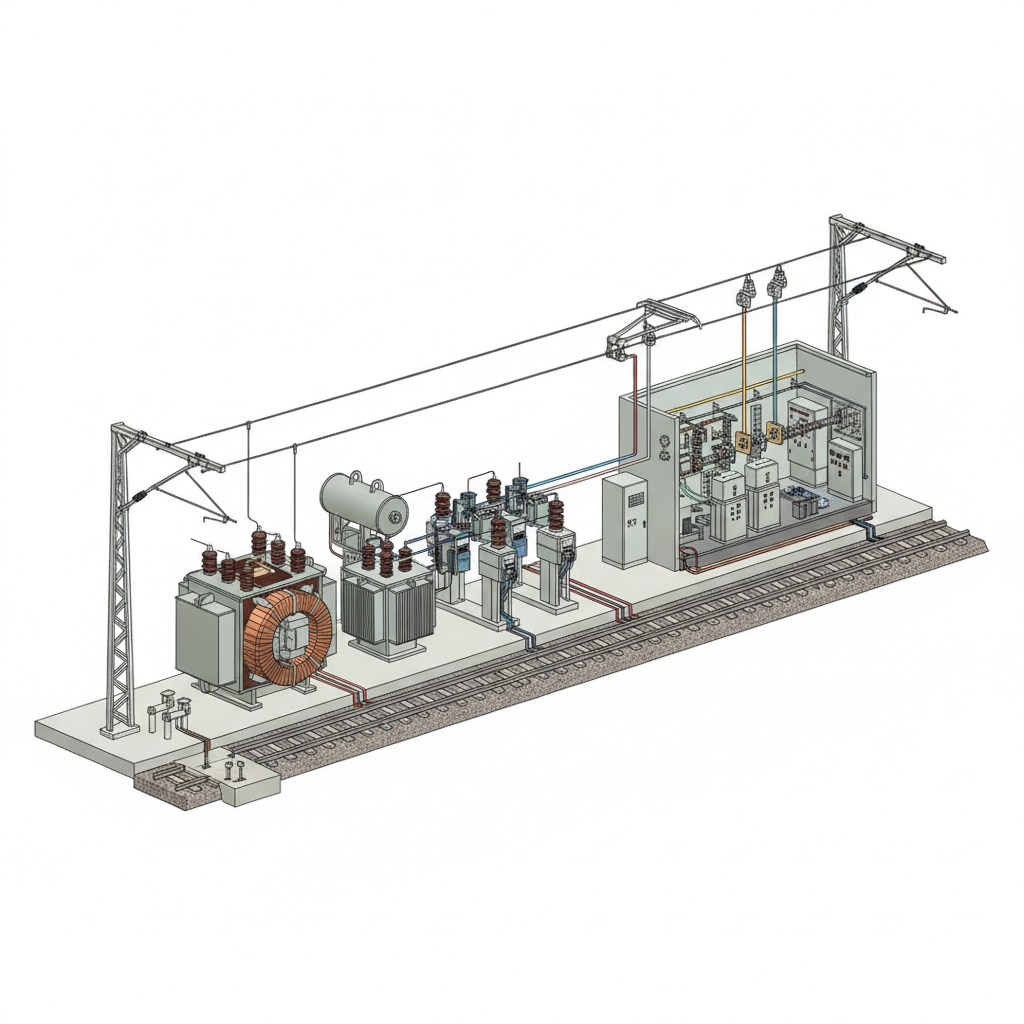
- The 2×25 kV traction system is an advanced electric traction configuration that uses two 25 kV overhead lines, with an auto-transformer feeding system to improve power supply quality and reduce transmission losses.
- In contrast to the conventional 1×25 kV system, the 2×25 kV system enhances the capacity of the traction power supply, enabling higher power delivery to trains without voltage drops over long distances.
- This system is particularly beneficial for high-traffic corridors, hilly terrains, and sections requiring higher tractive effort.
- The auto-transformer feeding system in 2×25 kV configuration ensures better voltage regulation, reduces the need for additional substations, and lowers maintenance costs over time.
- The upgrade from 1×25 kV to 2×25 kV on the Savalyapuram–Guntur section will improve the reliability and efficiency of electric train operations, supporting increased freight and passenger traffic.
- The system also facilitates the integration of renewable energy sources into the traction power supply, aligning with India’s decarbonisation goals for the railway sector.
- The 2×25 kV system is a proven technology globally, adopted by railways in countries such as France, Germany, and China, and is now being standardised for critical corridors in India.
Key Features
| Feature | Significance |
|---|---|
| Upgrade from 1×25 kV to 2×25 kV traction system | Enhances power supply capacity to 25 kV from two independent sources, improving efficiency and reliability of electric traction on the segment. |
| Cost outlay of ₹142 crore | Reflects investment in modernising traction infrastructure to meet growing traffic demands and operational requirements. |
| Coverage of 73 km segment (Savlapuram-Guntur) | Directly strengthens the operational capacity of a critical railway corridor in the South Central Railway zone. |
| Integration with HU-N Route 8 (Vasco-Gadag-Guntakal-Nandyal-Savlapuram-Guntur-Vijayawada) | Supports seamless electrified connectivity across a strategically important freight and passenger route. |
| Strengthening of electric traction infrastructure | Enables higher traction power for heavier and faster trains, reducing congestion and improving schedule adherence. |
Why it Matters
Economic
- Reduces operational costs by improving energy efficiency in electric traction, lowering fuel expenses for diesel alternatives.
- Enhances freight capacity on HU-N Route 8, a key corridor for coal, iron ore, and containerised cargo, supporting industrial logistics.
- Boosts regional economic connectivity by enabling faster, more reliable passenger services between Andhra Pradesh and Karnataka.
Strategic
- Improves national logistics efficiency by strengthening electrified freight corridors, aligning with the National Logistics Policy.
- Reduces dependency on imported fossil fuels by increasing reliance on domestically generated electricity for rail operations.
- Supports defence mobility and emergency response capabilities by ensuring robust rail connectivity in the southern peninsula.
Technological
- Adoption of 2×25 kV auto-transformer system enhances power transmission efficiency and reduces voltage drop over long distances.
- Modernisation of traction infrastructure aligns with India’s decarbonisation goals for the railway sector by 2030.
- Facilitates future adoption of advanced signalling and train control systems by providing stable power supply.
Operational
- Increases line capacity by enabling higher train density and reduced headways, especially for freight trains.
- Improves punctuality and reliability of electric services by mitigating power supply fluctuations and traction failures.
- Enables integration with upcoming Dedicated Freight Corridors (DFCs) by ensuring compatible traction standards.
Challenges
1. Land Acquisition and Right-of-Way Clearances
- Potential delays due to encroachments or disputes along the 73 km corridor, despite being a brownfield project.
- Need for coordination with state agencies to expedite statutory clearances for infrastructure augmentation.
UPSC Link: Land Reforms & ROR Act, 1908
2. Power Supply Reliability
- Dependence on state electricity boards for stable 25 kV supply may pose challenges in regions with grid instability.
- Requirement for dedicated traction substations and backup systems to ensure uninterrupted power during peak loads.
UPSC Link: Electricity Act, 2003
3. Interoperability with Existing Systems
- Ensuring seamless integration of the upgraded 2×25 kV system with existing 1×25 kV sections on the HU-N Route.
- Compatibility checks for rolling stock, signalling, and telecommunication systems across the corridor.
UPSC Link: Indian Railways Standards (IRS)
4. Maintenance and Skilled Workforce
- Need for upskilling of railway staff in handling advanced traction systems and auto-transformer technology.
- Ensuring availability of specialised maintenance teams for the new infrastructure to prevent downtime.
UPSC Link: Railway Staff College Curriculum
5.
- Mitigation of electromagnetic interference from traction power lines affecting nearby sensitive equipment.
- Compliance with environmental norms during construction, particularly in ecologically sensitive zones.
UPSC Link: Environment Protection Act, 1986
Challenges — UPSC Perspective
| Issue | Concern |
|---|---|
| Grid stability in feeder regions | Fluctuations in state grid supply may disrupt traction power, necessitating robust backup systems. |
| Corridor saturation during peak hours | Existing line capacity may still limit throughput despite traction upgrades, requiring signalling improvements. |
| Cost overruns in civil works | Delays in land acquisition or material procurement could escalate project costs beyond sanctioned ₹142 crore. |
| Compatibility with legacy rolling stock | Older electric locomotives may require retrofitting to utilise the upgraded traction system efficiently. |
| Cybersecurity risks in traction control systems | Increased digitalisation of traction infrastructure exposes systems to potential cyber threats. |
Way Forward
- Conduct pre-construction surveys to identify land parcels requiring acquisition or clearances under the Right of Way norms.
- Establish dedicated traction substations with backup power sources to ensure uninterrupted 2×25 kV supply.
- Implement phased commissioning of the upgraded system, starting with non-peak hours to minimise service disruptions.
- Organise training programmes for railway staff on 2×25 kV auto-transformer systems and maintenance protocols.
- Integrate the upgraded corridor with the upcoming Vijayawada–Chennai Dedicated Freight Corridor for seamless freight movement.
- Monitor power consumption patterns and optimise energy usage through smart metering and demand-side management.
- Undertake periodic audits of traction infrastructure to assess performance and address degradation proactively.
- Leverage the project as a case study for future electrification upgrades under the Mission 100% Electrification initiative.
UPSC Value Addition
Keywords for Mains Answer-Writing
Indian Railways · Electric traction system · 2×25 kV traction system · Railway electrification · South Central Railway · Railway capacity augmentation · HUN Route 8 · Railway infrastructure modernization · Operational efficiency in railways · Railway traffic growth
Concept Flow
Rising freight and passenger demand → Inadequacy of 1×25 kV traction system → Approval for 2×25 kV upgrade → Investment in traction infrastructure → Enhanced power supply capacity → Increased line capacity and efficiency → Improved operational reliability → Strengthened regional and national logistics network.
Prelims Practice Questions
Q1. Consider the following statements regarding the 2×25 kV electric traction system in Indian Railways:
1. The 2×25 kV system increases the power supply capacity compared to the 1×25 kV system.
2. It is primarily used to enhance the operational efficiency of diesel locomotives.
3. The system is part of the modernization efforts to handle increased rail traffic.
How many of the above statements are correct?
- Only one
- Only two
- All
- None
Answer: Only two — Statements 1 and 3 are correct as the 2×25 kV system enhances power supply capacity and supports modernization for increased traffic. Statement 2 is incorrect because the system is designed for electric locomotives, not diesel.
Q2. Assertion (A): The upgrade of the Savalyapuram-Guntur section to a 2×25 kV traction system is part of the HUN Route 8 electrification project.
Reason (R): The HUN Route 8 connects Vasco-Da-Gama to Vijayawada via Guntakal and Nandyal, enhancing the electric traction infrastructure in South India.
Options:
A. Both A and R are true, and R is the correct explanation of A.
B. Both A and R are true, but R is not the correct explanation of A.
C. A is true, but R is false.
D. A is false, but R is true.
Answer: ? — Both A and R are true, and R correctly explains A as the Savalyapuram-Guntur section is indeed part of the HUN Route 8 electrification project.
Q3. Which of the following railway zones is responsible for the Savalyapuram-Guntur section electrification project?
- Northern Railway
- South Central Railway
- Western Railway
- South Western Railway
Answer: South Central Railway — The Savalyapuram-Guntur section falls under the jurisdiction of the South Central Railway zone, as mentioned in the official PIB release.
Mains Practice Question
✍ The modernization of railway traction infrastructure through the adoption of 2×25 kV electric traction systems represents a critical step in enhancing operational efficiency and capacity augmentation of Indian Railways. Critically examine the significance of this transition, with reference to its technical, economic, and strategic implications. (15 Marks)
Approach: MODEL-ANSWER SKELETON:
1. **Technical Significance**:
– Explain the 2×25 kV system as a high-voltage traction system that increases power supply capacity, reduces transmission losses, and enables higher train speeds and heavier loads.
– Contrast with the conventional 1×25 kV system, highlighting advantages such as improved voltage stability and reduced infrastructure footprint.
– Reference the Savalyapuram-Guntur section as a case study for capacity augmentation.
2. **Economic Implications**:
– Discuss cost efficiency: long-term savings from reduced energy consumption and lower maintenance costs due to improved infrastructure.
– Highlight the initial capital investment (e.g., ₹142 crore for the Savalyapuram-Guntur project) and its justification through enhanced throughput and revenue generation.
– Mention the role of such upgrades in reducing dependence on diesel traction, aligning with India’s decarbonization goals.
3. **Strategic and Operational Benefits**:
– Capacity augmentation: How the system supports the handling of increased passenger and freight traffic, particularly on critical corridors like HUN Route 8.
– Reliability and safety: Reduced instances of power-related disruptions and improved scheduling.
– Integration with broader initiatives: Link to the National Rail Plan (NRP) 2030 and Mission Raftaar for network decongestion and modal shift toward rail.
4. **Challenges and Considerations**:
– High initial capital outlay and resource allocation challenges.
– Coordination between central and state agencies for land acquisition and utility realignment.
– Need for skilled manpower for installation, operation, and maintenance.
5. **Conclusion**:
– Summarize the transformative potential of 2×25 kV traction systems in positioning Indian Railways as a globally competitive, sustainable, and efficient transportation network.
– Emphasize the alignment with India’s broader goals of Atmanirbhar Bharat and climate resilience in the transport sector.
Source: PIB (Press Information Bureau)
Andhra Pradesh PCS (APPSC) — State PCS Practice
Prelims: Which Andhra Pradesh railway section was recently approved for an upgrade to 2×25 kV electric traction system at a cost of ₹142 crore by the Indian Railways?
- A. Secunderabad–Guntur section
- B. Vijayawada–Guntur section
- C. Sullurpeta–Guntur section
- D. Sullurpeta–Savalyapuram–Guntur section
Answer: D. Sullurpeta–Savalyapuram–Guntur section — The ₹142 crore approval was granted for upgrading the 73 RKM Sullurpeta–Savalyapuram–Guntur section to 2×25 kV electric traction system.
Mains: Discuss the significance of upgrading the Sullurpeta–Savalyapuram–Guntur railway section to 2×25 kV electric traction system for Andhra Pradesh’s transportation infrastructure and economic development. (150 words)
Generated by AanyaAi for educational purpose.
Related guides on our sites
- How to prepare for GS paper 1 for UPSC CSE mains exam
- Best UPSC coaching for IFOS exam
- Best mentorship programme for upsc
- UPSC+BA degree

- Piyush Goyal Attends G20 Trade Ministers’ Meeting in Milwaukee - October 1, 2026
- विशेष अभियान-6: कोल इंडिया लिमिटेड की तैयारी पर केंद्र सरकार की निगरानी - October 1, 2026
- ECL’s Action Plan for Special Campaign 6: A UPSC Governance Case Study - October 1, 2026

No Comments