


30 Jul UPSC Alert: India’s 100 GW Nuclear Energy Roadmap by 2047 Explained
Subject Relevance — Where This Topic Fits
- GS Paper III — Environment, Disaster Management and Climate Change | GS Paper III — Science and Technology
- Prelims: Pressurised Heavy Water Reactors (PHWR), Small Modular Reactors (SMR), Nuclear Power Corporation of India Limited (NPCIL), Net Zero Emissions by 2070, Atomic Energy Department (DAE), Bhabha Atomic Research Centre (BARC)
- Essay: Energy Transition and Sustainable Development: Balancing Growth and Environmental Responsibility, Technological Self-Reliance in Strategic Sectors: India’s Nuclear Programme
Quick Revision: India’s nuclear energy roadmap to 100 GW by 2047 prioritises indigenous PHWRs, advanced LWRs, and SMRs to meet net-zero targets, with NPCIL leading capacity expansion and BARC driving SMR innovation.
Why is this in the news?
The Department of Atomic Energy (DAE) has unveiled a comprehensive roadmap to scale up India’s nuclear energy capacity to 100 GW by 2047, as outlined in the Union Budget 2025-26 under the Nuclear Energy Mission. This initiative aligns with India’s commitment to achieving net-zero carbon emissions by 2070 and enhancing the share of low-carbon, base-load nuclear power in the energy mix. The announcement, made in a written reply to the Rajya Sabha on 30 July 2026, underscores the strategic importance of indigenous and advanced reactor technologies, including Small Modular Reactors (SMRs), in India’s energy transition.
Background
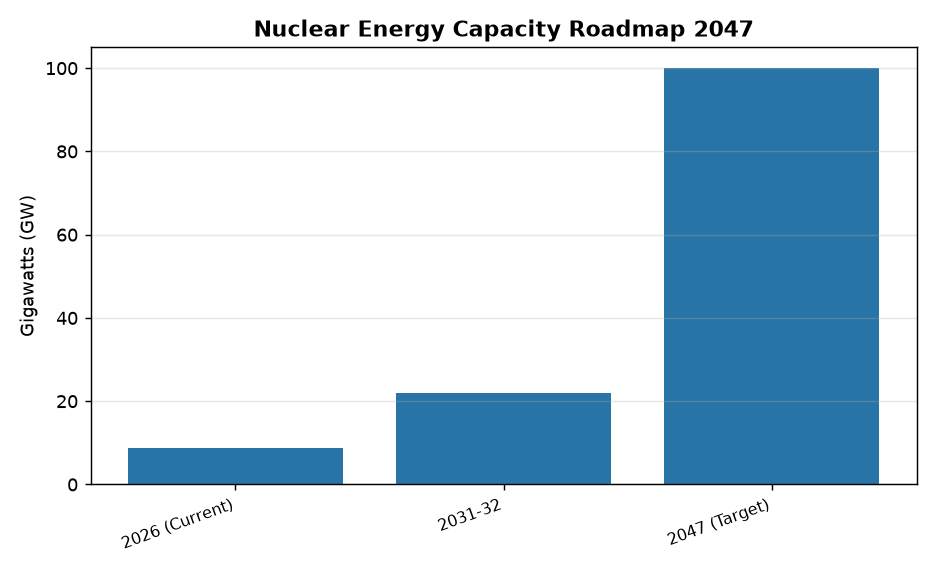
- India’s current nuclear energy capacity stands at 8.78 GW, with 22 GW expected by 2031-32 through ongoing projects under NPCIL.
- The Government of India’s ‘Net Zero by 2070’ target necessitates a diversified energy portfolio, with nuclear power positioned as a critical component for reliable, low-carbon base-load electricity.
- The Atomic Energy Act, 1962, vests regulatory and developmental authority in the Department of Atomic Energy (DAE), with NPCIL as the primary public sector enterprise for nuclear power generation.
- India’s indigenous Pressurised Heavy Water Reactor (PHWR) technology, developed by BARC, has been the backbone of its nuclear programme, with units ranging from 220 MW to 700 MW.
- The International Atomic Energy Agency (IAEA) plays a pivotal role in facilitating international cooperation, knowledge exchange, and safety standards for nuclear technologies.
- The Union Budget 2025-26 introduced the Nuclear Energy Mission to accelerate indigenous R&D, deployment of advanced reactors, and integration of nuclear power into the broader energy transition framework.
What is the 100 GW Nuclear Energy Roadmap by 2047?
- The roadmap is a two-pronged strategy to achieve 100 GW nuclear capacity by 2047, combining indigenous and imported technologies to ensure energy security and sustainability.
- The first pillar focuses on indigenous Pressurised Heavy Water Reactors (PHWRs), including 700 MW units, to leverage India’s proven technological capabilities and reduce dependence on imports.
- The second pillar involves the deployment of large advanced reactors in greenfield locations, including Light Water Reactors (LWRs), to diversify the energy mix and meet future demand.
- Small Modular Reactors (SMRs) are envisaged for brownfield applications, such as repurposing retired fossil fuel plants, captive power generation for energy-intensive industries, and off-grid applications.
- By 2033, the DAE aims to operationalise at least five indigenous SMRs.
- The HTGCR, developed by BARC, utilises advanced heat-chemical cycles for hydrogen generation, aligning with India’s green hydrogen mission and decarbonisation goals.
- NPCIL, under DAE, is projected to add 32 GW of capacity by 2047, raising its total from the current ~8.78 GW to ~54 GW, with the remaining 46 GW to be developed through public-private partnerships and joint ventures.
- The roadmap includes the repurposing of older fossil fuel-based plants for brownfield uses with SMRs, and the integration of SMRs into industrial and off-grid ecosystems to enhance energy efficiency.
Key Features
| Feature | Significance |
|---|---|
| 100 GW nuclear capacity target by 2047 | Aligns with India’s net-zero 2070 commitment and energy security goals under ‘Viksit Bharat’ vision. |
| Two-pronged strategy: PHWRs + advanced imported reactors | Balances indigenous technological strength with global best practices for rapid scale-up. |
| Small Modular Reactors (SMRs) development | Enables decentralised, flexible, and low-carbon energy for off-grid and industrial applications. |
| Brownfield utilisation of fossil plants | Reduces stranded assets and leverages existing infrastructure for nuclear expansion. |
| NPCIL-led 32 GW expansion by 2047 | Public sector dominance ensures strategic control over critical energy infrastructure. |
Why it Matters
Energy Security & Climate Resilience
- Reduces import dependence on fossil fuels by diversifying the energy mix with indigenous low-carbon nuclear power.
- Supports India’s Nationally Determined Contributions (NDCs) under the Paris Agreement by lowering carbon intensity.
- Ensures grid stability through base-load nuclear capacity, complementing intermittent renewables.
Indigenous Technological Advancement
- Strengthens India’s nuclear self-reliance through PHWR and SMR technologies, reducing geopolitical vulnerabilities.
- BARC’s development of SMRs (BSMR-200, SMR-55, HTGR) positions India as a potential exporter of niche nuclear technologies.
- Leverages existing expertise in pressurised heavy-water reactors to fast-track deployment.
Economic & Industrial Implications
- Creates high-skilled employment in nuclear engineering, manufacturing, and R&D sectors.
- Stimulates ancillary industries (e.g., heavy engineering, instrumentation) through supply chain localisation.
- Reduces long-term energy costs via lower carbon emissions and fuel efficiency compared to fossil alternatives.
Strategic & Geopolitical Dimensions
- Enhances India’s energy diplomacy by engaging with IAEA and potential reactor suppliers (e.g., Russia, USA) for advanced technologies.
- Supports ‘Atmanirbhar Bharat’ in nuclear energy, reducing reliance on external fuel and technology suppliers.
- Strengthens energy infrastructure resilience against global supply chain disruptions.
Challenges
1. Public Perception & Regulatory Hurdles
- Public scepticism regarding nuclear safety and waste management may delay project clearances.
- Stringent regulatory oversight by AERB (Atomic Energy Regulatory Board) could extend timelines for new reactors.
- Need for robust stakeholder engagement to address local concerns and secure social licence.
UPSC Link: Environmental Impact Assessment (EIA) 2006
2. Technological & Financial Risks
- High capital intensity (e.g., ₹5,960 crore for BSMR-200) requires sustained budgetary allocations and PPP models.
- Delays in indigenous SMR development could necessitate reliance on imported technologies, increasing costs.
- Currency fluctuations may impact imported reactor components, affecting project economics.
UPSC Link: Public Sector Enterprises (PSEs) financial autonomy
3. Grid Integration & Land Acquisition
- Integration of intermittent renewables with base-load nuclear capacity requires grid modernisation and storage solutions.
- Land acquisition for large-scale nuclear parks may face legal and socio-economic challenges.
- Need for dedicated transmission corridors to evacuate power from remote nuclear sites.
UPSC Link: Electricity Act 2003 (Section 63)
4. Fuel Cycle & Waste Management
- Indigenous uranium reserves are limited; reliance on imported fuel may pose supply chain risks.
- Long-term storage and disposal of high-level nuclear waste require advanced infrastructure and policy frameworks.
- Need for closed fuel cycle technologies (e.g., fast breeder reactors) to optimise fuel utilisation.
UPSC Link: Nuclear Waste Management Policy (DAE guidelines)
5. Human Resource & Skill Gaps
- Shortage of specialised nuclear engineers and technicians may hinder project execution.
- Need for revamped academic curricula and vocational training in nuclear sciences.
- Brain drain to private sectors or foreign firms could deplete scarce talent pools.
UPSC Link: National Skill Development Mission (NSDM)
Challenges — UPSC Perspective
| Issue | Concern |
|---|---|
| Public Opposition | NIMBYism (‘Not In My Backyard’) and misinformation may stall projects. |
| Regulatory Delays | Multi-layered approvals by AERB, MoEFCC, and state governments could extend timelines. |
| Cost Overruns | Inflation, import duties, and unforeseen engineering challenges may escalate project costs. |
| Grid Stability | Balancing nuclear base-load with variable renewable energy requires smart grid solutions. |
| Fuel Security | Dependence on imported uranium or thorium may expose India to geopolitical risks. |
| Waste Disposal | Lack of long-term storage facilities for spent fuel could pose environmental hazards. |
Government Initiatives — Must-Memorise for Prelims
- Atomic Energy Mission (AEM) – 2025-26 Budget Announcement
Way Forward
- Accelerate indigenous SMR development (BSMR-200, SMR-55, HTGR) with dedicated funding under AEM to meet 2033 operational targets.
- Fast-track regulatory clearances for PHWR and advanced reactor projects by streamlining AERB and MoEFCC approvals.
- Leverage brownfield sites of retired fossil plants to reduce land acquisition timelines and infrastructure costs.
- Establish public-private partnerships (PPPs) for large-scale reactor projects to share financial and technological risks.
- Develop a national nuclear fuel cycle strategy to reduce import dependence, including thorium utilisation and fast breeder reactors.
- Invest in grid modernisation and energy storage solutions to integrate nuclear base-load with renewables seamlessly.
- Strengthen IAEA collaborations for technology transfer, safety standards, and global best practices in SMR deployment.
- Launch nationwide awareness campaigns to address public misconceptions and build social licence for nuclear energy.
UPSC Value Addition
Keywords for Mains Answer-Writing
Atomic Energy Mission · Pressurised Heavy Water Reactors (PHWR) · Small Modular Reactors (SMR) · Nuclear Power Corporation of India Limited (NPCIL) · Net-zero emissions by 2070 · Department of Atomic Energy (DAE) · Bhabha Atomic Research Centre (BARC) · Advanced Heavy Water Reactor (AHWR) · Light Water Reactors (LWR) · Energy transition in India · Decarbonisation of power sector · Indigenous nuclear technology · Pressurised Water Reactor (PWR) · High Temperature Gas-Cooled Reactor (HTGR) · Nuclear energy roadmap · Brownfield utilisation in nuclear sector
Concept Flow
India’s net-zero 2070 target → Increased reliance on low-carbon energy sources → Nuclear energy expansion as base-load solution → Strategic roadmap for 100 GW capacity by 2047. → Current 8.78 GW capacity → Incremental additions via PHWRs and advanced reactors → Target of 22 GW by 2031-32 → NPCIL-led 54 GW by 2047. → Development of indigenous SMRs (BSMR-200, SMR-55, HTGR) → Deployment by 2033 → Decentralised, flexible energy for off-grid applications. → Brownfield utilisation of fossil plants → Reduced stranded assets → Lower land acquisition costs → Faster nuclear expansion. → Public sector dominance (NPCIL) → Strategic control over energy infrastructure → Reduced geopolitical vulnerabilities. → High capital intensity → Need for PPP models and sustained budgetary support → Financial viability challenges. → Grid integration → Smart grid solutions → Energy storage integration → Stable power supply with nuclear base-load.
Prelims Practice Questions
Q1. Consider the following statements regarding India’s nuclear energy roadmap as outlined in the Union Budget 2025-26:
1. The roadmap aims to achieve 100 GW of nuclear power capacity by 2047.
2. The strategy includes the development and deployment of Small Modular Reactors (SMRs) with at least five operational units by 2033.
3. The Pressurised Heavy Water Reactors (PHWRs) will be entirely imported from advanced nuclear nations.
4. The Department of Atomic Energy (DAE) will oversee the installation of 32 GW additional capacity through NPCIL by 2047.
How many of the above statements are correct?
- Only one
- Only two
- Only three
- All
Answer: Only three — Statements 1, 2, and 4 are correct. Statement 3 is incorrect as the roadmap includes indigenous development of PHWRs alongside imported advanced reactors.
Q2. Assertion (A): The Small Modular Reactors (SMRs) proposed under India’s nuclear energy roadmap are designed to utilise Pressurised Water Reactor (PWR) technology.
Reason (R): The Bhabha Atomic Research Centre (BARC) has initiated the design and development of SMRs based on PWR technology, including models like BSM-R200 and SMR-55.
In the context of the above two statements, which one of the following is correct?
- Both A and R are true and R is the correct explanation of A.
- Both A and R are true but R is not the correct explanation of A.
- A is true but R is false.
- A is false but R is true.
Answer: Both A and R are true and R is the correct explanation of A. — Both the Assertion (A) and Reason (R) are true, and the Reason (R) correctly explains the Assertion (A) as BARC’s work on PWR-based SMRs directly supports the assertion.
Q3. Match the following reactor technologies with their respective capacities as proposed in India’s nuclear energy roadmap:
Column I (Reactor Technology) Column II (Capacity)
A. Pressurised Heavy Water Reactor (PHWR) 1. 700 MWe
B. Small Modular Reactor (SMR-55) 2. 55 MWe
C. High Temperature Gas-Cooled Reactor 3. 5 MWe (thermal)
D. Advanced Heavy Water Reactor (AHWR) 4. 300 MWe
Select the correct match:
- A-1, B-2, C-3, D-4
- A-4, B-2, C-3, D-1
- A-1, B-3, C-2, D-4
- A-2, B-1, C-4, D-3
Answer: A-1, B-2, C-3, D-4 — The correct matches are: A-1 (PHWR with 700 MWe capacity), B-2 (SMR-55 with 55 MWe capacity), C-3 (HTGR with 5 MWe thermal capacity), and D-4 (AHWR with 300 MWe capacity).
Mains Practice Question
✍ Critically examine the strategic significance of India’s nuclear energy roadmap, particularly its emphasis on Pressurised Heavy Water Reactors (PHWRs), Small Modular Reactors (SMRs), and imported advanced reactors, in achieving the goals of energy security, decarbonisation, and net-zero emissions by 2070. (15 Marks)
Approach: MODEL-ANSWER SKELETON:
1. **Introduction (2 marks)**
– Context: India’s commitment to net-zero emissions by 2070 and energy transition.
– Key components of the roadmap: 100 GW nuclear capacity by 2047, PHWRs, SMRs, and imported advanced reactors.
2. **Strategic Significance of PHWRs (3 marks)**
– Indigenous technology: PHWRs (e.g., 700 MWe) leverage India’s expertise (e.g., DAE, NPCIL, BARC).
– Advantages: High fuel efficiency, utilisation of domestic uranium resources, and proven reliability.
– Role in energy security: Reduces dependence on fossil fuel imports and enhances grid stability.
3. **Role of SMRs in Decarbonisation (3 marks)**
– Definition and advantages: Modularity, scalability, and suitability for off-grid and brownfield applications.
– Indigenous development: BARC’s BSM-R200 (220 MWe), SMR-55 (55 MWe), and HTGR (5 MWe thermal) for hydrogen production.
– Timeline: Target of five operational SMRs by 2033.
4. **Imported Advanced Reactors (3 marks)**
– Technology selection: Light Water Reactors (LWRs) for high-capacity addition in greenfield sites.
– Strategic rationale: Faster deployment, higher efficiency, and complementarity with indigenous PHWRs.
– Challenges: Dependence on foreign technology, regulatory hurdles, and cost considerations.
5. **Critique and Challenges (2 marks)**
– Regulatory and safety concerns: Stringent IAEA safeguards, public perception, and land acquisition.
– Economic viability: High capital costs (e.g., ₹5,960 crore for BSM-R200) and financing models.
– Environmental impact: Nuclear waste management and long-term decommissioning.
6. **Conclusion (2 marks)**
– Balanced approach: Indigenous PHWRs and SMRs for energy security and decarbonisation, complemented by imported advanced reactors for scale.
– Way forward: Strengthening R&D, international collaborations (e.g., IAEA), and policy support for nuclear energy adoption.
Source: PIB (Press Information Bureau)
Generated by AanyaAi for educational purpose.

- महाराष्ट्र में त्योहार जुलूसों पर बॉम्बे हाईकोर्ट का बड़ा फैसला: पटाखे, लेजर और संगीत पर रोक - September 24, 2026
- Bombay HC Bans Firecrackers, Music in Maharashtra Processions: Key UPSC Analysis - September 24, 2026
- तमिलनाडु में महिला कर्मचारियों के लिए सवैतनिक माहवारी अवकाश नीति पर HC का आदेश - September 24, 2026

No Comments