


30 Jul UPSC Alert: India’s Underwater Cultural Heritage Exploration Drive by 2030
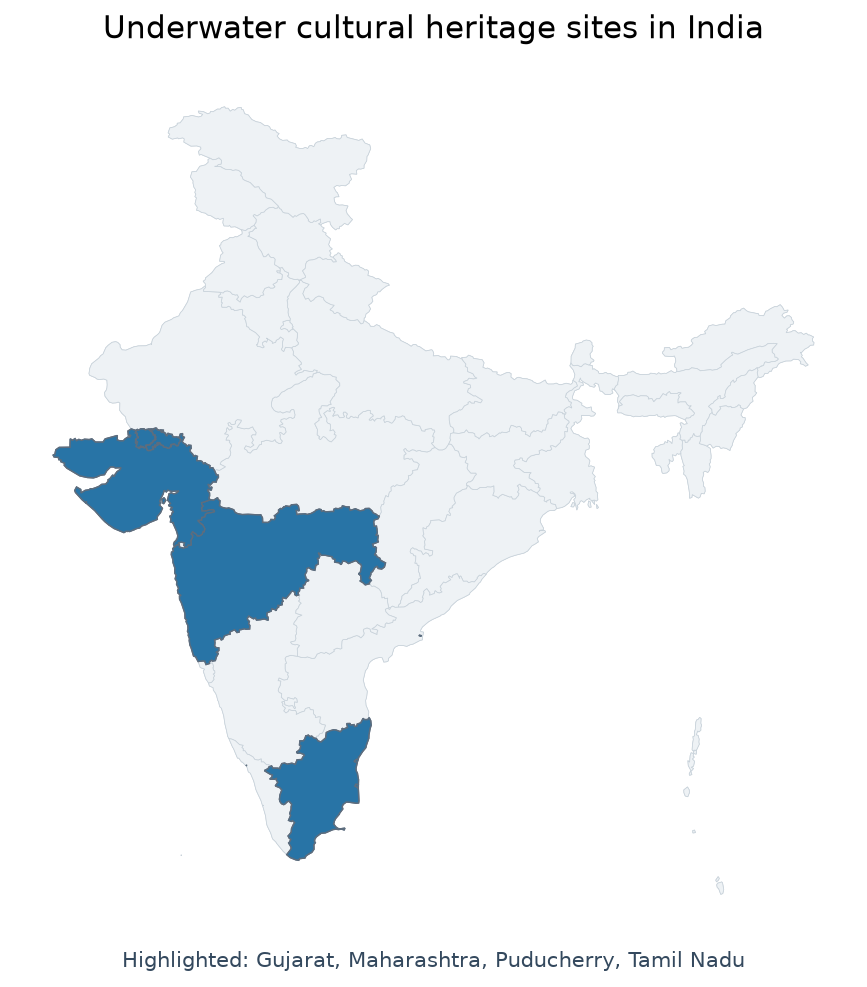
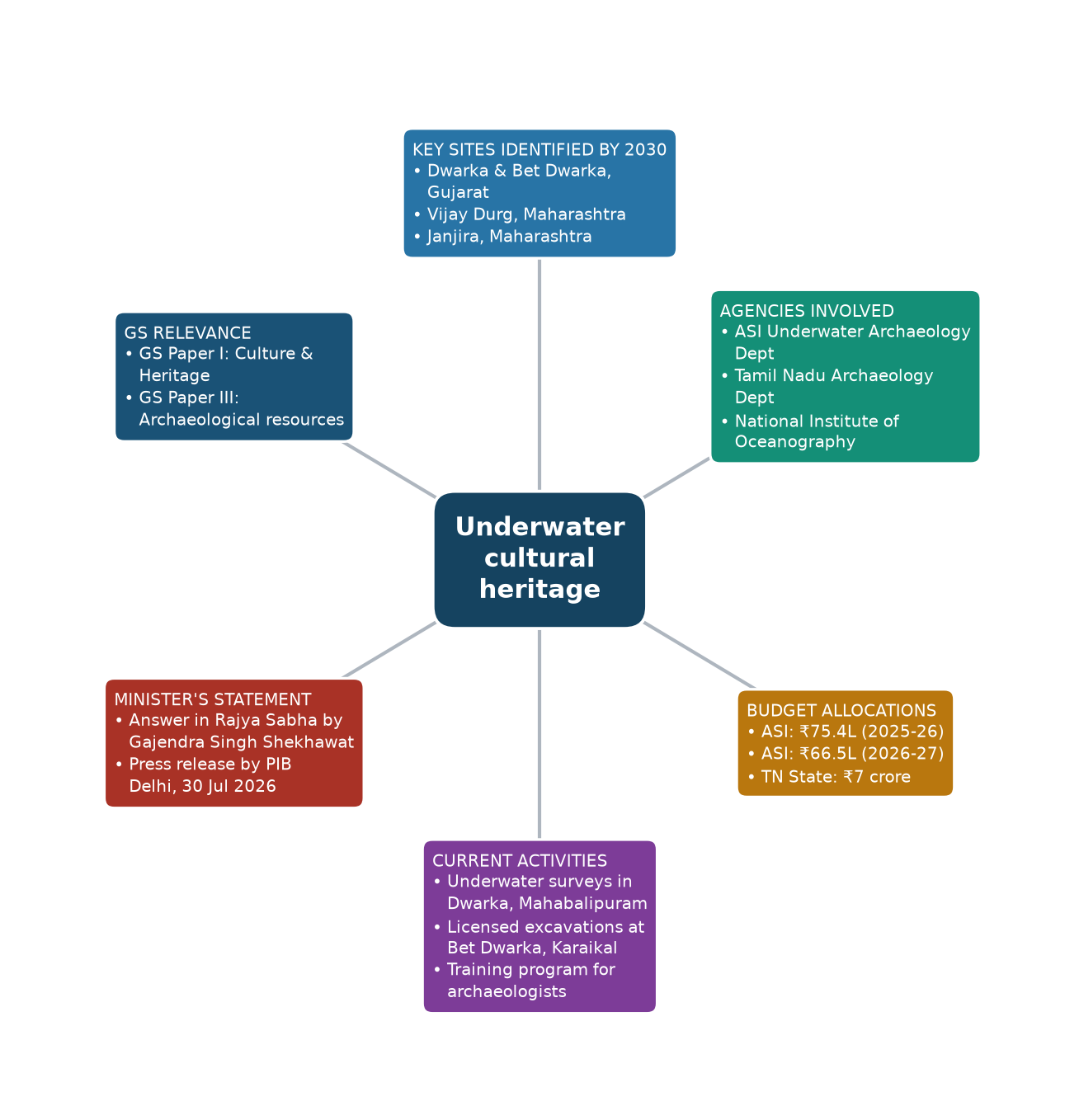
Map & concept mind-map: Underwater cultural heritage sites in India
Subject Relevance — Where This Topic Fits
- GS Paper I — Indian Heritage and Culture | GS Paper II — Governance, Constitution, Polity, Social Justice and International Relations (Maritime Heritage) | GS Paper III — Science and Technology (Marine Archaeology and Conservation)
- Prelims: Underwater Cultural Heritage (UCH), Maritime Archaeology, ASI’s Underwater Archaeology Wing, National Institute of Oceanography (NIO), UNESCO Convention on Underwater Cultural Heritage 2001, Poompuhar (Tamil Nadu), Dwarka and Bet Dwarka (Gujarat), Mahabalipuram (Tamil Nadu), Karaikal (Puducherry), Vijaydurg and Janjira (Maharashtra)
- Essay: The Role of Science and Technology in Preserving India’s Maritime Heritage, Cultural Diplomacy and the Protection of Underwater Cultural Heritage: India’s Strategic Approach
Quick Revision: Underwater Cultural Heritage (UCH) in India is preserved and studied by the ASI’s Underwater Archaeology Wing, guided by the UNESCO Convention 2001, with key sites including Dwarka, Mahabalipuram, and Poompuhar.
Why is this in the news?
The Press Information Bureau (PIB) of the Ministry of Culture, Government of India, released a detailed statement on 30 July 2026, outlining India’s expanding initiatives in underwater cultural heritage (UCH) archaeology. The announcement highlighted the active research and exploration activities being conducted by the Underwater Archaeology Wing of the Archaeological Survey of India (ASI) at key maritime sites, including Dwarka, Bet Dwarka, Mahabalipuram, and Karaikal. Additionally, the government has granted licenses to the Tamil Nadu State Department of Archaeology for Poompuhar and to the National Institute of Oceanography (NIO) for exploratory dives at Bet Dwarka and nearby islands in Gujarat. This development underscores India’s growing commitment to documenting, preserving, and studying submerged cultural resources, aligning with global frameworks such as the UNESCO Convention on Underwater Cultural Heritage (2001).
Background
- The concept of underwater cultural heritage encompasses all traces of human existence with cultural, historical, or archaeological significance that have been partially or totally submerged in bodies of water, including oceans, seas, lakes, and rivers.
- India’s engagement with underwater archaeology gained formal recognition with the establishment of the Underwater Archaeology Wing within the Archaeological Survey of India (ASI) in the early 21st century, following international conventions and domestic policy shifts.
- The UNESCO Convention on Underwater Cultural Heritage (2001) provides a global legal framework for the protection and management of submerged cultural resources, to which India is a signatory.
- Maritime archaeology in India has historical roots in the exploration of ancient ports such as Poompuhar (Tamil Nadu), associated with the Sangam period, and Dwarka (Gujarat), linked to the mythological city of Lord Krishna.
- The ASI’s Underwater Archaeology Wing conducts systematic surveys, excavations, and conservation efforts at identified sites, often in collaboration with national and international institutions such as the National Institute of Oceanography (NIO).
- Budget allocations for underwater archaeology reflect the government’s prioritization of this domain, with dedicated funds for training, equipment, and field operations.
What is Underwater Cultural Heritage and India’s Role in Its Preservation?
- Underwater Cultural Heritage (UCH) refers to all remains of human existence—such as shipwrecks, submerged cities, port structures, and artifacts—lying underwater, which hold archaeological, historical, or cultural value.
- India’s Underwater Archaeology Wing, under the ASI, is the nodal agency responsible for the identification, documentation, excavation, and conservation of submerged cultural resources across the country’s vast coastline and inland water bodies.
- The ASI’s initiatives are guided by the UNESCO Convention on Underwater Cultural Heritage (2001), which emphasizes in-situ preservation, non-intrusive survey methods, and capacity-building for local archaeologists and marine scientists.
- Key sites under active investigation include Dwarka and Bet Dwarka in Gujarat, known for their mythological and historical significance as ancient port cities; Mahabalipuram in Tamil Nadu, famed for its rock-cut temples and maritime trade links; and Karaikal in Puducherry, a historical port city with Sangam-era connections.
- The National Institute of Oceanography (NIO) and the Tamil Nadu State Department of Archaeology are collaborating agencies, conducting specialized underwater excavations and surveys with technical and financial support from the central government.
- Training programs initiated by the ASI aim to build a cadre of Indian underwater archaeologists, equipping them with skills in sonar mapping, underwater photography, and artifact conservation techniques.
- The identification of additional sites like Vijaydurg and Janjira in Maharashtra for exploration by 2030 expands the geographical scope of India’s underwater heritage mapping, highlighting the diversity of submerged cultural landscapes.
Key Features
| Feature | Significance |
|---|---|
| Underwater Archaeology Division (ASI) | Specialised unit for systematic exploration of submerged cultural heritage, ensuring scientific preservation and documentation. |
| Licensing to State Agencies | Delegation of underwater excavation rights to Tamil Nadu Archaeology Department and National Institute of Oceanography for targeted research. |
| Budget Allocation (2025-27) | Demonstrates government commitment to underwater heritage conservation, with ASI receiving ₹1.42 crore and state agencies additional funds. |
| Training Programme for Archaeologists | Capacity-building initiative to enhance expertise in submerged site survey and excavation techniques. |
| Identified Sites for 2030 Exploration | Strategic prioritisation of six key locations (Gujarat, Maharashtra, Puducherry, Tamil Nadu) for systematic underwater research. |
Why it Matters
Cultural Heritage Preservation
- Systematic documentation of India’s submerged cultural assets, including potential ancient ports, shipwrecks, and submerged settlements.
- Integration of maritime archaeology with terrestrial heritage studies to reconstruct historical trade and cultural exchanges.
- Protection of intangible cultural heritage linked to coastal communities and traditional maritime practices.
Scientific Research & Innovation
- Advancement of underwater archaeology techniques, including non-invasive survey methods and 3D modelling of submerged sites.
- Collaboration between ASI, state departments, and oceanographic institutes fosters interdisciplinary research.
- Potential discovery of artefacts from the Indus Valley Civilisation, Mauryan, or Chola periods, enriching historical narratives.
Policy & Institutional Framework
- Strengthening of India’s compliance with UNESCO’s 2001 Convention on the Protection of the Underwater Cultural Heritage.
- Establishment of a legal and administrative framework for underwater heritage management, including licensing and funding mechanisms.
- Alignment with the National Mission on Monuments and Antiquities (NMMA) for holistic heritage conservation.
Strategic & Diplomatic Implications
- Enhancement of India’s maritime heritage diplomacy, particularly in the Indian Ocean region where submerged sites hold shared historical narratives.
- Support for India’s Blue Economy initiatives by integrating heritage conservation with sustainable ocean resource management.
- Potential to attract international collaborations in underwater archaeology, including with UNESCO and foreign research institutions.
Challenges
1. Technological Limitations
- High costs and technical challenges associated with deep-sea exploration, including equipment limitations and underwater visibility constraints.
- Need for advanced sonar, ROVs (Remotely Operated Vehicles), and geophysical survey tools to map and excavate submerged sites effectively.
UPSC Link: GS III: Science & Technology
2. Legal & Ethical Concerns
- Complexities in balancing heritage conservation with commercial exploitation of underwater resources (e.g., salvage operations).
- Ensuring compliance with international laws, including the UNESCO 2001 Convention and UNCLOS provisions on underwater cultural heritage.
UPSC Link: GS II: International Treaties
3. Environmental & Ecological Risks
- Potential damage to marine ecosystems during excavation, necessitating stringent environmental impact assessments.
- Climate change-induced sea-level rise and coastal erosion threaten the preservation of submerged heritage sites.
UPSC Link: GS III: Environment
4. Institutional & Human Resource Gaps
- Shortage of trained underwater archaeologists and marine geologists in India, requiring long-term capacity-building programmes.
- Coordination challenges between central agencies (ASI) and state departments, leading to fragmented implementation of heritage projects.
UPSC Link: GS II: Governance
5. Funding & Prioritisation
- Limited budget allocation compared to the scale of underwater heritage, necessitating prioritisation of high-impact sites.
- Dependence on external funding for advanced technologies and international collaborations.
UPSC Link: GS III: Economic Development
Challenges — UPSC Perspective
| Issue | Concern |
|---|---|
| Technological Constraints | Lack of indigenous deep-sea exploration technology and high-resolution imaging systems. |
| Regulatory Gaps | Ambiguities in domestic laws governing underwater heritage excavation and ownership of artefacts. |
| Climate Vulnerability | Accelerated degradation of submerged sites due to rising sea temperatures and storm surges. |
| Inter-agency Coordination | Fragmented responsibilities among ASI, state departments, and research institutes leading to duplication or neglect. |
| Public Awareness | Limited understanding of underwater heritage among local communities, affecting stakeholder engagement and conservation efforts. |
Government Initiatives — Must-Memorise for Prelims
- National Mission on Monuments and Antiquities (NMMA)
- Sagar Mala Project (for maritime heritage integration)
Way Forward
- Enhance indigenous technological capabilities by partnering with ISRO, DRDO, and academic institutions for R&D in underwater archaeology tools.
- Establish a dedicated National Underwater Heritage Authority under the Ministry of Culture to streamline policy, funding, and inter-agency coordination.
- Expand training programmes for archaeologists and marine geologists in collaboration with international institutions like UNESCO and the Nautical Archaeology Society.
- Develop a national database for submerged cultural heritage, integrating GIS mapping with terrestrial heritage records for comprehensive documentation.
- Strengthen public-private partnerships to fund high-cost projects, including CSR contributions from maritime industries.
- Integrate climate resilience into excavation plans, adopting adaptive strategies for sites vulnerable to sea-level rise and coastal erosion.
- Promote heritage tourism at identified sites (e.g., Dwarka, Mahabalipuram) to generate revenue for conservation while raising awareness.
- Conduct pilot excavations at shortlisted sites (e.g., Bet Dwarka) to validate methodologies before scaling up operations.
UPSC Value Addition
Keywords for Mains Answer-Writing
Underwater Cultural Heritage · Maritime Archaeology · UNESCO Convention 2001 · Underwater Cultural Heritage Rules 2024 · Archaeological Survey of India (ASI) · Maritime Heritage Sites · Submerged Archaeological Exploration · National Institute of Oceanography (NIO) · Cultural Heritage Management · Maritime Archaeology Training Programme · UNESCO 2001 Convention on the Protection of the Underwater Cultural Heritage · Indian Ocean Archaeology
Constitutional & Policy Linkages
- Article 49: Protection of monuments and places of national importance (applies to underwater heritage).
- Article 51A(f): Fundamental duty to value and preserve the rich heritage of India’s composite culture.
Concept Flow
Maritime Trade & Cultural Exchange (Ancient & Medieval Periods) → Submersion of Coastal Settlements & Ports (due to sea-level rise, tectonic shifts) → → Discovery of Submerged Sites (through modern sonar, satellite imagery) → → Government Initiatives (ASI’s Underwater Archaeology Division, licensing to state agencies) → → Systematic Exploration & Documentation (training programmes, budget allocation) → → Policy & Legal Framework (UNESCO Convention, NMMA alignment) → → Conservation & Research Outcomes (artefacts, historical narratives, tourism integration) → → Sustainable Heritage Management (climate adaptation, public-private partnerships)
Prelims Practice Questions
Q1. Consider the following statements regarding the Underwater Cultural Heritage Rules, 2024 in India:
1. The rules are framed under the Ancient Monuments and Archaeological Sites and Remains Act, 1958.
2. They mandate the Archaeological Survey of India (ASI) as the nodal agency for underwater archaeological exploration.
3. The rules prohibit private entities from conducting underwater archaeological activities without a license.
4. The rules are aligned with the UNESCO Convention on the Protection of the Underwater Cultural Heritage, 2001.
How many of the above statements are correct?
- Only one
- Only two
- Only three
- All four
Answer: All four — Statements 1, 2, and 4 are correct. Statement 3 is incorrect as the rules do not explicitly prohibit private entities but require them to obtain a license from the competent authority for underwater archaeological activities.
Q2. Assertion (A): The National Institute of Oceanography (NIO) is primarily responsible for conducting underwater archaeological explorations in India.
Reason (R): The NIO operates under the Ministry of Earth Sciences and has expertise in marine archaeology and oceanographic research.
Options:
A. Both A and R are true, and R is the correct explanation of A.
B. Both A and R are true, but R is not the correct explanation of A.
C. A is true, but R is false.
D. A is false, but R is true.
Answer: ? — Assertion (A) is false because the Archaeological Survey of India (ASI) is the primary agency for underwater archaeological explorations, while the NIO is involved in specific licensed projects. Reason (R) is true as NIO operates under the Ministry of Earth Sciences and has marine archaeology expertise.
Q3. Which of the following sites has been identified for underwater exploration/ excavation by 2030 under the Archaeological Survey of India’s Maritime Archaeology Programme?
1. Dwarka and Bet Dwarka (Gujarat)
2. Mahabalipuram (Tamil Nadu)
3. Karaikal (Puducherry)
4. Jaisalmer (Rajasthan)
Select the correct answer using the code below:
- 1, 2 and 3 only
- 1, 2, 3 and 4
- 2 and 4 only
- 1 and 3 only
Answer: 1, 2 and 3 only — Sites identified for underwater exploration by 2030 include Dwarka and Bet Dwarka (Gujarat), Mahabalipuram (Tamil Nadu), Karaikal (Puducherry), Vijaydurg (Maharashtra), and Janjira (Maharashtra). Jaisalmer (Rajasthan) is not listed among the sites.
Mains Practice Question
✍ The protection and exploration of underwater cultural heritage in India is increasingly being recognised as a critical component of the nation’s cultural and archaeological policy. Critically examine the institutional framework, legal provisions, and contemporary initiatives for the preservation of submerged cultural heritage in India. (15 Marks)
Approach: MODEL-ANSWER SKELETON:
1. **Introduction**: Define underwater cultural heritage and its significance in India’s maritime history. Mention India’s coastal heritage and the need for systematic exploration.
2. **Institutional Framework**:
– Role of the Archaeological Survey of India (ASI) and its Underwater Archaeology Wing.
– Involvement of the National Institute of Oceanography (NIO) and state archaeology departments (e.g., Tamil Nadu).
– Training programmes initiated by ASI for maritime archaeologists.
3. **Legal and Policy Provisions**:
– Underwater Cultural Heritage Rules, 2024: Key provisions, licensing requirements, and prohibitions.
– Alignment with the UNESCO Convention on the Protection of the Underwater Cultural Heritage, 2001 (ratified by India in 2024).
– Overlap with the Ancient Monuments and Archaeological Sites and Remains Act, 1958.
4. **Contemporary Initiatives**:
– Sites identified for exploration: Dwarka, Bet Dwarka, Mahabalipuram, Karaikal, Vijaydurg, Janjira.
– Budget allocations for underwater archaeology (e.g., ₹75.4 lakh for ASI in 2025-26, ₹7 crore for Tamil Nadu).
– Inter-ministerial coordination (Culture, Earth Sciences, and Tourism).
5. **Challenges and Critique**:
– Limited funding and infrastructure for underwater archaeology.
– Need for international collaboration (e.g., UNESCO, ICOMOS).
– Balancing exploration with conservation and ethical concerns (e.g., looting, commercial exploitation).
6. **Conclusion**: Summarise the progress and suggest measures for strengthening India’s underwater cultural heritage management, including public-private partnerships and capacity-building.
Source: PIB (Press Information Bureau)
Generated by AanyaAi for educational purpose.

- राज्यों द्वारा सरकारी प्रतिभूतियों की नीलामी में ₹16,750 करोड़ का सफल संग्रह - September 22, 2026
- RBI Auction Results: State Govt Securities Yield Trends & Implications for UPSC 2026 - September 22, 2026
- सुप्रीम कोर्ट का चुनाव आयोग से बड़ा सवाल: दिल्ली में 33 लाख मतदाताओं को नोटिस देने का क्या आधार है? - September 22, 2026

No Comments